| World Statesmen.org HOME > |
Antarctica
|
|
![[Evan
Townsend's Antarctic Flag - True South
proposal 2018]](aq-trues.gif "[Evan Townsend's
Antarctic Flag - True South proposal 2018]") |
|
![[Whitney
Smith's Antarctic Flag proposal 1978]](aq-smith.gif "[Whitney Smith's Antarctic Flag
proposal 1978]")
![[Graham
Bartram's Antarctic Flag proposal 1996]](aq-bart.gif "[Graham Bartram's Antarctic Flag
proposal 1996]")
![[Antarctic Treaty
Secretariat flag]](aq.gif "[Antarctic Treaty
Secretariat flag]")
|
||||||||||||||||||||||||||||||||||||
Antarctic Treaty —
The Antarctic Treaty, signed on 1 Dec 1959 and entered
into force on 23 Jun 1961, establishes the legal
framework for the management of Antarctica.
Administration is carried out through consultative
member meetings.
Summary: Article 1 - area to
be used for peaceful purposes only; military activity,
such as weapons testing, is prohibited, but military
personnel and equipment may be used for scientific
research or any other peaceful purpose; Article 2 -
freedom of scientific investigation and cooperation
shall continue; Article 3 - free exchange of information
and personnel, cooperation with the UN and other
international agencies; Article 4 - does not recognize,
dispute, or establish territorial claims and no new
claims shall be asserted while the treaty is in force;
Article 5 - prohibits nuclear explosions or disposal of
radioactive wastes; Article 6 - includes under the
treaty all land and ice shelves south of 60 degrees 00
minutes south and reserves high seas rights; Article 7 -
treaty-state observers have free access, including
aerial observation, to any area and may inspect all
stations, installations, and equipment; advance notice
of all expeditions and of the introduction of military
personnel must be given; Article 8 - allows for
jurisdiction over observers and scientists by their own
states; Article 9 - frequent consultative meetings take
place among member nations; Article 10 - treaty states
will discourage activities by any country in Antarctica
that are contrary to the treaty; Article 11 - disputes
to be settled peacefully by the parties concerned or,
ultimately, by the ICJ; Articles 12, 13, 14 - deal with
upholding, interpreting, and amending the treaty among
involved nations; other agreements - some 200
recommendations adopted at treaty consultative meetings
and ratified by governments; a mineral resources
agreement was signed in 1988 but remains un-ratified;
the Protocol on Environmental Protection to the
Antarctic Treaty was signed 4 Oct 1991 and entered into
force 14 Jan 1998; this agreement provides for the
protection of the Antarctic environment through six
specific annexes: 1) environmental impact assessment, 2)
conservation of Antarctic fauna and flora, 3) waste
disposal and waste management, 4) prevention of marine
pollution, 5) area protection and management and 6)
liability arising from environmental emergencies; it
prohibits all activities relating to mineral resources
except scientific research; a permanent Antarctic Treaty
Secretariat was established in 2004 in Buenos Aires,
Argentina.
Antarctic Treaty Secretariat
Executive Secretaries of the Antarctic Treaty
Secretariat (in Buenos Aires, Argentina)
1 Sep 2004 - 31 Aug 2009 Johannes "Jan"
Huber
(b. 1947)
(The Netherlands)
1 Sep 2009 - 31 Aug 2017 Manfred Reinke
(Germany)
(b. 1952)
1 Sep 2017 - 31 Aug 2025 Albert Alexander
Lluberas Bonaba
(Uruguay)
1 Sep 2025
-
Francisco Javier Berguño Hurtado
(Chile)
Antarctic Treaty membership (58)
| Dates
of Membership |
Member Nations |
| 23 Jun 1961 | Argentina, Australia, Belgium, Chile,
France, Japan, New Zealand, Norway, Poland,
South Africa, Soviet Union1,
United Kingdom, United States |
| 14 Jun 1962 | Czechoslovakia2 |
| 20 May 1965 | Denmark |
| 30 Mar 1967 | The Netherlands |
| 15 Sep 1971 | Romania |
| 19 Nov 1974 | East Germany3 |
| 16 May 1975 | Brazil |
| 11 Sep 1978 | Bulgaria |
| 5 Feb 1979 | West Germany3 |
| 11 Jan 1980 | Uruguay |
| 16 Mar 1981 | Papua New Guinea4 |
| 18 Mar 1981 | Italy |
| 10 Apr 1981 | Peru |
| 31 Mar 1982 | Spain |
| 8 Jun 1983 | China |
| 19 Aug 1983 | India |
| 27 Jan 1984 | Hungary |
| 24 Apr 1984 | Sweden |
| 15 May 1984 | Finland |
| 16 Aug 1984 | Cuba |
| 28 Nov 1986 | South Korea |
| 8 Jan 1987 | Greece |
| 21 Jan 1987 | North Korea |
| 25 Aug 1987 | Austria |
| 15 Sep 1987 | Ecuador |
| 4 May 1988 | Canada |
| 31 Jan 1989 | Colombia |
| 15 Nov 1990 | Switzerland |
| 31 Jul 1991 | Guatemala |
| 28 Oct 1992 | Ukraine |
| 25 Jan 1996 | Turkey5 |
| 1 Jan 1993 |
Czech Republic, Slovakia |
| 24 May 1999 | Venezuela |
| 17 May 2001 | Estonia |
| 27 Dec 2006 |
Belarus |
| 30 May 2008 |
Monaco |
| 29 Jan 2010 |
Portugal |
| 31 Oct 2011 |
Malaysia |
| 1 Mar 2012 |
Pakistan |
| 27 Jan 2015 |
Kazakhstan |
| 23 Mar 2015 |
Mongolia |
| 13 Oct 2015 |
Iceland |
| 22 Apr 2019 |
Slovenia |
| 11 Aug 2022 |
Costa Rica |
| 14 Feb 2023 |
San Marino |
| 22 May 2024 |
Saudi Arabia |
| 11 Dec 2024 |
United Arab Emirates |
| 1Soviet
Union dissolved 25 Dec 1991, succeeded
by Russia. 2Czechoslovakia
dissolved 31 Dec 1992; on 1 Jan
1993 succeeded by Czech Republic and Slovakia. 3East
and West Germany united 3 Oct 1990. 4date
of deposit of notification of succession by
Papua New Guinea; effective 16 Sep 1975 the date
of its independence. 5from
1 Jun 2022 Türkiye. |
|
![[Tierra del Fuego, Antártida e
Islas del Atlántico Sur flag]](ar-tdf.gif "[Tierra del Fuego,
Antártida e Islas del Atlántico Sur flag]")
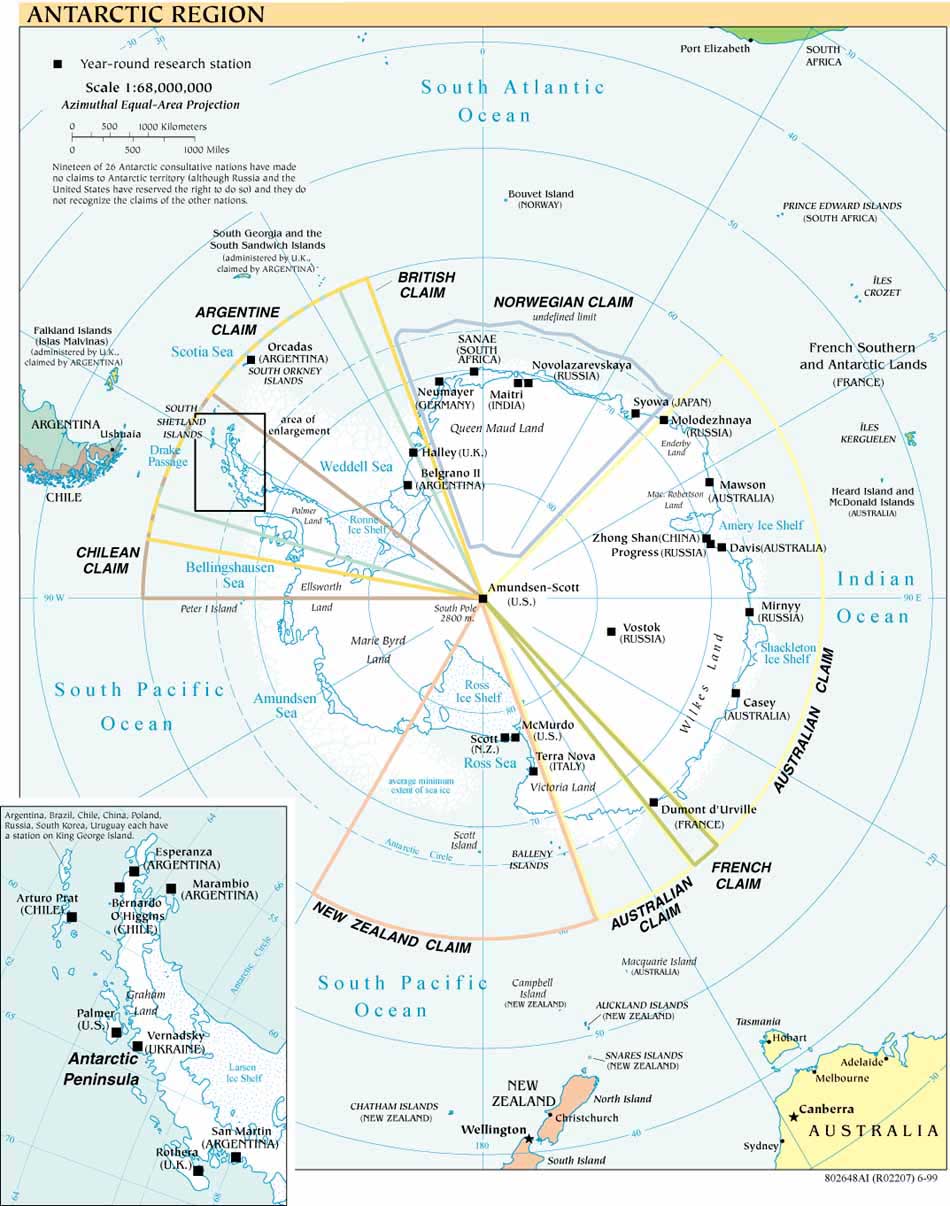
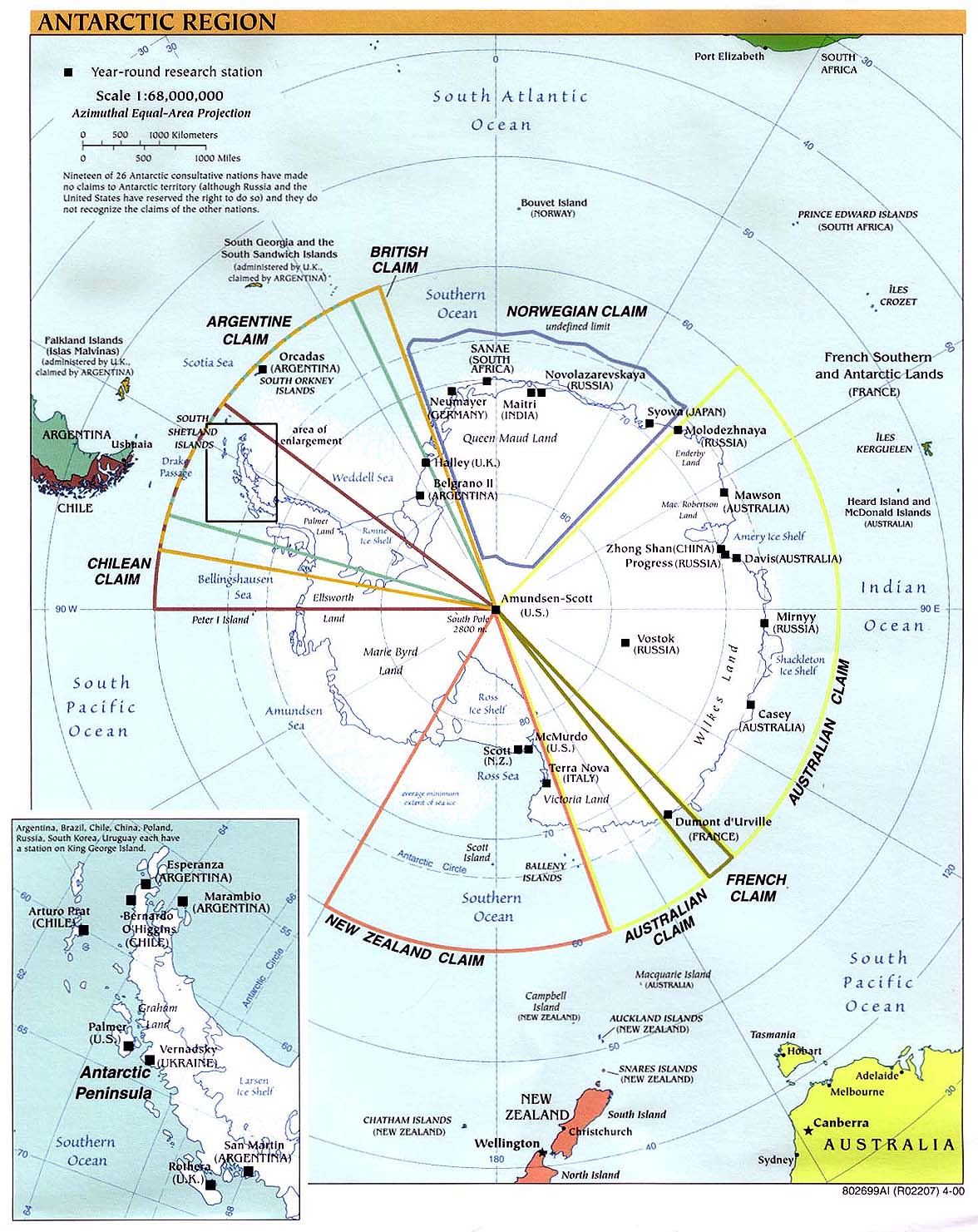
Tierra del Fuego, Antarctica, and the Island of the South Atlantic (Tierra del Fuego, Antárctica y Islas del Atlántico Sur); includes Argentine claim, 74°W and 25°W; overlaps British and Chilean claims. Claimed: 8 Feb 1942
Australia
![[flag of Australia]](au.gif "[flag
of Australia]")
Australian
Antarctic Territory Australian claim, 160°E
to 142°E and 136°E to 45°E;
Claimed: 13 Jun 1933
Chile
![[Chilean Región XII Magallanes
y Antártica Chilena]](cl-12.gif "[Chilean Región XII
Magallanes y Antártica Chilena]")
Magellanes and
Chilean Antarctica (Magallanes
y Antárctica Chilena); includes Chilean claim,
53°W to 90°W; overlaps Argentine and British claims.
Claimed: 6 Nov 1940
France
![[flag of French Southern and
Antarctic Lands]](tf.gif "[flag of French Southern and
Antarctic Lands]")
French Southern
and Antarctic Lands (Terres Australes et
Antarctiques Françaises) Adelie Land; includes
French claim, 142°E to 136°W. Claimed: 21 Nov 1924
New Zealand
![[Flag of New Zealand]](nz.gif "[Flag of New Zealand]")
New Zealand Antarctic Territory (Ross Dependency) New Zealand claim, 160°E to 150°W. Claimed: 30 Jul 1923
Norway
![[Flag of Norway]](no.gif "[Flag of
Norway]")
Norwegian Antarctic Territory (Dronning Maud Land) Queen Maud Land; Norwegian claim, 45°E to 20°E with Peter I Island. Claimed: 14 Jan 1938
United Kingdom
![[British Antarctic Territory
flag]](gb-bat.gif "[British Antarctic Territory flag]")
British Antarctic Territories (Graham Land) British claim, 20° W and 80°W; Argentine and Chilean claims overlap. Claimed: 21 Jul 1908
![[Brazil]](br.gif "[Brazil]")
Brazilian Antarctica (Antártida Brasileira)
proposed claim, 28°W to 53°W south of 60°;
zone overlaps Argentine, British and Chilean claims.
Zone of Interest first proposed: 1986
![[Germany flag 1871-1921]](de1871.gif "[Germany flag 1871-1921]")
New Swabia Land (Neu-Schwabenland) area explored 20°E to 10°W, overlaps Norwegian claim. Area was not formally claimed by Germany. Explored: 19 Jan - 6 Feb 1939
South Africa
![[flag of South Africa
1928-1994]](za-1928.gif "[flag of South Africa 1928-1994]")
South African Antarctica South African
unverified claim: 1963 - 1993?
Spain (Castile)
![[Burgundy Cross Flag, Banner
of Spain, 1506-1785 (Spain)]](es-1506.gif "[Burgundy Cross
Flag, Banner of Spain, 1506-1785 (Spain)]")
Governorate of the Southern Land (Gobernación
de la Terra Australis) nominally covered Tierra
del Fuego, which was considered part of the continent of
Terra Australis (Antarctica) and all the
territories from the south of the Strait of Magellan.
Spain (Castile) Nominal claim: 1539-1555.
Uruguay
![[Flag of Uruguay]](uy.gif "[Flag of
Uruguay]")
Uruguayan Antarctica (Antártida Uruguaya),
coordinates 0°W 25°W, overlapping with the Norwegian and
British claims. Uruguay Proposed
claim: 1973
Antarctica International Disputes: The
Antarctic Treaty freezes claims (see Antarctic Treaty
Summary in Government type entry); sections (some
overlapping) claimed by Argentina, Australia, Chile,
France, New Zealand, Norway, and U.K.; Australia, Chile,
and Argentina claim Exclusive Economic Zone (EEZ) rights
or similar over 200 nm extensions seaward from their
continental claims, but like the claims themselves,
these zones are not accepted by other countries; 22 of
29 Antarctic consultative nations have made no claims to
Antarctic territory, although Russia and the U.S. have
reserved the right to do so (and do not recognize the
claims of the other nations), and no country
can make a new claim; no claims have been made in the
sector between 90 degrees west and 150 degrees west; the
International Whaling Commission created a sanctuary
around the entire continent to deter catches by
countries claiming to conduct scientific whaling;
Australia has established a similar preserve in the
waters around its territorial claim.
© Ben Cahoon