Antarctica
|
| Map
of Antarctica |
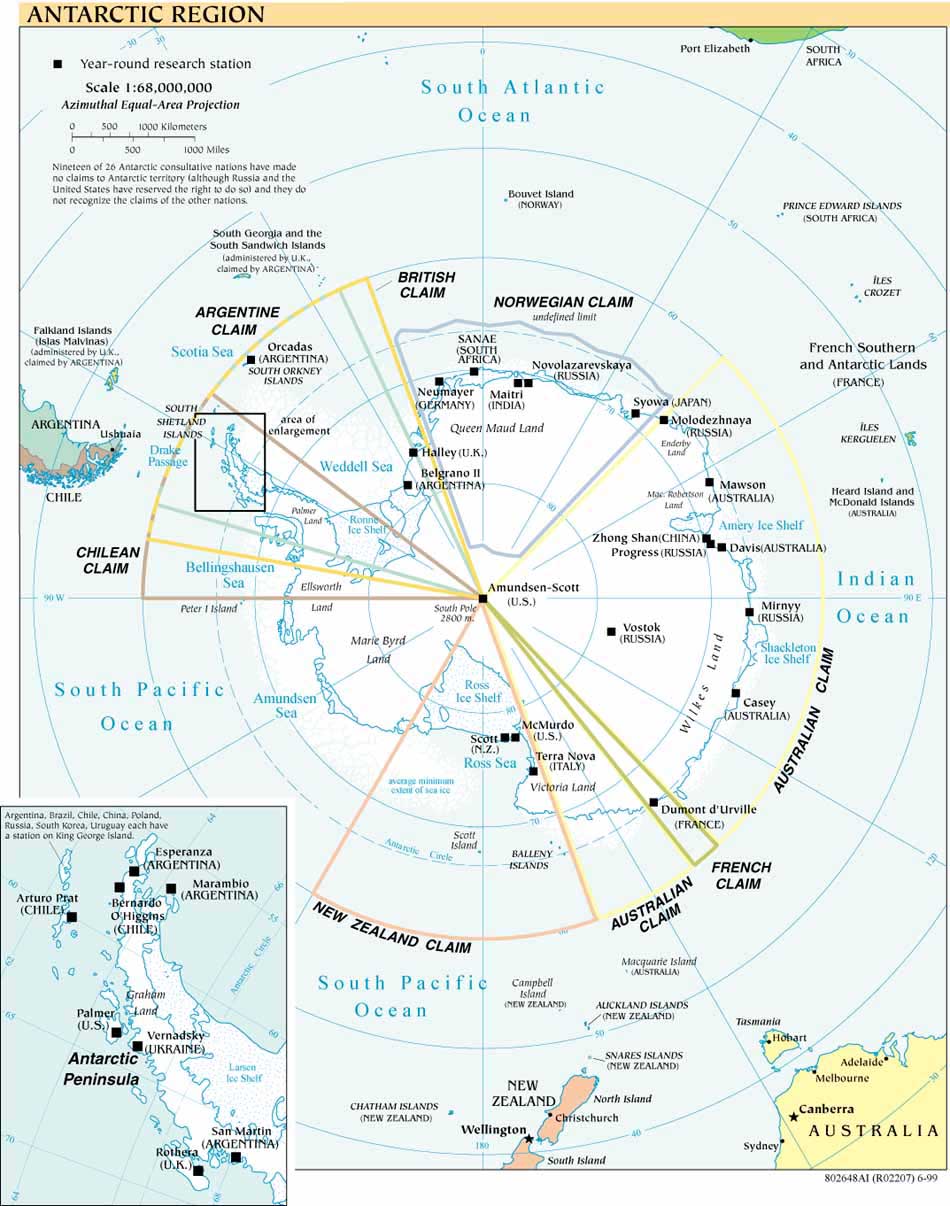
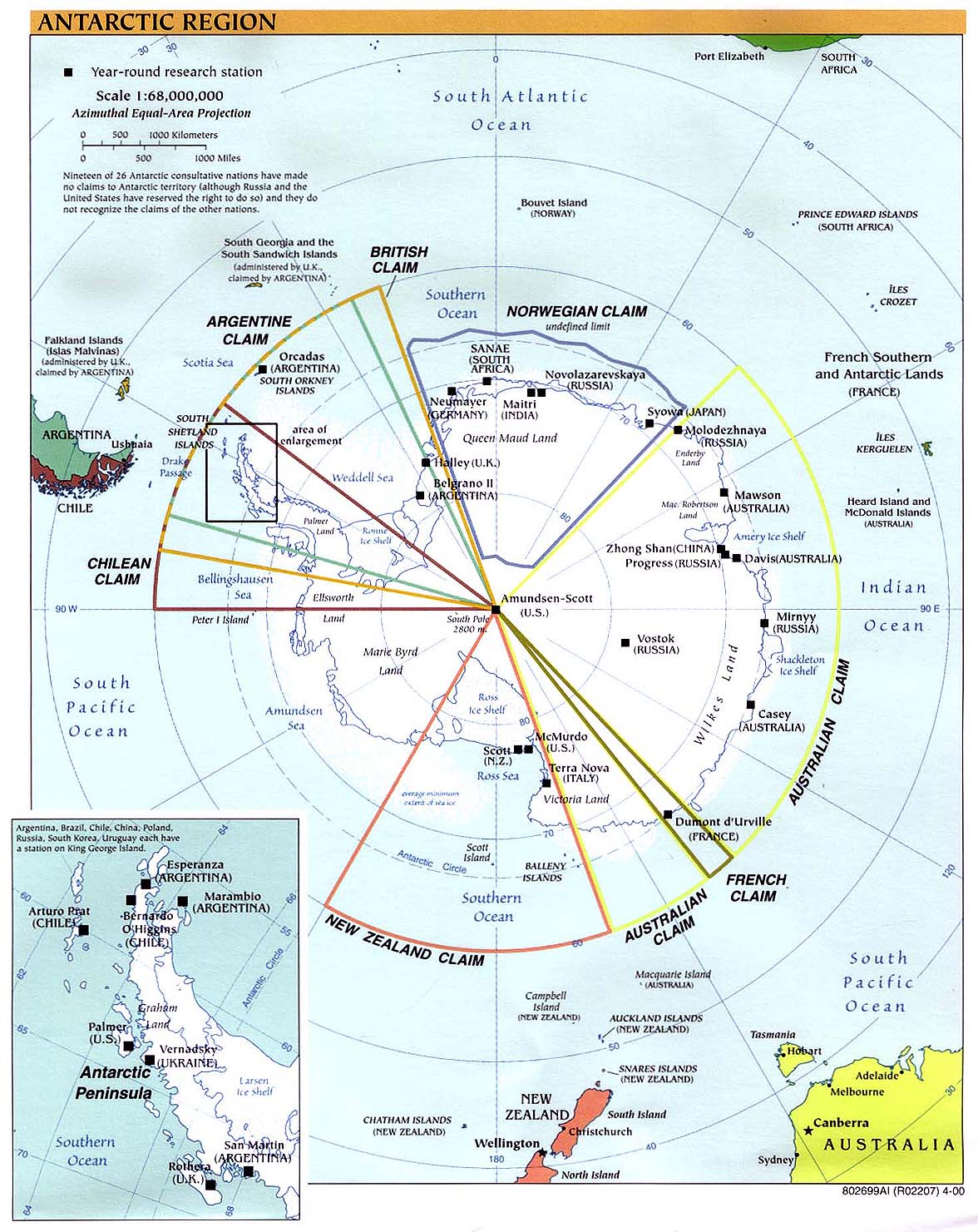
Map of Antarctic Research
Stations &
Territorial Claims |
Antarctic
Treaty
(23 Jun 1961) |
Major Stations:
Amundsen-Scott (US),
Belgrano (Arg.), Bernardo
O'Higgins (Chile),
Dumont d'Urville (Fr.),
Halley (UK),
Maitri (India),
Mawson (Aus.), McMurdo (US), Neumayer III (Ger), Palmer
(US), Scott (NZ),
Shōwa (Jap.), SANAE IV (South
Africa), Troll (Norway), Vostok (Rus.),
Zhongshan (China)
----------------------------
Antarctic Treaty Secretariat
Headquarters
(from 2004): Buenos Aires (Argentina)
|
Currency: No Common
Currency
-------------------------
Holidays: Jun. 20 or 21
Midwinter Day
(southern winter solstice day)
(de facto;
unofficial)
--------------------------
1 Dec. (1959)
Antarctica Day
(unofficial from 2010)
|
Population: Uninhabited
Approx. Seasonal
Research Staff:
Summer (Dec.-Feb.): 4,713
(2024)
Winter (Jun.-Aug.): 1,056
(2024) |
| Total Armed Forces:
Antarctic Treaty prohibits any measures of a military
nature. |
GDP:
Scientific undertakings rather than
commercial pursuits are the predominate
human activity in Antarctica. Fishing
off the coast and tourism, both based
abroad, account for Antarctica's limited
economic activity. |
| Peak Summer
(December-February) maximum capacity
in scientific stations - 4,713
total; Argentina 425, Australia 238,
Belarus 15, Belgium 55, Brazil 64,
Bulgaria 25, Chile 375, China 164,
Czechia 32, Ecuador 35, Finland 16,
France 136, France and Italy jointly 70,
Germany 60, India 72, Italy 150, Japan
130, South Korea 158, New Zealand 85,
Norway 60, Peru 30, Poland 41, Russia
211, South Africa 80, Spain 79, Sweden
16, Ukraine 15, United Kingdom 315,
United States 1,495, and Uruguay 66
(2024) |
Winter
(June-August) maximum capacity in
scientific stations - 1,056
total; Argentina 221, Australia 52,
Brazil 15, Chile 114, China 32, France
24, France and Italy jointly 13, Germany
9, India 48, Japan 40, The Netherlands
10, South Korea 25, New Zealand 11,
Norway 7, Poland 16, Russia 125, South
Africa 15, Ukraine 12, U.K. 44, U.S.
215, and Uruguay 8 (2024)
|
Number of Year-round
research stations operated within the
Antarctic Treaty area (south of 60
degrees south latitude) by National
Antarctic Programs -
approximately 47 total; Argentina 6,
Australia 3, Brazil 1, Chile 4, China 2,
France 1, France and Italy jointly 1,
Germany 2, India 2, Japan 1, South Korea
2, New Zealand 1, Norway 1, Poland 1,
Russia 5, South Africa 1, Ukraine 1,
U.K. 8, U.S. 3, and Uruguay 1 (2024)
|
Summer-only
Stations, refuges,
depots, and laboratories -
Argentina 7, Australia 1, Belarus 1,
Belgium 1, Brazil 1, Bulgaria 1, Chile
8, China 2, Czechia 1, Ecuador 1,
Finland 1, France and Italy 1, Germany
1, India 1, Italy 1, Japan 1, South
Korea 1, The Netherlands 1, New Zealand
1, Norway 1, Pakistan 1, Peru 1, Poland
1, Romania 1, Russia 1, South Africa 1,
Spain 1, Sweden 2, Turkey 1, Ukraine 1,
U.K. 1, U.S. 2, and Uruguay 1 (2023); in addition, during the
austral summer some nations have
numerous occupied locations such as tent
camps, summer-long temporary facilities,
and mobile traverses in support of
research.
|
Antarctica
Index |
Chronology
- 24 Jan 1539 - 29 May
1555 King of Spain, Charles V,
created the Governorate of
-
Terra Australis (Gobernación
de la Terra
-
Australis),
which encompassed lands south of the
-
Strait of Magellan and
theoretically Antarctica,
-
the existence of which
was only hypothesized at the
-
time. Spain claimed all
the territories to the
-
south of the Strait of
Magellan until the South
-
Pole, with eastern and
western borders to these
-
claims specified in the
Treaties of Tordesillas and
-
Zaragoza respectively.
- Dec 1773 - Jan
1775
British Capt. James Cook (b. 1728 -
d. 1779)
-
circumnavigates the continent
without sighting
-
land.
- 16 Feb
1819
First sighting of the Antarctic
Peninsula and South
-
Shetland Islands
by British Capt. William Smith
-
(b. c.1790 - d. 1847).
- 27 Jan
1820
Russian Capt. Fabian Gottlieb von
Bellingshausen
-
(Faddey
Faddeyevich Bellinsgauzen)(b.
1778 - d.
-
1852)
sights and lays claim to
being the first
-
person to set eyes on
the Antarctic continent.
16 Nov 1820
Palmer Land discovered by
American Capt. Nathaniel
-
Brown Palmer (b. 1799 -
d. 1877).
- 7 Feb
1821
U.S. Capt. John Davis (b. 1784 - d.
1861) makes
-
first known landing on the
continent at Hughes
-
Bay on Antarctic Peninsula.
- 24 Feb 1831
First sighting of the
Antarctic continent in the
-
Indian Ocean sector
(Enderby Land) by British
-
Capt. John Biscoe (b.
1794 - d. 1843), in the
-
Tula and Lively.
- 21 Feb
1832
Graham Land in Antarctica annexed
for U.K. by
Capt. John Biscoe (b. 1794 - d.
1843).
- 9 Feb 1839
First landing south of the
Antarctic Circle by
-
British Capt. John Balleny (b. 1770
- d. 1857)
-
in the Eliza
Scott, discovered
and landed on the
-
Balleny
Islands.
- 21 Jan
1840
Adelie Land (Terre
Adélie) in
Antarctica discovered
and claimed for France by Capt.
Jules Sébastien
César Dumont d'Urville (b. 1790 - d.
1842).
9 Feb 1841
Ross Ice Shelf and
Victoria Land claimed for
for U.K. by British Capt. James
Clark Ross
(b. 1800 - d. 1862) in HMS
Erebus.
- 26 Jan 1853
First landing on Greater
Antarctica (Victoria Land)
-
by
American Capt. Mercator Cooper (b.
1803 - d.
-
1872) in the Levant.
- 24 Jan
1895
Carsten Borchgrevink (b. 1864 - d.
1934) made the
-
first landing
on Antarctica since Davis.
Three
-
years later he
led the first
party to winter on
-
the continent.
- 22 Feb
1902
Kaiser Wilhelm
II Land (Kaiser-Wilhelm-II.-Land)
or
-
the Wilhelm II Coast (Wilhelm-II-Küste)
discovered
-
and named by Erich
Dagobert von Drygalski (b. 1865
-
- d. 1889), leader of
the German Expedition, on the
-
ship Gauss
in Antarctica Jan 1902 - Apr 1903
-
(Deutsche
Südpolar-Expedition).
1 Apr 1903 -
22 Feb 1904 First permanent
scientific station established in
-
the
Antarctic, at Laurie Island, South
Orkneys by
-
the
Scottish National Antarctic
expedition under
-
William
Speirs Bruce (b. 1867 - d. 1921).
- 22 Feb
1904
Argentina
began to occupy Antarctic lands when
-
purchasing the meteorological
station belonging
-
to the
Scottish Dr. William Speirs Bruce,
on
-
Laurie island, South Orkney islands.
- 1911 - 1914
Australian explorer Douglas Mawson
leads the
-
Australasian Antarctic
Expedition.
- 14 Dec
1911
Roald Amundsen (b. 1872 - d.
1928) of
Norway reaches
-
the South
Pole; on 18 Jan 1912 U.K. Capt.
Robert
-
Falcon
Scott (b. 1868 - d. 1912) located
the South
-
Pole but dies on the return
trip.
- 28 Jan
1912
Lt. Shirase Nobu (b. 1861 - d. 1941)
claims the
Antarctic territory spanning the
entirety of the
Ross Ice Shelf for Japan as Yamato
Yukihara ("The
Japan Snow Plain"), claim not
recognized by Japan
(part of the area named the Shirase
Coast in 1961).
-
Japanese claims are
renounced by the Treaty of San
-
Francisco 8
Sep 1951 (ratified 28 Apr 1952).
- 21 Feb
1912
Queen Mary Land
(or Queen Mary Coast) claimed for
-
U.K. and named by
Douglas Mawson (b. 1882 - d.
-
1958) of Australia.
- 16 Aug
1923
Antarctic seas which comprised all
the islands and
territories between 160°E and 150°W
longitudes
situated south of 60° S annexed by
the U.K.
to New Zealand and is named Ross
Dependency
(by order of 30 Jul 1923).
21 Nov
1924
Adelie Land (Terre
Adélie) is annexed by
France.
28-29 Nov
1939
The first flyover of the South Pole
is executed by
-
Norwegian air pioneer,
Bernt Balchen.
- 29 Nov 1929
U.S. explorer Richard E. Byrd
(b. 1888 - d. 1957)
-
made the first
flight over the
South Pole from
-
Little America
Base.
- 13 Jan
1930
Enderby Land is
claimed for U.K. by Sir Douglas
-
Mawson.
- 13 Jun
1933
British order
annexes the part of Antarctica south
of
60° and between longitudes
45° E and 160° E
(excluding French Terre Adelie 136°E
to 142°E), and
transfers
it to Australia.
- 14 Jan
1939
Queen Maud Land (Dronning Maud
Land) in Antarctica
(45°E
to 20°E), between the British and
Australian
claims, formally placed under the
sovereignty of
Norway.
- 19 Jan - 15 Feb
1939
The area 20°E to 10°W is explored by
a German
expedition led by Alfred Ritscher,
but not claimed.
- Aug
1939
Germany announces the formation of a
German Antarctic
sector between 4°59' E and 16°30' E,
called
Neuschwabenland (New Swabia
Land), lying
completely within the area that
Norway already
annexed; this claim never receives
international
approval and is not raised again
after World War II
- 6 Nov
1940
Chilean Antarctic (Antártica
Chilena), defined as
-
between longitudes 53°W
to 90°W, claimed by Chile.
- 13 Jan
1941
German commandos board and capture
two Norwegian
-
factory ships in the sea north of
Queen Maud Land.
-
By the end of the next day, the
Germans had taken
-
possession of three
factory ships and eleven
-
catchers. The German
Navy subsequently used the
-
waters of the Peninsula
and the sub-Antarctic
-
islands as a haven from
which they could venture
-
forth to attack allied
shipping. Their main base
-
was an obscure harbor
on Kergulen Island.
- 8 Feb
1942
Argentine Antarctica (Antártida
Argentina) claimed
-
by Argentina between longitudes and
68° W and 24° W
-
(formally taking
possession 8 Nov 1942).
- 1943 - 1945
British
dispatch a naval missions to
Antarctica
-
("Operation Tabarin") which
established the first
-
permanent British scientific bases.
- 31 Oct 1956
First permanent
station at South Pole built
-
(Amundsen-Scott South Pole Station).
-
1 Jul 1957 - 31 Dec
1958 International Geophysical
Year (IGY), scientists
-
of 67 nations research the Antarctica
environment.
- 24
Nov 1957 - 2 Mar 1958
First successful land traverse
of Antarctica by
-
British
Commonwealth Trans-Antarctic
expedition
-
(CTAE)
under Vivian Fuchs (b. 1908 - d.
1999)
-
covers Weddell Sea to Ross
Sea via the South
-
Pole.
- 16
Dec 1957
South
Geomagnetic Pole reached for the
first time
-
by a
tractor traverse by the Soviet
Union.
- 4
Jan 1958
Sir
Edmund Hillary (b. 1919 - d. 2008)
of New Zealand
-
and his party become
the first to reach the South
-
Pole overland since
Robert Falcon Scott.
- 1 Dec
1959
Antarctic Treaty signed in
Washington, D.C. by 12
-
nations.
-
23 Jun
1961
Antarctic Treaty enters
into force.
- 7
Jan
1978
Argentine, Emilio Marcos Palma,
becomes the first
-
recorded
human to be born in Antarctica.
- 11 Mar 1978
Convention for the Conservation of
Antarctic Seals
-
(of
11 Feb 1972) enters into
force.
- 28 Nov
1979
Air New
Zealand flight TE901 crashes into
Mt. Erebus
-
(on Ross Island),
killing all 257 aboard.
- 7 Apr
1982
Convention on the Conservation of
Antarctic Marine
-
Living Resources (CCAMLR)(of 1 Aug
1980) enters
-
into force.
- 1
Nov 1982
Agreed
Measures for the Conservation of
Antarctic
-
Fauna and Flora (of 2 Jun
1964) enters into
force.
- 13
Feb 1987 - Dec 1991
World Park Base a
non-governmental year-round
-
base
located at Cape Evans on Ross Island
in
-
the Ross
Dependency established by
Greenpeace.
- 2
Jun
1988
Convention on the Regulation of
Antarctic Mineral
-
Resources (CRAMRA) signed.
- 6
Dec
1994
The Antarctica (Environmental
Protection) Act 1994 is
-
assented to,
consolidating measures aimed at
-
conserving the region's
flora and fauna (which
-
includes 18 species of
penguin, 6 species of seal,
-
and several rare
species of whale) included in the
-
Antarctic Treaty, and reinforcing
the CCAMLR.
- 14 Jan
1998
Protocol on Environmental Protection
to the
-
Antarctic Treaty ("Madrid
Protocol")(of 4 Oct
-
1991) enters
into force.
- 1
Sep
2004
Secretariat of Antarctic
Treaty established in
Buenos
-
Aires, Argentina.
|
| Argentina
Claim |
| Australia Claim
|
British Claim
|
| Chile
Claim |
| France
Claim |
| New
Zealand Claim |
| Norway
Claim |
Brazil
|
Germany
|
South
Africa
|
Spain
(Castile)
|
Uruguay
|
Antarctic
Treaty
Secretariat
|
|
Antarctic Treaty —
The Antarctic Treaty, signed on 1 Dec 1959 and entered
into force on 23 Jun 1961, establishes the legal
framework for the management of Antarctica.
Administration is carried out through consultative
member meetings.
Summary: Article 1 - area to
be used for peaceful purposes only; military activity,
such as weapons testing, is prohibited, but military
personnel and equipment may be used for scientific
research or any other peaceful purpose; Article 2 -
freedom of scientific investigation and cooperation
shall continue; Article 3 - free exchange of information
and personnel, cooperation with the UN and other
international agencies; Article 4 - does not recognize,
dispute, or establish territorial claims and no new
claims shall be asserted while the treaty is in force;
Article 5 - prohibits nuclear explosions or disposal of
radioactive wastes; Article 6 - includes under the
treaty all land and ice shelves south of 60 degrees 00
minutes south and reserves high seas rights; Article 7 -
treaty-state observers have free access, including
aerial observation, to any area and may inspect all
stations, installations, and equipment; advance notice
of all expeditions and of the introduction of military
personnel must be given; Article 8 - allows for
jurisdiction over observers and scientists by their own
states; Article 9 - frequent consultative meetings take
place among member nations; Article 10 - treaty states
will discourage activities by any country in Antarctica
that are contrary to the treaty; Article 11 - disputes
to be settled peacefully by the parties concerned or,
ultimately, by the ICJ; Articles 12, 13, 14 - deal with
upholding, interpreting, and amending the treaty among
involved nations; other agreements - some 200
recommendations adopted at treaty consultative meetings
and ratified by governments; a mineral resources
agreement was signed in 1988 but remains un-ratified;
the Protocol on Environmental Protection to the
Antarctic Treaty was signed 4 Oct 1991 and entered into
force 14 Jan 1998; this agreement provides for the
protection of the Antarctic environment through six
specific annexes: 1) environmental impact assessment, 2)
conservation of Antarctic fauna and flora, 3) waste
disposal and waste management, 4) prevention of marine
pollution, 5) area protection and management and 6)
liability arising from environmental emergencies; it
prohibits all activities relating to mineral resources
except scientific research; a permanent Antarctic Treaty
Secretariat was established in 2004 in Buenos Aires,
Argentina.
Antarctic Treaty Secretariat
Executive Secretaries of the Antarctic Treaty
Secretariat (in Buenos Aires, Argentina)
1 Sep 2004 - 31 Aug 2009 Johannes "Jan"
Huber
(b. 1947)
(The Netherlands)
1 Sep 2009 - 31 Aug 2017 Manfred Reinke
(Germany)
(b. 1952)
1 Sep 2017 - 31 Aug 2025 Albert Alexander
Lluberas Bonaba
(Uruguay)
1 Sep 2025
-
Francisco Javier Berguño Hurtado
(Chile)
Antarctic Treaty membership (58)
Dates
of
Membership |
Member
Nations |
| 23 Jun 1961 |
Argentina, Australia, Belgium, Chile,
France, Japan, New Zealand, Norway, Poland,
South Africa, Soviet Union1,
United Kingdom, United
States |
| 14 Jun 1962 |
Czechoslovakia2 |
| 20 May 1965 |
Denmark |
| 30 Mar 1967 |
The Netherlands |
| 15 Sep 1971 |
Romania |
| 19 Nov 1974 |
East Germany3 |
| 16 May 1975 |
Brazil |
| 11 Sep 1978 |
Bulgaria |
| 5 Feb 1979 |
West Germany3 |
| 11 Jan 1980 |
Uruguay |
| 16 Mar 1981 |
Papua New Guinea4 |
| 18 Mar 1981 |
Italy |
| 10 Apr 1981 |
Peru |
| 31 Mar 1982 |
Spain |
| 8 Jun 1983 |
China |
| 19 Aug 1983 |
India |
| 27 Jan 1984 |
Hungary |
| 24 Apr 1984 |
Sweden |
| 15 May 1984 |
Finland |
| 16 Aug 1984 |
Cuba |
| 28 Nov 1986 |
South Korea |
| 8 Jan 1987 |
Greece |
| 21 Jan 1987 |
North Korea |
| 25 Aug 1987 |
Austria |
| 15 Sep 1987 |
Ecuador |
| 4 May 1988 |
Canada |
| 31 Jan 1989 |
Colombia |
| 15 Nov 1990 |
Switzerland |
| 31 Jul 1991 |
Guatemala |
| 28 Oct 1992 |
Ukraine |
| 25 Jan 1996 |
Turkey5 |
1 Jan 1993
|
Czech Republic, Slovakia
|
| 24 May 1999 |
Venezuela |
| 17 May 2001 |
Estonia |
27 Dec 2006
|
Belarus
|
30 May 2008
|
Monaco
|
29 Jan 2010
|
Portugal
|
31 Oct 2011
|
Malaysia
|
1 Mar 2012
|
Pakistan
|
27 Jan 2015
|
Kazakhstan
|
23 Mar 2015
|
Mongolia
|
13 Oct 2015
|
Iceland
|
22 Apr 2019
|
Slovenia
|
11 Aug 2022
|
Costa Rica
|
14 Feb 2023
|
San Marino
|
22 May 2024
|
Saudi Arabia
|
11 Dec 2024
|
United Arab Emirates
|
1Soviet
Union dissolved 25 Dec 1991, succeeded
by Russia. 2Czechoslovakia
dissolved 31 Dec 1992; on 1 Jan
1993 succeeded by Czech Republic and Slovakia. 3East
and West Germany united 3 Oct 1990. 4date
of deposit of notification of succession by
Papua New Guinea; effective 16 Sep 1975 the date
of its independence. 5from
1 Jun 2022 Türkiye.
|
Antarctic Territorial Claims
Argentina
Tierra del Fuego,
Antarctica, and the Island of the South Atlantic
(Tierra del Fuego, Antárctica y Islas del Atlántico
Sur); includes Argentine claim, 74°W
and 25°W; overlaps British and Chilean claims.
Claimed: 8 Feb 1942.
Australia
Australian
Antarctic Territory Australian claim, 160°E
to 142°E and 136°E to 45°E;
Claimed: 13 Jun 1933.
Chile
Magellanes and
Chilean Antarctica (Magallanes
y Antárctica Chilena); includes Chilean claim,
53°W to 90°W; overlaps Argentine and British claims.
Claimed: 6 Nov 1940.
France
French Southern
and Antarctic Lands (Terres Australes et
Antarctiques Françaises) Adelie Land; includes
French claim, 142°E to 136°W. Claimed: 21 Nov 1924.
New Zealand
New Zealand
Antarctic Territory (Ross Dependency) New
Zealand claim, 160°E to 150°W.
Claimed: 30 Jul 1923.
Norway
Norwegian
Antarctic Territory (Dronning Maud Land)
Queen Maud Land; Norwegian claim, 45°E to 20°E with
Peter I Island. Claimed: 14 Jan 1938.
United Kingdom
British Antarctic
Territories (Graham Land) British
claim, 20° W and 80°W;
Argentine and Chilean claims overlap. Claimed: 21 Jul
1908.
Brazil
Brazilian Antarctica (Antártida Brasileira)
proposed claim, 28°W to 53°W south of 60°;
zone overlaps Argentine, British and Chilean claims.
Zone of Interest first proposed: 1986.
Germany
New Swabia Land
(Neuschwabenland) sector between 4°59'
E and 16°30' E, overlaps Norwegian claim. Explored
19 Jan - 6 Feb 1939, Claimed: Aug 1939 (claim not
recognized).
South Africa
South African Antarctica South African
unverified claim: 1963 - 1993?
Spain (Castile)
Governorate of the Southern Land (Gobernación
de la Terra Australis) nominally covered Tierra
del Fuego, which was then considered a part of the
continent of Terra Australis (Antarctica) and
all the territories from the south of the Strait of
Magellan. Spain (Castile) Nominal claim: 1539-1555.
Uruguay
Uruguayan Antarctica (Antártida Uruguaya),
coordinates 0°W 25°W, overlapping with the Norwegian and
British claims. Uruguay Proposed
claim: 1973.
Antarctica International Disputes: The
Antarctic Treaty freezes claims (see Antarctic Treaty
Summary in Government type entry); sections (some
overlapping) claimed by Argentina, Australia, Chile,
France, New Zealand, Norway, and U.K.; Australia, Chile,
and Argentina claim Exclusive Economic Zone (EEZ) rights
or similar over 200 nm extensions seaward from their
continental claims, but like the claims themselves,
these zones are not accepted by other countries; 22 of
29 Antarctic consultative nations have made no claims to
Antarctic territory, although Russia and the U.S. have
reserved the right to do so (and do not recognize the
claims of the other nations), and no country
can make a new claim; no claims have been made in the
sector between 90 degrees west and 150 degrees west; the
International Whaling Commission created a sanctuary
around the entire continent to deter catches by
countries claiming to conduct scientific whaling;
Australia has established a similar preserve in the
waters around its territorial claim.
© Ben Cahoon
|