Minor French Dependencies

Amsterdam, Crozet, Kergulen,
and Saint Paul Islands: see French Southern and
Antarctic Lands
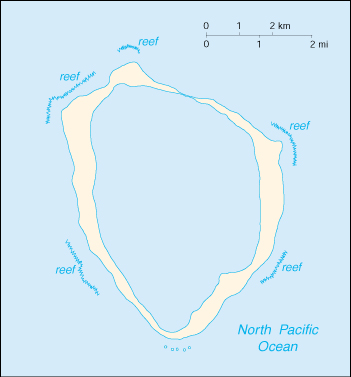
Clipperton
Island
24 Jan
1521
Fernão de Magalhães (Ferdinand Magellan) discovers the
island,
according to some (identifying Clipperton with
Magellan's San
Pablo), others say it was Álvaro de Saavedra Cerón in
1527.
15 Nov 1527
Reportedly discovered by Spanish Capt. Álvaro de
Saavedra Cerón
(d. 1529) which he names Isla Médanos. Early
maps regularly depict
one or more islands at Clipperton's approximate
location, notably
an Isla de Médanos ("Island of Dunes").
1705
English pirate John
Clipperton (b. c.1676 - d. 1722),
who led a
mutiny against William Dampier in Sep 1704, supposedly
makes the
island his base; although this is historically as
uncertain as the
16th century claims, the island ultimately takes its
dominant
name from him.
3 Apr 1711
The atoll is
sighted on Good Friday by French navigators Martin de
Chassiron (b. 1674 - d. 1722) and
Michel-Joseph Dubocage (b. 1676
- d. 1727), aboard the La Princesse and La Découverte,
who name
it Île de la Passion.
1753
Island appears as Ile de la Passion on the
reduced map of the South
Sea drawn by Frenchman Jacques-Nicolas Bellin.
17 Aug 1825
American Capt. Benjamin Morrell (b. 1795
- d. 1839) of the Wasp
visits the island, and a party apparently goes
ashore, perhaps
the first persons to do so.
8 May 1839
British Capt. Edward
Belcher (b. 1799 - d. 1877) surveys Clipperton.
17 Nov
1858
The island is formally claimed by a French navy
lieutenant, Victor
Édouard Le Coat de Kerveguen (b. 1816 - d. 1871),
aboard the
Amiral. Although he fails to leave any symbol of
French
sovereignty on the island, he does report his action
to the French
consulate in Honolulu, which makes a like
communication to the
Hawaiian government (Île de Clipperton).
30 Jul 1892
Under the Guano Islands Act
passed by the U.S. in 1856, Capt.
Frederick W. Permien (b. 1823 - d. 1904) claims
possession of
Clipperton for the Stoningham Phosphate
Company. He claims to have
sighted the island on 21 May 1881, gone
ashore on 30 Jun 1892, to
collect guano samples, and hoisted the
U.S. flag on 4 Jul. The
U.S. authorities take no action on the
application, However in
1893, Permien transferred his claim to
the Oceanic Phosphate
Company.
25 May 1893 - Oct 1893
Charles Jensen and "Brick" Thurman of the Oceanic
Phosphate Company
were left on the island to prevent other attempts to
claim the
island and its guano.
1 May 1897 - 27 Jun 1897 British
cargo vessel Kinkora and crew are wrecked on
Clipperton.
2 Aug 1897
A new three-man work crew and four
guests representing the Pacific
Islands Company of London arrive in the Navarro.
Governor George
D. Freeth of the Oceanic Phosphate Company supervises
the planting
of coconut trees. The guests leave with the ship on 5
Aug and it
is soon reported that the Pacific Islands Company
intends to
acquire the island. In Oct 1897 the Pacific Islands
Company
acquires the interests of Oceanic Phosphate.
24 Nov 1897
The French cruiser Duguay-Touin
confirms reports that the U.S. flag
is flying over the island. France subsequently
instructs its
ambassador in Washington to assert title to the atoll
and the U.S.
replies 6 Jan 1898 that it is making no claim of
sovereignty.
12 Dec 1897
The Mexican gunboat Demócrata
arrives at the island. The following
day a group of marines go ashore, take off the
Americans, and
raise the Mexican
flag (Isla de la Pasión).
Feb
1898
Pacific Islands Company received a concession from
Mexico for an
undisclosed cash consideration aside from royalties of
75 cent
per ton of product exported.
May 1898
Mexican President Porfirio Díaz
appoints Freeth as "interim
government inspector" on Clipperton. Freeth resigns on
30 Oct 1898
and upon his recommendation Díaz appoints Benjamin
Edward Holman
as replacement.
16 Jun 1898
The French chargé d'affaires in
Mexico City conveys to Mexican
foreign minister Ignacio Mariscal his government's
deep concern
over the Mexican seizure of the island. In a response
dated
30 Sep 1898, Mariscal dismisses the French claim.
1901
The Pacific Phosphate
Company is registered to take over from the
Pacific Islands Company.
Sep 1906
Col. Abelardo Avalos
arrives as prefect. His troops later place a
maritime beacon atop the Rock.
1908
Mexico garrisons the
island. Capt. Ramón Arnaud appointed governor.
20 Oct 1908
As Clipperton Island attains new
importance with the prospective
opening of the Panama Canal,
the French government proposes to
that of Mexico that King Vittorio Emanuele III of
Italy be named
as arbitrator of the rival claims of these two
countries to the
ownership of the island. An accord to that effect is
signed on
2 Mar 1909. Mexico submits its brief to the king late
in the year,
France following in 1912.
1910
Pacific Phosphate, its
operations long unprofitable, withdraws its
work force, save for a lone caretaker, Gustav Schulz.
28 Feb 1914
The U.S. schooner Nokomis crashes
into the reef. Due to the Mexican
revolution (the gunboat Tampico, which called
regularly at the
island, having been taken over on 24 Feb by
revolutionaries
fighting to overthrow President Victoriano Huerta),
the Mexican
garrison is no longer supplied.
26 Jun 1914
The cruiser Cleveland arrives at
Clipperton and takes off the
Nokomis castaways as well as Schulz and his
family.
End of May
1915
Capt. Arnaud spots a ship off the coast and, with Lt.
Secundino
Cardona, decides to launch a boat and compel all the
men to row
him out to the ship to ask for help, the boat
overturned and they
disappeared into the ocean. This leaves only
Victoriano Álvarez,
the lighthouse keeper who was living apart from the
community, and
15 women and children. The only man on the island,
Álvarez
proclaims himself "King of Clipperton," and for more
than two
years of tyrannical rule he abuses his subjects and
kills two of
them.
18 Jul 1917
Two women, Alicia Rovira de Arnaud and
Tirza Randon, strike Álvarez
dead. The same day the U.S. ship Yorktown
comes to check that
Clipperton is not harboring a German submarine base.
It discovers
three women, an adolescent girl, and seven surviving
children.
They are taken on the ship (which arrives at Salina
Cruz, Oaxaca,
on 22 Jul) and the island is left uninhabited.
28 Jan
1931
King Vittorio Emanuele III of Italy arbitrates the
conflicting
claims in favor of France, finding that the island was
terra
nullius in 1858 and legitimately acquired by
France. (Mexico
definitively recognized French sovereignty in 1959).
17 Jul
1934
U.S. President Franklin D. Roosevelt visits Clipperton
Island on
fishing cruises aboard the USS Houston.
26 Jan
1935
France takes possession by the training cruiser Jeanne
d'Arc.
12 Jun 1936 - 21 Feb 2007 Under the
jurisdiction of the French Establishments of Oceania
and then from 1957 French
Polynesia.
21 Jul 1938
U.S. President Franklin
D. Roosevelt visits Clipperton Island a
second time purposely
(taking with him a naturalist, Waldo L.
Schmitt, who collects specimens of
plants and animals for the
Smithsonian Institution).
1940
France awards
"exclusive and exceptional rights" on the atoll to
Charles Michelson (a stateless person
of Romanian origin, who has
been involved with projects to
establish wireless stations
throughout the French empire since 1936), lasting
for "30 years
after the conclusion of the present
war." U.S. Navy secretary
Frank Knox writes Michelson on 4 Mar
1942, thanking him for his
generous action in putting the rights
of the island to the
disposal of the U.S. Navy.
14-17 Sep 1943
A secret expedition led by Adm. Richard E.
Byrd (b. 1888 - d. 1957)
surveys Clipperton as a potential air
base site.
11 Dec 1944 - 21 Oct 1945 Occupied by U.S.
Navy during the "Island X" secret operation, a
weather station is completed on 13 Jan 1945.
22 Jan 1945
The U.S. disallows a French visit to the
island and France protests
about the U.S. occupation without previous
notification.
19 May 1947 - 29 Jun 1947 Capt. William Noble
and crew of fishing boat Thistle from San
Pedro,
California are stranded on the island.
1951 - 1957
French naval ships make several
calls on the island to cement the
French claim, with bronze plaques
fastened to the Rock's face and
to palm trees: Le Commandant
Charcot (23 Apr 1951), Jeanne
d'Arc
(11 Feb 1952), La Moqueuse
(6 Aug 1952), Le Dumont-d'Urville
(23
Aug 1957).
7 Aug 1958 - 25 Sep 1958
The Scripps Institution undertakes a scientific
expedition during
the International Geophysical Year.
1966 -
1969
"Bougainville" expeditions of the French army visit
the island.
2 Feb 1979
A ministerial decree is
gazetted by which the courts of the judicial
order seated in Paris are assigned
jurisdiction over the island.
1980
A marine expedition
under Jacques Cousteau (b. 1910 - d. 1997)(who
was at the island before) visits and a
documentary is filmed
("Clipperton: The Island Time Forgot").
1983
An exclusive economic zone (EEZ) with a radius of 200
nautical miles
is created around the island.
20 Mar 1986
Clipperton becomes a domaine
public de l'État (State-owned
public
domain).
1987
France announces that a fishing base is to be
established on the
island. Work begins in 1988.
2000
The tuna vessel Lily
Mary is grounded on the northeast coast of the
atoll.
Dec 2004 - Apr
2005 A
French scientific expedition to the island is led by
Jean-Louis
Étienne (b. 1946).
c.2005
The Costa Rican trawler Oco
runs aground southwest of the Rock.
21 Feb 2007
France assumes direct
administration of the dependency, placing it
under the authority of the minister of
overseas France.
14-29 Apr 2015
An international expedition visits
Clipperton.
15 Nov 2016
A biotope protection order is issued,
creating a Marine Protected
Area within the 12 nautical mile
territorial sea around the
island.
22 Feb
2022
A French law provides that "the island of Clipperton
may also be
referred to as "Île de la
Passion-Clipperton.
Mexican Government Inspectors on
Clipperton
May 1898 - 30 Oct 1898
George Douglas Freeth (interim)
7 Nov 1898 -
....
Benjamin Edward Holman
Mexican Governor
1908 - May 1915
Ramón Arnaud
(b. 1879 - d. 1915)
(= Ramón Nonato Arnaud Vignon)
May 1915 - 18 Jul 1917
Victoriano Álvarez
(b. 18.. - d. 1917)
(self-declared "king")
U.S. Military
Commander
22 Dec 1944 - 23 Oct 1945
George Lowry
(b. 1889 - d. 1981)
Îles Éparses (Scattered Islands)
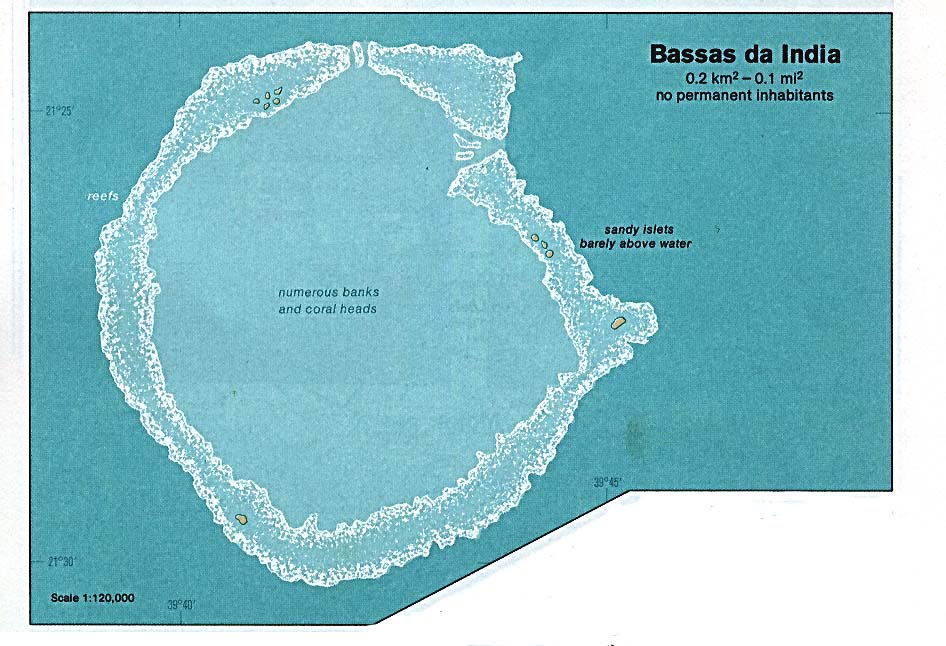
Bassas da India
1506
The Portuguese ship
São Cristóvão, nicknamed A Judia ("The
Jewess"),
wrecks on the atoll that gets the name Baixos da
Judia ("Banks of
the Jewess"), which from errors in map-copying becomes
Bassas
da India ("Banks of India").
1825
Named the Bassas da India in a map by British Admiral
William Owen
(b. 1774 - d. 1857).
8 Aug
1896
Claimed
by France as part of French Madagascar colony.
31 Oct 1897
Formally annexed to France, part
of French Madagascar
colony.
14 Jun
1960
French
possession; administered by the High
Commissioner
for Reunion (from 19 Sep
1960)(by décret no 60-555 1 Apr 1960).
1973
Madagascar claims
sovereignty over the Îles Éparses.
3 Jan
2005
Administrative control of the Îles Éparses is
transferred from the
prefect of Réunion to the administrator-superior of
the French
Southern and Antarctic Lands (TAAF).
21 Feb 2007
Incorporated into the French Southern and
Antarctic
Lands.
Territorial Dispute: Claimed
as
Nosy Bedimaky by Madagascar.
Banc du Geyser (Geysir)
c.1650
Shown on Spanish maps as
Arecife de Santo António.
23 Dec 1678
Named Geysir Reef, when the English
vessel Geysir, ran aground
on the reef.
8 Aug 1896
Banc du
Geyser, a drying reef in the Mozambique Channel,
claimed by France as part of
French Madagascar
colony.
14 Jun
1960
French
possession; administered by the High
Commissioner
for Reunion (from 19
Sep 1960)(by décret no 60-555 1 Apr
1960).
1976
Madagascar
announced the annexation of the reef (no effect).
3 Jan
2005
Administrative control of the Îles Éparses is
transferred from the
prefect of Réunion to the administrator-superior of
the French
Southern and Antarctic Lands (TAAF).
21 Feb 2007
Îles Éparses are incorporated into the French Southern and Antarctic
Lands.
22 Feb
2012
Included within the Glorioso Islands Marine Natural
Park.
Territorial Dispute: the
vegetated drying cays of Banc du Geyser, which were
claimed by Madagascar in 1976, also fall within the
EEZ claims of the Comoros and France (Glorioso
Islands).
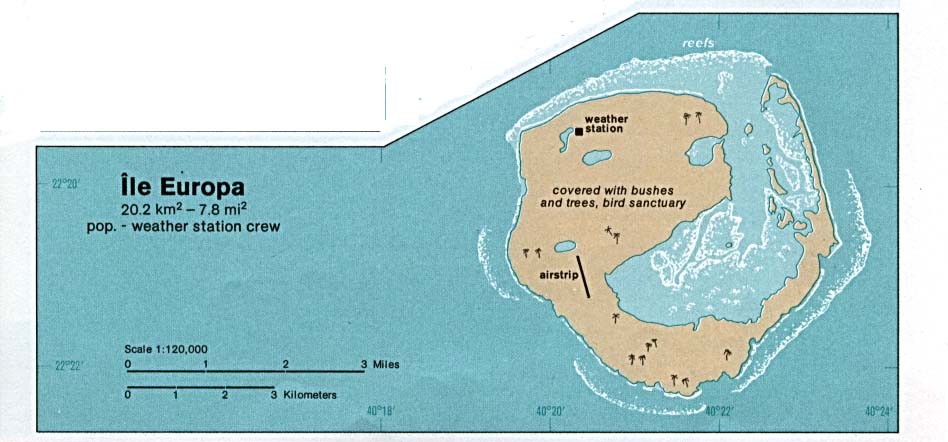
Europa Island
24 Dec 1774
Visited by the British ship Europa.
1825
Named Europa Island in a map by British Admiral
William Owen
(b. 1774 - d. 1857).
c.1860
Frenchman named de Rosiers came to settle the island
from
Madagascar (length of his stay is unknown).
8 Aug
1896
Claimed
by France as part of French Madagascar colony.
31 Oct
1897
Formally annexed to France, part of French Madagascar
colony.
1903
Presence of a small colony is attested.
c.1910
Two couples whose men were said to have been
Seychellois and three
Malagasy employees live on the island.
12 Jan
1950
First meteorological mission landed under the
leadership of Serge
Frolow (b. 1903 - d. 1959).
14 Jun
1960
French
possession administered by the High Commissioner
for Reunion (from 19 Sep
1960)(by décret no 60-555 1 Apr 1960).
1973
France begins garrisoning the island.
1973
Madagascar claims sovereignty over the Îles
Éparses.
3 Jan
2005
Administrative control of the Îles Éparses is
transferred from the
prefect of Réunion to the administrator-superior of
the French
Southern and Antarctic Lands (TAAF).
21 Feb 2007
Incorporated into the French Southern and
Antarctic
Lands.
Territorial Dispute: Claimed
as
Nosy Ampela by Madagascar.
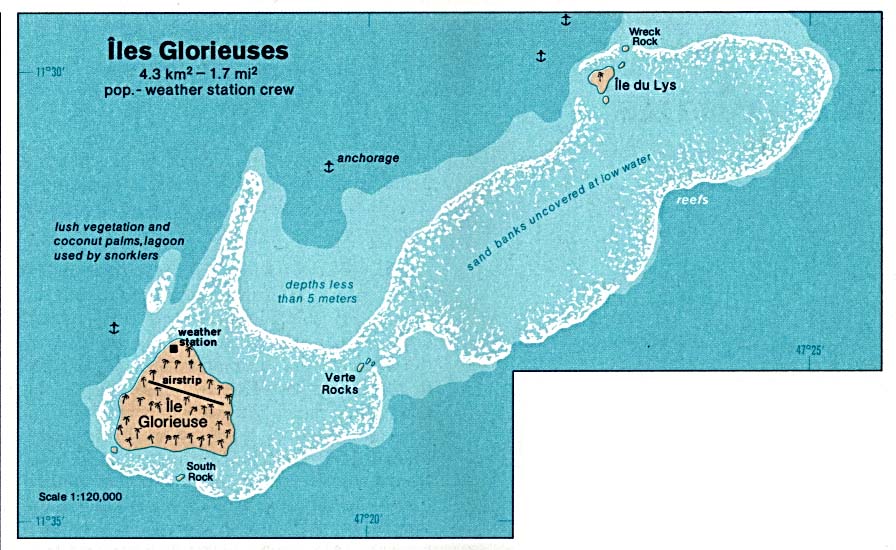
Glorioso Islands
(Îles Glorieuse)
1878
Hippolyte Caltaux
encounters a group of unknown islands he names
Îles Glorieuses (in remembrance of the
French revolution of 1830
["the Three Glorious Days"]).
2 Mar
1880
Hippolyte Caltaux plants the French flag there and
settles on the
island, encountering in subsequent years
difficulties with the
commanders of British ships that pass
near the islands.
23 Aug 1892
France takes possession of the Îles
Glorieuses. Caltaux remains
there until 1907; although he tried to
sell his rights to the
islands, a decree of forfeiture is issued
against him and they
are granted as a concession to the Société
des Îles Malgaches
(Malagasy Islands Company).
1895 -
1912
They are administratively attached to Mayotte.
1907
French government
ends the concession of Caltaux.
1907 - 1939
Islands entrusted to the Compagnie
des Îles Malgaches.
1912 - 1960
The Îles Glorieuses are administratively attached to Madagascar.
May 1945 - 1958
Returned to the Compagnie
des Îles Malgaches.
1950
France begins garrisoning the island.
1959
Permanent
meteorological station established.
14 Jun
1960
French
possession administered by the High Commissioner
for Reunion
(from 19 Sep 1960)(by décret no 60-555
1 Apr 1960).
1973
Madagascar
claims sovereignty over the Îles Éparses.
18 Nov 1975
Declared a wildlife reservation.
18 Jul
1980
The president of the Comoros expresses claims to Îles
Glorieuses.
3 Jan
2005
Administrative control of the Îles Éparses is
transferred from the
prefect of Réunion to the administrator-superior of
the French
Southern and Antarctic Lands (TAAF).
21 Feb 2007
Incorporated into the French Southern and Antarctic Lands.
22 Feb
2012
Glorioso Islands Marine Natural Park (Parc
naturel marin des
Glorieuses),
including Banc du Geyser, established.
23 Oct 2019
President Emmanuel Macron pays a
visit to Grande Glorieuse, the
first French president to do so. He announces that the
Glorieuses
marine reserve will become a national nature reserve.
8 Jun
2021
Marine park re-designated National Nature Reserve of
the Glorieuses
Archipelago (Réserve
naturelle nationale de l'archipel des
Glorieuses).
Proprietor (from 1892, Warden)
2 Mar 1880 - 1907
Hippolyte
Caltaux
(b. 1847 - d. af.1927)
Territorial Disputes: Claimed
by the Comoros (1980), Madagascar (1973) as Nosy
Sambatra.
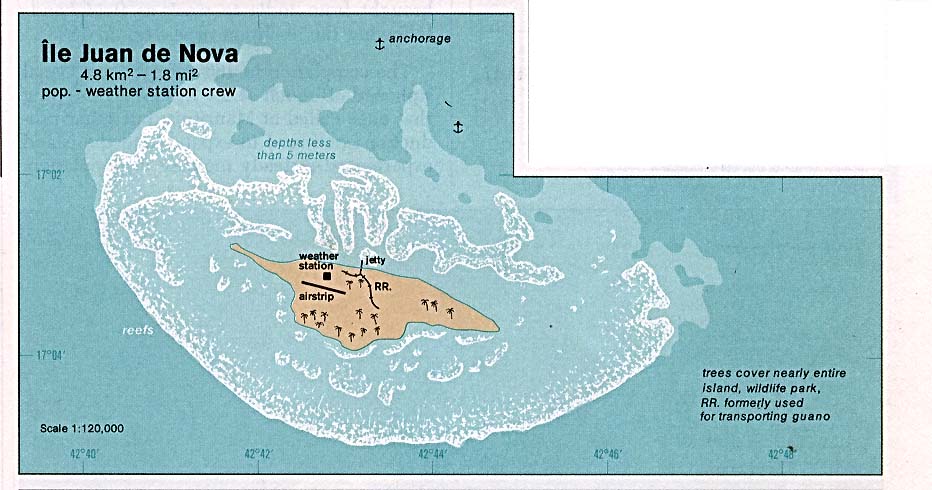
Juan de Nova Island
1501
Portuguese Capt. João da Nova (or Juan de Nova)(b.
1460 - d. 1509)
came across the uninhabited island which
he called the Galega or
Agalega
(Galician). It is later called Johan de
Nova (Pilestrima,
1519), Joa de Nova
(Mercator, 1569), San-Christophoro
(Ortelius,
1570), and Saint-Christophe
(Lislet Geoffroy).
1825
Named Juan de Nova Island in a map by British Admiral
William Owen
(b. 1774 - d. 1857).
8 Aug 1896
Claimed by France (Île Juan de
Nova) as part of French Madagascar.
31 Oct
1897
Formally annexed to France, part of French Madagascar
colony.
c.1900 - c.1940
Island is rented to a French firm for a 20-year lease
to extract
guano (phosphates) and coconuts.
14 Jun
1960
French
possession administered by the High Commissioner
for Reunion
(from 19 Sep 1960)(by décret no 60-555
1 Apr 1960).
10 Mar 1952 -
1968
Leased by France to Société française des
îles Malgaches (SOFIM)
to extract phosphate for a period of 15 years
(reappointed for
25 years on 15 Jun 1960).
1963
Installation of auxiliary meteorological station named
la Goulette.
1973
Madagascar
claims sovereignty over the Îles Éparses.
1974
France begins garrisoning the island.
3 Jan
2005
Administrative control of the Îles Éparses is
transferred from the
prefect of Réunion to the administrator-superior of
the French
Southern and Antarctic Lands (TAAF).
21 Feb 2007
Incorporated into the French Southern and Antarctic Lands.
Territorial Dispute:
Claimed as Nosy Kely by Madagascar.
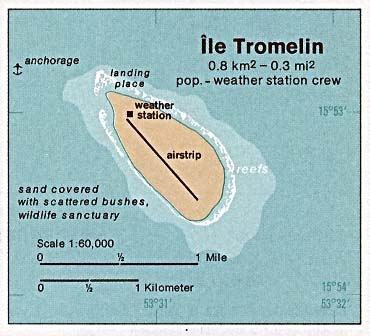
Tromelin Island
Aug
1722
Discovered by
the French ship of the Compagnie
française des Indes
orientales, the La
Diane, commanded by Jean Marie Briand
de la
Feuillée (b. 1685 - d. 1739) and
named Île de Sable
(Isle of Sand).
31 Jul 1761
French transport L'Utile,
of the Compagnie française des Indes
orientales,
wrecks on the island with 80 slaves left on it. All
die except seven women, who live chiefly
on shellfish and brackish
water for 15 years.
29 Nov
1776
French Capt. Jacques-Marie Boudin de Tromelin,
chevalier de
Tromelin (b. 1751 - d. 1798) on the
corvette La Dauphine rescues
the remaining slaves on
the island who are taken to Mauritius
and
freed.
1810 - 1814
Tromelin comes under the
jurisdiction of Île de France (Mauritius).
1814
Placed under the jurisdiction of Île Bourbon (later Réunion).
1825
Named Tromelin Island in a map by British Admiral
William Owen
(b. 1774 - d. 1857).
26 Nov 1867 - 22 Dec 1867 Indian ship Atieth
Rahamon commanded by Capt. Samuel
C. Hodges
with its crew is wrecked on the island.
1950
France begins garrisoning the island.
14 Jun
1960
Administration confirmed by the High Commissioner for
Réunion
(from 19 Sep 1960)(by décret
no 60-555 1 Apr 1960).
2 Apr 1976
Mauritius formally claims
sovereignty over Tromelin (the French
government officially rejects the claim
on 17 Dec 1976).
3 Jan
2005
Administrative control of the Îles Éparses is
transferred from the
prefect of Réunion to the administrator-superior of
the French
Southern and Antarctic Lands (TAAF).
21 Feb 2007
Incorporated into the French Southern and Antarctic Lands.
7 Jun 2010
A bilateral
co-management agreement relating to Tromelin and its
surrounding maritime areas is signed by
France and Mauritius. It
is not ratified by the French parliament,
however.
Territorial Dispute: Claimed
by Mauritius.
© Ben Cahoon
|