| World Statesmen.org HOME > |
United Kingdom
|
||||||||||||||||||||||||||||||||||||||
![[Flag
of England to 1606]](gb-eng.gif "[Flag of
England to 1606]")
![[England, Scotland Union flag,
1606 1801]](gb-1606.gif "[England,
Scotland Union flag, 1606 1801]")
![[Flag of
the United Kingdom]](gb.gif "[Flag of
the United Kingdom]")
Note on Dates: Dates listed below are Old
Style until Mar 1702. The U.K. officially adopted the
New Style (Gregorian) Calendar on 2
Sep 1752 which was followed by 14 Sep 1752.
Kings¹
c.881 - 26 Oct 899
Ælfred (Alfred "the Great")
(b. c.849 - d. 899)
26 Oct 899 - 17 Jul 924
Eadweard (Edward "the Elder")
(b. c.870 - d. 924)
17 Jul 924 - 2 Aug 924
Ælfweard (Alfward)
(b. c.904 - d. 924)
17 Jul 924 – 27 Oct 939
Æthelstan (Athelstan)
(b. c.895 - d. 939)
27 Oct 939 - 26 May 946
Eadmund I (Edmund I)
(b. c.921 - d. 946)
23 May 946 - 23 Nov 955
Eadred
(b. c.923 - d. 955)
(Edred "the Weak-in-the-Feet")
23 Nov 955 - 1 Oct 959
Eadwig (Edwy "the All-Fair") (b.
bf.943 - d. 959)
9 May 957 - 8 Jul
975 Eadgar I (Edgar I "the
Peaceable")(b. c.943 - d. 975)
8 Jul 975 - 18 Mar 978
Eadweard (Edward "the Martyr") (b.
c.963 - d. 978)
18 Mar 978 - late 1013
Æthelred "Unraed" (1st
time) (b. 968? - d. 1016)
(Ethelred "the Unready")
18 Mar 978 - 984
Queen Ælfthryth (f) -Regent
(b. c.945 - d. c.1000)
(Elfthryth)
late 1013 - 3 Feb 1014 Sweyn
"Tveskaeg" (Swein Forkbeard)(b. c.960 - d. 1014)
Mar/Apr 1014 - 23 Apr 1016 Æthelred
"Unraed" (2nd time) (s.a.)
23 Apr 1016 - 30 Nov 1016 Eadmund II
(Edmund II "Ironside") (b. c.993 - d. 1016)
23 Apr 1016 - 12 Nov 1035 Cnut
(Canute)
(b. c.955 - d. 1035)
12 Nov 1035 -
1037
Harthacnut (1st
time)
(b. c.1018 - d. 1042)
12 Nov 1035 - 17 Mar 1040 Harold I
"Harefoot"
(b. c.1016 - d. 1040)
(regent to 1037)
17 Mar 1040 - 8 Jun 1042 Harthacnut
(2nd
time)
(s.a.)
8 Jun 1042 - 4/5 Jan 1066 Eadweard
(Edward "the Confessor") (b. c.1002 - d. 1066)
5 Jan 1066 - 14 Oct 1066 Harold II
(Godwinesson)
(b. c.1020 - d. 1066)
14 Oct 1066 - 25 Dec 1066 Eadgar II "the
Ætheling"
(b. c.1052 - d. 1125)
(Edgar the "Atheling")
25 Dec 1066 - 9 Sep 1087 William I "the
Conqueror"
(b. 1027/28 - d. 1087)
(Guillaume "le Conquérant")
26 Sep 1087 - 2 Aug 1100 William II "Rufus"
(b. c.1060 - d. 1100)
(Guillaume "le Roux")
5 Aug 1100 - 1 Dec 1135 Henry I (=
Henri Beauclerc) (b.
1068 - d. 1135)
22 Dec 1135 - 8 Apr 1141 Stephen
(1st time)
(b. c.1096 - d. 1154)
(= Étienne de Blois)
(prisoner of Matilda 2 Feb - 1 Nov
1141)
Lady of the English (Anglorum Domina)
8 Apr 1141 - 7 Dec 1141
Matilda (left England Feb 1148) (b. 1102 - d.
1167)
Kings
7 Dec 1141 - 25 Oct 1154 Stephen
(2nd
time)
(s.a.)
6 Apr 1152 - 17 Aug 1153 Eustace
(not
recognized)
(b. c.1131 - d. 1153)
19 Dec 1154 - 6 Jul 1189 Henry
II
(b. 1133 - d. 1189)
14 Jun 1170 - 11 Jun 1183 Henry (III)
"the Young King" (b. 1155
- d. 1183)
Lord (Dominus Anglorum)
6 Jul 1189 - 3 Sep 1189
Richard
(b. 1157
- d. 1199)
King
3 Sep 1189 - 6 Apr 1199
Richard I "the
Lion-heart"
(s.a.)
(in France, on crusade, then prisoner
in Germany 12 Dec 1189 - 13 Mar 1194)
12 Dec 1189 - 13 Mar 1194 William de Longchamp,
Bishop (b. c.1130 - d. 1197)
of Ely -Regent
12 May 1194 - 6 Jun 1199 Hubert Walter,
Bishop (b.
c.1160 - d. 1205)
of
Canterbury -Regent
Lord (Dominus Anglorum)
8 Apr 1199 - 27 May 1199 John
"Lackland"
(b. 1167 - d. 1216)
Kings¹
27 May 1199-18/19 Oct 1216 John
"Lackland"
(s.a.)
2 Jun 1216 - 11 Sep 1217 Louis of
France (pretender)
(b. 1187 - d. 1226)
(later King Louis VIII of France)
28 Oct 1216 - 16 Nov 1272 Henry
III
(b. 1207 - d. 1272)
11 Nov 1216 - 9 Apr 1219 William
Marshal, Earl of
(b. 1146 - d. 1219)
Pembroke and Striguil -Governor
Apr 1219 - Jan
1227 Hubert de
Burgh -Regent
(b. c.1170 - d. 1243)
20 Nov 1272 - 7 Jul 1307 Edward I
"Longshanks"
(b. 1239 - d. 1307)
20 Nov 1272 - 2 Aug 1274 Regency
- Walter
Giffard, Archbishop (b. c.1225 - d.
1279)
of
York,
- Roger
Mortimer, Lord of Wigmore (b. 1231 - d. 1282)
- Sir Philip
Basset
(b. c.1184 - d. 1272)
(appointed, but died 29 Oct 1272)
- Robert
Burnell, Bishop of Bath (b. c.1239 - d. 1292)
13 May 1286 - 12 Aug 1289 Edmund, Earl of
Cornwall -Regent (b. 1249 - d.
1300)
7 Jul 1307 - 20 Jan 1327 Edward
II
(b. 1284 - d. 1237)
24 Jan 1327 - 21 Jun 1377 Edward
III
(b. 1312 - d. 1377)
24 Jan 1327 - 19 Oct 1330 Queen Isabella
(f) -Regent (b.
c.1295 - d. 1358)
21 Jun 1377 - 30 Sep 1399 Richard
II
(b. 1367 - d. 1400)
(captive of Henry Bolingbroke
from 19 Aug 1399)
30 Sep 1399 - 20 Mar 1413 Henry IV (=
Henry Bolingbroke) (b. 1366/67 - d.
1413)
20 Mar 1413 - 31 Aug 1422 Henry
V
(b. 1387 - d. 1422)
31 Aug 1422 - 4 Mar 1461 Henry VI
(1st
time)
(b. 1421 - d. 1471)
(also 21 Oct 1422-17 Jul 1453 King
Henri [II] of France)
(Yorkist prisoner 10 Jul 1460 - 17 Feb 1461)
5 Dec 1422 - 6 Nov 1429 Protectors
- John, Duke of
Bedford
(b. 1389 - d. 1435)
- Humphrey, Duke of Gloucester (b.
1390 - d. 1447)
3 Apr 1454 - Feb
1455 Richard Plantagenet,
Duke (b. 1411 - d.
1460)
of
York -Protector (1st time)
19 Nov 1455 - 25 Feb 1456 Richard
Plantagenet, Duke (s.a.)
of
York -Protector (2nd time)
4 Mar 1461 - 2 Oct 1470
Edward IV (1st
time)
(b. 1442 - d. 1483)
(prisoner at Warwick Castle 24 Jul - 10 Sep 1469)
5 Oct 1470 - 11 Apr 1471 Henry VI
(2nd
time)
(s.a.)
(prisoner in Tower of London 24 Jul 1465 - 5 Oct
1470)
11 Apr 1471 - 9 Apr 1483 Edward IV
(2nd
time)
(s.a.)
9 Apr 1483 - 25 Jun 1483 Edward
V
(b. 1470 - d. 1483)
30 Apr 1483 - 26 Jun 1483 Richard
Plantagenet, Duke
(b. 1452 - d.
1485)
of Gloucester -Lord Protector
26 Jun 1483 – 22 Aug 1485 Richard III
(s.a.)
(= Richard Plantagenet)
22 Aug 1485 - 21 Apr 1509 Henry
VII
(b. 1457 - d. 1509)
24 May 1487 - 16 Jun 1487 Lambet Simnel
(b. c.1477 - d. c.1525)
(in
rebellion as 'Edward VI')
21 Apr 1509 - 28 Jan 1547 Henry
VIII
(b. 1491 - d. 1547)
28 Jan 1547 - 6 Jul 1553 Edward
VI
(b. 1537 - d. 1553)
1 Feb 1547 - 13 Oct 1549 Edward
Seymour, Duke
(b. 1500 - d. 1552)
of
Somerset -Lord Protector
13 Oct 1549 - 6 Jul 1553 John
Dudley, (from Oct 1551) Duke (b. 1502 - d. 1553)
of
Northumberland -Regent
Queens¹
6 Jul 1553 - 19 Jul 1553 Jane (=
Lady Jane
Grey)
(b. 1537 - d. 1554)
19 Jul 1553 - 17 Nov 1558 Mary I "Bloody
Mary"
(b. 1516 - d. 1558)
17 Nov 1558 - 24 Mar 1603 Elizabeth
I
(b. 1533 - d. 1603)
Kings¹
24 Mar 1603 - 27 Mar 1625 James
I
(b. 1566 - d. 1625)
(James VI in Scotland from
24 Jul 1567)
27 Mar 1625 - 30 Jan 1649 Charles
I
(b. 1600 - d. 1649)
(Scots
prisoner 9 May 1646 - 28 Jan 1647,
then Parliamentary prisoner in London)
6 Aug 1651 - 15 Oct 1651
Charles II (in dissidence)
(b. 1630 - d. 1685)
(in Scotland on 23 June 1650,
proclaimed in Carlisle 6 Aug 1651,
fled
England on 15 Oct 1651)
Speaker of Commons of England, in Parliament Assembled
(from 19 May 1649,
Parliament of the Commonwealth of England)
4 Jan 1649 - 20 Apr 1653 William
Lenthall (1st time) (b.
1591 - d. 1662)
Captain-General and Commander-in-Chief
20 Apr 1653 - 4 Jul 1653 Oliver
Cromwell (1st
time) (b. 1599
- d. 1658) Mil
President of the Supreme Authority
5 Jul 1653 - 6 Jul 1653
Francis
Rous
(b. 1579 - d. 1658)
Speaker of the Parliament (from 7 Jul
1653, Parliament of the Commonwealth of England)
6 Jul 1653 - 12 Dec 1653 Francis
Rous
(s.a.)
Captain-General and Commander-in-Chief
12 Dec 1653 - 16 Dec 1653 Oliver Cromwell
(2nd time)
(s.a.)
Mil
Lord Protectors¹
16 Dec 1653 - 3 Sep 1658 Oliver
Cromwell
(s.a.)
Mil
3 Sep 1658 - 7 May 1659
Richard
Cromwell
(b. 1626 - d. 1712)
Speaker of the Parliament
7 May 1659 - 13 Oct 1659 William
Lenthall (2nd time)
(s.a.)
President of the Council of State
13 Oct 1659 - 25 Oct 1659 Bulstrode
Whitelock
(b. 1605 - d. 1675)
Committee of Safety
25 Oct 1659 - 23 Dec 1659 Members of
the Committee of Safety
- Sir Henry Vane,
Jr.
(b. 1613 - d. 1662)
- Bulstrode Whitelock
(s.a.)
- William
Sydenham
(b. 1615 - d. 1661) Mil
- John
Lambert
(b. 1619 - d. 1683) Mil
- James Berry
(d. 1691)
- Archibald Johnston, Lord
(b. 1611 - d. 1663)
Warriston
- Edmund
Ludlow
(b. 1617 - d. 1692)
- Richard
Salwey
(b. 1615 - d. 1685)
- John Desborow (Desborough) (b.
1608 - d. 1680) Mil
- Charles
Fleetwood
(b. c.1618 - d. 1692)Mil
- Sir James Harrington
(b. 1607 - d. 1680)
- William
Steele
(b. 1610 - d. 1680)
- Walter
Strickland
(b. 1600 - d. 1671)
- Henry Laurence (or Lawrence)
(b. 1600 - d. 1664)
- John
Ireton
(b. 1615 - d. 1689)
- Robert
Tichborne
(b. 1611 - d. 1682)
- Henry Brandreth
(b. 1610 - d. 1672)
- Robert Thomson
- John
Hewson
(b. 1595 - d. 1663)
- John Clerk (or Clarke)
- Robert
Lilburne
(b. 1613 - d. 1665)
- Robert
Bennet
(b. 1605 - d. 1683)
- Cornelius
Holland
(b. 1599 - d. 1671)
Speaker of the Parliament of England
24 Dec 1659 - 16 Mar 1660 William
Lenthall (3rd time)
(s.a.)
President of the Council of State
16 Mar 1660 - 25 Apr 1660 Arthur
Annesley
(b. 1614 - d. 1686)
Speaker pro tempore of the House of
Lords
25 Apr 1660 - 8 May 1660
Edward Montagu, Earl of Manchester(b.
1602 - d. 1671)
Speaker of the House of Commons
25 Apr 1660 - 8 May 1660
Sir Harbottle Grimston
(b. 1603 - d. 1685)
Kings¹
8 May 1660 - 6 Feb 1685 Charles
II
(s.a.)
(landed
at Dover 25 May 1660)
6 Feb 1685 - 12 Feb 1689
James
II
(b. 1633 - d. 1701)
(in Scotland James VII)
(fled England 23 Dec 1688, declared to
have
abdicated 12 Feb 1689; in
dissidence
in
Ireland 12 Mar 1689 - 2 Jul 1690)
Chairmen of the Peers of the Realm
11 Dec 1688 - 11 Dec 1688 Laurence Hyde, Earl of
(b. 1642 - d.
1711)
Rochester
12 Dec 1688 - 28 Dec 1688 George Savile,
Marquess of Halifax(b. 1633 - d. 1695)
28 Dec 1688 - 23 Feb 1689
William Henry, Prince of Orange (b.
1650 - d. 1702)
(administrator of
affairs)
King¹
23 Feb 1689-8/19 Mar 1702 William
III
(s.a.)
(in Scotland William II; in Gelderland
Willem III)
- jointly with the following -
Queens¹
23 Feb 1689 - 7 Jan 1695 Mary
II
(b. 1662 - d. 1695)
8/19 Mar 1702-12 Aug 1714 Anne
(b. 1665 - d. 1714)
Kings¹
12 Aug 1714 - 22 Jun 1727 George
I
(b. 1660 - d. 1727)
22 Jun 1727 - 25 Oct 1760 George
II
(b. 1683 - d. 1760)
25 Oct 1760 - 29 Jan 1820 George
III
(b. 1738 - d. 1820)
6 Feb 1811 - 29 Jan 1820 George
Prince of Wales -Regent (b. 1762 -
d. 1830)
29 Jan 1820 - 26 Jun 1830 George
IV
(s.a.)
(= George Prince of Wales)
26 Jun 1830 - 20 Jun 1837 William
IV
(b. 1765 - d. 1837)
Queen¹
20 Jun 1837 - 22 Jan 1901
Victoria
(b. 1819 - d. 1901)
Kings¹
22 Jan 1901 - 6 May 1910 Edward
VII
(b. 1841 - d. 1910)
6 May 1910 - 20 Jan 1936 George
V
(b. 1865 - d. 1936)
20 Jan 1936 - 11 Dec 1936 Edward
VIII
(b. 1894 - d. 1972)
11 Dec 1936 - 6 Feb 1952 George
VI
(b. 1895 - d. 1952)
Queen¹
6 Feb 1952 - 8 Sep 2022
Elizabeth
II
(b. 1926 - d. 2022)
King
8 Sep 2022
-
Charles
III
(b. 1948)
Lord Chancellors
28 Oct 1341 - 26 Aug 1343 Sir Robert Parving
(Parning) (d. 1343)
29 Sep 1343 - 26 Oct 1345 Sir Robert
Sadington
(b. 1280 - d. af.1346)
26 Oct 1345 - 20 May 1349 John de Offord, Dean of
Lincoln (d. 1349)
16 Jun 1349 - 27 Nov 1356 John Thoresby, Bishop of
(b. 1295 - d. 1373)
Worcester (from 8 Sep 1354, John
Cardinal Thoresby, Archbishop of York)
27 Nov 1356 - 21 Feb 1363 William Edington, Bishop
of (b. c.1310 - d. 1366)
Winchester
21 Feb 1363-af.18 Jul 1367 Simon Langham, Bishop of Ely
(b. 1310 - d. 1376)
10/17 Sep 1367-24 Mar 1371 William Wykeham, Bishop of
(b. 1324 - d. 1404)
Winchester (1st time)
26 Mar 1371 - 29 Jun 1372 Sir Robert Thorp
(d. 1372)
5 Jul 1372 - 11 Jan 1377 Sir John Knyvet
(b. c.1320 - d.
1381)
11 Jan 1377 - 29 Oct 1378 Adam Houghton, Bishop of
Saint (d. 1389)
David's
29 Oct 1378 - 30 Jan 1380 Richard le Scrope, Baron
Scrope (b. c.1327 - d. 1403)
of
Bolton (1st time)
30 Jan 1380 - 14 Jun 1381 Simon Sudbury,
Archbishop of (b. c.1316 - d. 1381)
Canterbury
16 Jun 1381 - 10 Aug 1381 Sir Hugh Segrave
(acting) (d.
1386/87)
(keeper of the Great Seal)
10 Aug 1381 - 30 Nov 1381 William Courtenay,
Archbishop of (b. c.1342 - d. 1396)
Canterbury
4 Dec 1381 - 11 Jul 1382 Richard le Scrope,
Baron Scrope (s.a.)
of Bolton (2nd time)
20 Sep 1382 - 10 Mar 1383 Robert Braybrook, Bishop
of (b. 1336/37 - d. 1404)
London
13 Mar 1383 - 23 Oct 1386 Michael de la Pole,
Baron de (b. c.1330 - d. 1389)
la Pole (from 27 Apr 1385,
Earl of Suffolk)
24 Oct 1386 - 4 Mar 1389 Thomas Arundel,
Bishop of (b. 1353
- d. 1414)
Ely (from 3 Apr 1388 Archbishop
of York)
(1st time)
4 May 1389 - 27 Sep 1391 William Wykeham,
Bishop of (s.a.)
Winchester (2nd time)
27 Sep 1391 - 15 Nov 1396 Thomas Arundel,
Archbishop
(s.a.)
of York (2nd time)
15 Nov 1396 - 15? Jul 1399 Edmund Stafford, Bishop
of (b. 1344 -
d. 1419)
Exeter (1st time)
23 Aug 1399 - 3? Sep 1399 Thomas Arundel,
Archbishop
(s.a.)
of Canterbury (3rd
time)
5 Sep 1399 - 9 Mar 1401 John Scarle,
Archdeacon of (b. c.1355 - d.
1403)
Lincoln
9 Mar 1401 - 28 Feb 1403 Edmund Stafford,
Bishop of (s.a.)
Exeter (2nd time)
28 Feb 1403 - 2 Mar 1405 Henry
Beaufort, Bishop of (b.
c.1374 - d. 1447)
Lincoln (from 19 Nov 1404,
Bishop of Winchester)(1st time)
2 Mar 1405 - 30 Jan 1407
Thomas Langley, Dean of York
(b. c.1363 - d. 1437)
(from 14
May 1406, Bishop of York)
(1st
time)
30 Jan 1407 - 21 Dec 1409 Thomas
Arundel, Archbishop
(s.a.)
of Canterbury (4th time)
31 Jan 1410 - 5 Jan 1412 Thomas
Beaufort
(b. 1377 - d. 1426)
(from 5 Jul 1412, Earl of Dorset)
5 Jan 1412 - 21 Mar 1413 Thomas Arundel,
Archbishop (s.a.)
of Canterbury (5th time)
21 Mar 1413 - 23 Jul 1417 Henry
Beaufort, Bishop of (s.a.)
Winchester (2nd time)
23 Jul 1417 - 16 Jul 1424 Thomas Langley,
Bishop of Durham (s.a.)
(2nd
time)
16 Jul 1424 - 16 Mar 1426 Henry Beaufort, Bishop
of (s.a.)
Winchester (3rd time)
16 Mar 1426 - 26 Feb 1432 John Kemp,
Archbishop of York (b. c.1380 - d. 1454)
(1st
time)
26 Feb 1432 - 31 Jan 1450 John Stafford,
Bishop of Bath (b. c.1392 - d. 1452)
and
Wells (and from 13 May 1443,
Archbishop of Canterbury)
31 Jan 1450 - 22 Mar 1454 John Cardinal Kemp,
Archbishop (s.a.)
of York
(from 31 Jul 1452,
Archbishop of Canterbury)
(2nd time)
2 Apr 1454 - 7 Mar 1455 Richard
Neville, Earl of Salisbury(b. 1400 - d. 1460)
7 Mar 1455 - 11 Oct 1456 Thomas Bourchier,
Archbishop of (b. 1404 - d. 1486)
Canterbury
11 Oct 1456 - 7 Jul 1460 William Waynflete,
Bishop of (b. 1395? - d. 1486)
Winchester
25 Jul 1460 - 8 Jun 1467 George
Neville, Bishop of Exeter (b. 1432? - d. 1476)
(1st
time)
20 Jun 1467 - 29 Sep 1470 Robert
Stillington, Bishop (b. 1420
- d. 1491)
of Bath
and Wells (1st time)
29 Sep 1470-af.4 Mar 1471 George Neville,
Archbishop of (s.a.)
York
(2nd time)
11 Apr 1471 - 18 Jun 1473 Robert
Stillington, Bishop (s.a.)
of Bath
and Wells (2nd time)
27 Jul 1473 - 27 May 1474 Laurence Booth, Bishop
of Durham (b. c.1420 - d. 1480)
27 May 1474 - 10 Jun 1475 Thomas
Rotherham, Bishop of (b. 1423
- d. 1500)
Lincoln
(1st time)
10 Jun 1475 - 29 Sep 1475 John
Alcock, Bishop of Rochester (b. 1430 - d. 1500)
(1st
time)(acing)
29 Sep 1475-af.22 Apr 1483 Thomas
Rotherham, Bishop of (s.a.)
Lincoln
(2nd time)
10 May 1483 - 29 Jul 1485 John Russell,
Bishop of Lincoln (s.a.)
18 Sep 1485 - 7 Oct 1485 Thomas Rotherham,
Archbishop (s.a.)
of York
(3rd time)
7 Oct 1485 - 6 Mar 1487 John Alcock,
Bishop of Worcester (s.a.)
(from 6
Oct 1486, Bishop of Ely)
(2nd
time)
6 Mar 1487 - 15 Sep 1500 John Morton,
Archbishop of (b.
1420? – d. 1500)
Canterbury (from 20 Sep 1493
John Cardinal Morton)
13 Oct 1500 - 27 Jul 1502 Henry Deane, Archbishop
of (b. c.1440 - d. 1503)
Canterbury (acting)
11 Aug 1502 - 24 Dec 1515 William Warham,
Archbishop (b. 1450?
- d. 1532)
of
Canterbury
(acting
to 21 Jan 1504)
24 Dec 1515 - 18 Oct 1529 Thomas Cardinal Wolsey,
(b. 1473 - d. 1530)
Archbishop of York
26 Oct 1529 - 16 May 1532 Sir Thomas
More
(b. 1478 - d. 1535)
20 May 1532 - 22 Apr 1544 Sir Thomas
Audley,
(b. 1487/88 - d. 1544)
(from 29 Nov 1538) Baron
Audley
of
Walden (acting to 26 Jan 1533)
22 Apr 1544 - 7 Mar 1547 Sir Thomas
Wriothesley, (b.
1505 - d. 1550)
(from 16
Feb 1547) Earl of
Southampton (acting to 3 May 1544)
7 Mar 1547 - 23 Oct 1547 Sir William Paulet
(acting) (b. c.1483 – d. 1572)
23 Oct 1547 - 21 Dec 1551 Richard Rich,
Baron Rich (b. 1496 -
d. 1567)
22 Dec 1551 - 23 Aug 1553 Thomas Goodrich, Bishop
of Ely (b. 1480 - d. 1554)
(acting to 19 Jan 1552)
21 Sep 1553 - 14 Nov 1555 Stephen Gardiner,
Bishop of (b. 1483 - d.
1555)
Winchester
1 Jan 1556 - 18 Nov 1558 Nicholas Heath,
Archbishop of York(b. c.1501 - d. 1578)
20 Dec 1558 - 20 Feb 1579 Sir Nicholas Bacon
(acting) (b. 1510 - d. 1579)
26 Apr 1579 - 11 Apr 1587 Sir Thomas
Bromley
(b. 1530 - d. 1587)
29 Apr 1587 - 20 Nov 1591 Sir Christopher Hatton
(b. 1540 - d.
1591)
28 May 1592 - 30 Apr 1596 Sir John Puckering
(acting) (b. 1544 - d. 1596)
6 May 1596 - 5 Mar 1617 Sir Thomas
Egerton
(b. 1540 - d. 1617)
(from 19 Jul 1603, Baron Ellesmere;
from 7 Nov 1616, Viscount Brackley)
(acting to 24 Jul 1603)
Lord High Treasurers and Chief Advisors
3 Feb 1550 - 10 Mar 1572 William
Paulet, Earl of Wiltshire,
(from
12 Oct 1551) Marquess of (s.a.)
Winchester
Jul 1572 - 4 Aug
1598 William Cecil, Baron Cecil
of (s.a.)
Burghley
4 Aug 1598 - 15 May 1599 Sir Thomas Egerton
(1st time) (b. 1540 - d. 1617)
(acting)
15 May 1599 - 19 Apr 1608 Thomas Sackville, Baron
Buckhurst,
Earl of
Dorset
(b. 1536 - d. 1608)
19 Apr 1608 - 4 May 1608 Thomas
Egerton, Baron Ellesmere (s.a.)
(2nd time)(acting)
4 May 1608 - 24 May 1612 Robert
Cecil, Viscount Cranborne,
Earl of
Salisbury
(b. 1563 - d. 1612)
24 May 1612 - 16 Jun 1612 Thomas
Egerton, Baron Ellesmere (s.a.)
(3rd time)(acting)
16 Jun 1612 - 24 May 1613 Henry Howard,
Earl of Northampton (b. 1540 - d. 1614)
24 May 1613 - 11 Jul 1614 Thomas Egerton,
Baron Ellesmere (s.a.)
(4th time)
11 Jul 1614 - 21 Jul 1618 Thomas Howard, Earl of
Suffolk (b. 1561 - d. 1626) Mil
21 Jul 1618 - 14 Dec 1620 George Abbott,
Archbishop (b. 1562
- d. 1633)
of Canterbury
14 Dec 1620 - 29 Sep 1621 Henry Montagu,
Viscount Mandeville(b. 1563 - d. 1642)
29 Sep 1621 - 14 May 1624 Lionel
Cranfield, Baron Cranfield,
Earl of
Middlesex
(b. 1575 - d. 1645)
14 May 1624 - 25 May 1624 Edward Somerset, Earl
(b.
1553 - d. 1628)
of Worcester (acting)
25 May 1624 - 11 Dec 1624 Sir Richard Weston (1st
time) (b. 1577 - d. 1635)
(acting)
11 Dec 1624 - 15 Jul 1628 James Ley, Baron Ley of
Ley,
Earl of
Marlborough
(b. 1552 - d. 1628)
15 Jul 1628 - 13 Mar 1635 Richard Weston,
Baron Weston, (s.a.)
Earl of Portland (2nd time)
15 Mar 1635 - 6 Mar 1636 William
Laud, Archbishop of
(b. 1573 - d. 1645)
Canterbury
6 Mar 1636 - 21 May 1641 William
Juxon, Bishop of London (b. 1582 - d. 1663)
21 May 1641 - 3 Oct 1643 Edward
Littleton, Baron Lyttleton (b. 1589 - d. 1645)
3 Oct 1643 - 30 Jan 1649 Francis
Cottington,
Baron Cottington of Hanworth (b. 1579
- d. 1652)
Jul 1646 - 30 Jan 1649 John
Finch, Baron Finch of (b.
1584 - d. 1660)
Fordwich (acting for Cottington)
Chairman of the Council of State
30 Jan 1649 - 15 Feb 1649 Oliver
Cromwell
(s.a.)
Mil
Presidency of the member for the day of the Council
of State
20 Feb
1649
Oliver Cromwell (1st
time)
(s.a.)
Mil
22 Feb 1649
Oliver Cromwell (2nd
time)
(s.a.)
Mil
23 Feb 1649
Oliver Cromwell (3rd time)
(s.a.)
Mil
24 Feb 1649
Basil Feilding, Earl of Denbigh (b.
c.1608 - d. 1675)
(1st time)
3 Mar 1649
Basil Feilding, Earl of Denbigh
(s.a.)
(2nd time)
7 Mar
1649
Sir William Masham
(b. 1591 - d. 1656)
7 Mar 1649
Sir Arthur
Hesilrige
(b. 1601 - d. 1661)
(or Hesilrig, Haselrig)
Presidents of the Council of State
(routinely styled in proceedings: Lord
President)
12 Mar 1649 - 15 Feb 1650 John Bradshaw (1st
time)
(b. 1602 - d. 1659)
15 Feb 1650 - 17 Feb 1650 Vacant
17 Feb 1650 - 29 Dec 1651 John Bradshaw (2nd time)
(s.a.)
29 Dec 1651 - 26 Jan 1652 Bulstrode
Whitelock (1st time) (s.a.)
26 Jan 1652 - 23 Feb 1652 Sir Arthur
Hesilrige (1st time) (s.a.)
(or Hesilrig, Haselrig)
23 Feb 1652 - 22 Mar 1652 Philip Sidney, Viscount
Lisle (b. 1619 - d. 1698)
22 Mar 1652 - 19 Apr 1652 John
Lisle
(b. 1610 - d. 1664)
19 Apr 1652 - 17 May 1652 Henry Rolle
(1st
time)
(b. 1589? - d. 1656)
17 May 1652 - 14 Jun 1652 Sir Henry Vane,
Jr. (1st time) (s.a.)
14 Jun 1652 - 12 Jul 1652 Philip Herbert,
Earl of Pembroke (b. 1584 - d. 1650)
and of Montgomery
12 Jul 1652 - 9 Aug 1652 Dennis
Bond (1st
time)
(b. 1588 - d. 1658)
9 Aug 1652 - 7 Sep 1652
William
Purefoy
(b. 1580? - d. 1659) Mil
7 Sep 1652 - 5 Oct 1652 Sir
James Harrington (1st time) (s.a.)
5 Oct 1652 - 25 Oct 1652 Sir
William Constable (1st time) (b. 1590 - d. 1655)
25 Oct 1652 - 22 Nov 1652 Sir William
Masham
(s.a.)
22 Nov 1652 - 1 Dec 1652 Sir
William Constable (2nd time) (s.a.)
1 Dec 1652 - 29 Dec 1652 ....
[unknown]
29 Dec 1652 - 26 Jan 1653 Henry Rolle
(2nd
time)
(s.a.)
26 Jan 1653 - 23 Feb 1653 John Bradshaw (3rd
time)
(s.a.)
23 Feb 1653 - 23 Mar 1653 Thomas Chaloner (or
Challoner) (b. 1595 - d. 1661)
23 Mar 1653 - 2 May 1653 Dennis Bond (2nd
time)
(s.a.)
2 May 1653 - 9 May 1653 John
Lambert
(s.a.)
9 May 1653 - 13 May 1653 Sir Gilbert
Pickering (1st time) (b. 1610 - d. 1668) Mil
13 May 1653 - 27 May 1653 .... [unknown]
27 May 1653 - 10 Jun 1653 John Desborough (or
Disbrowe) (s.a.)
10 Jun 1653 - 24 Jun 1653 .... [unknown]
24 Jun 1653 - 5 Jul 1653 Philip
Jones
(b. 1618 – d. 1674) Mil
8 Jul 1653 - 21 Jul 1653 Sir Gilbert
Pickering (2nd time)
(s.a.)
Mil
21 Jul 1653 - 4 Aug 1653 Edward Montagu (1st
time)
(b. 1602 - d. 1671) Mil
4 Aug 1653 - 17 Aug 1653 .... [unknown]
17 Aug 1653 - 31 Aug 1653 Sir Anthony Ashley
Cooper
(b. 1621 - d. 1683)
31 Aug 1653 - 14 Sep 1653 Robert
Tichborne
(s.a.)
14 Sep 1653 - 28 Sep 1653 .... [unknown]
28 Sep 1653 - 4 Oct 1653 Charles
Howard
(b. 1629 - d. 1685) Mil
4 Oct 1653 - 3 Nov 1653 William
Sydenham
(b. 1615 - d. 1661)
3 Nov 1653 - 6 Dec 1653 Edward
Montagu (2nd
time)
(s.a.)
Mil
6 Dec 1653 - 10 Dec 1653 Walter
Strickland
(s.a.)
Dec 1653 - 19? May? 1659 Henry
Laurence (or Lawrence)
(s.a.)
19? May 1659-2? Jun 1659 Sir James
Harrington (2nd time) (s.a.)
3? Jun 1659-27? Jun 1659 Archibald
Johnston, Lord
(s.a.)
Warriston
28? Jul 1659-16 Aug 1659 Bulstrode
Whitelock (2nd time) (s.a.)
16 Aug 1659 - 17 Aug 1659 Sir Henry Vane, Jr. (2nd
time) (s.a.)
17 Aug 1659 - 31 Aug 1659 Sir Arthur
Hesilrige (2nd time) (s.a.)
1 Sep 1659 - 15 Sep 1659 Sir Henry Vane, Jr.
(3rd time) (s.a.)
16 Sep 1659 - 29 Sep 1659 Richard Salway
(s.a.)
30 Sep 1659 - 13 Oct 1659 Thomas Scot
(b. 1604? - d. 1660)
13 Oct 1659 - 25 Oct 1659 Bulstrode
Whitelock (3rd time) (s.a.)
25 Oct 1659 - 3
Jan 1660 the Council of Safety
3 Jan 1660 - 31 Jan 1660 ....
[unknown]
31 Jan 1660 - 12 Feb 1660 Sir James
Harrington (3rd time) (s.a.)
12 Feb 1660 - Feb 1660 Henry
Neville
(b. 1619 - d. 1694)
Feb 1660 - 28 May 1660 Arthur
Annesley
(s.a.)
First Commissioner for Executing the Office of
Treasurer of His Majesty's Exchequer
19 Jun 1660 - 8 Sep 1660 Sir Edward
Hyde
(b. 1609 - d. 1674)
Lord High Treasurers
8 Sep 1660 - 16 May 1667 Thomas Wriothesley,
Earl of (b. 1607 -
d. 1667)
Southampton
16 May 1667 - 24 May 1667 Sir Robert Long
(acting) (b.
c.1600 - d. 1673)
First Commissioners for Executing the Office of
Treasurer of His Majesty's Exchequer
24 May 1667 - 3 Jan 1670 George Monk, Duke
of Albemarle (b. 1608 - d. 1670)
Mil
3 Jan 1670 - 2 Dec 1672
Anthony Ashley Cooper, Baron Ashley,
(from 23 Apr 1672, Earl of Shaftesbury)
(acting)
(s.a.)
Whg
Lords High Treasurers
2 Dec 1672 - 24 Jun 1673 Thomas
Clifford, Baron Clifford (b. 1630 - d.
1673)
of Chudleigh
24 Jun 1673 - 26 Mar 1679 Thomas Osborne,
Viscount Osborne (b. 1631 - d. 1712) Tor
(from 15 Aug 1673) Viscount Latimer,
(from
27 Jun 1674) Earl of Danby
First Commissioners for Executing the Office of
Treasurer of His Majesty's Exchequer
26 Mar 1679 - 19 Nov 1679 Arthur Capel,
Earl of Essex (b. 1632 -
d. 1683) Whg
19 Nov 1679 - 25 Aug 1684 Laurence Hyde,
Viscount Hyde of (b. 1642 - d. 1711)
Tor
Kenilworth, (from 29 Nov 1682)
Earl of Rochester (1st time)
25 Aug 1684 - 16 Feb 1685 Sidney
Godolphin, Baron
(b. 1645 - d. 1712) Tor
Godolphin of Rialton (1st time)
Lord High Treasurer
16 Feb 1685 - 4 Jan 1686 Laurence Hyde,
Viscount Hyde of (s.a.)
Tor
Kenilworth, Earl of Rochester
(2nd time)
First Commissioners for Executing the Office
of Treasurer of His Majesty's Exchequer2
4 Jan 1687 - 8 Apr 1689 John Belasyse,
Baron Belasyse (b. 1614 - d.
1689) Tor
8 Apr 1689 - 19 Mar 1690 Charles
Mordaunt, Earl of Monmouth(b. 1658 - d. 1735) Whg
19 Mar 1690 - 15 Nov 1690 John
Lowther
(b. 1655 - d. 1700) Whg
15 Nov 1690 - 1 May 1697 Sidney
Godolphin, Baron
(s.a.)
Tor
Godolphin of Rialton (2nd time)
1 May 1697 - 25 Nov 1699 Charles
Montagu (1st
time) (b. 1661
- d. 1715) Whg
25 Nov 1699 - 12 Dec 1700 Forde Grey,
Baron Grey of Werk, (b. 1655 - d.
1701) Whg
Earl of Tankerville
12 Dec 1700 - 27 Dec 1701 Sidney
Godolphin, Baron
(s.a.)
Tor
Godolphin (3rd time)
27 Dec 1701 - 8 May 1702 Charles
Howard, Earl of
(b. 1669 - d. 1738) Whg
Carlisle (1st time)
Lord High Treasurer2
8 May 1702 - 11 Aug 1710 John Churchill,
Duke of
(b. 1650 - d. 1722) Tor
Marlborough
First Commissioners for Executing the Office
of Treasurer of His Majesty's Exchequer2
11 Aug 1710 - 29 Mar 1711 John Poulett, Earl
Poulett (b. 1663 - d. 1743)
Tor
29 Mar 1711 - 30 Jul 1714 Robert
Harley,
(b. 1661 - d. 1724) Tor
Earl of Oxford and Mortimer
Lord High Treasurer2
30 Jul 1714 - 11 Oct 1714 Charles Talbot, Duke of
Shrewsbury(b. 1660 - d. 1718) Whg
First Commissioners for Executing the Office
of Treasurer of His Majesty's Exchequer2
11 Oct 1714 - 19 May 1715 Charles Montagu, Baron
of Halifax (s.a.)
Whg
(2nd time)
23 May 1715 - 10 Oct 1715 Charles Howard,
Earl of
(s.a.)
Whg
Carlisle (2nd time)
10 Oct 1715 - 9 Jun 1717 Robert
Walpole (1st time)
(b. 1676 - d. 1745) Whg
12 Jun 1717 - 21 Mar 1721 James Stanhope,
Viscount
(b.
1673 - d. 1721) Whg
Stanhope of Mahon
(from 14 Apr 1718, James Stanhope,
Earl of Stanhope)
21 Mar 1721 - 4 Apr 1721 Charles
Spencer, Earl of
(b. 1674 - d. 1722) Whg
Sunderland
4 Apr 1721 - 26 May 1730 Robert
Walpole (2nd
time)
(s.a.)
Whg
(from 27 May 1725, Sir Robert Walpole)
Prime ministers2
26 May 1730 - 11 Feb 1742 Sir Robert
Walpole
(s.a.)
Whg
16 Feb 1742 - 2 Jul 1743 Spencer
Compton, Earl
(b. 1673? - d. 1743) Whg
of
Wilmington
27 Aug 1743 - 6 Mar 1754 Henry
Pelham
(b. 1696 - d. 1754) Whg
16 Mar 1754 - 16 Nov 1756 Thomas
Pelham-Holles, Duke
(b. 1693 - d. 1768) Whg
of Newcastle (1st time)
16 Nov 1756 - 25 Jun 1757 William
Cavendish, Duke
(b. 1720 - d. 1764) Whg
of
Devonshire
25 Jun 1757 - 2 Jul 1757 James
Waldegrave, Earl
(b. 1715 - d. 1763) Whg
of Waldegrave (acting)
2 Jul 1757 - 26 May 1762 Thomas
Pelham-Holles, Duke
(s.a.)
Whg
of Newcastle (2nd time)
26 May 1762 - 16 Apr 1763 John Stuart,
Earl of
Bute (b.
1713 - d. 1792) Tor
16 Apr 1763 - 13 Jul 1765 George
Grenville
(b. 1712 - d. 1770) Whg
13 Jul 1765 - 30 Jul 1766 Charles
Watson-Wentworth,
(b. 1730 - d. 1782) Whg
Marquess of Rockingham (1st time)
30 Jul 1766 - 14 Oct 1768 William Pitt
"the Elder",
(b. 1708 - d. 1778) Whg
Earl of Chatham
14 Oct 1768 - 28 Jan 1770 Augustus Henry
Fitzroy, Duke (b. 1735 - d.
1811) Whg
of
Grafton
28 Jan 1770 - 22 Mar 1782 Frederick
North, Lord North
(b. 1732 - d. 1792) Tor
27 Mar 1782 - 1 Jul 1782 Charles
Watson-Wentworth,
(s.a.)
Whg
Marquess of Rockingham (2nd time)
4 Jul 1782 - 2 Apr 1783
William
Petty-Fitzmaurice,
(b. 1737 - d. 1805) Whg
Earl of Shelburne
2 Apr 1783 - 19 Dec 1783 William
Henry
Cavendish-
(b. 1738 - d. 1809) Whg
Bentinck, Duke of Portland
(1st time)
19 Dec 1783 - 14 Mar 1801 William Pitt
"the Younger"
(b. 1759 - d. 1806) Tor
(1st time)
17 Mar 1801 - 10 May 1804 Henry
Addington
(b. 1757 - d. 1844) Tor
10 May 1804 - 23 Jan 1806 William Pitt
"the Younger"
(s.a.)
Tor
(2nd time)
11 Feb 1806 - 31 Mar 1807 William Wyndham
Grenville, (b.
1759 - d. 1834) Whg
Baron Grenville
31 Mar 1807 - 4 Oct 1809 William
Henry
Cavendish-
(s.a.)
Whg
Bentinck, Duke of Portland
(2nd time)
4 Oct 1809 - 11 May 1812 Spencer
Perceval
(b. 1762 - d. 1812) Tor
9 Jun 1812 - 10 Apr 1827 Robert
Banks Jenkinson, Earl (b. 1770
- d. 1828) Tor
of Liverpool
10 Apr 1827 - 8 Aug 1827 George
Canning
(b. 1770 - d. 1827) Tor
31 Aug 1827 - 22 Jan 1828 Frederick John
Robinson,
(b. 1782 - d. 1859) Tor
Viscount Goderich
22 Jan 1828 - 22 Nov 1830 Arthur
Wellesley, Duke of
(b. 1769 - d.
1852) Tor
Wellington, Baron Douro of Wellesley
and Viscount Wellington of Talavera,
and of Wellington in the County
of Somerset (1st time)
22 Nov 1830 - 16 Jul 1834 Charles Grey,
Earl
Grey
(b. 1764 - d. 1845) Whg
16 Jul 1834 - 17 Nov 1834 William Lamb,
Viscount
(b. 1779 - d. 1848) Whg
Melbourne (1st time)
17 Nov 1834 - 10 Dec 1834 Arthur
Wellesley, Duke of
(s.a.)
Tor
Wellington,
Baron Douro of Wellesley
and Viscount Wellington of Talavera,
and of Wellington in the County
of Somerset (2nd time)
10 Dec 1834 - 18 Apr 1835 Sir Robert Peel
(1st time) (b.
1788 - d. 1850) Con
18 Apr 1835 - 30 Aug 1841 William Lamb, Viscount
(s.a.)
Whg
Melbourne (2nd time)
30 Aug 1841 - 30 Jun 1846 Sir Robert Peel
(2nd time)
(s.a.)
Con
30 Jun 1846 - 23 Feb 1852 John Russell,
Lord Russell
(b. 1792 - d. 1878) Whg
(1st time)
23 Feb 1852 - 19 Dec 1852 Edward Geoffrey
Stanley,
(b. 1799 - d. 1869) Con
Earl of Derby (1st time)
19 Dec 1852 - 6 Feb 1855 George
Hamilton-Gordon, Earl (b. 1784
- d. 1860) Peel
of Aberdeen
6 Feb 1855 - 20 Feb 1858 Henry John
Temple, Viscount (b. 1784
- d. 1865) Whg
Palmerston (1st time)
20 Feb 1858 - 12 Jun 1859 Edward Geoffrey
Stanley,
(s.a.)
Con
Earl of Derby (2nd time)
12 Jun 1859 - 18 Oct 1865 Henry John
Temple, Viscount
(s.a.)
Lib
Palmerston (2nd time)
29 Oct 1865 - 28 Jun 1866 John Russell,
Earl Russell
(s.a.)
Lib
(2nd time)
28 Jun 1866 - 27 Feb 1868 Edward Geoffrey
Stanley,
(s.a.)
Con
Earl of Derby (3rd time)
27 Feb 1868 - 3 Dec 1868 Benjamin
Disraeli (1st time) (b. 1804 - d.
1881) Con
3 Dec 1868 - 20 Feb 1874 William
Ewart Gladstone (1st time)(b. 1809 - d. 1898) Lib
20 Feb 1874 - 23 Apr 1880 Benjamin
Disraeli, (2nd time)
(s.a.)
Con
(from 12 Aug 1876) Earl of Beaconsfield
23 Apr 1880 - 23 Jun 1885 William Ewart
Gladstone (2nd
time)(s.a.)
Lib
23 Jun 1885 - 1 Feb 1886 Robert Arthur
Talbot Gascoyne-
(b. 1830 - d. 1903) Con
Cecil, Marquess of Salisbury
(1st time)
1 Feb 1886 - 25 Jul 1886 William Ewart
Gladstone (3rd
time)(s.a.)
Lib
3 Aug 1886 - 15 Aug 1892 Robert
Arthur Talbot Gascoyne-
(s.a.)
Con
Cecil, Marquess of Salisbury
(2nd time)
15 Aug 1892 - 5 Mar 1894 William
Ewart Gladstone (4th
time)(s.a.)
Lib
5 Mar 1894 - 25 Jun 1895 Archibald
Philip
Primrose, (b.
1847 - d. 1929) Lib
Earl of Rosebery
25 Jun 1895 - 12 Jul 1902
Robert Arthur Talbot Gascoyne-
(s.a.)
Con
Cecil, Marquess of Salisbury
(3rd time)
12 Jul 1902 - 5 Dec 1905 Arthur James
Balfour
(b. 1848 - d. 1930) Con
5 Dec 1905 - 8 Apr 1908 Sir Henry
Campbell-Bannerman (b.
1836 - d. 1908) Lib
8 Apr 1908 - 7 Dec 1916
Herbert Henry
Asquith
(b. 1852 - d. 1928) Lib
7 Dec 1916 - 23 Oct 1922 David
Lloyd
George
(b. 1863 - d. 1945) Lib
23 Oct 1922 - 22 May 1923 Andrew Bonar
Law
(b. 1858 - d. 1923) Con
22 May 1923 - 22 Jan 1924 Stanley Baldwin
(1st time) (b.
1867 - d. 1947) Con
22 Jan 1924 - 4 Nov 1924 James
Ramsay MacDonald (1st time) (b. 1866 - d. 1937)
Lab
4 Nov 1924 - 5 Jun 1929
Stanley Baldwin (2nd
time)
(s.a.)
Con
5 Jun 1929 - 7 Jun 1935 James
Ramsay MacDonald (2nd time)
(s.a.)
Lab
7 Jun 1935 - 28 May 1937 Stanley
Baldwin (3rd
time)
(s.a.)
Con
28 May 1937 - 10 May 1940 Arthur Neville
Chamberlain
(b. 1869 - d. 1940) Con
10 May 1940 - 26 Jul 1945 Winston Leonard
Spencer Churchill (b. 1874 - d. 1965) Con
(1st time)
26 Jul 1945 - 26 Oct 1951 Clement Richard
Attlee
(b. 1883 - d. 1967) Lab
26 Oct 1951 - 6 Apr 1955 Winston
Leonard Spencer Churchill
(s.a.)
Con
(from 24 Apr 1953, Sir Winston Leonard Spencer
Churchill)
(2nd time)
6 Apr 1955 - 10 Jan 1957 Sir Robert
Anthony
Eden
(b. 1897 - d. 1977) Con
10 Jan 1957 - 19 Oct 1963 Maurice Harold
Macmillan
(b. 1894 - d. 1986) Con
19 Oct 1963 - 16 Oct 1964 Alexander
"Alec" Frederick Douglas(b. 1903 - d.
1995) Con
-
Home, Earl of Home
(from 23 Oct 1963, Sir Alexander Frederick Douglas-Home)
16 Oct 1964 - 19 Jun 1970 James Harold
Wilson (1st time) (b. 1916 - d.
1995) Lab
19 Jun 1970 - 4 Mar 1974 Edward
Richard George Heath
(b. 1916 - d. 2005) Con
4 Mar 1974 - 5 Apr 1976 James
Harold Wilson (2nd time)
(s.a.)
Lab
5 Apr 1976 - 4 May 1979
Leonard James
Callaghan
(b. 1912 - d. 2005) Lab
4 May 1979 - 28 Nov 1990 Margaret
Hilda Thatcher (f)
(b. 1925 - d. 2013) Con
28 Nov 1990 - 2 May 1997 John Roy
Major
(b.
1943)
Con
2 May 1997 - 27 Jun 2007 Anthony
"Tony" Charles Lynton (b.
1953)
Lab
Blair
27 Jun 2007 - 11 May 2010 James Gordon
Brown
(b. 1951)
Lab
11 May 2010 - 13 Jul 2016 David William Donald
Cameron (b. 1966)
Con
13 Jul 2016 - 24 Jul 2019
Theresa Mary May
(f)
(b.
1956)
Con
24 Jul 2019 - 6 Sep 2022 Alexander Boris
de Pfeffel Johnson(b. 1964)
Con
6 Apr 2020 - 27 Apr 2020 Dominic Raab
(acting for Johnson) (b.
1974)
Con
6 Sep 2022 - 25 Oct 2022 Mary
Elizabeth "Liz" Truss (f) (b.
1975)
Con
25 Oct 2022 -
5 Jul 2024
Rishi Sunak
(b.
1980)
Con
5 Jul 2024
-
Sir Keir Rodney
Starmer
(b.
1962)
Lab
¹Full style of the ruler:
(a) Anglo-Saxon royal styles (9th-11th century):
evidence found in contemporary sources suggests
that the Anglo-Saxon rulers of England in the 9th-11th
century used a number of forms of royal title,
which loosely varied. As a matter of fact, the royal
title was a conflation of the word 'king', usually
inscribed in Latin Rex or Old English Cing
(cyng, or cyngc, etc.), with an
attribution to national authority — 'English',
'Anglo-Saxon', 'West-Saxon'. The combination which
became most common since the reign of King Æthelstan was
rex Anglorum ("king of the English"), but it was
usually coupled with colorful epithets in
charters and writs. Occasionally, Rex was
dropped in favor of other titles emphasizing imperium
over other peoples in Britain. The charters of
the first decade of Ælfred's reign mostly referred to
him as rex Saxonum ("king of the
Saxons"). After the capture of London (886), Alfred's
royal style shifted to variations on rex
Angulsaxonum ("king of the Anglo-Saxons") and rex
Anglorum et Saxonum ("king of the English and
Saxons"); Eadred was styled regis qui regimina
regnorum Angulsaxna, Northhymbra, Paganorum,
Brettonumque ("king of the Anglo-Saxons,
Northumbrians, Pagans, and Britons") in a
charter of 946, and again in 949-950. He was reduced to
rex Anglorum in 951, and raised back to "king of
the Anglo-Saxons, Northumbrians, pagans, and Britons" in
954. A charter of 974 styled Eadgar totius
Albionis finitimorumque regum basileus ("of all
Britain and of the neighboring kings basileus");
Edward "the Confessor" was rex Anglorum on
coins, Rex Anglorum or Anglorum Basileus
in charters and on his seal;
(b) 25 Dec 1066 - 12 Aug 1189: (in old English):
Englena cyning; (in French): Roy d'Engleis;
(in Latin): Rex Anglorum ("King of the
English");
(c) 12 Aug 1189 - 25 Jan 1340: Rex
Angliae; (in French): Roy d'Engleterre
("King of England");
(d) 25 Jan 1340 - 25 Oct 1415: Rex Angliae et
Franciae; (in French): Roy d'Engleterre et de
France ("King of England and France);
(e) 25 Oct 1415 - 11 Oct 1521: Dei gratia Rex
Angliae et Franciae Dominus Hiberniae ("by
the Grace of God, King of England and France, Lord of
Ireland");
(f) 11 Oct 1521 - 15 Jan 1535: Dei
gratia Rex Angliae et Franciae, Fidei Defensor et
Dominus Hiberniae ("by the Grace of God, King of
England and France, Defender of the Faith, Lord of
Ireland");
(g) 15 Jan 1535 - 6 Feb 1542: Dei gratia Rex Angliae
et Franciae, Fidei Defensor, Dominus Hiberniae, et in
terra ecclesiae Anglicanae (from 1536 et Hiberniae)
supremum caput ("by the Grace of God, King of
England and France, Defender of the Faith, Lord of
Ireland, and of the Church of England [from 1536 and of
Ireland] in Earth Supreme Head");
(h) 6 Feb 1542 - 25 Jul 1554: Dei gratia Angliae
Franciae et Hiberniae Rex/Regina, Fidei Defensor, et
in terra ecclesiae Anglicanae et Hiberniae supremum
caput ("by the Grace of God, King/Queen of
England, France and Ireland, Defender of the Faith, and
of the Church of England and of Ireland in Earth Supreme
Head");
(i) 25 Jul 1554 - 17 Nov 1554: Dei Gratia Rex et
Regina Angliae Franciae Neapolis Ierusalem et
Hiberniae, Fidei Defensores, Principes Hispaniae et
Siciliae, Archiduces Austriae, Duces Mediolani
Burgundiae et Brabanciae, Comites Haspurgi Flandriae
et Tirolis ("by the grace of God King and Queen of
England, France, Naples, Jerusalem, and Ireland,
Defenders of the Faith, Princes of Spain and Sicily,
Archdukes of Austria, Dukes of Milan, Burgundy, and
Brabant, Counts of Hapsburg, Flanders, and Tyrol");
(j) 17 Nov 1558 - 31 Mar 1603: Dei gratia Angliae
Franciae et Hiberniae Rex/Regina, Fidei Defensor, etc.
("by the Grace of God, King/Queen of England, France and
Ireland, Defender of the Faith, etc.");
(k) 31 Mar 1603 - 30 Jan 1649: Dei gratia Angliae
Scotiae Franciae et Hiberniae Rex, Fidei Defensor,
etc. ("by the Grace of God, King of England,
Scotland, France and Ireland, Defender of the Faith,
etc."); from 24 Oct 1604, James I also
began to use the style of "King of Great Britain,
France and Ireland, Defender of the Faith, etc." (Dei
gratia, Magnae Britanniae, Franciae et Hiberniae
Rex, Fidei Defensor, etc.) this
was formalized from 12 May 1707;
(l) 20 Apr 1653 - 16 Dec 1653: "Captain-General
and Commander-in-Chief of all the armies and forces
raised and to be raised within the Commonwealth of
England";
(m) 16 Dec 1653 - 7 May 1659: "by the Grace of God, Lord
Protector of the Commonwealth of England, Scotland, and
Ireland (and the Dominions and Territories thereunto
belonging)," often shorted to "By the
Grace of God and Republic, Lord
Protector of England, Scotland and Ireland" (Dei
Gratia Reip[ublicae] Angliae, Scotiae et
Hiberniae, &c Protector);
(n) from 8 May 1660: "by the Grace of God,
King/Queen of England, France and Ireland, Defender of
the Faith, etc. (Dei gratia Angliae Scotiae Franciae
et Hiberniae Rex/Regina, Fidei Defensor, etc.);
(o) from 12 May 1707: "by the Grace of
God, King/Queen of Great Britain, France and Ireland,
Defender of the Faith, etc." (Dei gratia, Magnae
Britanniae, Franciae et Hiberniae Rex/Reina, Fidei
Defensor, etc.);
(p) from 1 Jan 1801: "by the Grace of God, of the
United Kingdom of Great Britain and Ireland King/Queen,
Defender of the Faith"; in 1 Jul 1876 the title "Empress
of India" was added;
(q) from 4 Nov 1901: "by the Grace of God, of the
United Kingdom of Great Britain and Ireland and of the
British Dominions beyond the Seas King, Defender of the
Faith, Emperor of India";
(r) from 13 May 1927: "by the Grace of God, of
Great Britain, Ireland and of the British Dominions
beyond the Seas King, Defender of the Faith, Emperor of
India"; the title "Emperor of India" was dropped as of
15 Aug 1947 by retroactive proclamation dated 22 Jun
1948;
(s) 29 May 1953: "by the Grace of God, of the
United Kingdom of Great Britain and Northern Ireland and
of Her other Realms and Territories Queen, Head of the
Commonwealth, Defender of the Faith";
(t) from 10 Sep 2022: "by the Grace of God, of
the United Kingdom of Great Britain and Northern Ireland
and of His other Realms and Territories King, Head of
the Commonwealth, Defender of the Faith."
2The
origin of the term prime minister and the question to
whom it should originally be applied have long been
issues of scholarly and political debate. Although the
term was used as early as the reign of Queen Anne
(1702-1714), it acquired wider currency during the reign
of George II (1727-1760), when it began to be used as a
term of reproach toward Sir Robert Walpole (s.a.). It
was not until early 20th century when the Prime
Minister's precedence in England was established 2 Dec
1905 that placed the Prime Minister, mentioned as such,
in the order of precedence in England immediately after
the Archbishop of York.
The first Act of Parliament to mention the
office of Prime Minister was the Chequers Estate Act,
which received the Royal Assent on 20 Dec 1917. The
title was finally given full recognition on 1 Jul 1937,
when the Salaries of the Ministers of the Crown Act made
provision for paying "the First Lord of the Treasury and
Prime Minister" - the two offices that since the 18th
century, have usually been held by the Prime Minister,
though some exceptions existed. The Act made a certain
distinction between "position" (Prime Minister) and
"office" (First Lord of the Treasury) emphasizing the
unique character of the position and recognized the
existence of the Cabinet. Nevertheless, in spite of this
recognition, the brass plate outside the Prime
Minister's front door still bears the title of First
Lord of the Treasury.
From 1687 the formal style of the Prime minister:
8 May 1702 - 10 Aug 1710, 30 Jul 1714 - 13 Oct 1714
"Lord High Treasurer"; 4 Jan 1687 - 8 May 1702, 10 Aug
1710 - 30 Jul 1714, 13 Oct 1714 - 24 Jun 1885 and 1
Feb 1886 - 25 Jun 1895 "First Commissioner for
Executing the Office of Treasurer of His Majesty's
Exchequer"; 24 Jun 1885 - 1 Feb 1886 "Secretary of State
for Foreign Affairs and Prime Minister"; 25 Jun 1895 -
12 Nov 1900 "Prime Minister and Secretary of State for
Foreign Affairs"; 12 Nov 1900 - 12 Jul 1902 "Prime
Minister and Lord Privy Seal"; 12 Jul 1902 - 5 Dec 1905
"First Lord of the Treasury"; from 5 Dec 1905, "Prime
Minister and First Lord of the Treasury."
Territorial Disputes: In Nov 2002, Gibraltar residents voted overwhelmingly by referendum to reject any "shared sovereignty" arrangement between the U.K. and Spain; Spain disapproved of UK plans to grant Gibraltar greater autonomy; London and Madrid reached a temporary agreement at the end of 2020 that allowed Gibraltar to be part of the passport-free Schengen zone; Mauritius and Seychelles claim the Chagos Archipelago (UK-administered British Indian Ocean Territory); in 2001, the former inhabitants of the archipelago, evicted 1967 - 1973, were granted UK citizenship and the right of return, followed by Orders in Council in 2004 that banned rehabitation, a High Court ruling reversed the ban, a Court of Appeal refusal to hear the case, and a Law Lords' decision in 2008 denied the right of return; in addition, the U.K. created the world's largest marine protection area around the Chagos Islands prohibiting the extraction of any natural resources therein; U.K. rejects sovereignty talks requested by Argentina, which claims the Falkland Islands (Islas Malvinas) and South Georgia and the South Sandwich Islands; Rockall continental shelf dispute involving Denmark and Iceland remains dormant; territorial claim in Antarctica (British Antarctic Territory) overlaps Argentine claim and partially overlaps Chilean claim is not recognized by the Argentina, Chile, the United Nations, U.S., Russia, or by most other countries (other than Australia, France, New Zealand and Norway); the U.K., Iceland, and Ireland dispute Denmark's claim that the Faroe Islands' continental shelf extends beyond 200 nm; Iceland, Norway, and the Faroe Islands signed an agreement in 2019 extending the Faroe Islands' northern continental shelf area.
Party abbreviations: Con =
Conservative Party (center-right, est.1840s); Lab
= Labour Party (social-democratic, center-left, first
officially named 1868);
- Former parties - Note: Before
the development of the Conservative and Liberal
parties in the mid-19th century, parties were largely
simply alliances of prominent groups or aristocratic
families. The designations Whig and Tory tend often to
be approximate - Lib = Liberal Party
(liberal, 9 Jun 1859-3 Mar 1988, united with
Social Democratic Party on 19 Mar 1988 as
Social and Liberal Democrats, renamed Liberal
Democrats Oct 1989); Peel = Peelite (named for
Robert Peel, breakaway faction of Con. party,
1846-1859); Tor = Tory Party
(conservative, royalist, pro-Anglican, remnants became
the Conservative party by the 1840's); Whg
= Whig Party (moderate conservative, aristocratic,
pro-reform, later elements became the Liberal party by
the 1850's)
East Anglia
5.. Kingdom of the East Angles (Éast-Englena ríce;
in Latin regnum Anglorum orientalium).
651 - c.653 Occupied by Merica.
20 May 794 - 826 Direct rule by Mercia.
826 independence.
20 Nov 869 - 13 Dec 902 Danish suzerainty.
13 Dec 902 Annexed to England.
917 Re-conquered following failed revolt.
Kings(title Éast-Englena cyning/Rex Anglorum orientalium;
from 20 Nov 869, Éast-Engla lande cyning/Rex Angliae orientalis)
5.. - c.599 Tytila (b. 5.. - d. c.599)
c.599 - c.624 Raedwald Tytlan sunu (b. 56. - d. c.624)
c.624 - 4 Oct c.627 Eorpwald Raedwaldes sunu (b. 58. - d. c.627)
4 Oct c.627 - c.630 Rícberht (Ricbryht) (b. 59. - d. c.630)
c.630 - c.634 Sigeberht (Sigebryht) (b. 58. - d. c.636)
c.630 - 29 Oct? c.636 Ecgríc (co-ruler to c.634) (b. 59. - d. c.636)
29 Oct? c.636 - 651 Ánna (Onna) Enan sunu (1st time) (b. 60. - d. 653?)
651 - c.653 Mercia rule
c.653 - 653? Ánna Enan sunu (2nd time) (s.a.)
653? - 15 Nov 655 Æthelhére Enan sunu (b. 61. - d. 655)
653? - 664 Æthelwald Enan sunu (b. 61. - d. 664)
664 - 713 Ealdwulf Æthelríces sunu (b. 64. - d. 713)
c.713 - 749 Ælfwald Ealdwulfes sunu (b. 67. - d. 749)
749 - 76. Beorna (Beornraed) (b. 71. - d. 769?)
749 - 20 May 794 Æthelberht Æthelraedes sunu (b. 74. - d. 794)
(Æthelbryht)(co-ruler to c.769?)
20 May 794 - 826 Mercia rule
826 - c.847 Æthelstán I (b. 79. - d. c.847)
c.847 - 854 Æthelweard (b. 81. - d. 854)
854 - 20 Nov 869 Éadmund (b. c.840 - d. 869)
20 Nov 869 - 87. Óswald
87. - c.878 Æthelraed II
c.878 - c.890 Æthelstán II (Guththorm) (b. 8.. - d. c.890)
c.890 - 13 Dec 902 Eohríc (Eríkr) (b. 8.. - d. 902)
917 Guthrum (in rebellion) (d. 918)
Essex
5.. Kingdom of the East Saxons (Éastseaxena ríce;
in Latin regnum orientalium Saxonum).
67. - 812 Mercian overlordship.
812 - 825 Part of Mercia.
825 - 860 Wessex rule (administered from Kent).
20 Dec 860 Annexed to Wessex.
Kings (title Éastseaxena cyning/Rex orientalium Saxonum)
5.. - c.597 Slédda Æscwines sunu (b. 5.. - d. c.597)
c.597 - c.616 Saeberht Sléddan sunu (b. 5.. - d. c.616)
c.616 - 617 Seaxraed Saeberhtes sunu (b. 5.. - d. 617)
c.616 - 617 Saeward Saeberhtes sunu (b. 5.. - d. 617)
617 - c.653 Sigebeorht Saewardes sunu (b. 6.. - d. c.653)
(Sigebryht)(Sigeberht "the Little")
c.653 - 29 Aug 660 Sigebeorht (Sigebryht) (b. 6.. - d. 660)
(Sigeberht II "the Good")
(Saint Sigeberht)
29 Aug 660 - 664 Swíthhelm Seaxbaldes sunu (b. 6.. - d. 664)
664 - c.683 Sigehére Sigebeorhtes sunu (b. 6.. - d. c.683)
664 - c.694 Saebbi Sigebeorhtes sunu (b. 6.. - d. c.695)
(Saebeorht)(co-ruler to c.683)
c.694 - c.709 Sigeheard Saebban sunu (b. 6.. - d. c.709)
c.694 - c.704 Swaefraed Saebban sunu -Co-ruler (b. 6.. - d. c.704)
c.709 - c.709 Offa Sigeheardes sunu (b. 6.. - 7..)
c.709 - c.746 Saelraed Sigebeorhtes sunu (b. 6.. - d. c.746)
c.715 - c.738 Swaefbryht (Swaefbeorht)-Co-ruler (b. 6.. - d. c.738)
c.746 - c.758 Swíthraed Sigemundes sunu (b. 6.. - d. c.758)
(Swaefred)
c.758 - c.798 Sigeríc (b. 7.. - d. c.800)
c.798 - 812 Sigeraed Sigeríces sunu (b. 7.. - d. 83.)
(continues as Duke [Dux] to 825)
Kent
bf.560 Kingdom of Kent (Cant ríce; in Latin Cantii regnum)
founded by the Jutes.
4 Jul 673 - 674 Mercian rule.
31 Aug 686 - 687 West Saxon (Wessex) rule.
687 - 688 East Saxon (Essex) rule.
688 Mercian intervention.
c.739 - Sep? 796 Mercian overlordship.
Sep? 796 Independence restored.
798 Definitely subdued by Mercia.
825 - 860 Wessex rule.
20 Dec 860 Annexed to Wessex.
Kings (title Cantwara cyning/Rex Cantuariorum; from 686-687, 688-691,
c.739-796 and 825-860 Cantes cyning/Rex Cantae)
51. - 55. Octa (Octha) (d. 55.)
55. - 58. Eormenríc (b. 5.. - d. 58.)
58. - 24 Feb 616 Æthelberht Eormenríces sunu (b. 56. - d. 616)
24 Feb 616 - 20 Jan 640 Éadbald Æthelberhtes sunu (b. 59. - d. 640)
24 Feb 616 - 62. Æthelwald Æthelberhtes (b. 59. - d. 62.)
sunu -Co-ruler
20 Jan 640 - 14 Jul 664 Eorcenberht Éadbaldes sunu (b. 62. - d. 664)
14 Jul 664 - 4 Jul 673 Ecgberht Eorcenberhtes sunu (b. 64. - d. 673)
14 Jul 664 - 666 Seaxburh (f) -Regent (b. 62. - d. c.699)
(Saint Sexburga)
4 Jul 673 - 674 Mercian rule
674 - 6 Feb 685 Hlóthhere Eorcenberhtes sunu (b. 64. - d. 685)
c.679 - 31 Aug 686 Éadríc Ecgberhtes sunu (b. 66. - d. 686)
(co-ruler to 6 Feb 685)
31 Aug 686 - 687 Múl Cénbehrtes sunu (b. 66. - d. 687)
687 - c.692 Swaefheard Saebban sunu (b. 6.. - d. 69.)
(Suebhardus, Sueaberdus)
688 - Jul? 691 Óswyn (b. 6.. - d. 691?)
Jul? 691 - 23 Apr 725 Wihtraed Ecgberhtes sunu (b. 66. - d. 725)
(Wihtredus, Wythredus)
23 Apr 725 - c.730 Éadberht Wihtraedes sunu (b. 69. - d. 748)
23 Apr 725 - 72. Ælfríc Wihtraedes sunu -Co-ruler (b. 69. - d. 72.?)
c.730 - 762 Æthelberht Wihtraedes sunu (b. 69. - d. 762)
748 - 7.. Eardwulf Éadberhtes sunu -Co-ruler(b. 72. - d. 7..)
762 - c.763 Éadberht Æthelberhtes sunu (b. 7.. - d. c.763?)
762 - c.763 Sigeraed -Co-ruler (b. 7.. - d. c.763?)
c.763 - c.764 Éanmund (b. 7.. - d. c.764?)
c.764 - 765 Héaberht Æthelberhtes sunu (b. 7.. - d. 765?)
c.764 - 78. Ecgberht Æthelberhtes sunu (b. 7.. - d. 78.)
78. - 785 Ealhmund Eafes sunu (b. 74. - d. 785)
785 - Sep? 796 Vacant
Sep? 796 - 798 Éadbearht Ealhmundes sunu Praen (b. 7.. - d. 8..)
798 - 807 Cuthraed Cuthberhtes sunu (b. 7.. - d. 807)
(Cuthred)
807 - 821 the king of Mercia
821 - 825 Baldraed (Baldred)
825 - 4 Feb 839 Æthelwulf Ecgbehrtes sunu (b. c.795 - d. 858)
4 Feb 839 - 855? Æthelstán Æthelwulfes sunu (b. 81. - d. 855?)
855? - 20 Dec 860 Æthelberht Æthelwulfes sunu (b. c.832 - d. 865)
Mercia
5.. Myrce/Mercia kingdom (Myrcena ríce; in Latin regnum Merciorum).
Apr 656 - c.658 Northumbria occupation.
c.658 - 679 Mercia restored as tributary to Northumbria.
679 Independence restored.
829 - 830 Wessex rule.
874 - c.881 Under Danish suzerainty.
c.881 English rule.
Kings (title Myrcena cyning/Rex Merciorum)
5.. - c.593 Créoda Cynewaldes sunu (b. 54. - d. c.593)
c.593 - c.606 Pybba Créodan sunu (b. 57. - d. c.606)
c.606 - c.626 Cearl (b. 57. - d. c.626)
c.626 - 15 Nov 655 Penda Pybban sunu (b. 60. - d. 655)
c.635 - 5 Aug 642 Éowa Pybban sunu -Co-ruler (b. 60. - d. 642)
c.653 - 17 Apr 656 Péada Pendan sunu -Co-ruler (b. 62. - d. 656)
Apr 656 - c.658 Northumbria rule
c.658 - 675 Wulfhére Pendan sunu (b. 64. - d. 675)
675 - 704 Æthelraed Pendan sunu (b. 64. - d. 716)
704 - 709 Coenraed Wulfhéres sunu (b. 66. - d. 71.)
709 - 716 Céolraed Æthelraedes sunu (b. 67. - d. 716)
716 - 757 Æthelbald Alwéowes sunu (b. 69. - d. 757)
(Aetthlbalt)
757 - 757 Beornraed (b. 71. - d. 769?)
757 - 26 Jul 796 Offa Thingfríthes sunu (b. 73. - d. 796)
787 - 14 Dec 796 Ecgfríth Offan sunu (b. 77. - d. 796)
(co-ruler to 26 Jul 796)
Dec 796 - 821 Coenwulf Cuthberhtes sunu (b. 7.. - d. 821)
(Cénwulf)
821 - 823 Ceolwulf Cuthberhtes sunu (b. 7.. - d. 823?)
823 - 826 Beornwulf (b. 7.. - d. 825)
826 - 827 Ludeca (b. 7.. - d. 827)
827 - 829 Wígláf (1st time) (d. c.839)
829 - 830 Wessex rule
830 - c.839 Wígláf (2nd time) (s.a.)
c.839 Ælfflæd (f) -Regent
c.839 - 852 Beorhtwulf (Berhtwulf) (b. 8.. - d. 852)
852 - 874 Burgraed (b. 8.. - d. 88.?)
874 - c.881 Ceolwulf II (b. 8.. - d. c.881)
Sussex
c.645 Separated from Wessex by Mercian intervention;
Kingdom of South Saxons (Súthseaxena ríce; in Latin
regnum Sussaxonum).
686 - 688 Wessex rule.
688 Sussex Kingdom restored.
75. - c.772 Mercian overlordship.
c.772 - 825 Annexed by Mercia, ruling dynasty continue as governors
styled Dux (Duke).
825 - 860 Wessex rule (administered from Kent).
20 Dec 860 Annexed to Wessex.
Kings (title Súthseaxena cyning/Rex Sussaxonum)
c.645 - 685 Æthelwealh (b. 62. - d. 685)
685 - 686 Beorhthun -Duke (acting) (b. 6.. - d. 686)
685 - 686 Andhun -Duke (acting)
686 - 688 Wessex rule
688 - 71. Nóthhelm (Nunna) (b. 6.. - d. 71.)
71. - 72. Æthelstán (b. 6.. - d. 72.)
72. - 75. Æthelberht (b. 7.. - d. 75.)
75. - c.772 Ósmund (b. 7.. - d. 77.)
Wessex
c.538 Gewisse kingdom (Gewisinga).
c.645 - c.648 Mercian rule.
685 - 688 Caedwalla (Catgvallavn) claims kingship over all the Saxons.
688 Kingdom of West Saxons (Westseaxena ríce; in Latin
regnum occidentalium Saxonum).
802 Wessex independent from Mercia.
825 Wessex takes over Essex, Sussex and Kent from Mercia under
a separate (subordinate) kingship.
20 Dec 860 Kent, Essex, Sussex fully merged with Wessex.
15 Apr 871 Ælfraed the claims title 'king of the Anglo-Saxons.'
Kings of the Gewissae (title Gewisinga cyning/Rex Gewissae)
c.538 - c.554 Cerdic (Ceretic) (b. 5.. - d. c.554)
c.554 - c.581 Cynríc (b. 5.. - d. c.581)
c.581 - c.588 Ceawlin (b. 5.. - d. c.589)
c.588 - c.594 Céolríc Cúthwulfes sunu (b. 5.. - d. c.594)
c.594 - c.611 Céolwulf Cúthwulfes sunu (b. 5.. - d. c.611)
c.611 - c.636 Cwichelm (b. 59. - d. c.636)
c.611 - c.643 Cynegils (b. 5.. - d. c.643)
c.643 - c.645 Cénwealh Cynegilses sunu (b. 6.. - d. c.674)
(Kyngvallavn)(1st time)
c.645 - c.648 Mercian rule
c.648 - c.674 Cénwealh Cynegilses sunu (s.a.)
(Kyngvallavn)(2nd time)
c.674 - c.676 Æscwine Cénfúsing sunu (b. 6.. - d. c.676)
c.676 - 685 Centwine (Cénwine) (b. 6.. - d. 69.)
King of the Saxons (title Seaxena cyning/Rex Saxonum)
685 - 688 Caedwalla Cénbehrting sunu (b. c.659 - d. 689)
(Catgvallavn)
Kings of the West Saxons (title Westseaxena cyning/Rex occidentalium Saxonum)
688 - 726 Ine Cénraeding sunu (b. 6.. - d. 728)
726 - 740 Æthelheard (b. 7.. - d. 740)
740 - 756 Cúthraed (b. 7.. - d. 756)
756 - 757 Sigebeorht (b. 7.. - d. c.759)
757 - 786 Cynewulf (b. 7.. - d. 786)
786 - 802 Beorhtríc (b. 7.. - d. 802)
802 - 4 Feb 839 Ecgberht Ealhmundes sunu (b. c.770 - d. 839)
4 Feb 839 - 13 Jan 858 Æthelwulf Ecgbehrtes sunu (b. c.795 - d. 858)
855 - 856 Æthelbald Æthelwulfes sunu (b. c.834 - d. 860)
(subregulus [acting for Æthelwulf])
856 - 20 Dec 860 Æthelbald Æthelwulfes sunu (s.a.)
(co-ruler to 13 Jan 858)
13 Jan 858 - Sep? 865 Æthelberht Æthelwulfes sunu (b. c.832 - d. 865)
(co-ruler to 20 Dec 1860)
Sep? 865 - 1 Apr 871 Æthelraed Æthelwulfes sunu (b. c.843 - d. 871)
King of the Saxons (title Seaxena cyning/Rexs Saxonum)
1 Apr 871 - c.881 Ælfraed Æthelwulfes sunu (b. c.849 - d. 899)
(Ælfred "the Great")
Northumbria
|
|
![[Northumbria,
Oswald's Stripes]](gb-e-nhbp.gif "[Northumbria,
Oswald's Stripes]")
![[Northumbria,
Oswald's Stripes Variant]](gb-e-nhb.gif "[Northumbria, Oswald's Stripes
Variant]")
c.559 Deira (Dere, Derenrice) kingdom (in Latin: regum Deirae).
Nov 655 Unification of Bernicia and Deira (definitively from 679);
Kingdom of the Northumbrians (Northanhymbra ríce;
in Latin regnum Northanhymbrorum).
21 Nov 866 Danish occupy York (Jorvík).
21 Nov 866 - c.883 Danish rule.
5 Aug 910 - 918 English rule.
927 - Nov? 939 English rule.
944 - 947 English rule.
948 - 949 English rule.
954 Annexed to England.
Kings (title Beornice & Dere cyning/Rex Beorniciorum et Deirorum;
from Nov 655, Northanhymbra cyning/Rex Northanhymbrorum)
c.547 - c.559 Ida Eoppan sunu (b. 5.. - d. c.559)
c.559 - c.588 Ælla Yffan sunu (b. 5.. - d. c.588)
c.588 - c.592 Æthelríc Idan sunu (b. 55. - d. c.592)
c.592 - 616 Æthelfrith Æthelríces sunu (b. 57. - d. 616)
616 - 14 Oct 633 Éadwine Ællan sunu (b. c.586 - d. 633)
14 Oct 633 - 634 Éanfrith Æthelfrithes sunu (b. 60. - d. 634)
Nov 633 - 634 Ósríc Ælfríces sunu (in Deira) (b. 58. - d. 634)
(in rebellion)
634 - 5 Aug 642 Óswald Æthelfrithes sunu (b. c.604 - d. 642)
5 Aug 642 - Nov 655 Óswéo Æthelfrithes sunu (b. c.611 - d. 670)
5 Aug 642 - 20 Aug 651 Óswine Ósríces sunu (in Deira) (b. 61. - d. 651)
(in rebellion)
20 Aug 651 - Nov 655 Æthelwald Óswaldes sunu -Co-ruler (b. 63. - d. 655?)
(in Deira)
Nov 655 - 15 Feb 670 Óswéo Æthelfrithes sunu (b. c.611 - d. 670)
Nov 655 - 664 Ealhfrith Óswéowes sunu -Co-ruler (b. 63. - d. 664)
(in Deira)
664 - 15 Feb 670 Ecgfrith Óswéowes sunu -Co-ruler (b. c.645 - d. 685)
(in Deira)
15 Feb 670 - 20 May 685 Ecgfrith Óswéowes sunu (s.a.)
15 Feb 670 - 679 Ælfwine Óswéowes sunu -Co-ruler (b. c.661 - d. 679)
(in Deira)
20 May 685 - 14 Dec 704 Ealdfrith Óswéowes sunu (b. c.648 - d. 704)
14 Dec 704 - Feb 705 Éadwulf (b. 6.. - d. 717)
Feb 705 - 716 Ósraed Ealdfrithes sunu (b. c.697 - d. 716)
716 - 718 Coenraed Cúthwines sunu (b. 69. - d. 718)
718 - 9 May 729 Ósríc Ealdfrithes sunu (b. 70. - d. 729)
9 May 729 - 737 Ceolwulf (Saint Ceolwulf) (b. 70. - d. 764)
737 - Sep? 758 Éadberht Eates sunu (b. 71. - d. 768)
Sep? 758 - 24 Jul 759 Óswulf Éadberhtes sunu (b. 73. - d. 759)
24 Jul 759 - 30 Oct 765 Æthelwald Moll (b. 74. - d. af.765)
30 Oc 765 - Apr 774 Ealhraed Éanwines sunu (b. 73. - d. af.774)
Apr 774 - Feb? 779 Æthelraed Æthelwaldes sunu (b. 77. - d. 796)
(1st time)
Feb? 779 - 23 Sep 788 Ælfwald Óswulfes sunu (b. 75. - d. 788)
23 Sep 788 - 790 Ósraed Ealhraedes sunu (b. 77. - d. 792)
790 - 18 Apr 796 Æthelraed Æthelwaldes sunu (s.a.)
(2nd time)
18 Apr 796 - 14 May 796 Ósbald (b. 74. - d. 799)
14 May 796 - c.806 Eardwulf Eardwulfes sunu (b. 7.. - d. c.814)
(1st time)
c.806 - c.808 Ælfwald (b. 7.. - d. c.808?)
c.808 - c.814 Eardwulf Eardwulfes sunu (s.a.)
(2nd time)
c.814 - c.844 Éanraed Eardwulfes sunu (b. 79. - d. c.844)
c.844 - c.848 Æthelraed Éanraedes sunu (b. 8.. - d. c.848)
(1st time)
c.848 - c.848 Raedwulf (b. 8.. - d. c.848)
c.848 - c.853 Æthelraed Éanraedes sunu (s.a.)
(2nd time)
c.853 - 21 Nov 866 Ósberht (b. 8.. - d. 867)
21 Nov 866 - c.883 Danish rule
Dec 866 - 21 Mar 867 Ælle (Ælla) (in rebellion) (b. 8.. - d. 867)
21 Mar 867 - 872 Ecgberht (in rebellion) (b. 8.. - d. 873)
872 - 876 Rícsige (in rebellion) (b. 8.. - d. 876)
876 - c.878 Ecgberht (in rebellion) (b. 8.. - d. c.878?)
c.883 - 24 Aug 895 Godhefridhr Hardheknútsson (b. 8.. - d. 895)
24 Aug 895 - 896 Sightryggr Ívarsson (b. 8.. - d. 896)
(Sitriuc mac Ímhair)
896 - Dec 899 Knútr
Dec 899 - 13 Dec 902 Æthelwald Æthelraedes sunu (b. c.868 - d. 902)
(Adhalvaldr Adhalrádhsson)
13 Dec 902 - 904 Ívarr (Ímhar ua Ímhair) (b. 8.. - d. 904)
904 - 5 Aug 910 Hálfdan (b. 8.. - d. 910)
5 Aug 910 - 918 English rule
918 - 921 Røgnvaldr (Raghnall ua Ímhair) (b. 8.. - d. 921)
921 - 927 Sigtryggr (b. 8.. - d. 927)
(Sitriuc cáech ua Ímhair)
927 - Nov? 939 English rule
Nov? 939 - 941 Óláfr Gudhfridharson (b. 9.. - d. 941)
(Amhlaíbh mac Gofraidh)
941 - 944 Óláfr kváran Sigtryggsson (b. 90. - d. 981)
(Amhlaíbh cuarán mac Sitriuca)
(1st time)
944 - 947 English rule
947 - 948 Eiríkr blódhøx Haraldsson (b. c.895 - d. 954)
(1st time) (Eric "Bloodaxe")
948 - 949 English rule
949 - 952 Óláfr kváran Sigtryggsson (s.a.)
(2nd time)
952 - 954 Eiríkr blódhøx Haraldsson (s.a.)
(2nd time)
Northern Ireland
|
|
|
|
|
![[Northern
Ireland Governor's flag 1924-1973 (U.K.)]](gb-nigov.gif "[Northern Ireland Governor's flag
1924-1973 (U.K.)]")
![[Northern
Ireland Former government ensign 1929-1973
(U.K.)]](gb-gni1.gif "[Northern Ireland Former
government ensign 1929-1973 (U.K.)]")
![[Northern
Ireland civil ensign, 1924-1953 (U.K.)]](gb-nitud.gif "[Northern Ireland civil ensign,
1924-1953 (U.K.)]")
![[Northern
Ireland civil ensign, 1953-1973 (U.K.)]](gb-niedw.gif "[Northern Ireland civil ensign,
1953-1973 (U.K.)]")
| Map of Northern Ireland | Hear
National Anthem "God Save the King" |
Unofficial
National Song "A Londonderry Air" (a.k.a."Danny Boy") |
Northern Ireland Act (19 Nov 1998) |
| Capital: Belfast (Béal Feirste) |
Currency: British Pound (GBP); and from 1929 Northern Irish Pound (IBP) |
Local Holidays: 17 Mar (461) Saint Patrick's Day (Lá Fhéile Pádraig) -------------------------------- 12 Jul (1690) Battle of the Boyne (Orangemen's Day) |
Population: 1,927,855 (2024) |
Feb/Jun
1177
English rule begins in Ulster province of Ireland.
18 Jun
1541
Part of Kingdom of Ireland,
in personal union with England.
1 Jan
1801
Part of United Kingdom of Great Britain and Ireland.
18 Jun
1922
Independence of Southern Irish counties as Irish Free
State
(see Ireland),
six counties of Ulster remain part of the U.K.
as Northern
Ireland [Tuaisceart Éireann/Norlin Airlann]).
5 Oct 1968 - 10 Apr 1998 Cross
community Catholic - Protestant violence, referred to
as
"The Troubles."
30 Mar 1972 - 1 Jan 1974 U.K.
imposes direct rule.
28 May 1974 - 1 Jul 1998 U.K.
imposes direct rule.
22 May
1998
Referendum supports the Good Friday (Belfast) Agreement
71.1% to
28.9%.
11 Feb 2000 - 30 May 2000 Home rule suspended by
U.K.
10 Aug 2001 - 11 Aug 2001 Home rule
suspended by U.K.
22 Sep 2001 - 23 Sep 2001 Home rule
suspended by U.K.
15 Oct 2002 - 8 May 2007 Home rule
suspended by U.K.
9 Jan 2017 - 11 Jan 2020 Home rule suspended
by U.K.
4 Feb 2022 - 3 Feb 2024 Home
rule suspended by U.K.
Governors
12 Dec 1922 - 7 Sep 1945 James
Albert Edward Hamilton, (b. 1869
- d. 1953)
Duke of Abercorn
7 Sep 1945 - 1 Dec 1952
William Spencer Leveson Gower, (b.
1880 - d. 1953)
Earl Granville
3 Dec 1952 - 1 Dec 1964 John
de Vere Loder, Baron
(b. 1895 - d.
1970)
Wakehurst
3 Dec 1964 - 2 Dec 1968 John
Maxwell Erskine, Baron
(b. 1893 - d. 1980)
Erskine of Rerrick
3 Dec 1968 - 18 Jul 1973 Ralph
Francis Alnwick
Grey, (b. 1910 - d.
1999)
Baron Grey of Naunton
Secretaries of State for Northern Ireland
(in London)
1 Apr 1972 - 2 Dec 1973
William Stephen Ian
Whitelaw (b. 1918 - d.
1999) Con
2 Dec 1973 - 5 Mar 1974
Francis Leslie
Pym
(b. 1922 - d. 2008) Con
5 Mar 1974 - 10 Sep 1976 Merlyn
Merlyn-Rees
(b. 1920 - d. 2006) Lab
10 Sep 1976 - 5 May 1979 Roy
Mason
(b. 1924 - d. 2015) Lab
5 May 1979 - 14 Sep 1981 Humphrey
Edward
Atkins
(b. 1922 - d. 1996) Con
14 Sep 1981 - 10 Sep 1984 James Michael
Leathes Prior (b.
1927 - d. 2016) Con
10 Sep 1984 - 2 Sep 1985 Douglas
Richard
Hurd
(b.
1930)
Con
2 Sep 1985 - 24 Jul 1989 Thomas
"Tom" Jeremy
King
(b.
1933)
Con
24 Jul 1989 - 2 Apr 1992 Peter
Leonard
Brooke
(b. 1934 - d. 2023) Con
9 Apr 1992 - 3 May 1997 Sir
Patrick Barnabas Burk Mayhew (b. 1929 - d.
2016) Con
3 May 1997 - 11 Oct 1999 Marjorie
"Mo" Mowlam
(f)
(b. 1951 - d. 2005) Lab
11 Oct 1999 - 24 Jan 2001 Peter Benjamin
Mandelson
(b.
1953)
Lab
24 Jan 2001 - 24 Oct 2002 John
Reid
(b.
1947)
Lab
24 Oct 2002 - 6 May 2005 Paul Peter
Murphy
(b.
1948)
Lab
6 May 2005 - 28 Jun 2007 Peter
Gerald
Hain
(b.
1950)
Lab
(also Secretary of State for Wales)
28 Jun 2007 - 12 May 2010 Shaun Anthony
Woodward
(b. 1958) Lab
12 May 2010 - 4 Sep 2012 Owen
William
Paterson
(b. 1956) Con
4 Sep 2012 - 14 Jul 2016 Theresa
Anne Villiers
(f) (b.
1968)
Con
14 Jul 2016 - 11 Jan 2018 James Peter
Brokenshire
(b. 1968 - d. 2021) Con
11 Jan 2018 - 25 Jul 2019
Karen Anne Bradley (f)
(b.
1970)
Con
25 Jul 2019 - 13 Feb 2020 Julian Richard
Smith
(b. 1971) Con
13 Feb 2020 - 7 Jul 2022 Brandon
Kenneth
Lewis
(b.
1971)
Con
7 Jul 2022 - 13 Sep 2022 Shailesh
Lakhman
Vara
(b. 1960) Con
13 Sep 2022 - 5 Jul 2024 Christopher "Chris"
Heaton-Harris (b.
1967)
Con
5 Jul 2024 -
Hilary James Wedgwood
Benn (b. 1953)
Lab
Prime Ministers
7 Jun 1921 - 24 Nov
1940 Sir James
Craig
(b. 1871 - d. 1940) UUP
(from 20 Jan 1927, James Craig, Viscount
Craigavon)
24 Nov 1940 - 1 May
1943 John Miller
Andrews
(b. 1871 - d. 1956) UUP
(acting to 27 Nov
1940)
1 May 1943 - 26 Mar 1963 Sir Basil
Stanlake
Brooke
(b. 1888 - d. 1973) UUP
(from 4 Jul 1952, Basil Stanlake Brooke,
Viscount Brookeborough of Colebrooke)
26 Mar 1963 - 1 May
1969 Terence Marne
O'Neill
(b. 1914 - d. 1990) UUP
1 May 1969 - 23 Mar
1971 James Dawson
Chichester-Clark (b. 1923 - d.
2002) UUP
23 Mar 1971 - 30 Mar
1972 Arthur Brian
Faulkner
(b. 1921 - d. 1977) UUP
30 Mar 1972 - 1 Jan 1974 Post
abolished
Chief executive
1 Jan 1974 - 28 May 1974
Arthur Brian
Faulkner
(s.a.)
UUP
28 May 1974 - 1 Jul 1998 Post
abolished
First ministers
1 Jul 1998 - 1 Jul 2001 William
David Trimble (1st time) (b. 1944 - d. 2022)
UUP
(suspended 11 Feb - 30 May 2000)
1 Jul 2001 - 18 Oct 2001 Sir Reginald
Norman Morgan Empey (b.
1947)
UUP
(acting)(suspended 10-11 Aug 2001
and
22-23 Sep 2001)
6 Nov 2001 - 15 Oct 2002 William
David Trimble (2nd time)
(s.a.)
UUP
15 Oct 2002 - 8 May 2007 Post suspended
8 May 2007 - 5 Jun 2008 Ian Richard
Kyle
Paisley
(b. 1926 - d. 2014) DUP
5 Jun 2008 - 11 Jan 2016 Peter
David Robinson
(b. 1948)
DUP
11 Jan 2010 - 3 Feb 2010 Arlene Isabel
Foster
(f)
(b. 1970)
DUP
(acting for Robinson)
10 Sep 2015 - 20 Oct 2015 Arlene Isabel Foster
(f) (s.a.)
DUP
(acting for Robinson)
11 Jan 2016 - 9 Jan 2017 Arlene
Isabel Foster (f)(1st time)(s.a.)
DUP
9 Jan 2017 - 11 Jan 2020 Post suspended
11 Jan 2020 - 17 Jun
2021 Arlene Isabel Foster (f)(2nd
time)(s.a.)
DUP
17 Jun 2021 - 3 Feb 2022 Paul Jonathan
Givan
(b. 1981) DUP
4 Feb 2022 - 3 Feb 2024 Post
suspended
3 Feb 2024
-
Michelle Doris O'Neill
(f) (b.
1977) SF
Party abbreviations: Con =
Conservative Party (center-right, est.1840s);
DUP = Democratic Unionist Party (British
unionist, conservative, mainly Protestant,
Eurosceptic, est.30 Sep 1971); Lab
= Labour Party
(social-democratic, center-left, first officially
named 1868); SF
= Sinn Féin (We Ourselves, democratic socialist,
Irish republican, left-wing nationalist,
center-left, pro-Ireland unification,
est.1905/1970); UUP
= Ulster Unionist Party (conservative, center-right,
British unionist, mainly Protestant, est.3 Mar 1905)
Scotland
|
|
![[Flag of
Scotland]](gb-scotl.gif "[Flag of Scotland]")
![[Royal banner
of Scotland]](gb-sc-rb.gif "[Royal banner of
Scotland]")
| Map of Scotland | Hear
National Anthem "God Save the King" ("God Save the Queen 1837-1901, 1952-2022) |
Hear National Song "Flower of Scotland" ("Fhlùir na h-Alba/ Flouer o Scotland") (in use from 1974) |
Scotland
Act (19 Nov 1998) |
| Capital: Edinburgh (Dùn Èideann) (Perth 1306-1452; Stirling de facto 1296-1306; Scone c.842-1296; Dunfermline de facto 1058-1437) |
Currency: British Pound (GBP)(from 1707); Pound Scots (SSP) (to 1707) |
Local Holiday: 30 Nov Saint Andrew's Day (Là Naomh Anndrais/ Saunt Andra's Day) (adopted 2007) |
Population: 5,546,900 (2024) 1,000,000 (1707 est.) |
| GDP: $282.6 billion (2024) | Military: 3,650
(1707, including navy 375) |
Merchant marine: 215 ships (1707) | Acts
and Constitutions (1406-1587) |
c.430
Legendary foundation
of the Kingdom of the Picts (Pictavia)
(in Gaelic: Fortriu),
first historical reign from c.555.
c.498
Dál Riata (Dalriada) Kingdom
c.842
Cináedh
mac Ailpín (Kenneth
MacAlpine) unites the Picts with
remnants of Dál Riata.
858
Formal unification of kingdoms of the Picts and Dál
Riata
(of the Scots) as Kingdom of the Scots and Picts.
866 - 871
Under suzerainty of Norse
kingdom of Dublin.
889
Kingdom of Alba (Rìoghachd na h-Alba)
973
Lothian
(Laudian) incorporated.
c.1018 Strathclyde
(Ystrad Clud [Alclud])
annexed.
25 Nov
1034
Kingdom of Scotia (Scotiae regnum)
6 Jan 1156 - 19 May
1493 Lordship of the Isles (Hebrides Islands from
2 Jul 1266,
under Scottish suzerainty).
2 Jul
1266
Isle of Man (to 1333) and Hebrides ceded
to Scotland.
18 Mar
1286
Kingdom of Scotland
8 Dec 1174 - 5
Dec 1189 King of England acknowledged as overlord
of Scotland.
13 Jun 1291 - 2 Jan 1293
King of England acknowledged as overlord of Scotland.
10 Jul 1296 - 11 Sep 1297
Occupied by England.
9 Feb 1304 - 7
Jul 1307 Occupied by England.
24 Jun 1314
De facto independence following the
Battle of Bannockburn.
1326
First Scottish
parliament convenes.
17 Mar 1328
Independence recognized by England
in Treaty of Edinburgh-
Northampton, ending the First War of
Scottish independence.
12 Aug 1332 - 7 Jul 1339 Perth occupied
by England (in Edinburgh to 17 Apr 1341).
3 Oct
1357
Treaty of Berwick ends the Second War of Scottish
independence.
28 May
1439
Orkney Islands mortgaged to Scotland by Denmark-Norway.
8 Sep 1468
Shetland Islands mortgaged
to Scotland by Denmark-Norway.
20 Feb
1472
Orkney and Shetland Islands annexed to the Scottish
crown.
Aug 1560
Scotland becomes
Protestant.
21 Jan
1590
Denmark formally resigns all pretensions to the
sovereignty
over Orkney and Shetland Islands.
24 Mar 1603
Personal union with England
(kingship abolished in England
on 17 May 1649, it is restored 8 May 1660).
5 Feb 1649
Charles II is
proclaimed king in Edinburgh (he lands in Scotland
24 Jun 1650, crowned on 1 Jan 1651 and left
Scotland 6 Aug 1651).
23 Jun 1650 - 3 Sep 1650 English
occupation of Edinburgh and most of Scotland.
4 Feb 1652
Declaration of 28 Oct
1651 known as the "Tender of Union" which
declared that Scotland was "under authority
of the Commonwealth
of England," proclaimed
a Edinburgh.
16 Dec 1653 - 8 May 1660 Part of
the Commonwealth of England, Scotland, and Ireland.
4 May 1654
Kingship in Scotland
abolished upon proclaiming the Ordinance for
uniting Scotland into one Commonwealth with
England ("Ordinance
of Union").
8 May
1660
Kingdom of Scotland (restored).
11 Apr
1689
Claim of Right of 1689, the Scottish equivalent of the
English Bill
of
Rights, is passed by the Convention of the Estates.
12 May
1707
Act of Union formally unites Scotland and England as the
United Kingdom of Great Britain.
2 Jan 1716 - 16 Feb
1716 "Jacobite" (Stewart) restoration
rebellion by James Francis Stuart.
28 Sep 1745 - 1
Oct 1746 "Jacobite" restoration
rebellion by Charles Edward Stuart.
1 May
1979
Referendum on devolution fails. 51.6% voted in favor,
but
this was only 32.9% of the electorate not the
required 40%.
11 Sep
1997
Referendum on devolution endorses
home rule 74.3% to 25.7%.
1 Jul
1999
First Scottish parliament since 1707 opens.
1 Jul
1999
Scottish Office replaced by Scotland Office.
18 Sep
2014
Referendum rejects independence 55.3% to 44.7%.
19 Oct
2023
Date selected by First minister Nicola
Sturgeon for a consultative
vote on
independence.
Kings¹
(Old Irish and English names with Modern
Gaelic in parentheses to 1286)
c.842 - Feb 858
Cináedh mac Ailpín
= Kenneth I (III) (b. c.810 -
d. 858)
MacAlpin (Coinneach
mac Ailpein)
c.842 - c.843
Bruide mac Feradaidh (in
rebellion) (b. 82. - d. c.843)
c.843 - c.844
Cináedh
mac Feradaigh
(b. 82. - d.
c.844)
(in
rebellion)
c.844 - c.846
Bruide mac ...thail (in
rebellion) (b. 82. - d. c.846)
c.844 - c.847
Drest mac Feradaigh (in
rebellion) (b. 82. -
d. c.847)
Feb 858 - Apr 862 Domhnall
mac Ailpín = Donald I
(b. c.812 - d. 862)
(Dòmhnall
mac Ailpein)
Apr 862 - 877
Causantín mac Cináedh
= Constantine
(b. c.836 - d. 877)
(in rebellion)
877 -
878
Áedh mac Cináedh
(Aodh mac Choinnich) (b. 84. - d. 878)
878 -
889
Giric mac Dúnghail =
Giric I (b. 84. - d.
889)
(Griogair mac Dhunghail)
- jointly with -
878 -
889
Eochaid mac Rhun = Eochaid
(d. 889)
889 -
900
Domhnall mac Causantín = Donald
II (b. c.862 - d. 900)
(Dòmhnall
mac Chòiseim)
900 -
943
Constantín mac Áedha = Constantine II (b. 87. - d. 952)
(Còiseam
mac Aoidh)
943 -
954
Máel Choluim mac Domhnaill = Malcolm
I(b. c.897 - d. 954)
(Maol
Chaluim mac Dhòmhnaill)
954 -
962
Ildulb mac Causantín = Indulf
(b. 89. - d. 962)
962 - 20 Jul
966
Dubh mac Maíl Choluim = Duff
(b. 92. - d.
967)
(Dubh
mac Mhaoil Chaluim)
20 Jul 966 -
971
Cuilén mac Ilduilb = Colin
(b. 92. - d. 971)
971 -
995
Cináedh mac Maíl Choluim = Kenneth II
(b. c.932 - d. 995)
(Coinneach
mac Mhaoil Chaluim)
995 -
997
Causantín mac Cuiléin
= (b.
95. - d. 997)
Constantine
III (Còiseam mac Chailein)
997 - 25 Mar
1005
Cináedh mac Duibh = Kenneth III
(b. 96. - d. 1005)
(Coinneach mac Dhuibh)
25 Mar 1005 - 25 Nov 1034 Máel Choluim mac
Cináedha = Malcolm II(b. c.954 - d.
1034)
(Maol
Chaluim mac Choinnich)
25 Nov 1034 - 14 Aug 1040 Donnchadh mac
Crínáin = Duncan
I (b. 1001 - d. 1040)
(Donnchadh
mac Crìonain)
15 Aug 1040 - 15 Aug 1057 Macbethad mac
Finnláigh = Macbeth
(b. c.1005 - d. 1057)
(MacBheatha mac Fhionnlaigh)
15 Aug 1057 - 17 Mar 1058 Lulach
mac Gilla Choimhgháin =
Lulach (b. c.1032 - d. 1058)
(Lughlagh
mac Gille Chomghain)
17 Mar 1058 - 13 Nov 1093 Máel Choluim
mac Donnchada =
(b. 1031 - d. 1093)
Malcolm III
Canmore
(Maol
Chaluim mac Dhonnchaidh)
(in
rebellion at Cumbria from 27 Jul 1054)
13 Nov 1093 - 1 May 1094 Domhnall
Bán mac Donnchadha =
(b. c.1033 - d. 1099)
Donald III Bane (1st time)
(Dòmhnall Bàn mac Dhonnchaidh)
1 May 1094 - 12 Nov 1094 Donnchadh
mac Maíl Choluim = Duncan II(b.
106. - d. 1094)
(Donnchadh
mac Mhaoil Chaluim)
12 Nov 1094 - c.8 Oct 1097 Domhnall Bán
mac Donnchadha =
(s.a.)
Donald III Bane (2nd time)
(Dòmhnall Bàn mac Dhonnchaidh)
- jointly with following -
12 Nov 1094 - Oct 1097
Etmond mac Maíl Coluim = Edmund
(b. af.1070 - d. af.1097)
12 Nov 1094 - 8 Jan
1107 Étgar mac Maíl Choluim = Edgar
(b. c.1074 - d. 1107)
(Eagar mac Mhaoil Chaluim)
(in
rebellion to c.8 Oct
1097)
8 Jan 1107 - 23 Apr 1124 Alaxandar
mac Maíl Choluim =
(b. c.1078 - d. 1124)
Alexander I "the Fierce"
(Alasdair
mac Mhaoil Chaluim)
23 Apr 1124 - 24 May 1153 Dabhíd mac
Maíl Choluim = David I
(b. 1084 - d. 1153)
(Dàibhidh
mac Mhaoil Chaluim)
24 May 1153 - 9 Dec 1165 Máel
Choluim Cennmór mac Eanric
(b. 1141 - d. 1165)
= Malcolm IV "the Maiden"
(Maol Chaluim Ceannmór mac Eanraig)
9 Dec 1165 - 4 Dec 1214 Uilliam
Garbh mac Eanric = William I (b.
1143 - d. 1214)
"the
Rough" (Uilleam mac Eanraig)
(English prisoner 13 Jul 1174 - 2 Feb 1175)
13 Jul 1174 - 2 Feb 1175 Walter de Bidun -Regent
(b. 113. - d. 1178)
(for
absent Uilliam)
4 Dec 1214 - 8 Jul 1249 Alaxandar
mac Uilliam = Alexander II (b. 1198 - d.
1249)
(Alasdair
mac Uilleim)
8 Jul 1249 - 19 Mar 1286 Alaxandar
mac Alaxandair =
(b. 1241 - d. 1286)
Alexander III "the
Glorious"
(Alasdair mac Alasdair)
8 Jul 1249 - 1251
Robert de Keldeleth, Abbot
(b. 120. - d. 1273)
of
Dunfermline -Regent
1251 - 20 Sep 1255 Walter
Comyn, Earl of Menteith-Regent (b. c.1198 - d.
1258)
20 Sep 1255 - 1257 Ailean
mac Tomáis Dorsair -Regent (b.
c.1218 - d. c.1270)
(Alan Durward)
1258 - 3 Sep 1262
Alexander Comyn, Earl
(b. 121. - d. 1289)
of Buchan -Regent
19 Mar 1286 - 26 Sep 1290 Maighread
= Margaret
(b. 1283 - d. 1290)
"the Maid of Norway" -Queen
(did not come to Scotland)
19 Mar 1286 - 11 Apr 1286 Thomas Charteris
(de Carnoto) -Regent (b. 124. - d. af.1291)
11 Apr 1286 - 30 Nov 1292 Wardens (Regency)
- William Fraser, Bishop
(b.
c.1230 - d. 1297)
of St. Andrews
- Robert Wishart, Bishop of Glasgow (b.
123. - d. 1316)
- Donnchadh mac Colbáin MacDubh
= Duncan
MacDuff, Earl of Fife (b.
1262 - d. 1288)
(to 25 Sep 1288)
- Alexander Comyn, Earl of
Buchan (s.a.)
(to Sep? 1289)
- James Stewart, High Steward
(b. c.1243 - d. 1309)
- John
II Comyn, Lord of Badenoch (b. c.1242
- d. 1302)
30 Nov 1292 - 10 Jul 1296 John de Balliol
(b. c.1249 - d. 1314)
10 Jul 1296 - 11 Sep 1297 John de
Warenne, Earl of
(b. 1231? - d. 1304)
Surrey -Regent (acting to 29 Aug 1296)
11 Sep 1297 - 25 Mar 1306 Wardens
(Regency)
- Sir
William Wallace (to Aug 1298) (b. c.1270 - d.
1305)
- John III Comyn, Lord of Badenoch
(b. 126. - d. 1306)
(Aug 1298 - 21 Feb 1302 and
130. - 9 Feb 1304)
- Robert de
Bruce, Earl of Carrick (b. 1274 -
d. 1329)
(Aug 1298 - 10 May 1300)
- William de Lamberton,
Bishop (b.
126. - d. 1328)
of St. Andrews
(Aug
1299 - 21 Feb 1302)
- Sir Ingram de Umfraville
(b. 127. - d.
c.1325)
(10 May 1300 - 21 Feb 1302)
- Sir
John de Soulis (or de Soules) (b. 126. -
d. 1310)
(21 Feb 1302 - 130.)
- Sir
John de Segrave
(b. 1256 -
d. 1325)
(9 Feb
1304 - 25 Mar 1306)
25 Mar 1306 - 7 Jun 1329 Robert I (=
Robert de Bruce)
(s.a.)
(Raibeart Bruis)
1316 - 1317
Walter Stewart, High Steward -Regent (b.
c.1296 - d. 1327)
7 Jun 1329 - 12 Aug 1332 David II
(1st
time)
(b. 1324 - d. 1371)
(Dáibhidh
a Briuis)
7 Jun 1329 - 20 Jul 1332 Thomas
Randolph, Earl of Moray -Regent(b. c.1277 - d.
1332)
(Guardian of the Kingdom)
2 Aug 1332 - 12 Aug 1332 Domnall (Donald),
Earl of Mar -Regent (b. c.1302
- d. 1332)
12 Aug 1332 - 7 Jul 1339 Edward de
Balliol
(b. c.1282 - d.
1364)
7 Jul 1339 - 22 Feb 1371 David
II (2nd time)
(s.a.)
(in France to 2 Jun 1341; English
prisoner 17 Oct 1346 - 3 Oct 1357)
7 Jul 1339 - 2 Jun 1341 Robert
Stewart, High Steward -Regent (b. 1316 - d.
1390)
(1st
time)(Lieutenant of the Kingdom)
17 Oct 1346 - 3 Oct 1357 Robert
Stewart, Earl of Atholl,
(s.a.)
High
Steward -Regent (2nd
time)
(Lieutenant of the Kingdom)
22 Feb 1371 - 19 Apr 1390 Robert II (= Robert
Stewart)
(s.a.)
1 Dec 1388 - 19 Apr 1390 Robert
Stewart, Earl of Fife -Regent (b.
c.1340 - d. 1420)
(Custodian of the Kingdom)
19 Apr 1390 - 4 Apr 1406 Robert III
(b. c.1337 - d. 1406)
27 Jan 1399 - 26 Jan 1402 David
Stewart, Duke of
(b. 1378 - d. 1402)
Rothesay -Regent
(Lieutenant of the Kingdom)
4 Apr 1406 - 20 Feb 1437 James
I
(b. 1394 - d. 1437)
(English prisoner 22 Mar 1406 - c.5
Apr 1424)
6 Apr 1406 - 3 Sep 1420 Robert
Stewart, Duke
of
(b. c.1340 - d. 1420)
Albany -Regent (Governor of Kingdom)
3 Sep 1420 - c.5 Apr 1424 Murdoch
Stewart, Duke
of
(b. c.1362 - d. 1425)
Albany -Regent (Governor
of Kingdom)
20 Feb 1437 - 3 Aug 1460 James
II
(b. 1430 - d. 1460)
20 Feb 1437 - 26 Jun 1439 Archibald,
Earl of Douglas -Regent (b. c.1390 -
d. 1439)
(Lieutenant of the Kingdom)
26 Jun 1439 - 3 Jul 1449 Sir
Alexander Livingstone -Regent (b.
c.1382 - d. 1451)
(Governor
of the Kingdom)
1443 - 3 Jul 1449
William, Earl of Douglas and
(b. c.1425 - d. 1452)
of
Avondale -Regent
(Lieutenant
of the Kingdom)
3 Aug 1460 - 11 Jun 1488 James
III
(b. 1452 - d. 1488)
3 Aug 1460 - 1 Dec 1463 Queen
Marie of Guelders (f) -Regent (b. 1432 -
d. 1463)
1 Dec 1463 - 24 May 1465 James Kennedy,
Bishop of
(b. c.1406 - d. 1465)
St. Andrews -Regent
9 Jul 1466 - 13 Oct 1466 Robert, Lord
Fleming -Regent
(b. c.1416 - d. 1491)
13 Oct 1466 - 22 Nov 1469 Robert, Lord Boyd -Regent
(b. c.1425 - d. 1482)
(Governor of the Kingdom)
11 Jun 1488 - 9 Sep 1513 James
IV
(b. 1473 - d. 1513)
9 Sep 1513 - 14 Dec 1542 James
V
(b. 1512 - d. 1542)
(in France 24 Jul 1536 - 19 May 1537)
9 Sep 1513 - 12 Jul 1515 Queen
Margaret Tudor (f) -Regent
(b. 1489 - d. 1541)
(1st time)
12 Jul 1515 - 16 Nov 1524 John Stewart,
Duke of Albany
(b. c.1481 - d. 1536)
(Governor and Protector of the Realm)
(12 Jul
1515 - 16 Nov 1524)
Jun 1524 - 16 Nov 1524 James
Beaton, Archbishop of
(b. 1473 - d. 1539)
St. Andrews -Regent
(acting for Duke of Albany)
16 Nov 1524 - 23 Nov 1524 Queen
Margaret Tudor (f) -Regent
(s.a.)
(2nd time)
23 Nov 1524 - 13 Jun 1526 Archibald
Douglas, Earl of
(b. c.1489 - d. 1557)
Angus -Regent
14 Dec 1542 - 24 Jul 1567 Mary I -Queen
"Mary Queen of Scots"
(b. 1542 - d. 1587)
(in France Aug 1548 - Aug 1561; Queen
Consort of France 10 Jul 1559 - 5 Dec 1560;
in
dissidence 3-16 May 1568)
14 Dec 1542 - 3 Jan 1543 David
Cardinal Beaton, Archbishop
(b. c.1494 - d. 1546)
of St. Andrews -Regent
3 Jan 1543 - 12 Apr 1554 James Hamilton,
Earl of Arran -Regent (b. c.1517 - d.
1575)
(from 8
Feb 1548, duc de Châtellerault)
12 Apr 1554 - 11 Jun 1560 Queen Marie de Guise -Regent
(b. 1515 - d.
1560)
11 Jun 1560 - 19 Aug 1561 George Gordon, Earl of
Huntly -Regent (b. 1513 - d. 1562)
24 Jul 1567 - 27 Mar 1625 James
VI
(b. 1566 - d. 1625)
(from 24 Mar 1603, James II in
England)
27 Mar 1625 – 30 Jan 1649 Charles
I
(b. 1600 - d. 1649)
5 Feb 1649 - 4 Sep 1650 Charles
II (in dissidence)
(b. 1630 - d. 1685)
(proclaimed in Edinburgh 5 Feb 1649,
crowned
1 Jan 1651; in Scotland 24
Jun 1650
- 6 Aug 1651, fled 15 Oct 1651)
English Commanders-in-Chief (in
Edinburgh)
4 Sep 1650 - 4 Aug 1651 Oliver
Cromwell
(b. 1599
- d. 1658)
4 Sep 1650 - 7 Sep 1650 John Lambert
(acting for Cromwell) (b. 1619 - d. 1684)
4 Aug 1651 - 21 Jan 1652 George
Monck
(b. 1608 - d. 1670)
Commissioners of the Parliament of the Commonwealth of
England,
for ordering and
managing affairs in Scotland
21 Jan 1652 - 21 Apr 1652 Commissioners (appointed
23 Oct 1651)
- Oliver St.
John
(b. 1598? - d. 1673)
- Sir
Henry Vane, Jr.
(b.
1613 - d. 1662)
-
Richard Salwey
(b. 1615 - d.
1685)
- George
Fenwick
(b. 1603 – d. 1657)
- John
Lambert
(s.a.)
-
Richard Deane
(b. 1610 – d.
1653)
- Robert
Tichborne
(b. 1604 - d. 1682)
- George
Monck
(s.a.)
English Commanders-in-Chief
(in Edinburgh)
21 Apr 1652 - Dec 1652 Richard
Deane
(s.a.)
Dec 1652 - 22 Apr 1654 Robert
Lilburne
(b. 1613 - d. 1665)
22 Apr 1654 - 25 May 1660 George Monck
(s.a.)
2 Jan 1660 - 25 May 1660 Sir
Thomas Morgan (acting for Monck) (b. 1604 - d.
1679)
Kings¹
11 May 1660 - 23 Aug 1660 Commissioners of
the Parliament
(from 25 May 1660, for the King)
- Sir Thomas
Morgan
(s.a.)
- Philip Twisleton (Twistleton)
(b. 16.. - d. 1701)
- William Daniel (or Daniell)
(b. c.1625 - d. 1696)
- Molyneux
Disney
(b. 1614 - d. 1694)
25 May 1660 – 6 Feb 1685 Charles II
(s.a.)
6 Feb 1685 – 11 Apr 1689 James
VII
(b. 1633 - d. 1701)
(in England James II)
(fled England 23 Dec 1688, declared to
have
forfeited the throne 11 Apr
1689; in Ireland,
in
dissidence 12 Mar 1689 - 2 Jul 1690)
14 Jan 1689 - 11 Mar 1689 William Henry,
Prince of Orange (b.
1650 - d. 1702)
(administrator of affairs)
14 Mar 1689 - 11 May 1689 William
Douglas-Hamilton,
(b. 1634 - d. 1694)
Duke of
Hamilton
(President
of the Estates of the Kingdom of Scotland)
11 May 1689-8/19 Mar 1702 William II
(s.a.)
- jointly with the following -
11 May 1689 - 28 Dec 1694 Mary II -Queen
(b. 1662 - d. 1695)
8/19 Mar 1702-12 May 1707 Anne -Queen
(b. 1665 - d. 1714)
12 May 1707 -
the Kings/Queens of United Kingdom
2 Jan 1716 - 16 Feb 1716 James
(VIII)(1st time)(in dissidence) (b.
1688 - d. 1766)
(= James Francis Stuart "the Old Pretender")
28 Sep 1745 - 1 Oct
1746 James (VIII)(2nd time)(in
dissidence) (s.a.)
28 Sep 1745 - 1 Oct 1746 Charles, Prince of
Wales -Regent (b. 1720 - d.
1788)
(= Charles Edward Stuart "the Young
Pretender,"
"Bonnie
Prince Charlie")(in dissidence)
Lord High Commissioners to the Parliament of
Scotland
[personal representatives of the mostly absent
King in Scotland]
1605
John Graham, Earl of
Montrose
(b. 1648 - d. 1608)
1607 - 1608
Ludovic Stewart, Duke of Lennox
(b. 1574 - d. 1624)
1609
George Keith, Earl
Marischal (b. c.1553
- d. 1623)
1612 - 1617
Alexander Seton, Earl of Dunfermline (b. 1555 -
d. 1622)
1621
James Hamilton, Marquess of Hamilton, (b. 1589 - d.
1622)
Earl of Arran
1639 - 1640
John Stewart, Earl of Traquair
(b. 1599 - d. 1659)
1641 - 1645
John Elphinstone, Lord Balmerino
(b. c.1587 - d. 1649)
1646
James Hamilton, Duke of Hamilton
(b. 1606 - d. 1649)
1646 - 1660
Post
abolished
1661 -
1662
John Middleton, Earl of Middleton (b.
c.1608 - d. 1674)
1663 -
1667
John Leslie, Earl of Rothes
(b. c.1630 - d. 1681)
1669 - 1678
John Maitland, Duke of
Lauderdale, (b. 1616 - d. 1682)
Earl of Guilford
1681 - 1682
James, Duke of Albany (= James VII) (b.
1603 - d. 1701)
1685
William Douglas, Duke of Queensberry (b. 1637 -
d. 1697)
1686
Alexander Stuart, Earl of Selkirk,
(b. 1634 - d. 1701)
Earl of Moray
1689
William Douglas-Hamilton, Duke
(s.a.)
of
Hamilton(1st time)
1690 - 1692
George Melville, Earl of
Melville (b. 1636 - d. 1707)
1693 - 18 Apr 1694
William
Douglas-Hamilton, Duke
(s.a.)
of Hamilton (2nd time)
1695
John Hay, Marquess of
Tweeddale (b. 1625
- d. 1697)
1696 - 1697
John Murray, Earl of Tullibardine (b.
1660 - d. 1724)
1698 - 1699
Patrick Hume, Earl of Marchmont
(b. 1641 - d. 1724)
1700 - 1703
James Douglas,
Duke of Queensberry (b. 1662 - d.
1713) CP
and Dover (1st time)
1704
John Hay, Marquess of Tweeddale
(b. 1645 - d. 1713) SV
1705
John Campbell, Duke of Argyll
(b. 1680 - d. 1743) CP
1706 - 1 May
1707
James Douglas, Duke of Queensberry (s.a.)
CP
and Dover (2nd time)
1 May
1707
Post abolished
Lord Chancellors (first great officers of
state)
6 Jul 1460 - 17 Jun 1482 Andrew Stewart,
Lord Avandale (b. c.1426 -
d. 1488)
25 Aug 1482 - 11 Jan 1483 John Laing, Bishop of
Glasgow (d. 1483)
11 Jan 1483 - 28 Aug 1483 James Livingston, Bishop
of Dunkeld (d. 1483)
6 Sep 1483 - 21 Feb 1488 Colin
Campbell, Earl of Argyll (b.
c.1433 - d. 1493)
(1st
time)
21 Feb 1488 - 11 Jun 1488 William
Elphinstone, Bishop
(b. 1431 - d. 1514)
of
Aberdeen
15 Jun 1488 - 22 Oct 1492 Colin Campbell, Earl of
Argyll (s.a.)
(2nd
time)
9 Jan 1493 - 22 Sep 1497 Archibald Douglas,
Earl of Angus (b. 1449 - d. 1513)
12 Nov 1497 - c.8 Jun 1501 George Gordon, Earl of Huntly
(b. 1430 - d. 1501)
5 Jul 1501 - 13 Jan 1504 James Stewart, Duke
of Ross, (b. 1476 - d.
1504)
Archbishop
of St. Andrews
13 Jan 1504 - 14 Jun 1510 Vacant
14 Jun 1510 - 9 Sep 1513 Alexander
Stewart, Archbishop
(b. 1481 - d. 1513)
of St.
Andrews
29 Sep 1513 - 24 Jul 1526 James Beaton,
Archbishop of Glasgow (s.a.)
(from 5
Jun 1523, Archbishop of St. Andrews)
6 Aug 1527 - 28 May 1528 Archibald
Douglas, Earl of Angus
(s.a.)
26 Jun 1528 - 10 Jan 1543 Gavin Dunbar,
Archbishop of Glasgow (b. c.1490 - d. 1547)
(1st
time)
10 Jan 1543 - end Jan 1543 David Cardinal
Beaton, Archbishop (s.a.)
of St. Andrews (1st time)
end Jan 1543 - 18 Sep 1543
Gavin Dunbar, Archbishop of Glasgow (s.a.)
(2nd
time)
26 Sep 1543 - 29 May 1546 David
Cardinal Beaton, Archbishop
(s.a.)
of St. Andrews (2nd time)
5 Jun 1546 - 28 Oct 1562
George Gordon, Earl of Huntly
(b. 1514 - d. 1562)
7 Jan 1563 - 20 Mar 1566
James Douglas, Earl of Morton
(b. c.1516 - d. 1581)
(1st
time)
20 Mar 1566 - 11 Nov 1567 George Gordon,
Earl of Huntly (b.
c.1535 - d. 1576)
11 Nov 1567 - 17 Jan 1573 James Douglas, Earl of
Morton (s.a.)
(2nd
time)
17 Jan 1573 - 12 Sep 1573 Archibald Campbell, Earl
of Argyll (b. c.1532 – d. 1573)
8 Oct 1573 - 17 Mar 1578 John Lyon, Lord
Glamis
(b. c.1544 - d. 1578)
29 Mar 1578 - 24 Apr 1579 John Stewart, Earl of
Atholl (b. c.1528 - d.
1579)
17 Aug 1579 - 15 May 1584 Colin Campbell, Earl of
Argyll (b. c.1542 - d. 1584)
15 May 1584 - 10 Dec 1585 James Stewart, Earl of
Arran (acting) (b. c.1553 - d. 1595)
10 Dec 1585 - 31 May 1586 Vacant
31 May 1586 - 3 Oct 1595 Sir John Maitland
(b. 1537 - d. 1595)
(from 18
May 1590, Lord Thirlestane)
(acting
to 29 Jul 1587)
3 Oct 1595 - 18 Jan 1599 Vacant
18 Jan 1599 - 13 Dec 1604 John Graham, Earl of
Montrose (b. 1648 - d. 1608)
13 Dec 1604 - 16 Jun 1622 Alexander Seton, Lord
Fyvie (b. 1555 - d.
1622)
(from 4
Mar 1605, Earl of Dunfermline)
3 Jul 1622 - 14 Jan 1634 Sir George Hay
(b. 1572 - d.
1634)
(from
4 May 1627, Viscount Dupplin;
from 25
May 1633, Earl of Kinnoull)
14 Jan 1634 - 13 Nov 1638 John Spottiswood,
Archbishop of (b. 1565 - d. 1639)
St.
Andrews
13 Nov 1638 - 30 Sep 1641 James Hamilton, Marquess
of Hamilton (b. 1606 - d. 1649)
(acting)
30 Sep 1641 - Aug 1651 John Campbell, Earl
of Loudoun (b. 1598 - d.
1662)
Aug 1651 - May 1652
Vacant
May 1652 - Feb 1656 Alexander
Jaffray (acting)
(b. 1614 - d. 1673)
Feb 1656 - May 1660 Samuel
Disbrowe (acting)
(b. 1619 - d. 1690)
Aug 1660 – 30 May 1664 William Cunningham,
Earl of Glencairn (b. 1610 - d. 1664)
14 Oct 1664 – 27 Jul 1681 John Leslie, (from 29
May 1680) (b. c.1630 - d.
1681)
Duke of
Rothes
27 Jul 1681 - 1 May 1682 Vacant
1 May 1682 – 13 Jun 1684 George Gordon, Earl
of Aberdeen (b. 1637 - d. 1720)
13 Jun 1684 – Dec 1688 James Drummond,
Earl of Perth (b. 1648 - d.
1716)
1689 - 1692
In Commission
(three Lords Commissioners of the Great Seal)
- William Douglas-Hamilton, Duke
(s.a.)
of Hamilton
- Archibald Campbell, Earl of Argyll (b. 1658 – d.
1703)
- George Gordon, Earl of Sutherland (b. 1633 – d.
1702)
5 Jan 1692 - 2 May 1696 John Hay, Earl
of Tweeddale (b.
1625 - d. 1697)
2 May 1696 - 21 Nov 1702 Patrick
Hume, Earl of Marchmont (b. 1641 -
d. 1724)
21 Nov 1702 - 17 Oct 1704 James Ogilvy,
Earl of
Seafield (b.
1664 - d. 1730) CP
(1st time)
17 Oct 1704 - 9 Mar 1705 John Hay,
Marquess of
Tweeddale (b. 1645 -
d. 1713) SV
9 Mar 1705 - 25 May 1708 James
Ogilvy, Earl of
Seafield
(s.a.)
CP
(2nd time)
25 May 1708 - 14
Sep 1713 Vacant
14 Sep 1713 - 15 Aug 1730 James Ogilvy,
Earl of
Seafield (s.a.)
Tor
(3rd time) (titular)
15 Aug
1730
Post abolished
Secretaries of State for Scotland (in London)
1 May 1707 - 3 Feb 1709 John
Erskine, Earl of Mar (1st time) (b. 1675 - d.
1732) Whg
3 Feb 1709 - 6 Jul 1711 James Douglas,
Duke of Queensberry (s.a.)
Tor
and Dover
30 Sep 1713 - Sep 1714
John Erskine, Earl of Mar (2nd time) (s.a.)
Tor
24 Sep 1714 - Aug 1715
James Graham, Duke of Montrose
(b. 1684 - d. 1742) Tor
13 Dec 1716 - 25 Aug 1725 John Ker, Duke of
Roxburghe (b. 1680 -
d. 1741) Whg
25 Aug 1725 - 16 Feb 1742 Vacant
16 Feb 1742 - 3 Jan 1746 James Hay,
Marquess of Tweeddale (b. 1695
- d. 1762) Whg
3 Jan 1746
Post abolished
Secretaries for Scotland (in
London)
17 Aug 1885 - 17 Feb 1886 Charles
Gordon-Lennox, Duke
(b. 1818 - d. 1893) Con
of Richmond and Gordon
17 Feb 1886 - 3 Apr 1886 Sir George
Otto Trevelyan (1st time) (b. 1838 - d.
1928) Lib
3 Apr 1886 - 5 Aug 1886 John
William Ramsay
Dalhousie, (b.
1847 - d. 1887) Lib
Earl of Dulhousie
5 Aug 1886 - 25 Mar 1887 Arthur
James
Balfour
(b. 1848 - d. 1930) Con
25 Mar 1887 - 18 Aug 1892 Schomberg Henry
Kerr, Marquess (b.
1833 - d. 1900) Con
of Lothian
18 Aug 1892 - 29 Jun 1895 Sir George Otto
Trevelyan (2nd time)
(s.a.)
Lib
29 Jun 1895 - 9 Oct 1903 Alexander
Hugh Bruce, Baron
(b. 1849 - d. 1921) Con
Balfour
of Burleigh
9 Oct 1903 - 4 Feb 1905
Andrew Graham
Murray
(b. 1849 - d. 1942) Con
4 Feb 1905 - 11 Dec 1905 John
Adrian Louis Hope, Marquess (b.
1860 - d. 1908) Con
of Linlithgow
11 Dec 1905 - 29 Feb 1912 John Sinclair,
(from 16 Feb 1909) (b. 1860 - d.
1925) Lib
Baron Pentland
29 Feb 1912 - 12 Jul 1916 Thomas
MacKinnon
Wood
(b. 1855 - d. 1927) Lib
12 Jul 1916 - 11 Dec 1916 Harold John
"Jack"
Tennant
(b. 1865 - d. 1933) Lib
11 Dec 1916 - 25 Oct 1922 Robert
Munro
(b. 1868 - d. 1955) Lib
2 Nov 1922 - 23 Jan 1924 Ronald
Craufurd
Munro-Ferguson, (b.
1860 - d. 1934) Con
Viscount Novar
23 Jan 1924 - 7 Nov 1924 William
Adamson (1st time)
(b. 1863 - d. 1936) Lab
7 Nov 1924 - 26 Jul 1926 Sir John
Gilmour
(b. 1876 - d. 1940) Con
Secretaries of State for Scotland (in
London)
26 Jul 1926 - 7 Jun 1929 Sir John
Gilmour
(s.a.)
Con
7 Jun 1929 - 26 Aug 1931 William
Adamson (2nd time)
(s.a.)
Lab
26 Aug 1931 - 1 Oct 1932 Sir
Archibald Henry Macdonald Sinclair(b. 1890 - d.
1970) Lib
1 Oct 1932 - 13 Oct 1936 Sir
Godfrey Pattison
Collins
(b. 1875 - d. 1936) Lib
13 Oct 1936 - 16 May 1938 Walter Elliot
Elliot
(b. 1888 - d. 1958) Con
16 May 1938 - 15 May 1940 David John
Colville
(b. 1894 - d. 1954) Con
15 May 1940 - 12 Feb 1941 Alfred Ernest
Brown
(b. 1882 - d. 1962) Con
12 Feb 1941 - 28 May 1945 Thomas
Johnston
(b. 1882 - d. 1965) Con
28 May 1945 - 3 Aug 1945 Albert
Edward Harry Mayer Archibald (b. 1882 - d.
1974) Con
Primrose, Earl of Rosebery
3 Aug 1945 - 14 Oct 1947 Joseph
Westwood
(b. 1884 - d. 1948) Lab
14 Oct 1947 - 2 Mar 1950 Arthur
Woodburn
(b. 1890 - d. 1978) Lab
2 Mar 1950 - 30 Oct 1951 Hector
MacNeil
(b. 1910 - d. 1955) Lab
30 Oct 1951 - 14 Jan 1957 James Gray
Stuart
(b. 1897 - d. 1971) Con
14 Jan 1957 - 13 Jul 1962 John Scott
Maclay
(b. 1905 - d. 1992) Con
13 Jul 1962 - 19 Oct 1964 Michael Antony
Cristobal
Nobel (b. 1913
- d. 1984) Con
19 Oct 1964 - 20 Jun 1970 William
"Willie" Ross (1st time) (b.
1911 - d. 1988) Lab
20 Jun 1970 - 5 Mar 1974 Gordon
Thomas Calthrop Campbell
(b. 1921 - d. 2005) Con
5 Mar 1974 - 8 Apr 1976
William "Willie" Ross (2nd
time)
(s.a.)
Lab
8 Apr 1976 - 5 May 1979 Bruce
Millan
(b. 1927 - d. 2013) Lab
5 May 1979 - 11 Jan 1986 George
Kenneth Hostson
Younger (b.
1931 - d. 2003) Con
11 Jan 1986 - 29 Nov 1990 Malcolm Leslie
Rifkind
(b.
1946)
Con
29 Nov 1990 - 5 Jul 1995 Ian Bruce
Lang
(b.
1940)
Con
5 Jul 1995 - 3 May 1997
Michael Bruce
Forsyth
(b.
1954)
Con
3 May 1997 - 17 May 1999 Donald
Campbell
Dewar
(b. 1937 - d. 2000) Lab
17 May 1999 - 24 Jan 2001 John
Reid
(b.
1947)
Lab
24 Jan 2001 - 13 Jun 2003 Helen Lawrie
Liddell
(f)
(b.
1950)
Lab
13 Jun 2003 - 5 May 2006 Alistair
Maclean Darling
(b. 1953 - d. 2023) Lab
5 May 2006 - 28 Jun 2007 Douglas
Garven Alexander (1st time) (b. 1967)
Lab
28 Jun 2007 - 3 Oct 2008 Desmond "Des" Henry
Browne
(b. 1952)
Lab
3 Oct 2008 - 12 May 2010 James "Jim" Francis
Murphy
(b. 1967) Lab
12 May 2010 - 29 May 2010 Danny Grain
Alexander
(b. 1972)
LDP
29 May 2010 - 7 Oct 2013 Michael Kevin Moore
(b. 1965)
LDP
7 Oct 2013 - 11 May 2015 Alexander Morrison
"Alistair" (b. 1965)
LDP
Carmichael
11 May 2015 - 25 Jul 2019 David Gordon
Mundell
(b. 1962)
Con
25 Jul 2019 - 5 Jul 2024 Alister William
Jack
(b. 1963) Con
6 Jul 2024 - 5 Sep 2025 Ian
Murray
(b.
1976)
Lab
5 Sep 2025 -
Douglas Garven Alexander (2nd time)
(s.a.)
Lab
First ministers
17 May 1999 - 11 Oct 2000 Donald Campbell
Dewar
(s.a.)
Lab
11 Oct 2000 - 26 Oct 2000 James "Jim"
Robert Wallace (1st time) (b. 1954 - d. 2026) LDP
(acting)
26 Oct 2000 - 8 Nov 2001 Henry
Baird McLeish
(b.
1948)
Lab
8 Nov 2001 - 22 Nov 2001 James
"Jim" Robert Wallace (2nd time)
(s.a.)
LDP
(acting)
22 Nov 2001 - 17 May 2007 Jack Wilson
McConnell
(b.
1960)
Lab
17 May 2007 - 19 Nov 2014 Alexander
"Alex" Elliot Anderson (b. 1954
- d. 2024) SNP
Salmond
19 Nov 2014 - 29 Mar 2023 Nicola Ferguson
Sturgeon
(f)
(b. 1970) SNP
29 Mar 2023 - 8 May 2024
Humza Haroon
Yousaf
(b. 1985) SNP
8 May 2024
-
John Ramsay
Swinney
(b.
1964)
SNP
¹Full style of the ruler:
(a) 877 - 30 Nov 1292: Rí Alban; in Latin: Rex
Scottorum ("King of the Scots");
(b) 30 Nov 1292 - 31 Mar 1603: Dei gratia Rex/Regina
Scotorum (to 1460 spelled Scottorum)("by
the Grace of God King/Queen of the Scots");
(c) 31 Mar 1603 - 12 May 1707: Dei gratia Scotiae
Angliae Franciae et Hiberniae Rex, Fidei Defensor,
etc. ("by the Grace of God, King of Scotland,
England, France and Ireland, Defender of the Faith,
etc.").
Party abbreviations: Con
= Conservative Party (center-right, est.1840s); Lab
= Labour Party (social-democratic, center-left, first
officially named 1868); LDP = Liberal
Democrats ("Lib Dems," social-liberal,
center-left, est.3 Mar 1988); SNP = Scottish
National Party/Pàrtaidh Nàiseanta na h-Alba (Scottish
nationalist, social-democratic,
center-left, est.1934);
- Former parties: CP =
Court Party (early 18th cent, pro-Union); Lib
= Liberal Party (liberal, 9
Jun 1859-3 Mar 1988, united with Social
Democratic Party on 19 Mar 1988 as
Social and Liberal Democrats, renamed LDP
Oct 1989); SV
= Squadrone Volante (Flying Squadron, self-designation
New Party, early 18th cent., split from anti-Union
Country Party and allied with CP); Tor =
Tory Party (conservative, royalist, pro-Anglican,
remnants became the Conservative party by the 1840's);
Whg = Whig Party (moderate conservative,
aristocratic, pro-reform, later elements became the
Liberal party by the 1850's)
c.430
Legendary foundation
of the Kingdom of the Picts (Pictavia)
(in Gaelic: Cruithentuath
or Fortriu), first
historical reign
dates from c.555.
c.842
Cináedh
mac Ailpín (Kenneth
MacAlpine) unites the Picts
with remnants of Dál Riata (formally from 858).
Kings (title in Latin Rex Pictorum)
[Old Irish and English names with Modern Gaelic in
parentheses]
c.555 - c.584
Bruide mac Maílcon =
Bridei I (b.
5.. - d. c.584)
(Bredhei map Mailcon)
c.584 - c.601
Gartnaidh mac Domhnaill =
Gartnait II (b. 5.. - d.
c.601)
(Gartnait map Domhnell)
c.601 - c.612
Nechtan mac Canainn, nepos Uerb
(b. 5.. - d.
c.612)
(Nehhton
map Canainn)
c.612 - 631
Cináedh mac Lugthréine =
Kenneth I (b. 5.. - d.
631)
(Cemoydh map Lutrin)
631 - 635
Gartnaidh mac Foith
= Gartnait III (b. 58. - d.
635)
(Gartnait
map Úid)
635 - 641
Bruide mac Foith
= Bridei II
(b. 59. - d. 641)
(Bredhei
map Úid)
641 - 653
Talorcán
mac Foith = Talorc III
(b. 59. - d. 653)
(Talorg map Úid)
653 - 657
Talorcán
mac Ainfrith = Talorgan I
(b. 61. - d. 657)
(Talorg map Éanfríth)
657 - 663
Gartnaidh mac Domhnaill =
Gartnait IV (b. 62. - d. 663)
(Gartnait map Domhnell)
663 - 672
Drest mac Domhnaill
= Drest VI (b. 62. - d.
678)
(Drost map Domhnell)
672 - 693
Bruide mac Bili =
Bridei III
(b. 62. - d. 693)
(Bredhei
map Bili)
693 - 697
Taran mac Ainfidaigh
(b. 6.. -
d. 7..)
(Taran map Enfidech)
697 - 706
Bruide mac Der Ilei =
Bridei IV (b. 66. -
d. 706)
(Bredhei map Der Ilei)
706 - 724
Nechtan mac Der Ilei
(1st time) (b. 66. - d.
732)
(Nehhton map Der Ilei)
724 - 726
Drest (Drost) =
Drest VII
(b. 69. - d. 729)
726 - 728
Alpín
(Elpin or Ælfwine) = Alpin I
728
Óenghus
(Onuist)
728 - 732
Nechtan mac Der Ilei
(2nd time) (s.a.)
(Nehhton map Der Ilei)
732 - 761
Óenghus mac
Ferghusa = Angus I
(b. 69. - d.
761)
(Onuist map Úrguist)
761 - 763
Bruide mac Ferghusa
= Bridei V (b.
70. - d. 763)
(Bredhei
map Úrguist)
763 - 775
Cináedh mac
Feradaigh = Kenneth II (b. 72. -
d. 775)
(Cemoydh map Úroidech)
775 - 780
Ailpín
mac Feradaigh = Alpin II
(b. 72. - d. 780)
(Elpin map Úroidech)
780 - 782
Talorcán
mac Óenghusa =
Talorgan II (b. 73. - d.
782)
(Talorg map Oinuist)
782 - c.787
Drest mac Talorcáin
= Drest VIII (b. 74. - d. 787)
(Drost map Talorgen)
c.787 - 820
Causantín mac
Ferghusa = Constantine I(b. 75. - d. 820)
(Castantin map Úrguist)
820 - 834
Óenghus mac Ferghusa
= Angus II (b. 76. - d.
834)
(Onuist map Úrguist)
834 - c.836
Drest mac Causantín
= Drest IX
(b. 77. - d. c.836)
(Drost
map Castantin)
c.836 - 839
Eógan mac Óenghusa
(Úen map Oinuist) (b. 78. - d.
839)
839 - c.842
Feradach mac Bargoit
(b. 80. - d. c.842)
(Úrad
map Bargoit)
c.498
Dál
Riata ('portion of Reuda') kingdom founded.
6.. - 685
Tributary to Northumbria.
685 - 736
Tributary to the Picts.
736 - c.750
Pictish rule.
781
Pictish rule.
839
Norse rule over
coastal Dál Riata.
c.842
Cináedh
mac Ailpín (Kenneth
MacAlpine) unites the Picts
with remnants of Dál Riata as Alba (formally
from 858).
Kings (names in Middle Irish)
c.498 - c.501
Ferghus mór mac
Eirc
(b. 4.. - d.
c.501)
c.501 - c.507
Domangart mac Ferghusa
(b. 4.. - d. 5..)
c.507 - c.542
Comghall mac Domangairt
(b.
4.. - d. c.542)
c.542 - c.558
Garbán mac
Domangairt
(b. 5.. -
d. c.558)
c.558 - 574
Conall mac Comghaill
(b. 5.. - d. 574)
c.574 - 17 Apr 609 Áedán
mac Garbáin
(b. 5.. - d. 609)
609 - 629
Connadh cerr mac Conaill
(b. 5.. - d.
629)
629
Eochaidh buidhe mac
Áedháin
(b. 5.. - d. 629)
629 - Dec 642
Domhnall brecc mac Echdhaigh
(b. 6.. - d. 642)
Dec 642 - c.649
Ferchar mac Connaidh
(b. 6.. -
d. c.649)
649 - 654
Dúnchad mac
Conain
(b. 6.. - d. 654)
654 - 660
Conall mac Echdhaigh
(b. 6.. - d. 660)
(Crannamna, Crandomna)
660 - 673
Domangart mac Domhnaill
brecc (b. 6..
- d. 673)
c.673 - 689
Máel Dúin
mac Conaill
(b. 6.. -
d. 689)
689 - 697
Ferchar fota mac Feradhaigh
(b. 6.. - d.
697)
689 - 696
Domhnall donn mac Conaill
(b. 6.. - d.
696)
(in
rebellion)
696 - 697
Eochaidh mac Domangairt (in
rebellion)(b. 6.. - d. 697)
697 - 698
Ainbhchellach mac Ferchair
fota (b. 6.. - d. 719)
698 - 700
Fiannamail ua Dúnchada
(b. 6.. - d. 700)
700 - 707
Bécc ua Dúnchada
(b. 6.. - d. 707)
707 - 721
Dúnchadh Becc
(b. 6.. - d.
721)
(king of
Cenn Tíre)
721 - 723
Selbach mac Ferchair
fota
(b. 6.. - d. 730)
723 - 726
Dúnghal mac
Selbaigh
(b. 6.. - d. 736?)
726 - 733
Eochaidh mac Echdhaigh
(b. 6.. - d. 733)
733 - 736
Muiredhach mac Ainbhchellaigh
(b. 6.. - d. 744?)
736 - c.750
Pictish rule
c.750 - 778
Áedh find mac
Eochadha
(b. 7.. - d. 778?)
778 - 781
Ferghus mac Eochadha
(b. 7.. - d. 781)
781 - c.805
Selbach mac Eóghain
(b. 7.. - d. 805)
c.805 - 807
Conall mac Taidhc
(b. 7.. - d. 807)
807 - c.811
Conall mac Áedáin
(b. 7.. - d. c.811)
c.811 - c.835
Domhnall mac Caustantín
(b. 7.. - d. c.835)
c.835 - 839
Áedh mac
Boanta
(b.
7.. - d. 839)
Strathclyde (Alt Clut)
5..
Legendary
foundation of Briton Alt Clut kingdom
(Teyrnas
Ystrad Clut).
c.756
Submits to the Picts.
870
Norse rule.
c.872
Strathclyde kingdom
c.872
Under suzerainty of Alba
(Scotland).
945
Cumbria/Cumberland ceded to Alba (Scotland) by King
Edmund I of England.
c.1015
Incorporated into Scotland.
1092
Cumbria/Cumberland annexed to England.
Kings
5.. – 5..
Ceretic Guletic (Coroticus)
5.. – 5..
Cinuit (Cynwyd)
5.. – 5..
Dumnagual Hen (Dyfnwal Hen)
5.. – 5..
Clinoch (Clynog)
5.. - 5..
Tutagual (Tudwal)
c.580 – c.614
Riderch Hael
(d. c.614)
c.614 - c.621
Neithon
(d. c.621)
c.621 – c.642
Beli map Neithon
(d. c.642)
c.642 - 6..
Eugein map Beli
(Hoan)
6.. - c.658
Guret
(d. c.658)
6.. - c.693
Alpín
(Elpin)
(d. c.693)
c.693 - c.694
Dumnagual (Dyfnwal ap
Owain) (d. c.694)
6.. - c.720
Beli map Alphin
(d. c.722)
c.722 – c.752
Teudebur map Beli
(d. c.752)
c.752 - c.760
Dumnagual (Dyfnwal ap
Tewdwr) (d. c.760)
c.760 - c.780
Eugein
c.780 - c.800
Riderch
8.. - c.849
Domhnall
= Dumnagual IV
8.. - 872
Artgal (Norse prisoner from 870)
(d. 872)
c.872 – c.878
Run (Rhun)
(d. c.878)
c.878 – c.889
Eochaid mac Run
(d.
c.889)
c.889 - c.908/16
Domhnall = Dyfnwal I
(d. c.908/16)
c.908/16 – bf.934
Domhnall mac Aoidh = Dyfnwal II
(d. bf.934)
bf.934 – c.937
Eògan (= Owen I)
(d. c.937)
c.937 – c.973
Domhnall mac Eógain =
Dyfnwal III (d. 975)
(Dyfnwal
ab Owein)
c.973 - c.997
Máel Coluim (= Malcolm)
(d. c.997)
c.997 – c.1015
Eógan mac Domhnall
(=
Owen II) (d.
c.1015)
(Owen
"the Bald")
Wales
|
|
|
|
![[Welsh War flag
of Owain Glyndwr 1401 - Feb 1409 (Baner Y
Ddraig Aur) (reconstruction)(Wales)]](gb_w_aur.gif "[Welsh War flag of Owain Glyndwr 1401 -
Feb 1409 (Baner Y Ddraig Aur)
(reconstruction)(Wales)]")
![[Wales former
variant banner c.1807-1953 (U.K.)]](gb-w-col.gif "[Wales former variant banner
c.1807-1953 (U.K.)]")
![[Wales Flag,
1953-1959 (U.K.)]](gb-w1953.gif "[Wales Flag,
1953-1959 (U.K.)]")
![[Flag of Wales
(U.K.)]](gb-wales.gif "[Flag of Wales (U.K.)]")
|
|
"God Save the King" |
"Land of My Fathers" ("Hen wlad fy nhadau") first played 1858 |
(31 Jul 1998) |
|
(Caerdydd) (London 1284-1955) |
(GBP); and Welsh Pound (c.1818-1908) |
Saint David's Day (Dydd Gŵyl Dewi Sant) (adopted 2000) |
|
844 -
878
Rhodri II Mawr "the Great" (d. 909) unifies most Welsh
kingdoms
(from 844 Gwynedd, Deheubarth, and Dyfed; from 854
Powys; and
from 872 Ceredigion/Kereddigyawn).
910 -
949
Hywel I Dda (the Good) ap Cadell (d. 949/50) unifies
Deheubarth,
Powys and (from 942) Gwynedd under his rule.
1093
Dyfed under permanent English rule.
1258
Llywelyn (III) ap Gruffyd (d. 1282) takes the style Princeps
Wallie
("Prince of Wales").
11 Dec
1282
Gwynedd (the most important of the Welsh kingdoms) is conquered
by England.
3 Mar
1284
Act of union between England and Wales enacted by the Statute
of Rhuddlan; Northern Wales lands were organized into
the
Principality of Wales and shired after the English fashion,
as were part of the King's lands in the North East of Wales
which became the County of Flint. The remaining lands of
Wales were in the hands of the Marcher lords and a
handful of
native Welsh.
7 Feb
1301
Edward (future King Edward II) becomes the first English
"Prince of Wales." From this period on the heirs to the
English (from 1701, British) throne will bear the same
title.
16 Sep 1400 - Feb 1409
Revolt of Owain Glyn Dwr (b. 1359? - d. 1415?), who is
proclaimed
Tywysog Cymru ("Prince of Wales") in 1404.
20 Sep
1415
Glyndyfrdwy and Cynllaith, last
independent Welsh areas, are
subdued by England.
14 Apr
1536
First Act of union between England and Wales; Wales
is
officially annexed to England and the act also brought
Welsh law and legal practice into line with that
of
England and formed the County of Monmouthshire.
Jan 1542
Second Act
of union between England and Wales; this act
abolished most of the powers of the Marcher lords
and divided the remainder of Wales into shires.
1 Mar
1979
Referendum on devolution fails 20.3% to 79.7%.
18 Sep
1997
Referendum on devolution endorses
home rule 50.3% to 49.7%.
16 May
1999
National Assembly for Wales (Cynulliad
Cenedlaethol Cymru)
(renamed Senedd Cymru/Welsh
Parliament 6 May 2020) opens.
1
Jul
1999
Welsh Office replaced by Wales Office.
- Lord
Presidents of the Council of Wales and the
Marches
1473 - 1 Oct 1500 John Alcock, Bishop of (b. c.1430 - d. 1500) - Rochester (from 15 Jul 1576,
- Bishop of Worcester; from
-
6 Oct 1486, Bishop of Ely)
1500 - 1501 Sir James Croft (acting) (b. c.1518 - d. 1590) - 1501 - 1512 William Smyth, Bishop (b. c.1460 - d. 1514)
-
of Lincoln
1512 - 1525 Geoffrey Blythe, Bishop of (b. c.1470 - d. 1530?)
Coventry and Lichfield
1525 - 1534 John Vesey, Bishop of Exeter (b. 1462? - d. 1554)
May 1534 - 28 Jan 1543 Rowland Lee, Bishop of (b. c.1487 - d. 1543) -
Coventry and Lichfield
1543 - 1549 Richard Sampson, Bishop of (b. c.1470 - d. 1554)
Coventry and Lichfield - 1549 - 1550 John Dudley, Earl of (b. 1504 - d. 1553)
-
Warwick
1550 - 1553 William Herbert, Earl (b. c.1501 - d. 1570) -
of Pembroke (1st time)
1553 - 1555 Nicholas Heath, Archbishop (b. c.1501 - d. 1578) -
of York
1555 - 1558 William Herbert, Earl (s.a.) -
of Pembroke (2nd time)
1558 - 1559 Gilbert Bourne, Bishop (b. c.1509 - d. 1569) -
of Bath and Wells
1559 - 14 Oct 1559 John Williams, Baron Williams (b. 1500 - d. 1559) -
de Thame
1560 - 5 May 1586 Sir Henry Sidney (b. 1529 - d. 1586)
24 Feb 1587 - 19 Jan 1601 Henry Herbert, Earl of Pembroke (b. c.1538 - d. 1601) - 1601 - 1602 Sir Richard Lewkenor (acting) (b. 1542 - d. 1616)
- 20 Jul 1602 – 12 Sep 1607 Edward
la Zouche, Baron Zouche (b. 1556 - d.
1625)
12 Sep 1607 – 7 Mar 1617 Ralph Eure, Baron Eure (b. 1558 - d. 1617)
7 Mar 1617 – 24 Nov 1617 Thomas Gerard, Baron Gerard (b. c.1564 - d. 1618)
24 Nov 1617 – 24 Jun 1630 William Compton, Baron Compton (b. 1560 - d. 1630) -
(from 2 Aug 1618, Earl of
Northampton)
11 Jul 1631 - 1642 John Egerton, Earl of Bridgewater (b. 1579 - d. 1649)
1642 - 1660 dis-established by Parliament
22 Dec 1660 – 20 Jul 1672 Richard Vaughan, Earl of Carbery (b. 1600? - d. 1686)
20 Jul 1672 – 22 Mar 1689 Henry Somerset, Duke of Beaufort (b. 1629 - d. 1700)
22 Mar 1689 - 25 Jul 1689 Charles Gerard, Earl of (b. c.1618 - d. 1694) -
Macclesfield
25 Jul 1689 Post abolished - Ministers of State for Welsh Affairs (also Home Office Secretary; in London)
- 27 Oct 1951 - 19 Oct 1954 Sir David Patrick Maxwell Fyfe, (b. 1900 - d. 1967) Con
- Earl of Kilmuir
- 19 Oct 1954 - 14 Jan 1957 Gwilym Lloyd George, Viscount (b. 1894 - d. 1967) Con
- Tenby
- Ministers of Housing, Local government, and Welsh Affairs (in London)
- 14 Jan 1957 - 9 Oct 1961 Henry Brooke (b. 1903 - d. 1984) Con
- 9 Oct 1961 - 13 Jul 1962 Charles Hill (b. 1904 - d. 1989) Con
- 13 Jul 1962 - 18 Oct 1964 Sir Keith Sinjohn Joseph (b. 1918 - d. 1994) Con
- Secretaries of State for Wales (in London)
- 18 Oct 1964 - 5 Apr 1966 James "Jim" Griffiths (b. 1890 - d. 1975) Lab
- 5 Apr 1966 - 5 Apr 1968 Cledwyn Hughes (b. 1916 - d. 2001) Lab
- 5 Apr 1968 - 20 Jun 1970 Thomas George Thomas (b. 1909 - d. 1997) Lab
- 20 Jun 1970 - 5 Mar 1974 Peter John Mitchell Thomas (b. 1920 - d. 2008) Con
- 5 Mar 1974 - 5 May 1979 John Morris (b. 1931 - d. 2023) Lab
- 5 May 1979 - 13 Jun 1987 Roger Nicholas Edwards (b. 1934 - d. 2018) Con
- 13 Jun 1987 - 4 May 1990 Peter Edward Walker (b. 1932 - d. 2010) Con
- 4 May 1990 - 27 May 1993 David
James Fletcher
Hunt
(b.
1942)
Con
-
(1st time)
- 27 May 1993 - 26 Jun 1995 John Alan Redwood (b. 1951) Con
- 26 Jun 1995 - 5 Jul 1995 David James Fletcher Hunt (s.a.) Con
-
(2nd time)
- 5 Jul 1995 - 3 May 1997 William Jefferson Hague (b. 1961) Con
- 3 May 1997 - 27 Oct 1998 Ronald "Ron" Davies (b. 1946) Lab
- 27 Oct 1998 - 28 Jul 1999 Alun Edward Michael (b. 1943) Lab
- 28 Jul 1999 - 24 Oct 2002 Paul Peter Murphy (1st time) (b. 1948) Lab
- 24 Oct 2002 - 24 Jan 2008 Peter Gerald Hain (1st time) (b. 1950) Lab
- (also Northern Ireland Secretary 6 May 2005 - 28 Jun 2007)
- 24 Jan 2008 - 5 Jun 2009 Paul Peter Murphy (2nd time) (s.a.) Lab
- 5 Jun 2009 - 12 May 2010 Peter Gerald Hain (2nd time) (s.a.) Lab
- 12 May 2010 - 4 Sep 2012 Cheryl Elise Kendall Gillan (f) (b. 1952 - d. 2021) Con
- 4 Sep 2012 - 15 Jul 2014 David Ian Jones (b. 1952) Con
- 15 Jul 2014 - 19 Mar 2016 Stephen Crabb (b. 1973) Con
- 19 Mar
2016 - 6 Nov 2019 Alun Hugh
Cairns
(b. 1970) Con
- 7 Nov 2019 - 16 Dec 2019 Kevin John Foster (acting) (b. 1978) Con
- (under-secretary of state for Wales)
- 16 Dec 2019 - 8 Jul 2022 Simon Anthony Hart (b. 1963) Con
- 8 Jul 2022 - 25 Oct 2022 Sir Robert James Buckland (b. 1968) Con
- 25 Oct 2022 - 5 Jul 2024 David Thomas Charles Davies (b. 1970) Con
- 6 Jul 2024
-
Joanna "Jo" Meriel Stevens (f) (b.
1966)
Lab
-
- First Secretaries
- 12 May 1999 - 9 Feb 2000 Alun Edward Michael (s.a.) Lab
- 9 Feb 2000 - 16 Oct 2000 Hywel Rhodri Morgan (b. 1939 - d. 2017) Lab
- (acting to 15 Feb 2000)
- First ministers 16 Oct 2000 - 10 Dec 2009 Hywel Rhodri Morgan (s.a.) Lab
10 Dec 2009 - 13 Dec 2018 Carwyn Howell Jones (b. 1967) Lab
13 Dec 2018 - 20 Mar 2024 Mark Drakeford (b. 1954) Lab
20 Mar 2024 - 6 Aug 2024 Humphrey Vaughan ap David Gething (b. 1974) Lab+COP
6 Aug 2024 - 12 May 2026 Eluned Morgan, Baroness (b. 1967) Lab
Morgan of Ely (f)
12 May 2026 - Rhun ap Iorwerth (b. 1972) PC
Gwynedd
 c.1101 - 1137 Banner of Gruffydd ap Cynan |
|
|

![[Owain
Glyn Dwr's Banner 1400-1409 (Wales)]](gb-w-glyndwr1.gif "[Owain Glyn Dwr's Banner 1400-1409
(Wales)]")
942 - 950 Ruled by Deheubarth.
989 - 999 Ruled by Deheubarth.
1018 - 1023 Ruled by Powys.
1039 - 1075 Ruled by Powys.
1081 - 1101 Occupied by England.
Dec 1170 Principality of Gwynedd (Tywysogaeth Gwynedd).
1258 Llywelyn (III) ap Gruffyd takes the style Princeps Wallie
("Prince of Wales").
11 Dec 1282 Annexed by England.
16 Sep 1400 - Feb 1409 Revolt of Owain Glyn Dwr (b. 1359? - d. 1415?), who is proclaimed
Tywysog Cymru ("Prince of Wales") in 1404.
Kings (title Teyrn Gwynedd)
5.. - c.547 Maelgwn ap Cadwallon (b. 50. - d. c.547)
(Maelgwn "the Tall")
c.547 - c.586 Rhun Hir ap Maelgwn (b. 52. - d. c.586)
(Rhun "the Tall")
c.586 - c.599 Beli ap Rhun (b. 54. – d. c.599)
c.599 - 616 Iago ap Beli (b. 56. – d. c.616)
616 - c.625 Cadfan ap Iago (b. c.580 – d. c.625)
c.625 - 634 Cadwallon ap Cadfan (b. 59. - d. 634)
634 - c.655 Cadafael Cadomedd ap Cynfeddw (b. 60. - d. c.655)
(Cadafael "the Battle-Shirker")
c.655 - c.682 Cadwaladr Fendigaid ap Cadwallon (b. 62. - d. c.682)
(Cadwallader "the Blessed")
c.682 - 7.. Idwal Iwrch ap Cadwaladr
(Idwal "Roebuck")
7.. - c.754 Rhodri Molwynog ap Idwal (b. 6.. - d. c.754)
(Rhodri "the Bald and Grey")
c.754 - c.798 Caradog ap Meirchion (b. 7.. - d. c.798)
c.798 - 816 Cynan Dindaethwy ap Rhodri (b. 7.. - d. 818)
816 - 826 Hywel ap Caradog (b. 7.. - d. c.826)
826 - 845 Merfyn Frych ap Gwriad (b. 78. - d. c.845)
(Merfin "the Freckled")
845 - 878 Rhodri Mawr ap Merfyn (b. 8.. - d. 878)
(Rhodri "the Great")
878 - 916 Anarawd ap Rhodri (b. 8.. - d. 916)
916 - 942 Idwal Foel ab Anarawd (b. 88. - d. 942)
(Idwal "the Bald")
942 - 950 the king of Deheubarth
950 - 979 Iago ab Idwal (b. 91. - d. 979?)
950 - 969 Idwal Ieuaf ab Idwal -Co-ruler (b. 91. - d. 988?)
979 - 985 Hywel Foel ab Ieuaf (b. 94. - d. 985)
985 - 986 Cadwallon ab Ieuaf (b. 95. - d. 986)
989 - 999 the king of Deheubarth
999 - 1005 Cynan ap Hywel (b. 97. - d. 1005)
1005 - 1018 Aeddan ap Blegywryd (b. 98. - d. 1018)
1018 - 1023 the king of Powys
1023 - 1039 Iago ab Idwal (b. 99. - d. 1039)
1039 - 1075 the kings of Powys
1075 - 1081 Trahaearn ap Caradog (b. 102. - d. 1081)
1081 - 1101 English rule
1101 - 1137 Gruffydd ap Cynan (b. c.1055 - d. 1137)
1137 - 28 Nov 1170 Owain ap Gruffydd (b. c.1100 - d. 1170)
28 Nov 1170 - Dec 1170 Hywel ab Owain (b. c.1120 - d. 1170)
Princes (title Tywyssog Gwynedd)
Dec 1170 - 1195 Dafydd ab Owain (b. 113. - d. 1203)
Dec 1170 - 1175 Maelgwn ab Owain -Co-ruler (b. 112. - d. 117.)
(in Ynys Mon)
1176 - 1195 Rhodri ab Owain (in opposition) (b. 1135? - d. 1195)
1195 - 10 Apr 1240 Llywelyn Fawr ap Iorwerth (b. c.1173 - d. 1240)
(Llywelyn "the Great")
10 Apr 1240 - 25 Feb 1246 Dafydd ap Llywelyn (b. c.1208 - d. 1246)
25 Feb 1246 - Jun 1254 Owain Goch ap Gruffydd (b. 122. - d. 1282?)
(Owen "the Red")
25 Feb 1246 - 11 Dec 1282 Llywelyn ap Gruffydd (b. c.1223 - d. 1282)
(Llywelyn "the Last")
(from 1258, self-styled Princeps Wallie ["Prince of Wales"])
11 Dec 1282 - 22 Jun 1283 Dafydd ap Gruffydd (in dissidence) (b. 1238 - d. 1283)
(self-styled "Prince of Wales")
16 Sep 1400 - Feb 1409 Owain Glyndwr ap Gruffydd (b. 1359? - d. 1415?)
(from 1404, self-styled "Prince of Wales")
(in rebellion)
Powys
|
![[Banner of Principality of Powys-Fadog
c.1160-1236 (Wales)]](gb-w-powys-fdg.gif "[Banner of
Principality of Powys-Fadog c.1160-1236 (Wales)]") c.1160 - 1236 Powys Fadog Banner |
![[Banner of
Powys and Powys-Wenwynwyn c.1132-1195
(Wales)]](gb-w-powys.gif "[Banner of Powys and
Powys-Wenwynwyn c.1132-1195 (Wales)]")
c.656 - c.717 Occupied by Mercia.
855 - 878 Ruled by Gwynedd.
942 - 999 Ruled by Deheubarth.
1023 - 1033 Ruled by Deheubarth.
1033 - 1039 Ruled by Gwynedd.
1063 Under English overlordship (Principality of Powys
[Tywysogaeth Powys]).
1160 Division into southern part at Y Trallwng, later called
Powys Wenwynwyn, and northern part at Dinas Bran, later
called Powys Fadog.
1208 - 1282 South Powys annexed by Gwynedd.
1236 Powys Wenwynwyn falls to England.
10 May 1277 - 11 Dec 1282 English occupation.
11 Dec 1282 Annexed by England.
Kings (title Teyrn Powys)
5.. - c.616 Selyf ap Cynan (b. 5.. - d. c.616)
c.616 - c.616 Manwgan ap Selyf (b. 60. - d. c.655)
c.616 - c.642 Eiludd ap Cynan (b. 58. - d. c.642)
c.642 - c.655 Manwgan ap Selyf (b. 60. - d. c.655)
c.655 - c.656 Beli ab Eiludd (b. 61. - d. c.656?)
c.656 - c.717 under Mercia
c.717 - 75. Elisedd ap Gwylog (b. 69. - d. 75.)
75. - c.773 Brochfael ap Elisedd (b. 72. - d. c.773)
c.773 - c.808 Cadell ap Brochfael (b. 75. - d. c.808)
c.808 - 855 Cyngen ap Cadell (b. 78. - d. 855)
855 - 878 part of Gwynedd
878 - 900 Merfyn ap Rhodri (b. 84. - d. 900)
900 - 942 Llywelyn ap Merfyn (b. 87. - d. 942)
942 - 999 part of Deheubarth
999 - 1023 Llywelyn ap Seisyll (b. 96. - d. 1023)
1023 - 1033 part of Deheubarth
1033 - 1039 part of Gwynedd
1039 - 5 Aug 1063 Gruffydd ap Llywelyn (b. c.1007 - d. 1063)
Princes (title Tywyssog Powys)
1063 - 1075 Bleddyn ap Cynfyn (b. 102. - d. 1075)
1075 - 1110 Cadwgan ap Bleddyn (b. c.1051 - d. 1111)
1075 - 1103 Iorwerth ap Bleddyn -Co-ruler (b. c.1053 - d. 1111)
(captive 1103-1010)
1110 - 1111 Iorwerth ap Bleddyn (s.a.)
1111 Cadwgan ap Bleddyn (s.a.)
1111 - 1116 Owain ap Cadwgan (b. 107. - d. 1116)
1116 - 1132 Maredudd ap Bleddyn (b. 106. - d. 1132)
1132 - 1160 Madog ap Maredudd (b. 110. - d. 1160)
1160 - 1195 Owain ap Gruffydd (b. c.1130 - d. 1197)
(in Y Trallwng)
1160 - 1191 Gruffydd Maelor ap Madog (b. 112. - d. 1191)
(in Dinas Bran)
1191 - 1236 Madog ap Gruffydd (in Dinas Bran) (b. 114. - d. 1236)
1195 - 1208 Gwenwynwyn ab Owain (b. 115. - d. 1216?)
Deheubarth
|

920 Deheubarth kingdom (Teyrnas Deheubarth)
(Dyfed and Ceredigyawn united).
999 - 1005 Part of Gwynedd.
1018 - 1023 Part of Powys.
1023 - 1033 Part of Morgannwg.
1043 - 1045 Part of Gwynedd.
1045 - 1055 Part of Morgannwg.
1055 - 1063 Part of Gwynedd.
1087 - 1093 Occupied by Powys.
Jul 1093 - 1135 Occupied by England.
1135 Partly (Ceredigyawn) restored as Deheubarth Principality
(Tywysogaeth Deheubarth).
1234 - 11 Dec 1282 Part of Gwynedd.
11 Dec 1282 Annexed along with Gwynedd by England.
Kings of Dyfed (title Teyrn Dyfed)
c.495 - 540 Vortipor (Vortiporious)
c.550 Cyngar ap Gwrthefyr
c.570 Pedr ap Cyngar
c.595 - c.615 Arthur map Petr
c.625 Nowy Hen
c.650 Cloten ap Nowy
c.670 Caten ap Cloten
c.690 Cadwgan Tredylig ap Caten
c.710 Rhain ap Cadwgan
c.730 Tewdos ap Regin
7.. - 798 Meredydd ap Teuder
798 - 808 Rhein ap Maredydd
808 - c.810 Triffyn ap Rhein
c.810 - c.811 Owain ap Meredydd
8.. - 893 Hyfaidd ap Bledrig (b. 81. - d. 893)
893 - 904 Llywarch ap Hyfaidd (b. 84. - d. 904)
904 - 905 Rhodri ap Hyfaidd (b. 84. - d. 905)
905 - 920 Hywel Dda ap Cadell (b. c.880 - d. 950)
Kings of Deheubarth (title Teyrn Deheubarth)
920 - 950 Hywel Dda ap Cadell (s.a.)
(Howell the Good)
950 - 987 Owain ap Hywel (b. 90. - d. 987)
950 - 953 Rhodri ap Hywel (in rebellion) (b. 91. - d. 953)
950 - 954 Edwin ap Hywel (in rebellion) (b. 91. - d. 954)
987 - 999 Maredudd ab Owain (b. 93. - d. 999)
999 - 1005 part of Gwynedd
1005 - 1018 Edwin ap Einion
1018 - 1023 part of Powys
1023 - 1033 part of Morgannwg
1033 - 1043 Hywel ab Edwin (b. 100. - d. 1044)
1033 - 1035 Maredudd ab Edwin -Co-ruler (b. 101. - d. 1035)
1043 - 1045 part of Gwynedd
1045 - 1055 part of Morgannwg
1055 - 1063 part of Gwynedd
1063 - 1072 Maredudd ab Owian (b. 104. - d. 1072)
1072 - 1078 Rhys ab Owain (b. 105. - d. 1078)
1078 - Apr 1093 Rhys ap Tewdwr (b. 106. - d. 1093)
Apr 1093 - Jul 1093 Gwronwy ap Rhys (b. 108. - d. 1093)
Jul 1093 - 1135 English rule
Princes (title Tywyssog Deheubarth)
1135 - 1137 Gruffydd ap Rhys (b. 109. - d. 1137)
1137 - 1143 Anarawd ap Gruffydd (b. 112. - d. 1143)
1143 - 1153 Cadell ap Gruffydd (b. 112. - d. 1175)
1153 - 1155 Maredudd ap Gruffydd (b. c.1130 - d. 1155)
1155 - 28 Apr 1197 Rhys ap Gruffydd (b. c.1132 - d. 1197)
28 Apr 1197 - 25 Jul 1201 Gruffydd ap Rhys (b. 116. - d. 1201)
1199 - 1231 Maelgwyn ap Rhys (b. c.1170 - d. 1231)
(in rebellion to 25 Jul 1201)
1216 - 1234 Rhys Gryg ap Rhys (Rhys "the Hoarse")(b. 116. - d. 1234)
(co-ruler to 1231)
County Palatine of Durham
|
![[Bishop of
Durham flag (former Bishopric of
Durham)(England)]](gb-bdurham.png "[Bishop of Durham
flag (former Palatine Bishopric of
Durham)(England)]")
|
of Durham and Sadberge |
|
|
995
Roman Catholic diocese of Durham (Dunelmensis)
erected and is a
lineal continuation of
the See of Lindisfarne founded in 635.
1091
Bishops granted palatine powers and Durham (Comitatus
Palatinus
Dunelmensis) becomes one of the three
English Counties Palatine¹.
1100
Hexhamshire removed from the see of Durham and
transferred to the
see of
York.
1141 - 1157
Durham occupied by the Scots.
1189
Bishop acquires the Wapentake of Sadberge.
1342
King David II of Scotland
plunders Durham.
4 Feb 1536
The Bishop's semi-regal power
abolished and much of the civil and
judicial independence
of the palatinate is ended by the
Act of Resumption.
31
Dec
1539
Durham Monastery closes.
12 May
1541
King Henry VIII restructures the government and
organization of
Durham Cathedral which is no longer a Priory church,
though it
remains
the seat of the Bishop of Durham.
14 Oct
1552
Durham bishop deprived of see and Bishopric of Durham
dissolved.
2 Apr
1554
Queen Mary I restores the Bishopric of Durham and its
Bishop.
28 Sep
1559
Becomes an Anglican diocese after the removal of
the last Catholic
bishop, and the Durham mint ceases. In
1561, James Pilkington is
elected as the first Protestant Bishop of Durham.
13 Nov 1569 - Jan 1570 Catholic
rebels occupy Durham, and the bishop and chapter flee.
29 Aug
1640
English army loots Durham.
30 Aug 1640 - 20 Aug 1641 Durham occupied
by the Scots.
1 Jul 1644 - 8 May 1660
Controlled by Parliament (from 1649, the Commonwealth).
9 Oct 1646
County Palatine of Durham and
the bishopric abolished by Parliament,
the
separate courts are abolished
in 1649.
5 Jun 1653
Durham returns its first members to Parliament
(abolished 1660-75).
2 Dec 1660
County Palatine of Durham and the bishopric are
restored.
24 Dec 1660
Tenures Abolition Act ends the
bishop's rights as chief feudal
lord in the Palatinate.
21
Feb
1836
Semi-independence ends when the territory is fully
integrated
into England (re-stated 23 Jul 1858); separate courts
are
retained until abolished on 12 May 1971.
Prince-Bishops of Durham
Mar 1071 - 14 May 1080
(William)
Walcher
(d. 1080)
9 Nov 1080 - 2 Jan 1096 William
de St-Calais (or Carilef) (b. c.1030 - d. 1096)
(provisional to 27 Dec 1080 or 3 Jan 10881)
29 May 1099 - 5 Sep 1128 Ranulf
Flambard
(b. c.1060 - d. 1128)
(provisional to 5 Jun 1099)
14 May 1133 - 6 May 1141 Geoffrey
Rufus
(d. 1141)
(provisional to 6 Aug 1133)
14 Mar 1143 - 13 Nov 1152 William of St.
Barbe
(b. c.1080 - d. 1152)
(provisional to 20 Jun 1143)
12 Jan 1153 - 3 Mar 1195 Hugh du
Puiset
(b. c.1125 - d. 1195)
(provisional to 20 Dec 1153)
Nov 1195 - 22 Apr 1208
Philip of
Poitiers
(d. 1208?)
(provisional to 20 Apr 1197)
29 Jun 1217 - 1 May 1226 Richard
Marsh (Richard de Marisco)(d. 1226)
(provisional to 2 Jul 1217)
14 May 1228 - 15 Apr 1237 Richard le Poor
(Richard Poore) (d. 1237)
(provisional to to 22 Jul 1228)
10 Feb 1241 - 2 Feb 1249 Nicholas
Farnham
(d. 1257)
(provisional to 26 May/9 Jun 1241)
20 Oct 1249 - 9 Aug 1260 Walter
Kirkham
(d. 1260)
(provisional to 5 Dec 1249)
5 Dec 1260 - 4 Aug 1274
Robert
Stitchill
(d. 1274)
(provisional to 13 Feb 1261)
8 Nov 1274 - 7 Jun 1283
Robert of Holy
Island
(d. 1283)
(Robert de Insula)
(provisional to 9 Dec 1274)
4 Sep 1283 - 3 Mar 1311
Antony Bek (Beck)
(b.
c.1245 - d. 1311)
(provisional to 9 Jan 1284)
20 May 1311 - 9 Oct 1316 Richard
Kellaw
(d. 1316)
9 Feb 1317 - 24 Sep 1333 Lewis de
Beaumont
(d. 1333)
(provisional to 26 Mar 1318)
14 Oct 1333 - 14 Apr 1345 Richard de Bury
(b. 1287 - d. 1345)
(= Richard Aungerville)
(provisional to 15 Dec 1333)
1 Jun 1345 - 8 May 1381 Thomas
Hatfield
(b. c.1310 - d. 1381)
9 Sep 1381 - 3 Apr 1388 John
Fordham
(b. c.1340 - d. 1425)
(provisional to 5 Jan 1382)
3 Apr 1388 - 23 Mar 1406 Walter
Skirlaw
(b. c.1330 - d. 1406)
(provisional to 13 Sep 1388)
14 May 1406 - 20 Nov 1437 Thomas
Langley
(b. 1363 - d. 1437)
(provisional to 8 Aug 1406)
27 Jan 1438 - 9 Jul 1457 Robert
Neville
(b. 1408 - d. 1457)
(provisional to 8 Apr 1438)
22 Aug 1457 - 1 Sep 1476 Laurence
Booth
(b. c.1420 - d. 1480)
(provisional to 25 Sep 1457)
1 Sep 1476 - 29 Sep 1483 William
Dudley
(b. c.1429 - d. 1483)
29 Mar 1484 - 14 Jan 1494 John Shirwood
(Sherwood)
(d.
1494)
(provisional to 26 May 1484)
30 Jul 1494 - 20 Aug 1501 Richard Foxe
(Fox)
(b. c.1448 - d. 1501)
(provisional to 18 Dec 1494)
15 Oct 1502 - 14 May 1505 William
Senhouse (Senews, Sever) (b. 14.. - d. 1505)
27 Aug 1507 - 20 Sep 1508 Christopher
Bainbridge (b.
1464? - d. 1514)
(provisional to 12 Dec 1507)
12 Jun 1509 - 4 Feb 1523 Thomas
Ruthall (Rowthall)
(b. c.1465 -
d. 1523)
(provisional to 3 Jul 1509)
30 Apr 1523 - 8 Feb 1529 Thomas
Cardinal Wolsey
(b. 1473 - d. 1530)
21 Feb 1530 - 28 Sep 1559 Cuthbert
Tunstal
(b. 1474 - d. 1559)
(deposed
14 Oct 1552 - 4 Apr 1554)
2 Mar 1561 - 23 Jan 1576 James
Pilkington
(b. 1520 - d. 1576)
9 May 1577 - 24 Aug 1587 Richard
Barnes
(b. 1532 - d. 1587)
27 Jul 1589 - 24 Mar 1595 Matthew Hutton
(b. 1529 - d. 1606)
13 Apr 1595 - 28 Aug 1606 Tobias Matthew
(b. 1546 - d. 1628)
7 Sep 1606 - 12 May 1617 William
James
(b. 1542 - d. 1617)
9 Oct 1617 - 7 Feb 1628
Richard Neile
(b. 1562 - d. 1640)
19 Feb 1628 - 1 Jul 1628 George
Monteigne
(b. 1569 - d. 1628)
17 Sep 1628 - 6 Feb 1632 John
Howson
(b. 1557 - d. 1632)
2 Jul 1632 - 9 Oct 1646
Thomas Morton
(b.
1564 - d. 1659)
(deposed 9 Oct 1646)
9 Oct 1646 - 2 Dec 1660
Post abolished
2 Dec 1660 - 15 Jan 1672 John
Cosin
(b. 1594 - d. 1672)
6 Dec 1674 - 18 Sep 1721 Nathaniel
Crewe
(b. 1633 - d. 1721)
(from from 30 Sep 1697, Nathaniel
Crew, Baron Crew of Stene)
7 Nov 1721 - 10 Oct 1730 William
Talbot
(b. 1658 - d. 1730)
21 Nov 1730 - 20 Jul 1750 Edward
Chandler
(b. 1668 - d. 1750)
16 Oct 1750 - 16 Jun 1752 Joseph
Butler
(b. 1692 - d. 1752)
7 Dec 1752 - 9 Jun 1771
Richard
Trevor
(b. 1707 - d. 1771)
20 Jul 1771 - 30 Jan 1787 John
Egerton
(b. 1721 - d. 1787)
19 Feb 1787 - 27 May 1791 Thomas
Thurlow
(b. 1737 - d. 1791)
7 Jul 1791 - 25 Mar 1826 Shute
Barrington
(b. 1734 - d. 1826)
24 Apr 1826 - 21 Feb 1836 William Van
Mildert
(b. 1765 - d. 1836)
¹Counties
Palatine were erected in the 11th century to defend the
northern (Scottish) and western (Welsh) frontiers of the
Kingdom of England. In order to allow them to do so in
the best way they could, their counts were granted royal
or palatine ("from the palace") powers within their
territories, making these territories nearly sovereign
jurisdictions with their own administrations and courts.
The two other Counties Palatine were Chester (or
Cheshire) 1071-1246, and the only of the three English
medieval Counties Palatine which survived until the
present-day, the Duchy of Lancaster, created in 1351 but
in 1399 united as a separate holding to the English
Crown. The Prince-Bishops of Durham were so powerful,
that medieval historians often styled them the "second
kings of England."
Isles of Scilly
|
![[Isles
of Scilly Council flag (Scilly Islands, U.K.)]](gb-e_cis.gif "[Isles of Scilly
Council flag (Scilly Islands, U.K.)]") Adopted Aug 2002
Council Flag Adopted Aug 2002
Council Flag
|
![[Isles of
Scilly unofficial flag (Scilly Islands,
U.K.)]](gb-e-cis.gif "[Isles of Scilly unofficial
flag (Scilly Islands, U.K.)]")
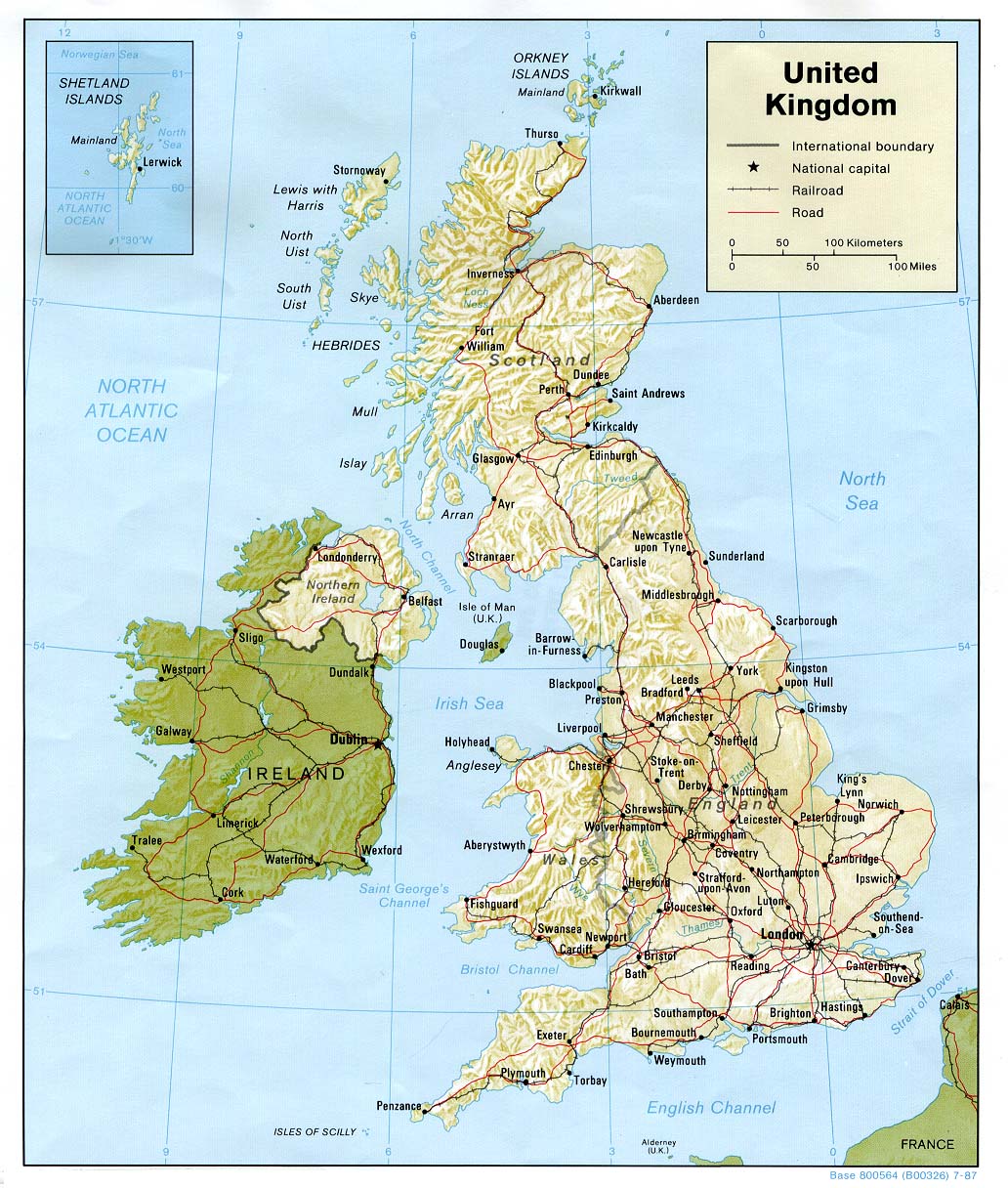

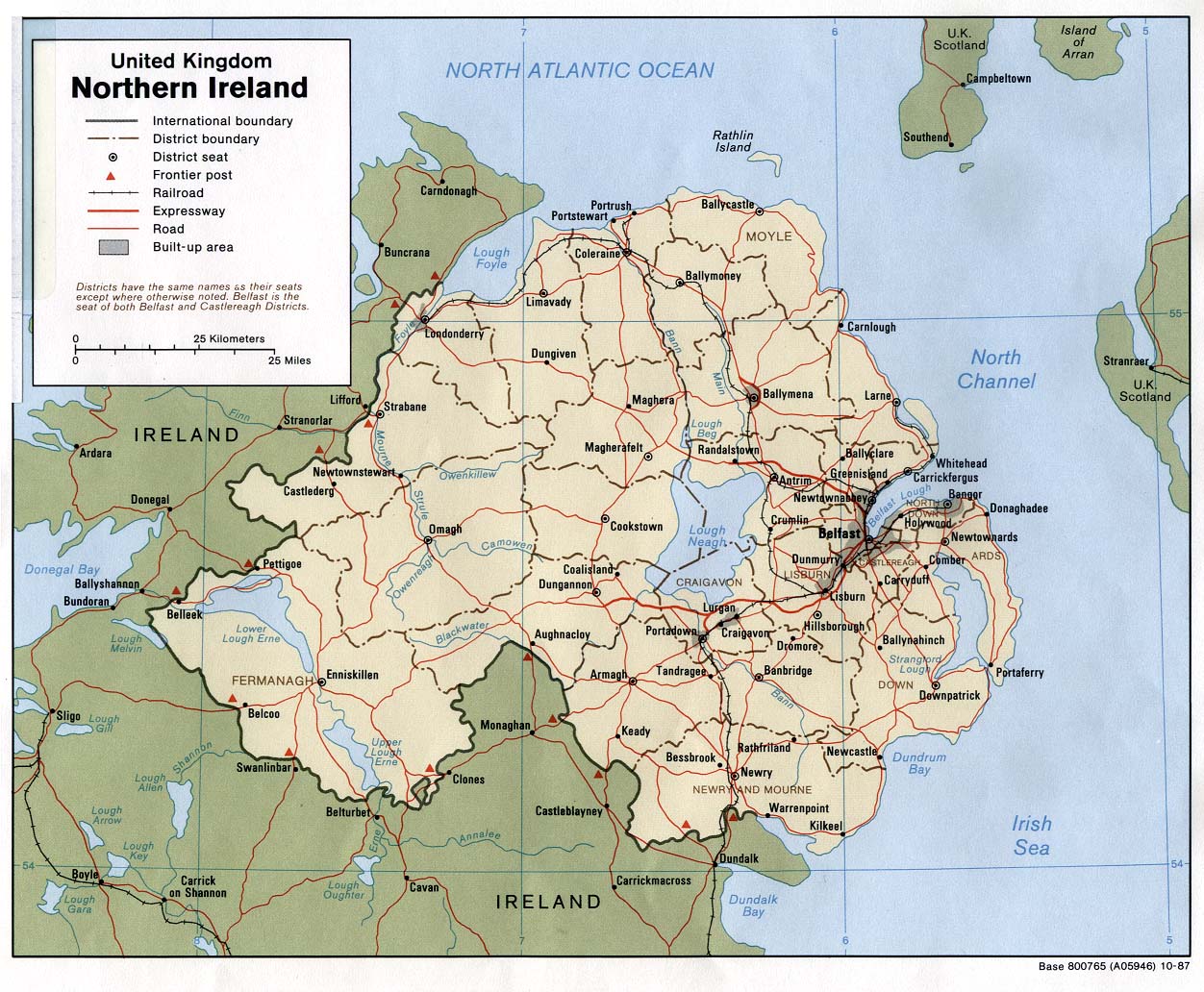


|
|
(Heugh Town) (Tre Huw) |
650 (1651) |
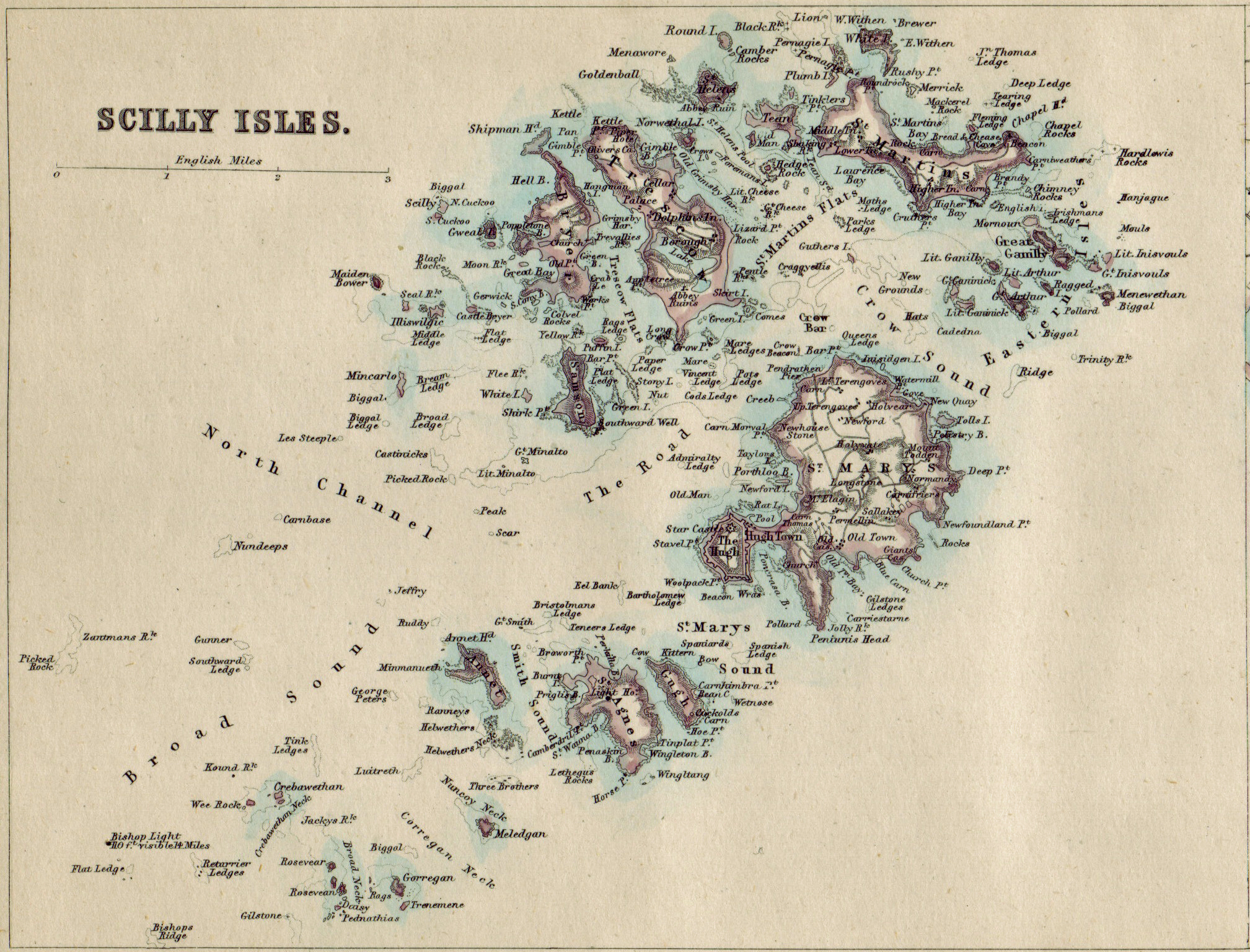
c.938
Isles of Scilly (known as Silina, Syllingar, Sillan,
Sullie, Sully,
Scilley) part of the Kingdom of
England (St. Martin's, St. Mary's,
Tresco,
St. Agnes, and Bryher Islands [uninhabited:
Annet, Eastern
Isles,
Norrad Rocks, Northwethel, St. Helen's, Samson, Teän,
and
Western
Rocks]), as part of Earldom (1068-1337) of Cornwall.
1114 - 20 Mar 1538
Granted to the Abbey of
Tavistock in "mortmain" under the Dukes
of Cornwall.
1180
The Bishop of Exeter confirmed a grant by Richard de
Wicha.
17 Mar
1337
Part of the Duchy of Cornwall established for the
Black Prince.
20 Mar 1538
Re-united to the
Crown, part of the Duchy of Cornwall.
1547
Thomas, Baron Seymour, the Lord High Admiral, became
proprietor of
the Scilly islands.
20 Mar
1549
Baron Seymour beheaded and attainted, temporal
property of the
Scilly islands reverted to the Crown.
14 Dec 1570
Leased by the Crown to
the Godolphin family (renewed 10 Aug 1603,
20 Jun
1636; interrupted during civil war Sep 1646-Jun 1660).
1642 - 25 Aug 1646
Royalist forces hold the islands (Prince
Charles in Scilly
Mar -
Apr 1646).
25 Aug 1646 - Sep 1648 Occupied by
Parliamentarian forces.
Sep 1648 - 3 Jun 1651
Garrisoned by Royalist forces. Charles, Prince of
Wales names
Sir
John Grenville governor by commission of 13 Dec
1648.
3 Jun 1651 - 30 Jun 1660 Garrisoned
by Parliamentarian forces (taking
Northwethel and Teän
on 17 Apr 1651, New Grimsby 2 May 1651, and St.
Mary's on 3 Jun
1651), part of Commonwealth of England (to 8 May
1660).
30 Jun 1660
Lease re-confirmed
to the Godolphin family by
the King Charles II.
25 May 1785 - 3 Nov 1831
Lease passes to the Osborne family, by the extinction of
the male
line of
the Godolphin family.
3 Nov 1831 - 10 Oct 1834 Lease is not
renewed and reverts to the Crown. Administered by the
Duchy of
Cornwall directly.
10 Oct
1834
Leased to Augustus John Smith (and later his heirs).
4 Aug 1890
Isles of Scilly Rural District Council formed as a sui
generis
local
government authority, outside the administrative County
of
Cornwall
(by the Local Government Act 1888).
1920
Dorrien-Smith
surrendered the lease of all inhabited islands,
except Tresco, back to the Crown and the Duchy of
Cornwall. In
1922, they take out new lease solely for Tresco.
28 Mar
1930
Rural District Council granted the
"powers, duties and liabilities"
of a
county council (by the Isles of Scilly Order 1930).
1 Apr
1974
Isles of Scilly Rural District Council renamed Council
of the
Isles of Scilly.
Captains of the Isles of Scilly
1547 - 20 Mar 1549
Thomas Seymour, Baron Seymour (b.
1508? - d. 1549)
of Sudeley
1549 - 1557?
Sir William Godolphin
(b. c.1486 – d. 1570)
1557? - 30 Jul 1570
Sir Thomas Godolphin
(b. 1520
- d. 1570)
Governors of Scilly
14 Dec 1570 - 4 Apr 1608 Francis
Godolphin
(b. c.1534 - d. 1608)
(from 20 Nov 1580, Sir Francis Godolphin)
4 Apr 1608 - 5 Sep 1613 Sir
William
Godolphin
(b. 1567 - d. 1613)
5 Sep 1613 -
1626
William Godolphin
(b. 1611 - d.
1636)
1626 - 1640
Sir Francis Godolphin
(b. c.1578 - d. 1640)
(administrator 20 Nov 1619 - 1626)
Mar 1640 - 25 Aug 1646
Sir Francis Godolphin (1st time) (b. 1605 - d.
1667)
12 Mar 1647 - Sep 1648 Anthony Buller
(parliament) (b.
1613 – d. 1679)
(acting to 29 Jun 1647)
Nov 1648 - 3 Jun 1651 Sir
John Grenville (royalist) (b. 1643 - d.
1701)
(acting to 13 Dec 1648)
Jul 1651 - 1660
Joseph Hunkin (Hunkyn)(parliament)(b.
1610 - d. 1661)
30 Jun 1660 - 22 Mar 1667 Francis Godolphin
(2nd time) (s.a.)
(from 23 Apr 1661, Sir Francis Godolphin)
2 Apr 1667 - 8 Nov 1682 Sir
William
Godolphin
(b. 1659 - d. 1682)
2 Dec 1682 - 14 Mar 1697 Francis
Godolphin
(b. 1661? - d. 1697)
2 Apr 1697 - Apr 1700 Sidney
Godolphin
(b. 1645 - d. 1712)
(from
8 Sep 1684, Sidney Godolphin,
Viscount of Rialton, Baron
Godolphin of Rialton)
Apr 1700 - 23 Sep 1732 Sidney
Godolphin, Baron Godolphin
(b. 1652 - d. 1732)
(from 29 Dec 1706, Francis Godolphin,
Viscount of Rialton, Earl of Godolphin)
1733 - 7 Jul 1733
majr. George Bennet
7 Jul 1733 - 17 Jan 1766 Francis Godolphin,
Earl of (b. 1678 - d. 1766)
Godolphin (from 23 Jan 1735,
Francis Godolphin,
Baron Godolphin
of Helston)
18 Apr 1766 - 25 May 1785 Francis
Godolphin, Baron Godolphin(b. 1706 - d. 1785)
25 May 1785 - 31 Jan 1799 Francis Godolphin
Osborne, (b.
1751 - d. 1799)
Marquess of Carmarthen
(from 23 Mar 1789, Duke of Leeds)
31 Jan 1799 - 3 Nov 1831 George
William Frederick Osborne, (b. 1775 - d. 1838)
Duke of Leeds, Baron Conyers,
Baron Darcy de Knayth
3 Nov 1831 - 10 Oct 1834 reversion to
the Crown
Governors of the Isles of Scilly
(self-styled Lord Proprietor of the Isles of Scilly and
Tenants)
10 Oct 1834 - 31 Jul 1872 Augustus John
Smith
(b. 1804 - d. 1872)
31 Jul 1872 - 6 Aug 1918 Thomas
Algernon Smith-Dorrien (b. 1846 -
d. 1918)
(from 2 Oct 1874, Thomas
Algernon Smith-Dorrien-Smith)
6 Aug 1918 -
1920
Arthur Algernon Dorrien-Smith
(b. 1876 - d. 1955)
Garrison Commanders
12 Sep 1646 - 12 Mar 1647 Sir George Ayscue (Askew)
(b. c.1616 - d. 1672)
(parliament)
12 Mar 1647 - Sep 1648 Anthony
Buller (parliament)
(s.a.)
Nov 1648 - 3 Jun
1651 Sir John Grenville
(royalist) (s.a.)
3 Jun 1651 - Jul 1651
Robert Blake (parliament)
(b. 1598 - d. 1657)
Jul 1651 - 1660
Joseph Hunkin (Hunkyn)(parliament)(s.a.)
Lieutenant governor of the Scilly Isles
1 Apr 1819 - 2 Nov 1838 John Nugent
Smyth
(b. 1773 - d. 1838)
© Ben Cahoon