| World Statesmen.org HOME > |
Germany
|
||||||||||||||||||||||||||||||||||||||||||||||||
![[flag
of the Holy Roman Emperor
1402-1806]](de_ro438.gif "[flag of the Holy
Roman Emperor 1402-1806]")
![[Germany 1871-1921, N. Ger.
Confed. 1867-1870]](de1871.gif "[Germany
1871-1921, N. Ger. Confed.
1867-1870]")
![[Germany,
1848-1852, 1919-1933]](de.gif "[Germany, 1848-1852,
1919-1933]")
![[Third
Reich 1933-1945 (Germany)]](de-1933.gif "[Third Reich 1933-1945
(Germany)]")
![[Allied Occupation of Germany
(C-Ensign) 1945-1950]](de-1945.gif "[Allied Occupation of Germany
(C-Ensign) 1945-1950]")
|
|
![[Emperor's
Banner 962-1402 (Holy Roman Empire, Germany)]](de_sacr1.gif "[Emperor's Banner 962-1402 (Holy Roman
Empire, Germany)]")
| Map the Holy Roman Empire in 1789 |
National
Anthem "Die Kaiserhymne" (The Emperor's Hymn) (12 Feb 1797-1806) |
Currency:
Reichsthaler (XDRT) (1566-1754); German Convention Thaler (XDCT) (1754-1806) (some states of the Empire had their own currencies) |
Constitution The Golden Bull 1356 (25 Dec 1356) Treaty of Westphalia (24 Oct 1648) Final Imperial Recess (25 Feb 1803; in German) |
| Capital: officially none; Seat of Imperial Diet: Regensburg (1594-1806); Seat of Imperial Chancellery: Vienna (1559-1806) |
Ethnic groups: German 79%, Slavic (Czech, Slovene, Polish) 15%, French 4%, Italian 1%, Jewish and other 1% (1792) | Religions: Roman Catholic 59%, Lutheran 34%, Calvinist 6%, Jewish and other 1% (1792) | Population: 28,185,000 (1792); 12,000,000 (1648 est.) ----------------------------------- Military: Reichsarmee (Army of the Empire) 44,000 (1795) (states including Austria, had their own military) |
- 25 Dec 800 Roman Empire¹ ("Reich")(originally simply Imperium; from
-
1034, Romanum Imperium), the
king of the Franks crowned as
the Emperor.
- 11 Aug 843
Empire divided into kingdoms, including
the Kingdom of the
East Franks (Regnum Francorum Orientalium).
2 Feb 962 King of the East Franks crowned as the Roman Emperor (this
provision continues during existence of the Empire), having
acquired the Kingdom of Italy in Dec 961, and eventually in
1041, restyling himself as the 'Roman King.'
6 Sep 1032 Kingdom of Burgundy/Arles is inherited by the King/Emperor.
1254 First use of designation Holy Roman Empire (Sacrum Romanum Imperium, -
and from 1340 in German: Heiliges
Römisches Reich)(name
confirmed by the Golden Bull of 25 Dec 1356).
25 Dec 1356 The Golden Bull confirms that the King is to be elected by 7 prince- - electors (by 1806 their number had increased to 10), four of them
- theoretically representing the 4 original Germanic tribal duchies
-
and three Archchancellors.
1500 Italy omitted from the structure and the constitutional order
of the Empire by the Imperial Reforms.
1512 Informal suffix "of the German Nation" prescribed by the Imperial
Diet (Holy Roman Empire of the German Nation [in German:
Heiliges Römisches Reich Deutscher Nation]; in Latin: Sacrum
-
Imperium Romanum Nationis Germanicae), it
follows the 1508
restyling of the Roman King as the King in Germany.
8 Feb 1649 Peace of Westphalia treaties go into effect; rulers of states
of the Empire, while remaining vassals of the Emperor, are
recognized having limited sovereignty (Landeshoheit) and rights
to enter into foreign treaties that are not against the Empire.
25 Feb 1803 Final Imperial Recess refers to the Empire only as the German
Empire (Deutsches Reich)(as does the 1806 dissolution).
- 6 Aug 1806 Empire dissolved by the Emperor.
Emperors
25 Dec 800 - 28 Jan 814 Karl I "der
Grosse" (Charlemagne) (b. 742 - d. 814)
813 - 20 Jun 840
Ludwig I "der Fromme"
(b. 778 - d. 840)
(co-ruler to 28 Jan 814)
5 Apr 823 - 29 Sep 855 Lothar I
(Lothair)
(b. 795 - d. 855)
(co-ruler to 20 Jun 840)
29 Sep 855 - 28 Aug 875
Ludwig II "der Deutsche"
(b. 825 - d. 875)
(King
of the East Franks)
28 Aug 875 -
6 Oct 877 Karl II "der Kahle"
(b. c.823 - d.
877)
28 Aug 876 - 22 Mar 880 Karlman
(Carloman)
(b. c.830 - d. 880)
(King
of the East Franks)
28 Aug 876 - 20 Jan
882 Ludwig III "der Jüngere"
(b. c.835 - d. 882)
(King
of the East Franks)
12 Feb 881
- 13 Jan 888 Karl III
(b. 839 - d. 888)
(also King
of the West Franks to 20
Jan 882)
13 Jan 888 - 21 Feb 891 interregnum
21 Feb 891 - 12 Dec 894
Guy
(d. 894)
30 Apr 892 - 15 Oct 898 Lambert
(b. c.875 - d. 898)
(co-rulers to 12 Dec 894; in opposition from 22 Feb 896)
22 Feb 896 - 8 Dec 899 Arnolf
(Arnulf)
(b. c.850 - d. 899)
(from 30 Nov 887, King of East Franks)
8 Dec 899 - 4 Feb 900 Hatto,
Erzbischof von
Mainz (b.
c.850 - d. 913)
-Imperial chancellor (1st
time)
4 Feb 900 - 24 Sep 911
Ludwig III "das Kind"
(b. c.893 - d. 911)
(also King
of the East Franks)
4 Sep 900 - 24 Sep
911 Hatto, Erzbischof von Mainz -Regent(s.a.)
24 Sep 911 - 10 Nov 911 Hatto, Erzbischof
von Mainz (s.a.)
-Imperial
chancellor (2nd time)
10 Nov 911 - 23 Dec 918 Konrad I "der
Jüngere" -King (b.
c.881 - d. 918)
(also King of the
East Franks)
23 Dec 918 - 12 May 919 Heriger,
Erzbischof von
(d. 927)
Mainz -Imperial chancellor
12 May 919 - 2 Jul 936 Heinrich I
"der Vogler" -King
(b. c.876 - d. 936)
(also King
of the East Franks)
2 Jul 936 - 7 Aug 936
Hildebert, Erzbischof von Mainz
7 Aug 936 - 7 May 973 Otto
I "der
Grosse"
(b. 912 - d. 973)
(King of the East Franks to 2 Feb 962)
9 May 973 - 7 Dec 983 Otto II
"der Rote"
(b. 955 - d. 983)
(king to 26 May 961)
7 Dec 983 - 25 Dec 983
Willigis, Erzbischof von Mainz
(b. c.940 - d. 1011)
-Imperial chancellor (1st time)
25 Dec 983 - 24 Jan 1002 Otto III
(b. 980 - d. 1002)
(king to
21 May 996)
25 Dec 983 - 15 Jun 990 Theophanu
(Theofáneia) (f) -Regent (b. c.955 - d. 990)
15 Jun 1990 - 6 Jul 994 Adelheid von
Burgund (f) -Regent (b. 931 - d. 999)
24 Jan 1002 - 7 Jun 1002 Willigis,
Erzbischof von Mainz (s.a.)
-Imperial chancellor (2nd time)
7 Jun 1002 - 13 Jul 1024 Heinrich II "der
Heilige" (b. 973
- d. 1024)
(king to 14 Feb 1014)
8 Sep 1024 - 4 Jun 1039 Konrad II
(b. c.990 - d. 1039)
(king to 26 Mar 1027)
4 Jun 1039 - 5 Oct 1056 Heinrich III
(b. 1016 - d. 1056)
(king from 14 Apr 1028, Emperor from 25 Dec 1046)
5 Oct 1056 - 31 Dec 1105 Heinrich
IV
(b. 1050 - d. 1106)
(king from Nov 1053)
15 Mar 1077 - 15 Oct 1080 Rudolf von Rheinfelden -King
(b. c.1025 - d. 1080)
(in opposition)
26 Dec 1081 - 29 Sep 1088 Hermann von Salm -King
(b. c.1035
- d. 1088)
(in opposition)
30 May 1087 - 1 Apr 1098 Konrad (III) -King
(in opposition) (b. 1074 - d. 1101)
6 Jan 1106 - 23 May 1125 Heinrich V
(b. 1085 - d. 1125)
(co-King from 1099 - 31 Dec 1105)
23 May 1125 - 30 Aug 1125 Adalbert, Erzbischof
von (b. c.1075 -
d. 1137)
Mainz -Imperial chancellor
30 Aug 1125 - 3 Dec 1137 Lothar (Lothair) II
(III) (b. 1075 - d.
1137)
(King to 4 Jun 1133)
3 Dec 1137 - 7 Mar 1138 Imperial
Vicars
- Albero von Montreuil, Erzbischof (b c.1080 - d. 1152)
von Trier (to 1 Feb 1138)
- Arnold,
Erzbischof von Köln (b. c.110 - d.
1151)
(from 1
Feb 1138)
7 Mar 1138 - 15 Feb 1152 Konrad III -King
(b. 1093? - d. 1152)
30 Mar 1147 - 30 Apr 1150 Heinrich (VI) Berengar -co-King
(b. 1136? - d. 1150)
Jun 1147 - May
1149 Imperial
governors (for Heinrich)
- Wibald, Abt zu Stablo-Malmedy (b.
c.1098 - d. 1158)
- Heinrich von Wiesenbach
15 Feb 1152 - 9 Mar 1152 Heinrich
von Harburg,
Erzbischof (b.
c.1080 - d. 1153)
von Mainz
-Imperial chancellor
9 Mar 1152 - 10 Jun 1190 Friedrich
I "Barbarossa"
(b. 1122 - d. 1190)
(king to 8 Jun 1155)
14 Apr 1191 - 28 Sep 1197 Heinrich VI
(b. 1165 - d. 1197)
(co-King from 15 Aug 1169)
28 Sep 1197 - 8 Mar 1198 Konrad von
Wittelsbach, Erzbischof (b.
c.1120 - d. 1200)
von Mainz -Imperial
chancellor
8 Mar 1198 - 21 Jun 1208 Philipp -King
(b. 1177 - d. 1208)
(coronation 8 Sep 1198)
21 Jun 1208 - 11 Nov 1208
Siegfried von Eppstein, Erzbischof (b. c.1149 - d.
1249)
von Mainz -Imperial
chancellor
11 Nov 1208 - 19 May 1218
Otto IV
(b. 1175
- d. 1218)
(rival king 8 Jun 1198 - 11 Nov 1208, Emperor from 21
Oct 1209)
22 Nov 1220 - 13 Dec 1250 Friedrich II
(b. 1194 - d. 1250)
(King to 12 Nov 1220)
6 Apr 1220
- 4 Jul 1235 Heinrich (VII) -co-King
(b. 1211 - d. 1242)
(elected 6 Apr 1220, coronation 8
May 1222;
in rebellion Sep 1234 - 2 Jul 1235)
6
Apr 1220 - 25
Dec 1228
Imperial governors
(for Heinrich)
- Engelbert, Erzbischof von Köln (b. 1185? -
d. 1225)
(to 7 Nov 1225)
- Ludwig I, Herzog von Bayern und (b. 1173 - d.
1231)
Pfalzgraf bei Rhein
(Jul 1226 - 25 Dec 1228)
4 Jul 1235 - 1245
Imperial
governors (for Konrad IV)
- Siegfried, Erzbischof von Mainz (to 1241)
- Heinrich Raspe (1242-1245)
(b. 1204 - d. 1247)
- Wenzel I, König von Böhmen
(b. 1205 - d. 1253)
(1242-1245)
22 May 1246 - 16 Feb 1247 Heinrich Raspe -King
(s.a.)
(rival King to Friedrich
II)
3 Oct 1247 - 28 Jan 1256 Wilhelm von
Holland -King
(b. 1227 - d. 1256)
(rival King to Friedrich II and Konrad
IV to 21 May 1254)
13 Dec 1250 - 21 May 1254 Konrad IV -King
(b. 1228 - d. 1254)
(elected King May 1237)
Jun 1251 - 29 Nov 1253 Imperial
governor (for Konrad IV)
- Otto II Herzog von
Bayern (b. 1206 - d. 1253)
28 Jan 1256 - 13 Jan 1257 Gerhard Wildgraf von
Dhaun
(d. 1259)
und
Kyrburg, Erzbischof
von
Mainz
-Imperial chancellor
13 Jan 1257 - 4 Apr 1272 Richard von
Cornwall -King
(b. 1209 - d. 1272)
(coronation 27 May 1257)
1 Apr 1257 - 22 Oct 1275 Alfons (rival
claimant)
(b. 1221 - d. 1284)
4 Apr 1272 - 29 Sep 1273 Werner von Eppstein,
Erzbischof (b.
c.1225 - d. 1284)
von
Mainz -Imperial
Chancellor
29
Sep 1273 - 15 Jul 1291 Rudolf I -King
(b. 1218 - d. 1291)
15 Jul 1291 - 5 May 1292 Gerhard
von Eppstein,
Erzbischof (b.
c.1230 - d. 1305)
von Mainz -Imperial
Chancellor
(1st
time)
5 May 1292 - 23 Jun 1298 Adolf -King
(b. c.1255 - d. 1298)
24 Jun 1298 - 27 Jul 1298 Gerhard von Eppstein,
Erzbischof (s.a.)
von Mainz -Imperial
Chancellor
(2nd
time)
27 Jul
1298 - 1 May 1308 Albrecht I -King
(b. 1255 - d. 1308)
24 Aug 1313 - 20 Oct 1314 Peter von
Aspelt, Erzbischof von (b.
c.1245 - d. 1320)
Mainz
-Imperial Chancellor
(1st time)
27 Feb 1308 - 24 Oct 1313 Heinrich VII
(b. c.1275 - d. 1313)
(coronation 6 Jan 1309, Emperor from 29 Jun 1312)
24 Aug 1313 - 20 Oct 1314 Peter von Aspelt,
Erzbischof von (s.a.)
Mainz
-Imperial Chancellor
(2nd time)
20 Oct 1314 - 11 Oct 1347 Ludwig IV
(b. 1282 - d. 1347)
(coronation 25 Nov 1314; Emperor from
17 Jan 1328)
19 Oct 1314 - 23 Sep 1322 Friedrich (III)
(b. c.1289 - d. 1330)
(in opposition, then jointly 5 Sep 1325 - 13 Jan 1330)
21 Nov 1346 - 29 Nov 1378 Karl IV
(b. 1316 - d. 1378)
(in opposition to 11 Oct 1347; Emperor from 6 Jan 1355)
30 Jan 1349 - 24 May 1349 Günther von
Schwarzburg (b.
1304 - d. 1349)
(in
opposition)
29 Nov 1378 - 20 Aug 1400 Wenzel (Wenceslas)
(b. 1361 - d. 1419)
(elected king
10 Jun 1376)
21 Aug 1400 - 18 May 1410 Ruprecht -King
(b. 1352 - d. 1410)
(coronation 6
Jan 1401)
18 May 1410 - 1 Oct 1410 Imperial
vicars
- Ludwig III (1st time)
(b. 1378 - d. 1436)
(count palatine of the Rhine)
- Rudolf III (1st time)
(b. c.1378 - d. 1419)
(count palatine of Saxony, duke of
Saxony)
1 Oct 1410 - 18 Jan
1411 Jobst
(b. c.1234 - d. 1411)
(elected 1 Oct 1410)
18 Jan 1411 - 8 Nov 1411
Imperial vicars
- Ludwig III (2nd time)
(s.a.)
(count palatine of the Rhine)
- Rudolf III (2nd time)
(b. c.1378 - d. 1419)
(count palatine of Saxony, duke of
Saxony)
8 Nov 1411 - 9 Dec
1437 Sigismund
(b. 1368 - d. 1437)
(elected
king 21 Jul 1411; Emperor from 31 May 1433)
9 Dec 1437 - 18 Mar 1438
Imperial vicars
- Ludwig IV (1st time)
(b. 1424 - d. 1449)
(count palatine of the Rhine)
- Friedrich II (1st time)
(b. 1412 - d.
1464)
(count palatine of Saxony, duke of
Saxony)
18 Mar 1438 - 27 Oct 1439 Albrecht II -King-elect
(b. 1397 -
d. 1438)
27 Oct 1439 - 2 Feb 1440 Imperial
vicars
- Ludwig IV (2nd time)
(s.a.)
(count palatine of the Rhine)
- Friedrich II (2nd time)
(s.a.)
(count palatine of Saxony, duke of
Saxony)
2 Feb 1440 - 19 Aug 1493 Friedrich
III
(b. 1415 - d. 1493)
(elected 2 Feb 1440, crowned 19 March 1452)
Emperors-elect¹
19 Aug 1493 - 12 Jan 1519 Maximilian I
(b. 1459 - d. 1519)
(elected 16 Feb 1486)
12 Jan 1519 - 17 Jun 1519 Imperial
vicars
- Ludwig V
(b. 1478 - d. 1544)
(count palatine of the Rhine)
- Friedrich III
(b. 1463 - d. 1525)
(count palatine of Saxony, duke of Saxony)
28 Jun 1519 - 26
Aug 1556 Karl V
(b. 1500 - d. 1558)
(coronation 24 Feb 1530)
26 Feb 1558 - 25 Jul 1564 Ferdinand
II
(b. 1503 - d. 1564)
(elected 5 Jan 1531)
25 Jul 1564 - 12 Oct 1576 Maximilian II
(b. 1527 - d. 1576)
(elected
28 Nov 1562)
2 Nov 1576 - 20 Jan 1612 Rudolf
II
(b. 1552 - d. 1612)
(elected 27 Oct 1575)
20 Jan 1612 - 13 Jun 1612 Imperial
vicars
- Friedrich V (1st time)
(b. 1596 - d. 1632)
(count palatine of the Rhine)
- Johann Georg I (1st time)
(b. 1585 - d. 1656)
(count palatine of Saxony, duke of Saxony)
24 Jun 1612 - 20 Mar 1619 Matthias
II
(b. 1557 - d. 1619)
(elected 13 Jun 1612)
20 Mar 1619 - 28 Aug 1619 Imperial
vicars
- Friedrich V (2nd time)
(s.a.)
(count palatine of the Rhine)
- Johann Georg I (2nd time)
(s.a.)
(count palatine of Saxony, duke of Saxony)
28 Aug 1619 - 15 Feb 1637 Ferdinand
III
(b. 1578 - d. 1637)
15 Feb 1637 - 2 Apr 1657 Ferdinand
IV
(b. 1608 - d. 1657)
(elected 22 Dec 1636)
2 Apr 1657 - 18 Jul 1658 Imperial
vicars
- Karl I Ludwig
(b. 1617 - d.
1680)
(count palatine of the Rhine;
in dispute with Ferdinand Maria)
- Ferdinand Maria (duke of Bavaria)(b.
1636 - d. 1679)
(in
dispute with Karl I Ludwig)
- Johann Georg II
(b. 1613 - d. 1680)
(count palatine of Saxony, duke of Saxony)
1 Aug 1658 - 5 May 1705
Leopold
I
(b. 1640 - d. 1705)
(elected 18 Jul 1658)
5 May 1705 - 17 Apr 1711 Joseph
I
(b. 1678 - d. 1711)
(elected 23 Jan 1690, crowned 26 Jan 1690)
17 Apr 1711 - 12 Oct 1711 Imperial
vicars
- Johann
Wilhelm
(b. 1658 - d. 1716)
(count palatine of the Rhine)
- Friedrich August I "der Starke" (b. 1670 - d.
1740)
(count palatine of Saxony, duke of Saxony)
22 Dec 1711 - 20 Oct 1740 Karl
VI
(b. 1685 - d. 1740)
(elected 12 Oct 1711)
20 Oct 1740 - 14 Jan 1742 Imperial
vicars
- Karl
Albrecht
(b. 1697 - d. 1745)
(duke of Bavaria)
- Friedrich August II (1st time) (b. 1696 -
d. 1763)
(count palatine of Saxony, duke of Saxony, etc.)
12 Feb 1742 - 20 Jan 1745 Karl
VII
(s.a.)
(Karl Albrecht, duke of Bavaria)
(elected 14 Jan 1742)(in Frankfurt am Main)
20 Jan 1745 - 13 Sep 1745 Imperial
vicars
- Maximilian III
Joseph
(b. 1727 - d. 1777)
(duke of Bavaria)
- Friedrich August II (2nd time) (s.a.)
(count palatine of Saxony, duke of Saxony, etc.)
4 Oct 1745 - 18 Aug 1765 Franz
I
(b. 1708 - d. 1765)
(elected 13 Sep 1745)
18 Aug 1765 - 20 Feb 1790 Joseph
II
(b. 1741 - d. 1790)
(elected 27 Mar 1764, crowned 3 Apr 1764)
20 Feb 1790 - 30 Sep 1790 Imperial
vicars
- Karl IV Philipp
Theodor
(b. 1724 - d. 1799)
(1st time) (count palatine of the Rhine, duke of
Bavaria)
- Friedrich August
III
(b. 1750 - d. 1827)
"der Gerechte" (1st time)
(count palatine of Saxony, duke of Saxony, etc.)
9 Oct 1790 - 1 Mar 1792 Leopold
II
(b. 1747 - d. 1792)
(elected 30 Sep 1790)
1 Mar 1792 - 7 Jul 1792 Imperial
vicars
- Karl IV Philipp
Theodor
(s.a.)
(2nd time) (count palatine of the Rhine, duke of
Bavaria)
- Friedrich August
III
(s.a.)
"der Gerechte" (2nd time)
(count palatine of Saxony, duke of Saxony, etc.)
14 Jul 1792 - 6 Aug 1806 Franz
II
(b. 1768 - d. 1835)
(elected 7 Jul 1792)
Archchancellors for Germany²
25 Dec 1356 - 25 Jul 1806 the Archbishops of
Mayence (Mainz)
Archchancellors for Gaul and the Kingdom of Arles
(Burgundy)²
25 Dec 1356 - 27 Apr 1803 the Archbishops of
Trier
Archchancellors for Italy²
25 Dec 1356 - 27 Apr 1803 the Archbishops
of Cologne
Imperial Vice-Chancellors²
[heads of the Imperial Chancellery]
3 Jul 1519 - 1525
Nikolaus Ziegler
1525 - 28 Jun 1531 Balthasar
Merklin Bischof von (b. c.1579
- d. 1531)
Konstanz und Hildesheim
Jul 1531 - Jun 1541 Matthias
Held von Arle
(b. 1496 - d. 1564)
Jun 1541 - 20 Feb 1547 Johann von Naves
(b. c.1500 - d. 1547)
(= Jean Naves de Messancy)
1547 - 28 Dec 1558
Jakob von Jonas
(b. c.1500 - d. 1558)
28 Dec 1558 - Dec 1563 Georg
Sigismund
Seld
(b. 1516 - d. 1565)
Aug 1564 - 27 Apr 1570 Johann Ulrich
Zasius von Rabenstein(b. 1521 - d. 1570)
1570 -
1577
Johannes Baptist Weber
(b. 1526 - d. 1584)
23 Apr 1577 - 23 Apr 1587 Siegmund Viehäuser
(b. c.1545 - d. 1587)
1587 - 11 Mar 1594
Jacob Kurz Freiherr von Senftenau (b. 1553 - d.
1594)
1594 - Sep 1597
Johann Wolf Freymann von Oberhausen(b. 1546 - d. 1610)
Sep 1597 - 24 Nov 1606 Rudolf Coradutz
(d. c.1618)
Nov 1607 - 1612
Leopold Freiherr von Stralendorf (b. c.1545
- d. 1626)
29 Sep 1612 - 16 Jul 1627 Hans Ludwig von
Ulm
(b. 1567 - d.
1627)
(from 20 Sep 1622, Hans Ludwig Freiherr von Ulm zu
Erbach)
25 Sep 1627 - 19 Oct 1637 Peter Heinrich von
Stralendorf, (b. 1580 - d. 1637)
Freiherr von Goldrebe
1637 - 24 Mar
1659
Ferdinand Sigismund Kurtz, Graf (b. 1592 -
d. 1659)
von
Senftenau
28 Apr 1660 - 30 Jun 1669 Wilderich Freiherr von
Walderdorff (b. 1617 - d. 1680)
11 Jul 1669 - 5 Feb 1694 Leopold Wilhelm
Graf von Königsegg-
Rothenfels
(b. 1630 - d.
1694)
10 Feb 1694 - 25 Dec 1695 Gottlieb Amadeus Graf
von Windisch-
Graetz
(b. 1630
- d. 1695)
1696 - 11 Jan
1705
Dominik Andreas Graf von Kaunitz (b. 1654 -
d. 1705)
13 Feb 1705 - May 1734 Friedrich Karl
Graf von Schönborn- (b. 1674 - d. 1746)
Buchheim (from 30 Jan 1729, Fürstbischof
zu Bamberg [from 18 May 1729] und zu
Würzburg)
20 Aug 1734 - 28 Nov 1740 Johann Adolf Graf von
Metsch (b. 1672 - d. 1740)
21 May 1737 - 1742 Rudolph
Joseph Graf von Colloredo- (b. 1706 - d. 1788)
Waldsee (1st time)(substitute to 1740)
1742 - 1745
Johann Georg Graf von Königsfeld (b.
1679 - d. 1750)
(in Frankfurt am Main)
22 Sep 1745 - 1 Nov 1788 Rudolph Joseph Graf
von Colloredo- (s.a.)
Waldsee (from 29 Dec 1763, Rudolph Joseph
Reichsfürst von Colloredo-Waldsee)
(2nd time)
24 Dec 1788 - 6 Aug 1806 Franz de Paula
Gundaker Fürst von (b. 1731 - d. 1807)
Colloredo-Waldsee
¹Constitutionally the entity dealt
here is the Reich ruled by the
king elected by the electors (Kurfürsten)
and crowned king. (It is a matter of dispute whether the
king acquires his ruling authority with the election or
only with the coronation; both dates are given in the
following record.) In theory, his title is just King (König)
without territorial appendage. By the time period of the
16th century, it was understood that the king had
acquired the dignity and notional authority of a Roman
emperor (see below), and the scope of his authority as
such was styled the Holy Roman Empire (Heiliges
Römisches Reich - Sacrum
Romanum Imperium); the addition "of the
German Nation" (deutscher Nation
- nationis germanicae) comes
into official use in the 15th century (e.g., Act of the
Imperial Diet [Reichsschluss]
of 1486); its meaning has been the subject of
considerable dispute since the 17th century. In the time
period covered, the imperial authority extended de facto
(except for some vestigial remnants, such as the
chartering of notaries-public throughout Western Europe)
only to the (German) Reich,
and official use made no distinctions.
Upon his election (and
coronation) the person acquired the style of king,
whether during the lifetime of the ruler or after an
interregnum. Theoretically, he was king just as much as
an existing ruler, but this was just theory. In honor of
the imperial status of the ruler, the elected and
crowned king, if not yet emperor-elect (see above), was
styled, not just King or German King, but Roman King (Römischer
König - Rex Romanorum, literally "king of
the Romans").
With the demise of the imperial
authority, by death or abdication, if a Roman King was
in existence, he took the style of Roman Emperor-Elect,
King in Germany (see above). The imperial coronation by
the pope having been discontinued (except for Karl V 24
Feb 1530), it was decided 4 Feb 1508 to forego the
formal acquisition of the style of Roman Emperor and to
fall back on the theory that an elected German king was
ipso facto Roman emperor-elect and to make this point by
incorporating this concept into the ruler's style.
The full style from 1658 (to
which were, of course, attached the styles belonging to
the states ruled by the emperor-elect, such as Archduke
of Austria) was as follows: Von Gottes
Gnaden erwählter römischer Kaiser, R.I.S.A., König in
Germanien - Divina favente clementia Romanorum
imperator electus et semper augustus, R.I.S.A., rex in
Germania. The initials R.I.S.A.
stood for Romanorum imperator semper
augustus, but were misinterpreted to
stand for Romani imperii semper auctor,
and this misinterpretation had by the period covered
come into official use, being rendered in German as zu
allen Zeiten Mehrer des Reichs ("at all
times increaser of the empire").
Under the provisions of the
Golden Bull of 1356, when there was no king the royal
authority was exercised by two imperial vicars (Reichsvikare
- vicarii imperii), each with a separate
territorial jurisdiction. They were specified to be the
count palatine of the Rhine (Pfalzgraf bei
Rhein) and the count palatine of Saxony (Pfalzgraf
von Sachsen). By the time period covered,
the count palatine of Saxony was the duke of Saxony,
elector; and the count palatine of the Rhine was the
elector with that title, until the interregnum of 1657,
when the electorate in question, and with it the county
palatine, were in dispute with Bavaria.
²Due to the Empire losing its
Burgundian and Italian territories, the Archchancellors
for Germany remained the only Imperial Archchancellors (Reichserzkanzler).
Permanent deputies to the Archchancellors, who remained
in Mainz, were appointed from 1520 with title of
Imperial Vice-Chancellor (Reichsvizekanzler) and
a seat in Vienna for directing the Imperial Chancellery
(Reichshofkanzlei) there.
In 1620, the Chancellery became purely an
Imperial institution upon the separation of the Austrian
Chancellery. Absence of the Archchancellor from Vienna
increased the role of the Vice-Chancellor who developed
into an administrator of the day-to-day Imperial
government.
The Confederation of the Rhine
|
| Map
of Confederation of the Rhine 1812 |
Capital: Frankfurt am Main |
Population:
14,609,000 (1811); Military: 119,000 (1811 (total of states military contingents) |
Constitution Rheinbundakt (Treaty of the Confederation of the Rhine)(12 Jul 1806) |
25 Jul
1806
Confederation of the Rhine founded.
Charter members:
- King of Bavaria (left 8 Oct 1813)
- King of Württemberg (left 2 Nov 1813)
- Prince-Primate (formerly archbishop of Mayence) and
Prince
of Regensburg und Aschaffenburg [from 16
Feb 1810 Grand
Duke of Frankfurt]).
- Elector of Baden, becomes a grand duke.
- Duke of Berg and Cleves, becomes a grand duke.
- Landgrave of Hesse-Darmstadt, becomes a grand duke.
- Prince of Nassau-Usingen, senior of these two becomes
a duke.
- Prince of Nassau-Weilburg (to 30 Aug 1806)
- Prince of Hohenzollern-Hechingen
- Prince of Hohenzollern-Sigmaringen
- Prince of Salm-Salm (to 13 Dec 1810)
- Prince of Salm-Kyrburg (to 13 Dec 1810)
- Prince of Isenburg-Birstein
- Duke of Arenberg (to 11 Feb 1811)
- Prince of Liechtenstein
- Count of Leyen in Hohengeroldseck, becomes a prince.
From 25 Sep 1806:
- Grand Duke of Würzburg (left 26 Oct 1813)
From 11 Dec 1806:
- King of Saxony
From 15 Dec 1806:
- Duke of Saxe-Weimar
- Duke of Saxe-Gotha
- Duke of Saxe-Meiningen
- Duke of Saxe-Hildburghausen
- Duke of Saxe-Coburg
From 18 Apr 1807:
- Duke of Anhalt-Dessau
- Duke of Anhalt-Bernburg
- Duke of Anhalt-Köthen
- Prince of Lippe-Detmold
- Prince of Schaumburg-Lippe
- four Princes of Reuss (Reuss-Schleiz-Gera,
Reuss-Greiz, Reuss-Ebersdorf, Reuss-Lobenstein)
- Prince of Schwarzburg-Rudolstadt
- Prince of Schwarzburg-Sondershausen
- Prince of Waldeck
From 15 Nov 1807:
- King of Westphalia
From 10 Feb 1808:
- Duke of Mecklenburg-Strelitz (left 30 Mar 1813)
From 22 Mar 1808:
- Duke of Mecklenburg-Schwerin (left 25 Mar
1813)
From 14 Oct 1808:
- Duke of Oldenburg (to 13 Dec 1810)
19 Oct
1813
Confederation dissolves after the Battle of Leipzig.
4 Nov
1813
Dissolution pronounced by the Allies.
Protector of the Confederation of the Rhine1
25 Jul 1806 - 19 Oct 1813 Napoléon I
(France)
(b. 1769 - d. 1821)
Prince-Primate1
25 Jul 1806 - 19 Oct 1813 Carl
Theodor Anton Maria Freiherr
(b. 1744 - d. 1817)
von und zu Dalberg, Fürst-Primas,
Fürst
von Regensburg und Aschaffenburg
(from 16 Feb 1810, Grossherzog
von Frankfurt)
(Frankfurt)
1titles:
(a) Protecteur de la
Confédération du Rhin/Protector des Rheinischen Bundes
("Protector of the Confederation of the
Rhine");
(b) Prince-Primat
de la Confédération du Rhin/Fürstprimas
des Rheinbundes ("Prince-Primate
of Confederation of the Rhine").
Transitional Central Administration 1813-1814
Note: After the dissolution of the Rhine Confederation, there was no central authority in Germany until the creation of the German Confederation. An attempt to administer the former French satellites and occupied territories in Germany was, however, made, and was headed by a body called the Central Administration Council (Zentralverwaltungsrat).
1 Oct 1813
Central Administrative Council
Germany (Zentralverwaltungsrat
Deutschland/Conseil d'Administration Centrale)
formed by Austria,
Russia, Prussia, Great Britain and Sweden to oversee
the
administration of liberated German territory.
21 Oct 1813 - 15 Jun 1814 Central Administration
Department Germany (in Frankfurt ma Main).
(Zentralverwaltungsdepartement
Deutschland/
Département Central d'Administration Temporaire).
President of the Central Administration
21 Oct 1813 - 15 Jun 1814
Heinrich Friedrich Karl
Freiherr (b. 1757 - d.
1831)
vom und zum Stein (Prussia)
German Reich
|
|
|
|
(Flensburg 2 - 23 May 1945; Plön 1 - 2 May 1945) (Seat of the Diet: Frankfurt am Main 8 Jun 1815 - 24 Aug 1866, & 12 Jul 1848 - 20 Dec 1849) |
|
1933-1945: 1 May (1933) Nationaler Feiertag des Deutschen Volkes (National Holiday of the German People) and 1939-1945: 9 Nov (1923) Gedenktag für die Gefallenen der Bewegung (Memorial Day for the Martyrs of the Movement) ----------------------------------- 1921-1932: 11 Aug (1919) Verfassungstag (Constitution Day) ----------------------------------- 1888-1918: None, Unofficially: 2 Sep (1870) Sedantag (Day of Sedan) |
62,410,619 (1925) 64,925,993 (1910) 45,234,061 (1880) |
|
1815-1866 |
|
1815-1870 (None) |
Constitution (in German) (8 Jun 1815 - 24 Aug 1866) |
|
1871-1914 |
"Heil Dir im Siegerkranz" (Hail to Thee in Victor’s Crown) |
(18 Jan 1871 - 11 Aug 1922) (unofficial) |
(16 Apr 1871 - 14 Aug 1919) |
|
|
"Deutschlandlied" (Song of Germany) |
(11 Aug 1922 - 5 Jun 1945) |
(14 Aug 1919 - 5 Jun 1945; by-passed from 23 Mar 1933) |
|
|
National Anthem "Horst-Wessel-Lied" (Host Wessel Song) |
(19 May 1933 - 23 May 1945) |
(15 Sep 1935-May 1945) |
| International Organizations/Treaties 1871-1945: BIS, CED, ICRM, IDC, IHB (1926-1933), ILO, IMO, IOC, ICPC, IPU, ITU, LoN (1926-1933), LORCS, PCA, PCIJ, UIBPIP, UPU | |||
| States to 1918 | States after 1918 |
||
by adoption of the constitution, accepted by most of the member
1 Jul 1867 North German Confederation (Norddeutscher Bund).
1 Jan 1871 German Empire (Deutsches Reich).
10 Nov 1918 Germany a republic (but style Deutsches Reich not abandoned).
23 May 1945 Allied occupation (formally assuming supreme power 5 Jun 1945).
Presidents of the German Confederation
5 Oct 1815 - 24 Aug
1866 the Emperors of Austria
Presidential Envoys to the Federal
Parliament (in Frankfurt am Main)(all
Austrian)
5 Oct 1815 - 16 Dec 1815
Franz Joseph Freiherr von Albini (b. 1748
- d. 1816)
auf Dürrenried
16 Dec 1815 - 24 Feb 1823 Johann Rudolf
Graf von Buol- (b.
1763 - d. 1834)
Schauenstein
24 Feb 1823 - 12 Mar 1848 Joachim
Eduard Freiherr
von (b. 1786
- d. 1866)
Münch-Bellinghausen
12 Mar 1848 - 14 May 1848 Franz Graf
von Colloredo-Wallsee (b. 1799 - d. 1859)
14 May 1848 - 12 Jul 1848 Anton von
Schmerling
(b. 1805 - d. 1893)
1 May 1850 - 1 Nov
1852 Friedrich Graf von Thun-Hohenstein (b. 1810
- d. 1881)
2 Jan 1853 - 12 Oct 1855
Anton Freiherr
Prokesch
(b. 1795 - d. 1876)
12 Oct 1855 - 4 May 1859 Johann
Bernhard Graf von Rechberg (b. 1806 - d.
1899)
und Rothenlöwen
23 May 1859 - 24 Aug 1866 Aloys
Freiherr von
Kübeck
(b. 1819 - d. 1873)
Presidents of the National Constituent Assembly
(in Frankfurt am Main)
18 May 1848 - 19 May 1848 Friedrich
Lang (Hanover)
(b. 1778 - d. 1859)
(president by age)
19 May 1848 - 12 Jul 1848 Heinrich
Wilhelm August Freiherr (b. 1799 - d.
1880) R-Lib
von Gagern (Hesse-Darmstadt)
Provisional Central Authorities of the
German Reich
12 Jul 1848 - 20 Dec 1849 Johann
Erzherzog von Österreich (b. 1782 -
d. 1859)
(Imperial Vicar [Reichsverweser])
6 Jun 1849 - 18 Jun 1849 German
Imperial Regency
(in Stuttgart, in rebellion)
- Peter Franz Joseph
Raveaux (b. 1810 -
d. 1851) Dem
(Baden) (president)
- August Christoph Carl
Vogt (b. 1817 - d.
1895) Dem
(Hesse-Darmstadt)
- August Heinrich
Simon
(b. 1805 - d. 1860) Dem
(Prussia)
- Friedrich Schüler
(Bavaria) (b. 1791 - d.
1873) Dem
- August Heinrich
Becher
(b. 1816 - d. 1890) Dem
(Württemberg)
20 Dec 1849 - 1 May 1850 Provisional
Federal Central Commission
(on behalf of the Emperor of Austria
and the King of Prussia)
- Karl Friedrich Kübeck Freiherr (b. 1780
- d. 1855) Con
von Kübau (Austria)
- Karl Freiherr von Schönhals (b.
1788 - d. 1857) Mil
(Austria)
- Carl Wilhelm von Bötticher
(b. 1791 - d. 1868) Con
(Prussia)
- Joseph Maria von
Radowitz (b.
1797 - d. 1853) Con
(to 31 Mar 1850)(Prussia)
- Eduard von Peucker (Prussia)
(b. 1791 - d. 1876) Mil
(from 19 Jan 1850; acting to 31 Mar 1850)
President of the North German
Confederation4
1 Jul 1867 - 31 Dec 1870
the king of Prussia
Emperors4
18 Jan 1871 - 9 Mar 1888 Wilhelm
I
(b. 1797 - d. 1888)
4 Jun 1878 - 5 Dec 1878 Friedrich
Wilhelm
von
(b. 1831 - d. 1888)
Prussen -Regent
(acting for incapacitated Wilhelm)
9 Mar 1888 - 15 Jun 1888 Friedrich
III
(s.a.)
9 Mar 1888 - 15 Jun
1888 Wilhelm von Preussen -Regent
(b. 1859 - d. 1941)
(acting for incapacitated Friedrich)
15 Jun 1888 - 9 Nov 1918 Wilhelm
II
(s.a.)
(confirmed abdication 28 Nov 1918, Amerongen,
Netherlands)
Chairmen of the Executive Council of the Workers'
and Soldiers'
Councils of Greater Berlin
11 Nov 1918 - 20 Dec 1918 Richard
Müller
(b. 1880 - d. 1943) USPD
+ Hans-Georg von
Beerfelde
(b. 1877 - d. 1960) Mil
(to 12 Nov 1918)
+ Hugo Brutus Hermann Molkenbuhr (b. 1881 - d.
1959) SPD
(from 12 Nov 1918)
Chairmen of the Central Council of the
German Socialist Republic
20 Dec 1918 - 4 Feb 1919 Robert
Leinert
(b. 1873 - d. 1940) SPD
+ Emmanuel "Max"
Cohen-Reuss (b.
1876 - d. 1963) SPD
+ Hermann
Müller
(b. 1876 - d. 1931) SPD
Presidents of the Constituent National
Assembly
6 Feb 1919 -
7 Feb 1919 Wilhelm
Pfannkuch
(b. 1841 - d. 1923) SPD
(president by age)
7 Feb 1919 - 11 Feb
1919 Eduard Heinrich Rudolph
David (b. 1863 - d.
1930) SPD
Presidents
11 Feb 1919 - 28 Feb 1925 Friedrich
Ebert
(b. 1871 - d. 1925) SPD
28 Feb 1925 - 12 Mar 1925 Hans Luther
(acting)
(b. 1879 - d. 1962) Non-party
12 Mar 1925 - 12 May 1925 Walter Simons
(acting)
(b. 1861 - d. 1937) Non-party
12 May 1925 - 2 Aug 1934 Paul Ludwig Hans
Anton
von
(b. 1847 - d. 1934) Non-party
Beneckendorff und von Hindenburg
Führer and Reichs Chancellor4
2 Aug 1934 - 30 Apr 1945 Adolf Hitler
(b. 1889 - d. 1945) NSDAP
President
30 Apr 1945 - 23 May 1945 Karl
Dönitz
(b. 1891 - d. 1980) Mil
Presidents of the Reich Council of Ministers
5 Aug 1848 - 16 Sep 1848 Karl Friedrich
Wilhelm Emich (b.
1804 - d. 1856) Lib-Con
Fürst zu Leiningen (Baden)
(interim from 5 Sep 1848)
16 Sep 1848 - 17 Dec 1848 Anton Ritter von
Schmerling
(b. 1805 - d. 1893) Lib-Con
(Austria) (interim)
17 Dec 1848 - 16 May 1849 Heinrich Wilhelm
August Freiherr
(s.a.)
R-Lib
von Gagern (Hesse-Darmstadt)
(interim from 21 Mar 1849)
16 May 1849 - 3 Jun 1849 Maximilian Carl
Friedrich Wilhelm (b. 1781 - d. 1860) Con
Grävell (Prussia) (interim)
3 Jun 1849 - 20 Dec 1849 August Ludwig
Prinz von Sayn- (b. 1788
- d. 1874) Non-party
Wittgenstein-Berleburg (Prussia)
Federal Chancellor
14 Jul 1867 - 21 Mar 1871 Otto Eduard Leopold
Graf von (b. 1815
- d. 1898) Non-party
Bismarck-Schönhausen (from 21 Mar 1871,
Fürst von Bismarck-Schönhausen)
Reichs Chancellors
21 Mar 1871 - 20 Mar 1890 Otto Eduard Leopold
Fürst von
(s.a.)
Non-party
Bismarck-Schönhausen
20 Mar 1890 - 29 Oct 1894 Georg Leo von Caprivi
de Caprara (b. 1831 - d. 1899)
Non-party
de Montecuculi
(from 18 Dec 1891, Graf von Caprivi de Caprara de
Montecuculi)
29 Oct 1894 - 17 Oct 1900 Chlodwig Carl Victor
Fürst zu (b. 1819 - d.
1901) Non-party
Hohenlohe-Schillingsfürst,
Prinz von Ratibor und Corvey
17 Oct 1900 - 14 Jul 1909 Bernhard Martin
Heinrich Carl von (b. 1849 - d. 1929)
Non-party
Bülow
(from 6 Sep 1905, Fürst von Bülow)
14 Jul 1909 - 13 Jul 1917 Theobald Theodor
Friedrich Alfred (b. 1856 - d. 1921)
Non-party
von Bethmann-Hollweg
14 Jul 1917 - 1 Nov 1917 Georg
Michaelis
(b. 1857 - d. 1936) Non-party
1 Nov 1917 - 3 Oct 1918 Georg
Friedrich Graf von Hertling (b. 1843 - d.
1919) Z
3 Oct 1918 - 9 Nov 1918 Maximilian
Prinz von
Baden
(b. 1867 - d. 1929) Non-party
9 Nov 1918 - 10 Nov 1918 Friedrich
Ebert
(s.a.)
SPD
Chairmen of the Council of the People's Deputies
10 Nov 1918 - 29 Dec 1918 Friedrich Ebert (1st
time)
(s.a.)
SPD
+ Hugo
Haase
(b. 1863 - d. 1919) USPD
30 Dec 1918 - 11 Feb 1919 Friedrich Ebert (2nd
time)
(s.a.)
SPD
+ Philipp Heinrich Scheidemann
(b. 1865 - d. 1939) SPD
Presidents of the Reich Ministry
13 Feb 1919 - 21 Jun 1919 Philipp Heinrich
Scheidemann
(s.a.)
SPD
21 Jun 1919 - 14 Aug 1919 Gustav Adolf
Bauer
(b. 1870 - d. 1944) SPD
Reich Chancellors
14 Aug 1919 - 27 Mar 1920 Gustav Adolf
Bauer
(s.a.)
SPD
13 Mar 1920 - 17 Mar 1920 Wolfgang Kapp (in
rebellion) (b.
1858 - d. 1922) ADV
27 Mar 1920 - 21 Jun 1920 Hermann Müller (1st
time)
(s.a.)
SPD
21 Jun 1920 - 10 May 1921 Konstantin Fehrenbach
(b. 1852 - d. 1926) Z
10 May 1921 - 22 Nov 1922 Joseph Karl
Wirth
(b. 1879 - d. 1956) Z
22 Nov 1922 - 13 Aug 1923 Wilhelm Carl Josef
Cuno
(b. 1876 - d. 1933) Non-party
13 Aug 1923 - 30 Nov 1923 Gustav
Stresemann
(b. 1878 - d. 1929) DVP
30 Nov 1923 - 15 Jan 1925 Wilhelm Marx (1st
time)
(b. 1863 - d. 1946) Z
15 Jan 1925 - 13 May 1926 Hans
Luther
(s.a.)
Non-party
13 May 1926 - 17 May 1926 Otto Karl Gessler
(acting)
(b. 1875 - d. 1955) DDP
17 May 1926 - 29 Jun 1928 Wilhelm Marx (2nd
time)
(s.a.)
Z
29 Jun 1928 - 30 Mar 1930 Hermann Müller (2nd
time)
(s.a.)
SDP
30 Mar 1930 - 1 Jun 1932 Heinrich Aloysius
Maria Elisabeth (b. 1885 - d. 1970) Z
Brüning
1 Jun 1932 - 3 Dec 1932 Franz Joseph
Hermann Michael Maria (b. 1879 - d. 1969) Z
von Papen
3 Dec 1932 - 30 Jan 1933 Kurt Ferdinand
Friedrich Hermann (b. 1882 - d.
1934) Non-party
von Schleicher
30 Jan 1933 - 30 Apr 1945 Adolf
Hitler
(s.a.)
NSDAP
30 Apr 1945 - 1 May 1945 Joseph Paul
Goebbels
(b. 1897 - d. 1945) NSDAP
2 May 1945 - 23 May 1945 Johann Ludwig
"Lutz" Graf Schwerin (b. 1887 - d. 1977)
Non-party
von Krosigk
(chairman [Leitender Minister] of interim
government, at Flensburg)
³According to the Constitution of the North German Confederation, "The Crown of Prussia is entitled to the Presidency of the Confederation" (Präsidium des Bundes). The office does not confer a specific style on the King of Prussia; when exercising it, the style used is "King of Prussia on behalf of the North German Confederation."
4Full official style of the
rulers:
(a) 1 Jul 1867 - 31 Dec 1870: König
von Preussen im Namen des Norddeutschen Bundes
("King of Prussia on behalf of the North German
Confederation");
(b) 18 Jan 1871 - 9 Nov 1918: Von
Gottes Gnaden Deutscher Kaiser und König von Preussen,
Markgraf zu Brandenburg, Burggraf zu Nürnberg, Graf zu
Hohenzollern, souveräner und oberster Herzog von
Schlesien wie auch der Grafschaft Glatz, Grossherzog
vom Niederrhein und Posen, Herzog zu Sachsen,
Westfalen und Engern, zu Pommern, Lüneburg, Holstein
und Schleswig, zu Magdeburg, Bremen, Geldern, Cleve,
Jülich und Berg, sowie auch der Wenden und Kaschuben,
zu Krossen, Lauenburg, Mecklenburg, Landgraf zu Hessen
und Thüringen, Markgraf der Ober- und Niederlausitz,
Prinz von Oranien, Fürst zu Rügen, zu Ostfriesland, zu
Paderborn und Pyrmont, zu Halberstadt, Münster,
Minden, Osnabrück, Hildesheim, zu Verden, Kammin,
Fulda, Nassau und Moers, gefürsteter Graf zu
Henneberg, Graf der Mark und zu Ravensberg, zu
Hohnstein, Tecklenburg und Lingen, zu Mansfeld,
Sigmaringen und Veringen, Herr zu Frankfurt ("By
the Grace of God, German Emperor and King of Prussia,
Margrave of Brandenburg, Burgrave of Nürnberg, Count of
Hohenzollern, Sovereign and Supreme Duke of Silesia as
well as of the County of Glatz, Grand Duke of the Lower
Rhine and of Posen, Duke of Saxony, Wesphalia, and
Angaria, of Pomerania, Lüneburg, Holstein and Schleswig,
of Magdeburg, Bremen, Gelders, Cleves, Jülich and Berg,
as well as of the Wendes and Kaschubs, of Krossen,
Lauenburg, Mecklenburg, Landgrave of Hesse and
Thuringia, Margrave of Upper and Lower Lusatia, Prince
of Orange, Prince of Rügen, of East Frisia, of Paderborn
and Pyrmont, of Halberstadt, Münster, Minden, Osnabrück,
Hildesheim, of Verden, Kammin, Fulda, Nassau and Moers,
Princely Count of Henneberg, Count of the Mark and of
Ravensberg, of Hohnstein, Tecklenburg and Lingen, of
Mansfeld, Sigmaringen and Veringen, Lord of Frankfurt");
(c) 2 Aug 1934 - 30 Apr 1945: in
official use for internal affairs (from 17 May 1939): Der
Führer; ("The Leader"), in official use
for external affairs (from 28 Jul 1942): Der
Führer des Grossdeutschen Reichs ("The
Leader of the Greater German Reich").
Party abbreviations (from 1
Dec 1933, all political parties except NSDAP were
banned): ADV
= Alldeutscher Verband (All-German [or Pan-German]
League, nationalist, imperialist, 9 Apr 1891-13 Mar
1939); DDP = Deutsche
Demokratische Partei (German Democratic Party, liberal
democratic, center-left, 16 Nov 1918-28 Jun
1933); DVP = Deutsche
Volkspartei (German People's Party, national
liberal, moderate nationalist, constitutional
monarchist, 15 Dec 1918-4 Jul 1933, merged into NSDAP);
NSDAP = Nationalsozialistische
Deutsche Arbeiterpartei (National Socialist German
Workers' Party, German nationalist, national
socialist, Nazi fascist, xenophobic, 14
Jul 1933-31 May 1945 only legal party,
24 Nov 1920-10 Oct 1945); SPD =
Sozialdemokratische Partei Deutschlands (Social
Democratic Party of Germany, social-democratic, Marxist
to 1925, 27 May 1875-22 Jun 1933, re-est.Oct
1945); USPD =
Unabhängige Sozialdemokratische Partei Deutschlands
(Independent Social Democratic Party of
Germany, democratic socialist,
centrist Marxist, pacifist, split
from SPD, 6 Apr 1917-1 Nov 1931, merged into
Sozialistische Arbeiterpartei Deutschlands
[Socialist Workers' Party of Germany]); Z
= Deutsche Zentrumspartei
"Zentrum" (German Center Party
"Center", catholic, centrist, christian democratic, 13
Dec 1870-5 Jul 1933); Mil
= Military;
-
Former parties: Con
= Konservative (Conservative, 1848-1918
as Conservative Party [Konservative Partei]); Dem
= Democrat; Lib = Liberalen
(Liberal); Lib-Con = Liberal-Conservative;
R-Lib = Right Liberal
Allied Military Occupation
|
|
|
Zones in Germany |
Commanders of Berlin |
2 May
1945
Soviet forces begin the Allied occupation of Berlin.
8
May
1945
Allies accept the unconditional surrender of
Germany.
23
May
1945
Allied occupation.
5 Jun
1945
Four Allied Powers issue a declaration on
"assumption of supreme
authority with respect
to Germany."
11 Mar
1946
German Economic Council for the British Zone created in
Minden.
1 Jan
1947
German Economic Council for the Anglo-American Zone
("Bizone" or
"Bizonia") formed.
11
Jun
1947
German Economic Commission established in the Soviet
Zone (from 12
Feb 1948 granted legislative power to issue
orders and directives
to all German organs within the Soviet Zone).
25 Jun 1947
Economic Council of the
"Bizone" established in Frankfurt am Main
(re-organized on 9 Feb 1948 as part of the United
Economic Area).
20 Mar
1948
End of four-power administration of Germany, Soviet
representatives
of the Allied Control Commission leave this body in
protest at the
London Six Power Conference (of 23 Feb - 6 Mar 1948 by
U.S.,
U.K., France, Belgium, Netherlands and
Luxembourg).
8 Apr
1949
Trizone ("Trizonia") formed by addition of French zone
to "Bizone."
24 Jun 1948 -
12 May 1949 Berlin Blockade; Soviet Union blocks
the Western Allies railway,
road, and canal access to the Berlin sectors under
Western control.
23 May
1949
American, British, and French zones become Federal
Republic
of Germany ("West" Germany).
21
Sep 1949 - 23 Oct 1954 American, French, and
British form Allied High Commission.
7
Oct
1949
Soviet zone becomes German Democratic Republic ("East"
Germany).
5
May
1955
End of formal Allied occupation of "West" Germany,
sovereignty given
to the ("West") Germany by the
Paris Treaties.
21
Sep
1955
Soviet military occupation of "East" Germany ends.
3
Oct
1990
Re-unification of Germany, end of allied control on 15
Mar 1991.
![[US flag]](us.gif "[US flag]")
Military Governors
8 May 1945 - 10 Nov 1945
Dwight David "Ike"
Eisenhower (b. 1890 - d.
1969)
11 Nov 1945 - 25 Nov 1945 George
Smith Patton, Jr. (acting) (b. 1885 - d.
1945)
26 Nov 1945 - 5 Jan 1947
Joseph Taggart
McNarney
(b. 1893 - d. 1972)
6 Jan 1947 - 14 May 1949
Lucius DuBignon
Clay
(b. 1897 - d. 1978)
15 May 1949 - 1 Sep 1949
Clarence Ralph Huebner (acting) (b.
1888 - d. 1972)
High Commissioners
2 Sep 1949 - 1 Aug
1952 John Jay
McCloy
(b. 1895 - d. 1989)
1 Aug 1952 - 11 Dec 1952
Walter Joseph
Donnelly
(b. 1896 - d. 1970)
11 Dec 1952 - 10 Feb 1953 Samuel
Reber
(acting)
(b. 1903 - d. 1971)
10 Feb 1953 - 5 May 1955
James Bryant
Conant
(b. 1893 - d. 1978)
British Zone
![[United Kingdom flag]](gb.gif "[United Kingdom flag]")
Military Governors
22 May 1945 - 30 Apr 1946 Sir
Bernard Law
Montgomery
(b. 1887 - d. 1976)
(from 1 Jan 1946, Bernard Law
Montgomery, Viscount Montgomery
of Alamein)
1 May 1946 - 31 Oct 1947
Sir William Sholto
Douglas
(b. 1893 - d. 1969)
1 Nov 1947 - 21 Sep 1949
Sir Brian Hubert
Robertson
(b. 1896 - d. 1974)
High Commissioners
21 Sep 1949 - 24 Jun 1950 Sir
Brian Hubert
Robertson
(s.a.)
24 Jun 1950 - 29 Sep 1953 Sir
Ivone
Kirkpatrick
(b. 1897 - d. 1964)
29 Sep 1953 - 5 May 1955
Sir Frederick Hoyer
Millar
(b. 1900 - d. 1989)
Head of the Central Office for Economic Affairs in
the British Zone
Apr 1946 - Dec 1946
Viktor Agartz
(b. 1897 - d. 1964) SPD
French Zone
![[France]](fr.gif "[France]")
Military Commander
8 May 1945 - 25 Jul 1945 Jean
Joseph Marie Gabriel de
(b. 1889 - d. 1952)
Lattre de Tassigny
Military Governor
25 Jul 1945 - 30 Sep 1949 Marie-Pierre
Joseph François (b. 1898 - d.
1970)
Koenig
High Commissioner
21 Sep 1949 - 5 May 1955 André
François-Poncet
(b. 1887 - d. 1978)
Soviet Zone
![[Flag of USSR]](su.gif "[Flag of
USSR]")
Military Commanders
Apr 1945 - 9 Jun
1945 Georgiy Konstantinovich
Zhukov (b. 1896 - d. 1974)
(1st Belarussian Front commander,
in Brandenburg and Berlin)
+ Konstantin
Konstantinovich (b.
1896 - d. 1968)
Rokossovskiy
(2nd Belarussian Front commander,
in Mecklenburg)
+ Ivan Stepanovich Konev
(b. 1897 - d. 1973)
(1st
Ukrainian Front commander, in Saxony)
Chief Administrators of Soviet Military
Administration
9 Jun 1945 - 10 Apr 1946
Georgiy Konstantinovich Zhukov
(s.a.)
10 Apr 1946 - 29 Mar 1949
Vasiliy Danilovich Sokolovskiy
(b. 1897 - d. 1968)
29 Mar 1949 - 10 Oct 1949
Vasiliy Ivanovich
Chuykov
(b. 1900 - d. 1982)
Chairman of the Soviet Control
Commission
10 Oct 1949 - 28 May 1953
Vasiliy Ivanovich Chuykov
(s.a.)
High Commissioners
28 May 1953 - 16 Jul 1954
Vladimir Semyonovich
Semyonov (b. 1911 - d.
1992)
16 Jul 1954 - 20 Sep 1955
Georgiy Maksimovich
Pushkin (b.
1909 - d. 1963)
Chairman of the German Economic Commission
9 Mar 1948 - 7
Oct 1949 Heinrich Gottlob "Heiner" Rau
(b. 1899 - d. 1961) SED
Commanders-in-chief of Group of Soviet
Occupation Forces in Germany (from 24 Mar 1954,
Group of Soviet Forces in Germany; from 1 Jul
1989, Western Group of Forces)
9 Jun 1945 - 10 Apr 1946
Georgiy Konstantinovich Zhukov
(b. 1896 - d. 1974)
10 Apr 1946 - 29 Mar 1949
Vasiliy Danilovich Sokolovskiy
(b. 1897 - d. 1968)
29 Mar 1949 - 26 May 1953
Vasiliy Ivanovich
Chuykov
(b. 1900 - d. 1982)
27 May 1953 - 16 Nov 1957 Adrey
Antonovich Grechko
(b. 1903 - d. 1976)
17 Nov 1957 - 14 Apr 1960
Matvey Vasilyevich Zakharov
(b. 1898 - d. 1972)
15 Apr 1960 - 9 Aug 1961
Ivan Ignatyevich Yakubovskiy
(b. 1912 - d. 1976)
(1st time)
9 Aug 1961 - 18 Apr 1962
Ivan Stepanovich Konev
(b. 1897 - d. 1973)
19 Apr 1962 - 26 Jan 1965
Ivan Ignatyevich Yakubovskiy
(s.a.)
(2nd time)
27 Jan 1965 - 31 Oct 1969
Pyotr Kirillovich Koshevoy
(b. 1904 - d. 1976)
1 Nov 1969 - 13 Sep 1971
Viktor Georgiyevich Kulikov
(b. 1921 - d. 2013)
14 Sep 1971 - 19 Jul 1972
Semyon Konstantinovich Kurkotkin (b. 1917 - d.
1990)
20 Jul 1972 - 25 Nov 1980
Evgeniy Filippovich Ivanovskiy (b. 1918
- d. 1991)
26 Nov 1980 - 6 Jul 1985
Mikhail Mitrofanovich Zaytsev
(b. 1923 - d. 2009)
7 Jul 1985 - 11 Jul 1986
Pyotr Georgiyevich Lushev
(b. 1923 - d. 1997)
12 Jul 1986 - 12 Nov 1987
Valeriy Aleksandrovich Belikov (b.
1925 - d. 1987)
26 Nov 1987 - 13 Dec 1990
Boris Vasilyevich Snetkov
(b. 1925 - d. 2006)
13 Dec 1990 - 31 Aug 1994 Matvey Prokopyevich
Burlakov (b. 1935 - d. 2011)
German areas temporarily annexed by Belgium
![[National flag of Belgium]](be.gif "[National flag of Belgium]")
23 Apr
1949
Belgian administration begins in the frontier areas of ("West")
Germany
as authorized by Treaty of Paris as compensation
for the 1940-45 German occupation of
Belgium (including -
Bildchen west of Aachen; parts of Leykaul and several
farms of the
Kalterherberg municipality; Losheim in
Hellenthal municipality
Losheimergraben; Hemmeres and a part
of Winterspelt municipality).
24 Sep
1956
By Belgian-German Treaty, the territories
are to be returned to
("West") Germany (effective 28
Aug 1958).
28 Aug
1958
Areas are returned to ("West") Germany
(except for the place
Losheimergraben and the western part of Leykaul
municipality
which remain Belgian).
Military Commandant of the
Territories Transferred to Belgium
23 Apr 1949 - 28 Aug 1958 Paul François
Bolle
(b. 1890 - d. 19..) Mil
German area temporarily annexed by Luxembourg
![[Flag of Luxembourg]](lu.gif "[Flag of Luxembourg]")
23 Apr
1949
Luxembourg administration
begins in the frontier areas of ("West")
Germany as
authorized by Treaty of Paris as compensation for
the 1940-1945 German occupation of
Luxembourg (including - the
small Kammerwald forest, the settlement
of Roth an der Our and
the estate of Neuscheuerhof
[Bauler] near the Luxembourg
settlement of Vianden. Shortly
thereafter, however, Luxembourg
declines to annex
Roth and Neuscheuerhof, so that only
the
uninhabited area of the Kammerwald is
separated from Germany).
11 Jul
1959
By Luxembourg-German Treaty, the
Kammerwald is to be returned to
("West") Germany and the
border to revert to the status quo ante,
in return for a payment of 53
million German Marks as a war
indemnity (ratified 29 Aug 1961).
29 Sep
1961
Areas are returned to ("West")
Germany.
Note: No separate administration was
established. The nearest unit of the Luxembourg Water
and Forestry Administration (Administration des Eaux
et Forêts/Wasser- und Forstverwaltung) became
responsible for the area.
German areas temporarily annexed by The Netherlands
![[National flag of the
Netherlands]](nl.gif "[National flag of the Netherlands]")
- 22 Mar 1949 By the Treaty of Paris, The Netherlands are authorized to occupy
- and annex some frontier parts of Germany as a compensation
- for the German occupation 1940-45.
- 23 Apr
1949
Dutch administration begins in two frontier areas of
("West")
Germany, as authorized by Treaty of Paris as
compensation
for the 1940-45 German occupation of The
Netherlands; two
Drostambten come into
existence (including - municipalities
of Havert, Hillensberg, Millen, Süsterseel, Tüddern
[Dutch: - 26 Sep
1951
The areas are annexed to the neighboring Netherlands
provinces
(Elten to Gelderland, Tudderen to Limburg); the landdrosten
continue in office. - 8 Apr 1960 Germany agrees to a 280 million German Mark payment as a war
-
indemnity for
the return of the areas (effective 1 Aug
1963).
- 1 Aug
1963
Areas are returned to ("West")
Germany (except for a small area
- near Wyler village, called Duivelsberg/Wylerberg, which remains
- Dutch).
Tudderen], Wehr, parts of Höngen, Gangelt, Schümm, Saeffelen
as and Elten and Hoch-Elten).
to the Queen's Commissioners for Gelderland)
23 Apr 1949 - 28 Oct 1961 Adriaan Blaauboer (b. 1906 - d. 1961) PvdA
5 Nov 1961 - 1 Aug 1963 Hans Georg Inundat baron van Tuyll (b. 1917 - d. 1988) VVD
van Serooskerken
Landdrost of Tudderen (subordinated to the Netherlands government, from 26 Sep 1951
to the Queen's Commissioners for Limburg)
23 Apr 1949 - 1 Aug 1963 Hubert "Huub" Michiel Jozef Dassen (b. 1909 - d. 1978) KVP
Party abbreviations: KVP = Katholieke Volkspartij (Catholic People's Party, confessionalist [catholic], conservative, 22 Dec 1945-10 Oct 1980, merged into Christen-Democratisch Appèl [Christian-Democratic Appeal]); PvdA = Partij van de Arbeid (Labour Party, social-democratic, center-left, est.9 Feb 1946); VVD = Volkspartij voor Vrijheid en Democratie (People's Party for Freedom and Democracy, conservative liberal, center-right, est.24 Jan 1948)
Bizonal Economic Council
|
|
1 Jan
1947
Economic union of the American and British Zones ("Bizone"
or
"Bizonia").
25 Jun 1947
Economic Council (Wirtschaftsrat) of
the "Bizone" established in
Frankfurt am Main.
9 Feb
1948
United Economic Area (Vereinigten
Wirtschaftsgebietes)(of the
"Bizone") and reorganization of the
Economic Council.
20 Jun 1948
Currency reform in the three Western
zones, introduction of the
Deutsche Mark by the Western Allies.
8 Apr
1949
Trizone ("Trizonia") formed by addition of French zone
to "Bizone."
20 Sep
1949
Dissolved.
Chairmen of the Economic Council of the Bizone
1946 - 16 Jan
1947
Rudolf Mueller
(b.
1904 - d. 1997) Non-party
16 Jan 1947 - Jun 1947
Viktor
Agartz
(b. 1897 - d. 1964) SPD
Chairmen of the Land Council
of the United Economic Area
25 Jun 1947 -
1948
Erich Köhler
(b. 1892 - d. 1958) CDU
24 Feb 1948 - 1949
Heinrich Köhler
(b. 1878 - d.
1949) CDU
Jul 1949 - Aug 1949
Christian Paul
Stock
(b. 1884 - d. 1967) SPD
Director of the Administration of Economic Affairs
of the United Economic Area
2 Mar 1948 - 20 Sep
1949 Ludwig Wilhelm
Erhard
(b. 1897 - d. 1977) Non-party
Director-General of the Economic Council
2
Mar 1948 - 20 Sep 1949 Hermann Josef
Pünder
(b. 1888 - d. 1976) CDU
Federal Republic of Germany
|
|
|
|
Hear
W. Ger. Anthem "Das Lied der Deutschen" (Song of the Germans) Adopted 2 May 1952 |
"Hymne an Deutschland" (Hymn to Germany) (31 Dec 1950-2 May 1952) --------------------------------------- Hear Former Anthem "Ich hab mich ergeben" (I Am Devoted To You) (23 May 1949-31 Dec 1950) (unofficial) |
(23 May 1949) |
|
Bonn am Rhein (23 May 1949 - 3 Oct 1990) |
Mark (DEM) (20 Jun 1948 - 1 Jan 2002) |
W. Ger. National Holiday: 1954-1990: 17 Jun (1953) Tag der Deutschen Einheit (Day of German Unity) (from 1963, Nationaler Gedenktag des Deutschen Volkes [National Day of Memorial of the German People]) ----------------------------------- 1949-1953: 23 May (1949) Tag der Republik (Day of the Republic) |
62,679,000 (1989) 49,842,624 (1950) (includes West Berlin) West Berlin: 2,013,000 (1987) |
|
billion (1989) |
billion (1988) W. Ger. Imports: $250.6 billion (1988) |
1%, Italian 1%, Greek 0.5%, Spanish 0.3%, Austrian 0.3%, Dutch 0.2%, Portuguese 0.2%, Danish 0.1%, other 1% (1983) |
|
|
U.S. Military Forces: 245,300 (1989) U.K. Military Forces: 66,912 (1989) French Military Forces: 50,000 (1989) W. Ger. Merchant marine: 422 ships (1990) |
(Evangelical Church in Germany) 41.6%, Muslim 2.7%, other 11.4% (1987) |
||
| International
Organizations/Treaties of W. Ger.
1949-1990: ADB (nonregional), AG, ANT
(consultative), BIS, BTWC, CCC,
CE, CERN, COCOM, CTBT, DC (observer), EC, EIB,
ENMOD, ESCR, ESA, Euratom, Eutelsat, FAO, FATF,
GATT, G-7, IAEA, IBRD, ICAO, ICO, ICRM, ICSID,
IDA, IDB, IFAD, IEA, IFC, IFCTU, IHO, ILO, IMF,
IMO, Inmarsat, Intelsat, Interpol, IOC, IOM, IPU,
ISO, ITU, LORCS, MTCR, NATO, NPT, NSG, OAS
(observer), OECD, OST, Paris Club, PCA, UN (as
observer 1952-73), UNCTAD, UNESCO, UNHCR, UNIDO,
UPU, WEU, WHO, WIPO, WMO, WToO, ZC |
|||
| States |
|||
7 Sep
1949
Federal Republic of Germany (FRG)(Bundesrepublik
Deutschland [DE])
(commonly called "West Germany" to 2 Oct
1990), by promulgation
the Basic Law (adopted 8 May 1949).
5 May 1955
("West")
Germany obtains sovereignty by the
Paris Treaties.
14 Nov
1970
FRG recognized the existing Oder-Neisse line as Poland's
western border,
by Treaty of Warsaw (reconfirmed 27 Nov 1990 by
German–Polish Border
Treaty
of 1990).
3 Oct
1990
East Germany incorporated into the Federal Republic of
Germany.
Presidents
7 Sep 1949 - 12 Sep
1949 Karl Arnold
(acting)
(b. 1901 - d. 1958) CDU
12 Sep 1949 - 12 Sep 1959 Theodor
Heuss
(b. 1884 - d. 1963) FDP
13 Sep 1959 - 30 Jun 1969 Karl Heinrich
Lübke
(b. 1894 - d. 1972) CDU
1 Jul 1969 - 30 Jun
1974 Gustav Walter
Heinemann
(b. 1899 - d. 1976) SPD
1 Jul 1974 - 30 Jun
1979 Walter
Scheel
(b. 1919 - d. 2016) FDP
1 Jul 1979 - 30 Jun
1984 Karl Walter
Carstens
(b. 1914 - d. 1992) CDU
1 Jul 1984 - 30 Jun
1994 Richard Karl Freiherr von
(b. 1920 - d. 2015) CDU
Weizsäcker
1 Jul 1994 - 30 Jun 1999
Roman
Herzog
(b. 1934 - d. 2017) CDU
1 Jul 1999 - 30 Jun
2004 Johannes
Rau
(b. 1931 - d. 2006) SPD
1 Jul 2004 - 31 May
2010 Horst
Köhler
(b. 1943 - d. 2025) CDU
31 May 2010 - 30 Jun 2010 Jens Böhrnsen
(acting)
(b. 1949)
SPD
30 Jun 2010 - 17 Feb 2012
Christian Wilhelm Walter Wulff (b. 1959)
CDU
17 Feb 2012 - 18 Mar 2012 Horst Lorenz
Seehofer (acting) (b. 1949)
CSU
18 Mar 2012 - 18 Mar 2017 Joachim
Wilhelm
Gauck
(b. 1940)
Non-party
19 Mar 2017
-
Frank-Walter Steinmeier
(b. 1956) SPD
Chancellors
20 Sep 1949 - 15 Oct 1963 Konrad Hermann
Joseph Adenauer (b. 1876 - d. 1967) CDU
16 Oct 1963 - 1 Dec 1966 Ludwig
Wilhelm
Erhard
(b. 1897 - d. 1977) CDU
1 Dec 1966
- 21 Oct 1969 Kurt Georg
Kiesinger
(b. 1904 - d. 1988) CDU
21 Oct 1969 - 7 May 1974 Willy
Brandt
(b. 1913 - d. 1992) SPD
7 May 1974
- 16 May 1974 Walter Scheel
(acting)
(s.a.)
FDP
16 May 1974 - 1 Oct 1982 Helmut
Heinrich Waldemar Schmidt(b. 1918 - d. 2015) SPD
1 Oct 1982
- 27 Oct 1998 Helmut Josef Michael Kohl
(b. 1930 - d. 2017) CDU
27 Oct 1998 - 22 Nov 2005 Gerhard Fritz
Kurt Schröder (b.
1944)
SPD
22 Nov 2005 - 8 Dec 2021
Angela Dorothea Merkel (f) (b.
1954)
CDU
8 Dec 2021 - 6 May 2025
Olaf Scholz
(b.
1958)
SPD
6 May 2025
-
Joachim-Friedrich Martin Josef (b.
1955)
CDU
Merz
Territorial Disputes: None identified.
Party abbreviations: CDU
= Christlich Demokratische Union
Deutschlands (Christian Democratic Union of Germany,
christian-democratic, liberal conservative,
center-right, est.26 Jun 1945); CSU
= Christlich-Soziale Union in Bayern
(Christian Social Union in Bavaria, christian
democratic, christian democratic,
conservative, center-right, Bavaria
regionalist, est.13 Oct 1945); FDP
= Freie Demokratische Partei (Free Democratic Party,
liberal, centrist, est.12 Dec 1948); SPD =
Sozialdemokratische Partei Deutschlands (Social
Democratic Party of Germany, social-democratic, Marxist
to 1925, 27 May 1875-22 Jun 1933, re-est.Oct 1945)
German Democratic Republic (East Germany)
|
|
![[The national
flag of German Democratic Republic (East
Germany) 1959-1990]](de-ddr.gif "[The national flag
of German Democratic Republic (East Germany)
1959-1990]")
| Map of East Germany | Hear
National Anthem "Auferstanden aus Ruinen" (Risen from Ruins) |
Text
of National Anthem (5 Nov 1949 - 3 Oct 1990) |
Constitution (6 Apr 1968; in German) |
| Capital: East Berlin (not officially recognized by U.S., U.K., or France) |
Currency: Deutsche Mark (DEM) 1 Jul - 3 Oct 1990; Ostmark (DDM) 1968 - 1 Jul 1990; Mark der Deutschen Notenbank (DDM) 1964-1967; Deutsche Mark (DDM) 1948-1964; German Reichsmark (DER) 1945 - 23 Jun 1948 |
National Holiday: 7 Oct (1949) Tag der Republik (Day of the Republic) |
Population: 16,307,170 (1990) 18,388,000 (1950) |
|
|
Imports: $31.0 billion (1988) |
(Soviet troops and their dependents not included) |
|
|
Soviet Military Forces: 380,000 (1989) G.D.R. Merchant marine: 145 ships (1990) |
unaffiliated or other 46%; less than 5% of Protestants and about 25% of Roman Catholics active participants |
||
| International Organizations/Treaties G.D.R. 1949-1990: ANT (consultative), BTWC, CCC, Comecon, ENMOD, ESCR, IAEA, IBEC, ICRM, IHO, IIB, ILO, IMO, Inmarsat, Interkosmos, Intersputnik, IOC, IPU, ISO (from 1988), ITU, LORCS, NPT, NSG, OST, UN (as observer 1972-73), UNCLOS (signatory), UNCTAD, UNESCO, UNHCR, UNIDO, UPU, WFTU, WHO, WIPO, WMO, WP, WToO, ZC | |||
|
|
|||
7 Oct
1949
German Democratic Republic (GDR)(Deutsche
Demokratische Republik [DDR])
(commonly called "East Germany").
6 Jul 1950
Treaty of Zgorzelec
('The Agreement Concerning the Demarcation of the
Established and the Existing Polish-German State
Frontier'), that
recognized the Oder-Neisse Line as the permanent eastern
boundary
of Geramny, signed by the GDR and Poland.
3 Oct
1990
Incorporated into the Federal Republic of Germany.
General Secretaries (28 Jul 1953 - 22 May 1976,
First Secretaries) of the
Central Committee of the Socialist Unity (Communist)
Party of Germany (SED)
22 Apr 1946 - 25 Jul 1950 Friedrich
Wilhelm Reinhold Pieck (b. 1876 - d. 1960)
+ Otto
Grotewohl
(b. 1894 - d. 1964)
(co-chairmen)
25 Jul 1950 - 3 May 1971 Ernst Paul
Walter
Ulbricht
(b. 1893 - d. 1973)
3 May 1971 - 18 Oct 1989
Erich
Honecker
(b. 1912 - d. 1994)
18 Oct 1989 - 3 Dec 1989 Egon
Krenz
(b. 1937)
("leading role" of the party abolished 1 Dec 1989)
18 Dec 1989 - 4 Feb 1990 Gregor
Gysi
(b. 1948)
(chairman of the SED-PDS)
Co-Chairmen of the Presidium
of the German People's Council
19 Mar 1948 - 7 Oct 1949 Friedrich
Wilhelm Reinhold Pieck
(s.a.)
SED
+
Wilhelm Külz (to 10 Apr 1948) (b.
1875 - d. 1948) LDPD
+ Otto Nuschke (to 18 Mar 1949)
(b. 1883 - d. 1957) CDU
+ Ernst
Goldenbaum
(b. 1898 - d. 1990) DBD
(from
18 Mar 1949)
+ Lothar
Bolz (from 18 Mar 1949) (b. 1903
- d. 1986) NDPD
+
Hermann Kastner (from 18 Mar 1949)(b. 1886 - d.
1957) LDPD
Presidents
7 Oct 1949 - 11 Oct 1949
Johannes Dieckmann (1st
time) (b. 1893 - d.
1969) LDPD
(acting)
11 Oct 1949 - 7 Sep 1960 Friedrich
Wilhelm Reinhold Pieck
(s.a.)
SED
7 Sep 1960 - 12 Sep 1960
Johannes Dieckmann (2nd
time)
(s.a.)
LDPD
(acting)
Chairmen of the Council of State
12 Sep 1960 - 1 Aug 1973 Ernst Paul
Walter Ulbricht
(s.a.)
SED
1 Aug 1973 - 3 Oct
1973 Friedrich Ebert
(acting)
(b. 1894 - d. 1979) SED
3 Oct 1973 - 29 Oct 1976
Willi
Stoph
(b. 1914 - d. 1999) SED
29 Oct 1976 - 24 Oct 1989 Erich
Honecker
(s.a.)
SED
24 Oct 1989 - 6 Dec 1989 Egon
Krenz
(s.a.)
SED
6 Dec 1989 - 5 Apr
1990 Manfred Gerlach
(acting)
(b. 1928 - d. 2011) LDPD
President of the People's Chamber
5 Apr 1990 - 2 Oct
1990 Sabine Bergmann-Pohl
(f)
(b.
1946)
CDU
Minister-president
12 Oct 1949 - 8 Dec 1958 Otto
Grotewohl
(s.a.)
SED
Chairmen of the Council of Ministers
(premiers)¹
8 Dec 1958 - 21 Sep 1964 Otto
Grotewohl
(s.a.)
SED
21 Sep 1964 - 3 Oct 1973 Willi
Stoph (1st
time)
(s.a.)
SED
(acting to 24 Sep 1964 [acting for
Grotewohl
Nov 1960 - 21 Sep 1964])
3 Oct 1973 - 29 Oct 1976 Horst
Sindermann
(b. 1915 - d. 1990) SED
29 Oct 1976 - 13 Nov 1989 Willi Stoph
(2nd
time)
(s.a.)
SED
13 Nov 1989 - 12 Apr 1990 Hans
Modrow
(b. 1928 - d. 2023) SED
Minister-president
12 Apr 1990 - 2 Oct 1990 Lothar de
Maizière
(b.
1940)
CDU
¹Although initially the government
was officially called Regierung,
the term Ministerrat was used
unofficially and, from 16 Nov 1954, officially; the term
Vorsitzender des Ministerrates
for its head was made official 8 Dec 1958, replacing the
earlier Ministerpräsident.
Territorial Disputes: It was U.S.
policy that the final borders of Germany had not been
established; the U.S. sought to settle the
property claims of U.S. nationals against the G.D.R.;
East Berlin was not officially recognized as the capital
of the G.D.R. by France, U.K., and U.S., which together
with the U.S.S.R. had special rights and
responsibilities in Berlin; the G.D.R. considered that
Berlin (West) had never been a "Land of the Federal
Republic of Germany" and did not form part of the
Federal Republic of Germany and was not governed by it.
This was re-affirmed and given legal effect in the
Quadripartite Agreement of 3 Sep 1971, declarations by
the Federal Republic of Germany extending international
agreements to "Land Berlin" were regarded as having no
legal effect.
Party abbreviations: SED
= Sozialistische Einheitspartei Deutschlands (Socialist
Unity Party of Germany, Marxist-Leninist communist,
1949-89 government party, 21 Apr 1946-4 Feb 1990, named
SED-PDS Sozialistische Einheitspartei
Deutschlands-Partei des Demokratischen Sozialismus
[Socialist Unity Party of Germany-Party of Democratic
Socialism] 16 Dec 1989 - 4 Feb 1990);
- the four "bloc parties" below
were in alliance with the SED until 1989 (all 5
Parties, along with some mass organizations, on 7 Oct
1949 formed NFDD = Nationalen Front des
demokratischen Deutschlands [National Front of
Democratic Germany], which from 1973 became
NFDDR = Nationale Front der Deutschen
Demokratischen Republik [National Front of the German
Democratic Republic]) -
LDPD =
Liberaldemokratische Partei Deutschlands (Liberal
Democratic Party of Germany, liberal, 5 Jul 1945-11 Aug
1990, from 9 Feb 1990 as Liberaldemokratische Partei,
merged 12 Feb 1990 into BFD which on 11 Aug
1990 merged into FDP); CDU =
Christlich-Demokratische Union Deutschlands
(Christian-Democratic Union of [East] Germany,
26 Jun 1945-3 Oct 1990, merged into [West] German CDU);
NDPD = National-Demokratische
Partei Deutschlands (National-Democratic Party of
Germany, national conservative, 25 May 1948-27 Mar 1990,
merged into FDP); DBD =
Demokratische Bauernpartei Deutschlands (Democratic
Farmer's Party of Germany, socialist, 29 Apr
1948-15 Sep 1990, merged into CDU);
- new parties from 1989 -
DSU = Deutsche Soziale Union (German
Social Union, social conservative, est.20 Jan 1990); FDP
= Freie Demokratische Partei ([East German] Free
Democratic Party, liberal, centrist, 4 Feb 1990-11
Aug 1990, merged into [West German] FDP); DFP
= Deutsche Forumpartei (German Forum Party, liberal,
centrist, 27 Jan 1990-11 Aug 1990, merged into [West
German] FDP); SDP = Sozialdemokratische Partei
in der Deutschen Demokratischen Republik (Social
Democratic Party in the German Democratic Republic, 7
Oct 1989-13 Jan 1990, renamed SPD or Sozialdemokratische
Partei Deutschlands [Social Democratic Party of
Germany]); AD = Allianz für Deutschland
(Alliance for Germany, electoral alliance for 18 Mar
1990 elections by the CDU, DA, and DSU); BFD =
Bund Freier Demokraten (Alliance of Free Democrats,
liberal alliance, LDP and NDPD, 12
Feb 1990 - 11 Aug 1990, merged into [West German] FDP)
Heligoland (Helgoland)
|
|
|
![[Heligoland
unofficial civil flag 1807-c.1814]](de-hel.gif "[Heligoland unofficial civil flag
1807-c.1814]")
![[Heligoland
unofficial civil flag c.1814-1890]](de-helgo.gif "[Heligoland unofficial civil flag
c.1814-1890]")
| Map of Heligoland |
Capital:
Heligoland (In the Town) |
Constitutions (29 Feb 1868-1890; 7 Jun 1864-1868) |
Population:
2,001 (1881); 2,041 (1807) |
1402
Part of the Duchy of Schleswig
(confirmed 1470).
10 Aug
1490
Part of the Duchy of Holstein-Gottorp
(under Danish royal
administration 1684-1689)(subordinated to Gottorp amt
to
1639,
them to Husum amt).
7 Aug
1714
Part of Denmark
royal part of Duchy of Schleswig.
31 Dec
1720
Storm separates Sandy Island from Heligoland.
5 Sep
1807
British occupation.
14 Jan
1814
British colony (formally ceded to U.K. by Denmark in
Treaty of Kiel)
7 Jan
1864
Ancient Frisian constitution
abolished.
1 Jul
1890
Ceded to Germany by U.K. in the Anglo-German Agreement
(Heligoland–Zanzibar Treaty).
9 Aug
1890
Formal handover to Germany by U.K.
15 Dec
1890
Annexed to Germany (from 18 Feb 1891, part of
Prussian
province of Schleswig-Holstein).
8 May 1945 - 1
Mar 1952 British occupation (population evacuated
Apr 1945).
Lieutenant governors
5 Sep 1807 - 16 Oct
1807 Corbet James d'Auvergne (acting) (b.
1767 - d. 1826)
16 Oct 1807 - 1815
William
Osborne
Hamilton
(b. 1750? - d. 1818)
Apr 1815 - 1840
Henry King
(b. 1777/78 - d. 1854)
(from 5 Jun 1834, Sir Henry King)
13 Oct 1840 - 7 Mar 1857 John
Hindmarsh
(b. 1775 - d. 1860)
(from 7 Aug 1851, Sir John
Hindmarsh)
1857 -
1863
Richard Pattinson
(b. 1809 - d. 1875)
2 Jun 1863 - Feb 1864
Henry Fitzharding Berkeley
Maxse (b. 1832 - d. 1883)
Governors
Feb 1864 -
1881
Henry Fitzharding Berkeley Maxse (s.a.)
(from 1 May 1877, Sir Henry Fitzhardinge
Berkeley Maxse)
26 Oct 1881 -
1888 John
Terence Niolls
O'Brien (b.
1830 - d. 1903)
(from 24 May 1887, Sir John Terence Nicolls
O'Brien)
27 Nov 1888 - 9 Aug
1890 Arthur Cecil Stuart
Barkly
(b. 1843 - d. 1890)
German Administrator
9 Aug 1890 -
1891
Adolf Wermuth (interim)
(b. 1855 - d. 1927)
Saarland (Saargebiet, Saarbecken)
|
|
|
![[Saar Territory
1920-1935 (Germany)]](de-sa-20.gif "[Saar Territory
1920-1935 (Germany)]")
![[Saar
Territory 1920-1935 version for governmental
use]](de-sa-20g.gif "[Saar Territory 1920-1935 version
for governmental use]")
![[Saar 1947-1956
(Germany)]](de-sa-47.gif "[Saar 1947-1956 (Germany)]")
| Map
of Saarland 1947 and Saar Territory 1920 and Sarre Province 1685 |
Hear
National Anthem "Saarlied" (The Saar Song) |
Text
of National Anthem (1921-1935, 29 Nov 1950-1957) |
Constitutions (17 Dec 1947; in German; 26 Feb 1920 [Part III Sec. IV]) |
| Capital: Saarbrücken (Sarrebruck) (Sarre-Louis 1685-1697) |
Currency: 1945 - 6 Jul 1959 French Franc (FRF); 1947 Saar Mark (SAAM); 1919-1935 French Franc (FRF); 1919-1930 Saar Franc (SAAF) |
National Holiday: 1947-1957: 15 Dec (1947) Verfassungstag (Constitution Day) ------------------------------------ 1920-1935: N/A |
Population: 1,019,000 (1957) 853,000 (1946) 812,000 (1935) 713,000 (1922) |
| GDP: 5.5 billion DEM (1960) | Exports:
149,9 billion French Francs (1951); Imports: 148,8 billion French Francs (1951) |
Ethnic Groups: German, French ----------------------------------- Saarland Police: c.1,000 (1946) (including 200 Gendarmerie) |
Religions: Roman Catholic 72.2%, Protestant 25.7%, Jewish 0.5% (1927) |
| International
Organizations/Treaties: 1920-1935:
ITU, UPU; 1947-1957:
CE (associate), IOC, UPU, WMO |
|||
11 Jul 1680 - 30 Oct 1697 Annexed by France
(from Feb 1685, province de la Sarre)(restored
to the Holy Roman Empire by the Peace of Ryswick 30
Oct 1697).
Oct 1792 - 18 Oct 1797 Occupied by
France (Saarbrücken named Sarrebruck).
18 Oct 1797 - 20 Nov 1815 Annexed to France (part of the
Sarre département from 9 Mar 1801).
Jan 1814 - 20 Nov 1815
Allied occupation.
20 Nov
1815
Annexed to Prussia
(part of Rhein province); small parts are
annexed to Bavaria (part of Pfalz province).
11 Nov 1918 - 26 Feb 1920 Allied (French)
occupation.
26 Feb
1920
League of Nations administration (Saargebiet/Saar
Territory/
Territoire de la Sarre)(also
in official use: Saarbecken = Bassin
de la Sarre and Saarbeckengebiet =
Territoire du Bassin de la
Sarre).
13 Jan 1935
In a plebiscite 90.73% vote to
re-join Germany.
1 Mar
1935
Re-incorporated into Germany (but not in Prussia) as
Saar state
(Saarland).
8 Apr 1940
Palatinate (Pfalz), a district of Bavaria, administered
by Saarland,
jointly known as Saarpfalz (from 11 Mar 1941,
Westmark).
20 Mar 1945 - 31 Jul 1945 U.S. occupation.
10 May 1945
Part of Saar-Pfalz-Rheinhessen (from 1 Jun 1945,
Mittelrhein-Saar).
31 Jul
1945
French administration, separated from
Mittelrhein-Saar (Saargebiet =
Territoire
de la Sarre)(also in official use: Sarre
(French);
Saarland
(German, gradually into official use after 8 Oct
1946).
17 Dec
1947
Constituted as an autonomous state in
economic and customs union
with France (Saarland)(semi-official
(French) before incorporation
into
Germany: Sarre), separated from Germany.
23 Oct 1955
Referendum votes against proposal
for an independent Saarland
under Western European Union (WEU)
protection, 67.7% to 32.3%
1 Jan
1957 Incorporated
into Federal Republic of Germany as a state
(for Saarland from 1957 see under German states).
Intendant of Justice, Police, Finances and
Fortifications of the Province of the Sarre
(Intendant de Justice, Police, Finances et
Fortifications de la province de la Sarre)
1682 - 1690
Antoine de Bergeron,
seigneur (b. 1640 - d.
1720)
de la Goupillière, de Montreuil
et de Neuilly
Administrateurs-supérieur (Supreme
Administrators)
20 Nov 1918 - 17 Feb 1919 Henri Wirbel (France)(1st
time) (b. 1861 - d.
1948)
17 Feb 1919 - 20 Nov 1919 Joseph Louis
Marie Andlauer
(b. 1869 - d. 1956)
(France)
20 Nov 1919 - 7 Mar 1920 Henri
Wirbel (France)(2nd time)
(s.a.)
Presidents of the Governing Commission of
the Territory of the Saar Basin
21 Feb 1920 - 31 Mar 1926 Victor
Michel Émile Marie
Rault (b. 1858 - d. 1930?)
(France)
1 Apr 1926
- 9 Jun 1927 George Washington Stephens
(Canada)(b. 1866 - d. 1942)
1 Apr 1927
- 20 Jun 1927 František Veženský
(Czechoslovakia)(b. 18.. - d. 1938)
(acting [for
absent Stephens to 9 Jun 1927])
20 Jun 1927 - 31 Mar 1932 Sir Ernest
Colville Collins Wilton (b. 1870 - d. 1952)
(U.K.)
1 Apr 1932
- 28 Feb 1935 Geoffrey George Knox
(U.K.) (b. 1884 -
d. 1958)
(from 1 Mar 1935, Sir Geoffrey George Knox)
Chairman of the Tripartite Committee of the
League of Nations for the Saar Territory
28 Feb 1935 - 1 Mar 1935 Barone
Pompeo Aloisi, conte di (b. 1847
- d. 1949)
Allumiere
(Italy)
Reichskommissar für die Rückgliederung
des Saarlandes (from 17 Jun 1936,
Reichskommissar für das Saarland;
from 8 Apr 1940, Reichskommissar für
die Saarpfalz; from 11 Mar 1941, Reichsstatthalter
in der Westmark)
(also
chiefs of civil administration in Lorraine 7 Aug
1940 - 19 Mar 1945)
1 Mar 1935 - 28 Sep 1944 Josef
Bürckel
(b. 1895 - d. 1944) NSDAP
29 Sep 1944 - 21 Mar 1945 Willi Stöhr
(acting)
(b. 1903 - d. 1994?) NSDAP
Allied Military Governors
Mar 1945 - 7 Jul 1945
Louis G. Kelly (U.S.)
(b. 1897 - d. 1970)
Mil
7 Jul 1945 -
7 Sep 1945 Louis Constant
Morlière (France) (b. 1897 - d.
1980) Mil
Superior Delegate for the Military
Government of Saarland
30 Aug 1945 - 7 Sep 1945
Gilbert Yves Édmond
Grandval (b. 1904 -
d. 1981) Mil
Governor of the Saar
7 Sep 1945 - 10 Jan 1948
Gilbert Yves Édmond
Grandval
(s.a.)
Mil
High Commissioner of the French Republic in the Saar
10 Jan 1948 - 1 Jan 1952 Gilbert
Yves Édmond
Grandval (s.a.)
Chiefs of the Diplomatic Mission of the
French Republic in the Saar
1 Jan 1952
- 8 Jul 1955 Gilbert Yves
Édmond
Grandval (s.a.)
8 Jul 1955
- 27 Oct 1956 Charles Marie
Eric de Carbonnel (b.
1910 - d. 1965)
Presidents of the Landesrat (Vorsitzender
des Landesrates)
19 Jul 1922 - 23 Mar 1924 Bartholomäus
Kossmann
(b. 1883 - d. 1952) ZP
24 Mar 1924 - 1 Mar 1935 Peter
Scheuer
(b. 1882 - d. 1944) ZP
Presidents of the Government (Regierungspräsidenten)
1 Mar 1935 - 8 Apr 1940 Philipp
Wilhelm Jung
(b. 1884 - d. 1965) NSDAP
8 Apr 1940 - Mar 1945 Karl
Barth
(b. 1895 - d. 1962) NSDAP
Mar 1945 - 4 May 1945 Vacant
4 May 1945 - 8 Oct 1946
Hans
Neureuter
(b. 1901 - d. 1953) Non-party
Chairman of the Administration Commission
(Vorsitzender der Verwaltungskommission des
Saarlandes)
8 Oct 1946
- 20 Dec 1947 Erwin
Müller
(b. 1906 - d. 1968) Non-party
Minister-presidents (Ministerpräsident;
semi-official French: Ministre-Président)
15 Dec 1947 - 29 Oct 1955 Johannes
Hoffmann
(b. 1890 - d. 1967) CVP
29 Oct 1955 - 10 Jan 1956 Heinrich
Welsch
(b. 1888 - d. 1976) Non-party
10 Jan 1956 - 1 Jan 1957 Hubert
Ney
(b. 1892 - d. 1984) CDU
(continues to 4 Jun 1957)
Party abbreviations: CDU
= Christlich Demokratische Union
Deutschlands (Christian Democratic Union of Germany,
christian-democratic, liberal conservative,
center-right, est.26 Jun 1945); CVP
= Christliche Volkspartei des Saarlandes
(Saarland Christian People's Party, christian
democratic, Saarland regionalist, 10 Jan 1946-19 Apr
1959, merged into CDU); NSDAP
= Nationalsozialistische Deutsche Arbeiterpartei
(National Socialist German Workers' Party, German
nationalist, national socialist, Nazi fascist,
xenophobic, 14 Jul 1933-31 May 1945
only legal party, 24 Nov 1920-10 Oct 1945);
ZP = Zentrumspartei des
Saargebietes (Center Party of Saarland,
catholic centrist, Saarland
regionalist, 1920-1935); Mil
= Military
Allied Occupation of the Rhineland
|
of the Rhineland 1918-30 |
in the Rhineland |
16 Nov 1918 - 10 Jan 1920 The Permanent
Inter-Allied Armistice Commission (Commission
Interalliée
Permanente d'Armistice)(CIPA) established
in Spa, Belgium.
1 Dec
1918
Allied occupation of territories in western Germany
begins
(Belgian zone - north Rhine prov., Aachen,
and from 1919
Eupen-Malmedy; British zone -
north-central Rhine prov.,
and Köln; French zone -
southern Rhine prov., Hessian Rhine prov.,
Bavarian Pfalz district, Mainz,
Kehl, and from 1921 Wiesbaden; and
U.S. zone - south-central Rhine prov., Birkenfeld
and Koblenz).
1 Jun 1919 -
1919 Rhineland Republic, failed
French attempt to back separatists.
6 Apr 1920 - 18 May 1920
France briefly occupies the Hessian towns of
Bad-Homburg, Darmstadt,
Frankfurt, Hanau, and Offenbach.
8 Jan 1923 - 28 Oct 1924
Inter-Allied Mission for the Control of Factories and
Mines (Mission
Interalliée
de Contrôle des Usines et des Mines)(MICUM)
Franco-Belgian
mission
established to enforce the provisions of the Treaty of
Versailles to oversee industry and ensure the payment of
German
reparations by seizing coal production in the Ruhr
Basin.
8 Mar 1921
Franco-Belgian occupation of
Düsseldorf, Duisberg and Ruhrort.
24 Jan
1923
Withdrawal U.S. forces, former U.S. zone
taken over by France.
11 Jan 1923 - 1 Aug 1924
Franco-Belgian occupation of the Ruhr.
23 Aug 1923
Germany establishes a separate
ministry for the western territories
under allied occupation.
21 Oct 1923 - 26 Nov 1924 Rhineland Republic,
second failed French attempt to back separatists
(Palatine Republic proclaimed at
Speyer (2 Nov 1923 - 17 Feb 1924).
Dec 1929
Withdrawal of British forces, zone taken over
by Belgium and France.
30 Jun
1930
End of Allied occupation, Rhineland a demilitarized
zone.
7 Mar
1936
The Rhineland is remilitarized by Germany.
President (and French Representative) of the
Permanent Inter-Allied Armistice Commission
(Président de la Commission interalliée
permanente d'armistice)(in Spa, Belgium)
12 Nov 1918 - 10 Jan 1920 Alphonse Pierre Nudant
(France) (b. 1861 - d. 1952)
Controller General of the Civil
Administration in the Occupied Territories
(in Coblenz)
(Contrôle général des Administrations civiles
dans les territoires occupés)
Dec 1918 - 14 Jan 1920 Paul Tirard
(France)
(b. 1879 - d. 1945)
French High Commissioner and President of the
Inter-Allied Rhineland High Commission (in
Coblenz)
(Président de la Haute Commission
interalliée des territoires rhénans)(HCITR)
14 Jan 1920 - 30 Jun 1930 Paul Tirard
(France)
(s.a.)
Commanders-in-Chief of the Allied Armies
in Germany
(Belgian forces remained under direct command
of King Albert)
1 Dec 1918 - 10 Jan 1920
Ferdinand Jean-Marie Foch (France) (b. 1851 - d.
1929) Mil
10 Jan 1920 - 30 Jun 1930 the
Commanders of the French Zone
Reichskommissare (Imperial and
Prussian State Commissioners) for Occupied Rhenish
Territories
29 Aug 1923 - 30 Nov 1923 Johannes
Fuchs
(b. 1874 - d. 1956) Non-party
30 Nov 1923 - 15 Jan 1925 Anton Höfle
(acting)
(b. 1882 - d. 1925) Z
15 Jan 1925 - 21 Nov 1925 Josef Alois Frenken
(acting) (b. 1854 -
d. 1945) Z
21 Nov 1925 - 20 Jan 1926 Heinrich
Brauns
(b. 1868 - d. 1939) Z
20 Jan 1926 - 16 May 1926 Wilhelm Marx (1st
time)(acting) (b. 1863 - d. 1946) Z
16 May 1926 - 29 Jan 1927 Johannes Bell
(acting)
(b. 1868 - d. 1949) Z
29 Jan 1927 - 28 Jun 1928 Wilhelm Marx (2nd
time)(acting)
(s.a.)
Z
28 Jun 1928 - 7 Feb 1929 Theodor von
Guérard
(b. 1863 - d. 1943) Z
7 Feb 1929 - 13 Apr 1929 Carl Severing
(acting)
(b. 1875 - d. 1952) SPD
13 Apr 1929 - 30 Mar 1930 Joseph
Wirth
(b. 1879 - d. 1956) Z
30 Mar 1930 - 30 Sep 1930 Gottfried Reinhold
Treviranus (b. 1891 - d.
1971) DNVP; 23 Jul
1930: KVP
Ruhr Occupation Area 1923-24
Commander of the French occupation forces
(32nd Army Corps)
(subordinated to commander of French Rhine
Army)
11 Jan 1923 - 1 Aug 1924 Alphonse
Édouard Caron
(b. 1862 - d. 1951)
Commander of the Belgian occupation forces
(detachement belge de la
Rhur)
(subordinated to the French commander in the
Ruhr)
11 Jan 1923 - 1924?
Albert
Borremans
(b. 1868 - d. 1943)
Heads of Financial Mission Organization of the
Financial Mission in the Ruhr
(Chefs de la Mission financière Organisation de la
Mission financière dans la Ruhr)
3 Feb 1923 - 3 Mar 1923 Pierre
Schweisguth
(b. 1885 - d. 1940)
3 Mar 1923 - 1 Nov 1923 Gabriel
Dayras
(b. 1887 - d.
1956)
1 Nov 1923 - 15 Apr 1924 Jean-Marie Adrien
Paul de Thomasson(b. 1894 - d. 1973)
Head of the Organization of the French Financial
Mission in the Ruhr
(Chef de Organisation de la Mission financière
française dans la Ruhr)
15 Apr 1924 - 15 Jan 1925 Étienne
Moeneclaey
(b. 1887 - d. 1982)
Directors of the Inter-Allied Mission for the
Control of Factories and Mines (MICUM)
(directeur de la
Mission Interalliée de Contrôle des Usines et
des Mines])(Essen, then
Düsseldorf)
8 Jan 1923 - 6 Mar 1923 Émile
Gustave Alfred Coste (France)(b. 1864 - d. 1945)
6 Mar 1923 - 30 Sep 1924 Paul
Herman Frantzen (France) (b. 1880 -
d. 1935)
1 Oct 1924 - 1 Jan 1925 Léon Migaux
(France) (acting) (b. 1897 - d.
1974)
Party abbreviations: DNVP = Deutschnationale Volkspartei (German National Party, conservative, nationalist, monarchist, split from DKP, 24 Nov 1918-27 Jun 1933, merged into NSDAP); DVP = Deutsche Volkspartei (German People's Party, national liberal, moderate nationalist, constitutional monarchist, 15 Dec 1918-4 Jul 1933, merged into NSDAP); KVP = Konservative Volkspartei (Conservative People's Party, republican conservative, split from DNVP, Jul 1930-14 Jul 1933); SPD = Sozialdemokratische Partei Deutschlands (Social Democratic Party of Germany, social-democratic, Marxist to 1925, 27 May 1875-22 Jun 1933, re-est.Oct 1945); Z = Deutsche Zentrumspartei "Zentrum" (German Center Party "Center", catholic, centrist, christian democratic, 13 Dec 1870-5 Jul 1933); USPD = Unabhängige Sozialdemokratische Partei Deutschlands (Independent Social Democratic Party of Germany, democratic socialist, centrist Marxist, pacifist, split from SPD, 6 Apr 1917-1 Nov 1931)
American Zone
American Commissioners
to the Inter-Allied Rhineland
High Commission
Apr 1920 - May 1920
Pierrepont
Burt
Noyes
(b. 1870 - d. 1959)
May 1920 - 24 Jan 1923
Henry Tureman Allen
(s.a.)
24 Jan 1923 - 30 Jun 1930 Vacant
Commander of the American Expeditionary Force
5 Jul 1917 - 1 Jul 1919 John
Joseph
Pershing
(b. 1860 - d. 1948)
Commanding Generals of the U.S. Third Army
7 Nov 1918 - 2 May 1919
Joseph Theodore
Dickman
(b. 1857 - d. 1927)
2 May 1919 - 2 Jul 1919
Hunter
Liggett
(b. 1857 - d. 1935)
Commander of American Forces in Germany
8 Jul 1919 - 24 Jan 1923 Henry
Tureman Allen
(b. 1859 - d. 1930)
Belgian High Commissioners to the
Inter-Allied High Rhineland
Commission
1919 - 1920
Émile Édouard
Charles Louis (b.
1858 - d. 1937)
Digneffe
1920 - Jul 1925
Édouard, baron
Rolin-Jaecquemyns (b. 1863 - d. 1936)
Jul 1925 - 4 Mar 1929
Pierre
Forthomme
(b. 1877 - d. 1959)
4 Mar 1929 - 30 Jun 1930 Jules Le Jeune de
Münsbach (b. 1869 - d.
1941)
Lieutenant Generals Commanding the Belgian
Army of Occupation
(Lieutenants Généraux Commandant
de l'Armée d'Occupation Belge)
Dec 1918 - 1 Jun 1920 Augustin
Édouard Michel
(b. 1855 - d. 1931)
(from 15 Nov 1921, baron du Faing d'Aigremont)
1 Jun 1920 - Dec 1923
Louis Hubert Ruquoy
(b. 1861 - d. 1937)
(from 24 Jul 1924, baron Ruquoy)
Dec 1923 - 26 Jun 1928
Laurent Jacques Burguet
(b. 1866 - d. 19..)
26 Jun 1928 - 30 Nov 1930
Ferdinand Henry Jean Antoine
(b. 1869 - d. 1952)
Ghislain
de Posch
(from 5 Aug 1931, baron de Posch)
British Zone
British High Commissioners to the
Inter-Allied High Rhineland Commission
Apr 1920 - Oct 1920
Sir Harold Arthur
Stuart
(b. 1860 - d. 1923)
Oct 1920 - Dec 1920
Malcolm Arnold Robertson
(b. 1878 - d. 1951)
Dec 1920 - 20 Feb 1928
Victor Alexander Sereld Hay,
(b. 1876 - d. 1928)
Baron Kilmarnock (from 8 Jul 1927)
Earl of
Erroll
May 1928 - Jan 1930
William Seeds
(b. 1892 - d. 1973)
30 Jan 1930 - 30 Jun 1930 James
Herbertson
(b. 1883 - d. 1974)
General Officers Commanding-in-Chief for
British Army of the Rhine
Dec 1918 - Apr 1919 Sir
Herbert Charles Onslow Plumer (b. 1857 - d. 1932)
22 Apr 1919 - Mar 1920 Sir
William Robert Robertson
(b. 1860 - d. 1933)
3 Mar 1920 - 1922
Sir Thomas Lethbridge Napier
(b. 1865 - d. 1925)
Morland
8 Mar 1922 - 1924
Sir Alexander John
Godley (b.
1867 - d. 1957)
17 Jun 1924 - 1927 Sir
John Philip Du Cane
(b. 1865 - d. 1947)
30 Apr 1927 - Dec 1929 Sir William
Thwaites
(b. 1868 - d. 1947)
French High Commissioner
Dec 1918 - 14 Jan 1920 Paul Tirard
(France)
(b. 1879 - d. 1945)
French High Commissioner and Chairman
of the Inter-Allied Rhineland High Commission
14 Jan 1920 - 30 Jun 1930 Paul Tirard
(France)
(s.a.)
Commander of the French 10th Army (Xe
Armée)
Dec 1918 - 21 Oct 1919
Charles Marie Emmanuel Mangin
(b. 1866 - d. 1925)
Commander of the French 8th Army (VIIIe
Armée)
Dec 1918 – 21 Oct 1919
Augustin Grégoire Arthur Gérard (b.
1857 - d. 1926)
Commanders of the French Army of the Rhine (général
commandant l’armée française du Rhin)
21 Oct 1919 - 1924
Jean-Marie Joseph
Degoutte
(b. 1866 - d. 1938)
1924 - 30 Jun 1930
Louis Adolphe
Guillaumat
(b. 1863 - d. 1940)
Rhineland republics
|
|
![[Rhineland
Republic flag 1919 (Germany)]](de-rhine.gif "[Rhineland Republic flag 1919
(Germany)]")
![[Rhineland
Republic flag 1923-24, Variant 1919
(Germany)]](de_cisrh.gif "[Rhineland Republic flag
1923-24, Variant 1919 (Germany)]")


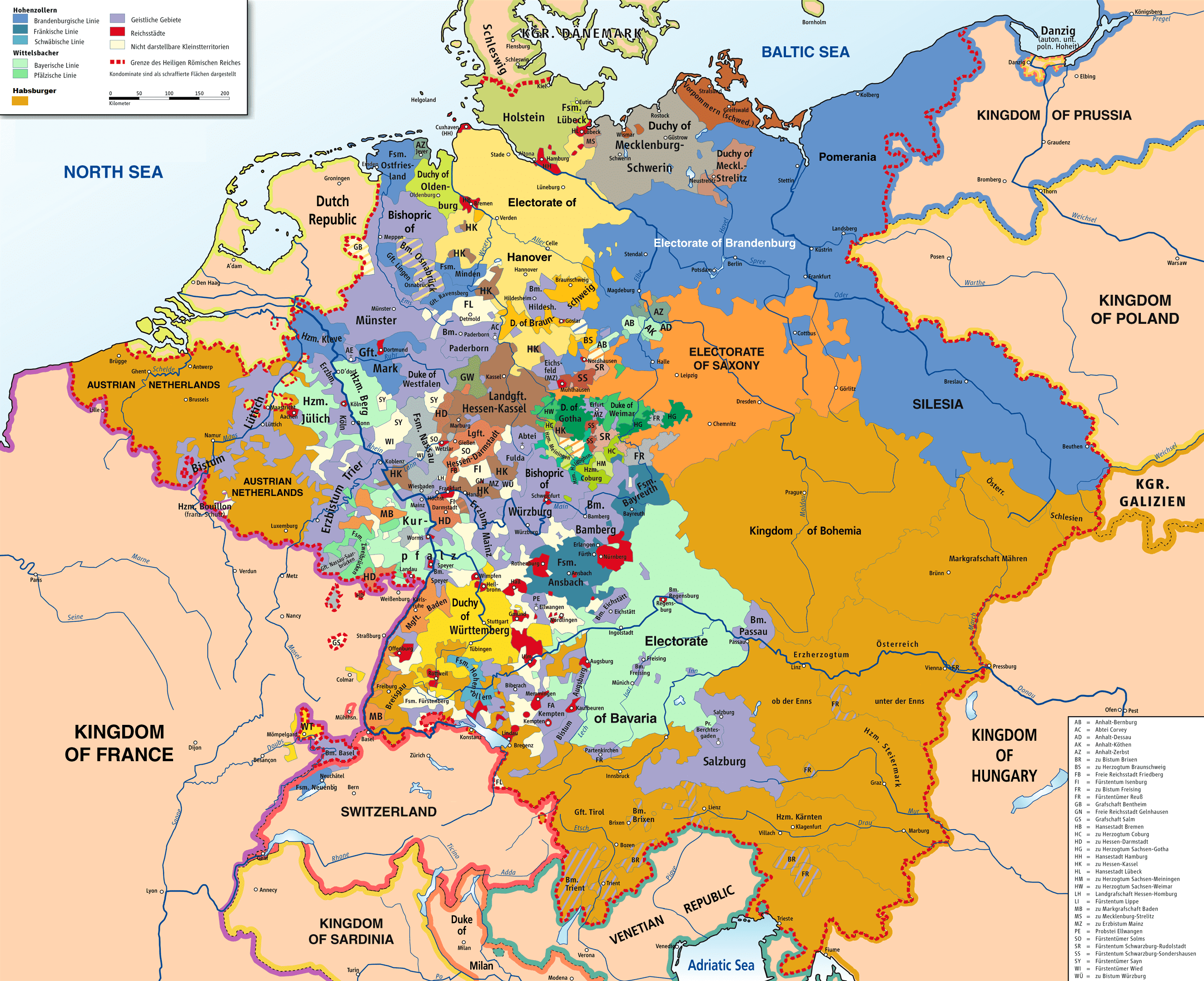
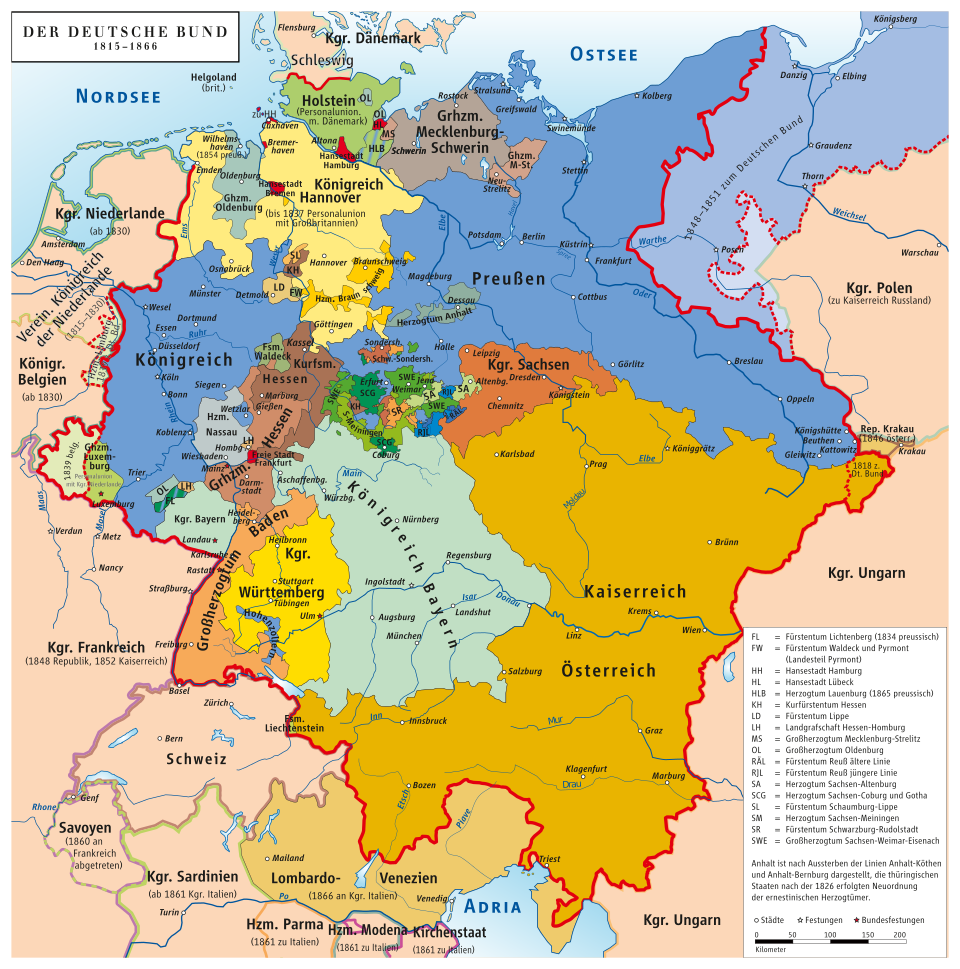


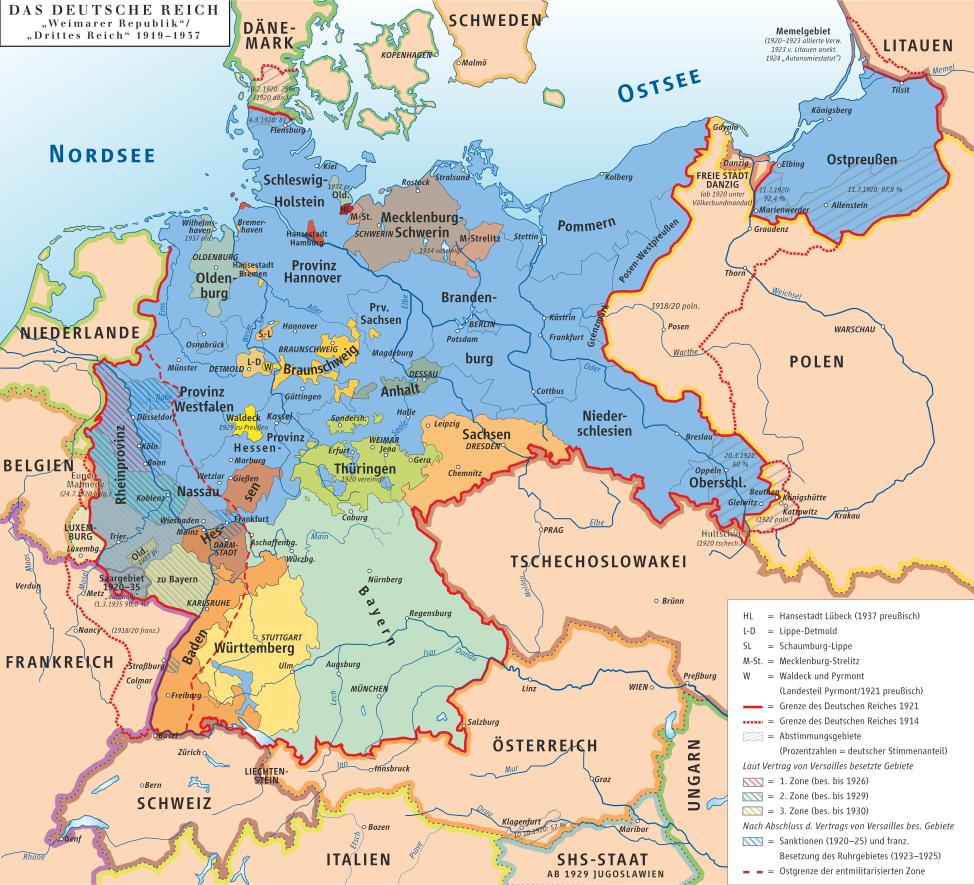

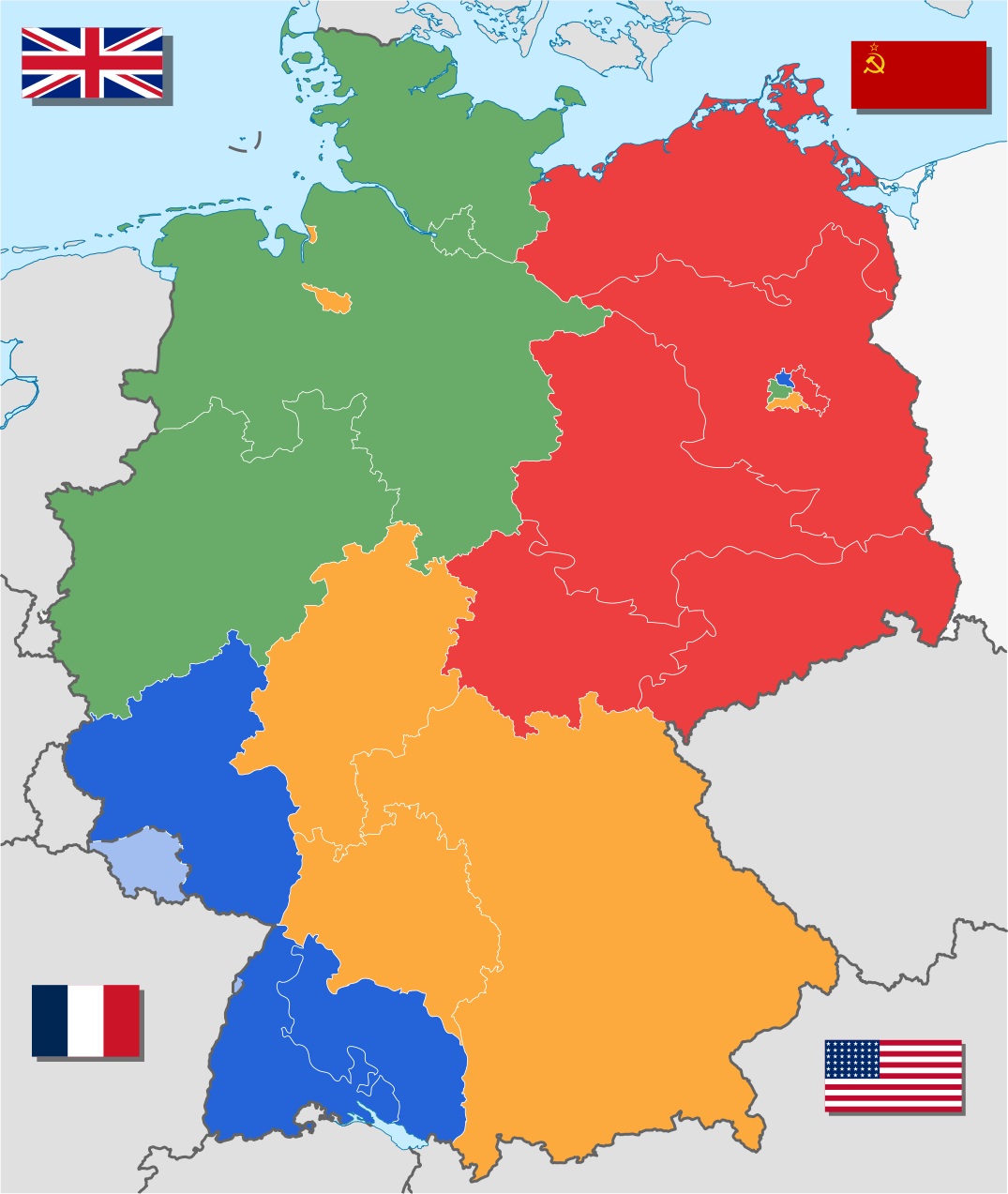
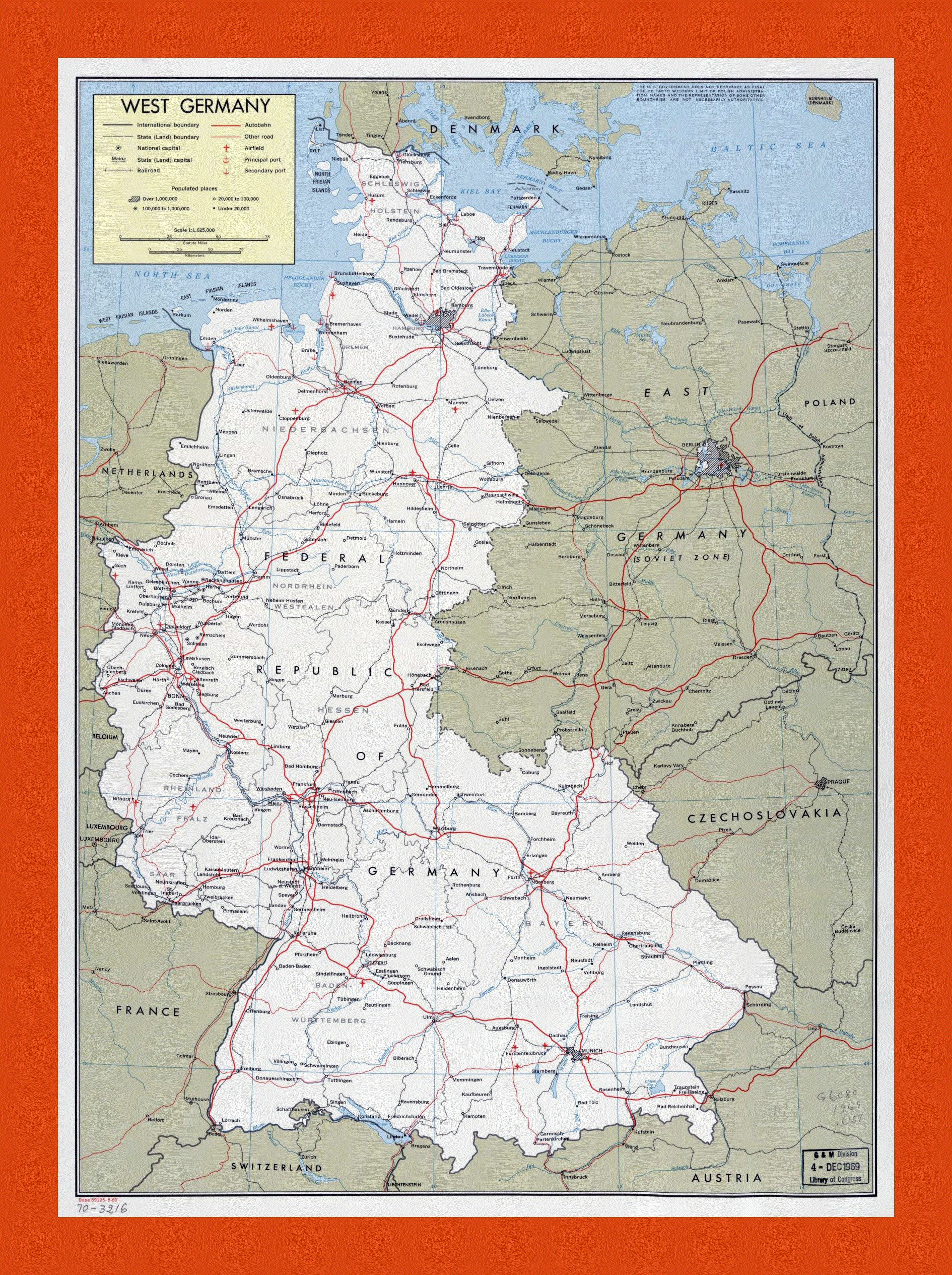
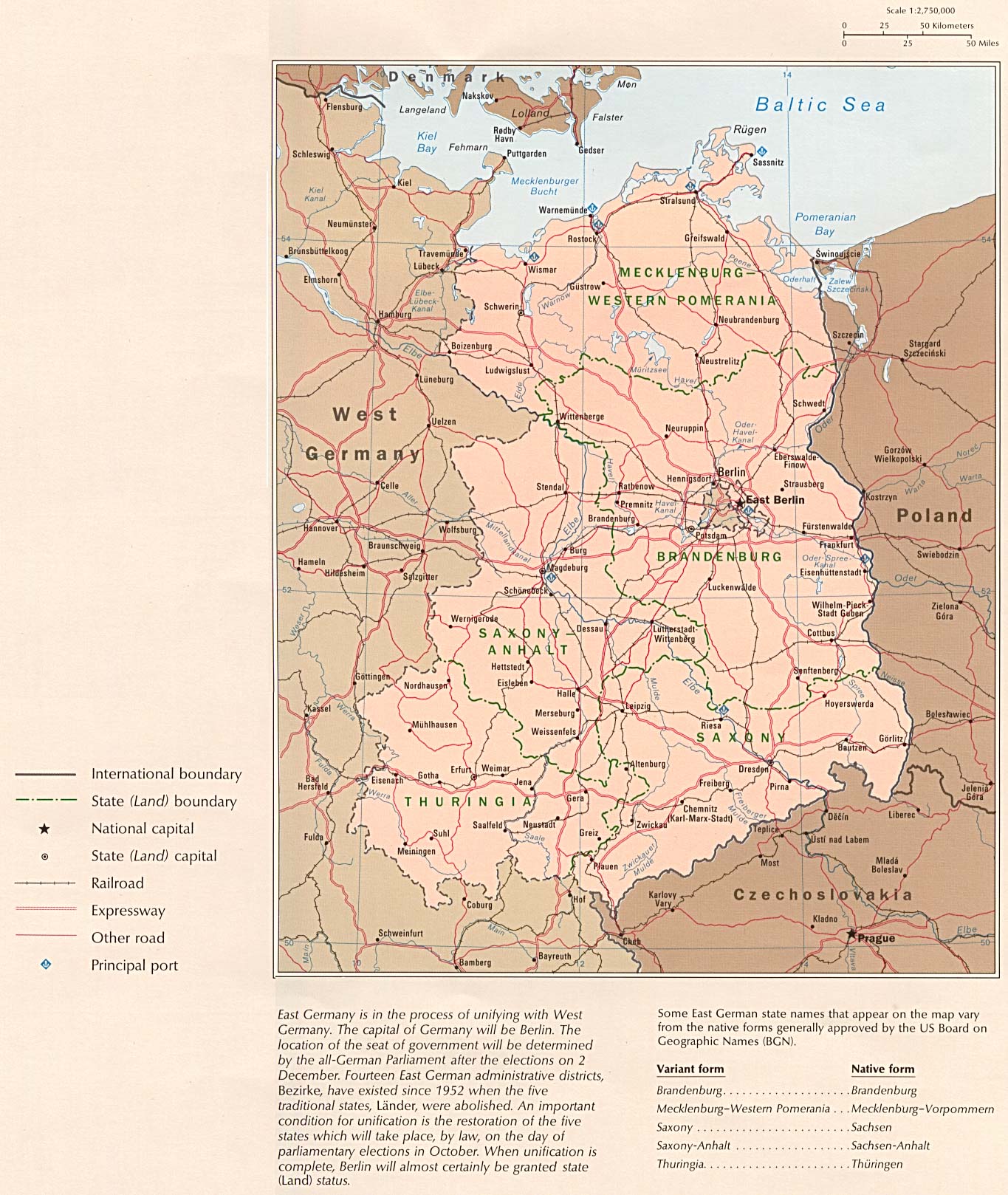


at Wiesbaden (supported by French occupation forces).
21 Oct 1923 - 30 Nov 1923 Provisional Government of the Rhenish Republic (Vorläufige Regierung
der Rheinischen Republik); from 23 Oct 1913 capital at Koblenz
(supported by French and Belgian occupation forces).
12 Nov 1923 - 17 Feb 1924 Autonomous Palatinate Republic, federated with the Rhenish Republic,
declared in rebellion (see Bavaria under German states from 1918).
President of the Government of the Rhenish
Republic
1
Jun 1919 - Jun 1919 Johannes
"Hans" Adam Dorten
(b. 1880 - d. 1963) Z
Minister-president (prime minister) of the
Rhenish Republic
25 Oct 1923 - 29 Nov 1923
Josef Friedrich
Matthes
(b. 1886 - d. 1943) VRB
(provisional)
Party abbreviations: Z = Deutsche Zentrumspartei "Zentrum" (German Center Party "Center", catholic, centrist, christian democratic, 13 Dec 1870-5 Jul 1933); VRB = Vereinigte Rheinische Bewegung (United Rhenish Movement, Rhenish separatist, 15 Aug 1923-1924)
French Departments in Germany 1797-1814
2 Oct
1794
French invasion of the Rhineland begins (Aachen on 6 Oct
1794,
Cologne 26 Oct 1794, Bonn 8 Nov 1794).
14 Nov
1794
French create central administration (Pays
d'entre Meuse et Rhin).
18 Oct
1797
Treaty of Campo Formio cedes de facto Rhineland
territories
to France.
4 Nov
1797
A French commissioner is appointed to supervise and
organize
the territories into départements
(not yet considered to be
part of France); Roer, Sarre, Mont Tonnerre,
Rhin-et-Moselle.
9 Feb
1801
By the Treaty of Lunéville the Rhineland is de jure
annexed
to France.
30 Jun
1802
Rhine départements become
regular départements of France.
23 Sep
1802
Unified administration terminated.
1813 -
1815
Allied administration; territories later restored to
Prussia,
Bavaria, Oldenburg, etc.
Commanders of the Army of the Sambre and Meuse
(northern zone)
2 Jul 1794 - 20
Dec 1794 Jean-Baptiste Jourdan (1st
time) (b. 1762 - d. 1833)
21 Dec 1794 - 28 Feb 1795
Jacques Maurice
Hatry
(b. 1742 - d. 1802)
1 Mar 1795 - 21 Jan 1796
Jean-Baptiste Jourdan (2nd time) (s.a.)
22 Jan 1796 - 28 Feb 1796
Jean-Baptiste Kléber (1st time) (b.
1753 - d. 1800)
29 Feb 1796 - 30 Jul 1796
Jean-Baptiste Jourdan (3rd time) (s.a.)
31 Jul 1796 - 7 Aug 1796
Jean-Baptiste Kléber (2nd time) (s.a.)
8 Aug 1796 - 23 Sep 1796
Jean-Baptiste Jourdan (4th time) (s.a.)
23 Sep 1796 - 23 Jan 1797 Pierre
Riel de
Beurnonville
(b. 1752 - d. 1821)
- together
with -
14 Dec 1796 - 23 Jan 1797
Jean-Baptiste Kléber (3rd time) (s.a.)
26 Feb 1797 - 18 Sep 1797 Louis
Lazare
Hoche
(b. 1768 - d. 1797)
Commander of the Army of the Rhine
(southern zone)
14 Jan 1794 - 10 Apr 1795 Claude
Ignace François Michaud (b. 1751
- d. 1835)
Commander of the Army of the
Moselle
2 Jul 1794 - 9 Feb
1795 Jean Victor
Moreau
(b. 1763 - d. 1813)
Commanders of the Army
of the Rhine and
Moselle
20 Apr 1795 - 4 Mar 1796
Jean Charles
Pichegru
(b. 1761 - d. 1804)
21 Apr 1796 - 9 Sep 1797
Jean Victor
Moreau
(s.a.)
10 Sep 1797 - 18 Sep 1797 Louis
Lazare
Hoche
(s.a.)
18 Sep 1797 - 7 Oct 1797
Laurent de
Gouvion-Saint-Cyr
(b. 1764 – d. 1830)
Commander of the Army of Germany
7 Oct 1797 - 12 Dec 1797
Charles Pierre Francois Augereau (b. 1757 -
d. 1816)
French Government Commissioners
Army of Germany
4 Nov 1797 - 21 Feb 1799
François Joseph
Rudler
(b. 1757 - d. 1837)
26 Mar 1799 - Aug
1799 Jean Joseph Marquis
(b.
1747 - d. 1823)
Aug 1799 – 29 Nov 1799 Joseph
Lakanal
(b. 1762 - d. 1845)
29 Nov 1799 - Dec
1799 Louis Thibaut
Dubois-Dubais
(b. 1743 - d. 1834)
(did not exercise office)
22 Dec 1799 – Oct 1800 Henri
Shée
(b. 1739 - d. 1820)
22 Sep 1800 - Feb 1802
Jean-Baptiste Moisë
Jollivet (b. 1753 -
d. 1818)
Feb 1802 - 22 Sep 1802
André Jeanbon, dit Jeanbon Saint- (b. 1749 - d.
1813)
André
Bouches-de-l'Elbe
13 Dec
1810
French département of Bouches-de-l'Elbe formed
from
free cities of Hamburg and Lübeck and parts of Holstein.
1814
End of French rule.
Prefects
10 Jan 1811 - 6 Mar 1813 Patrice
Charles Ghislain de (b. 1770
- d. 1827)
Coninck-Outryve
25 Mar 1813 -
1814
Achille Stanislas Émile
Le (b.
1781 - d. 1864)
Tonnelier, baron de Breteuil
Bouches-du-Weser
13 Dec
1810
French département of Bouches-du-Weser formed
from
free city of Bremen, Duchy of Oldenburg, county of
Hoya and part of Hanover.
1814
End of French rule.
Prefect
10 Jan 1811 -
1814
Charles Philippe Alexandre
(b. 1776 - d. 1814)
d'Arberg
Ems-Oriental
Jul
1807
Principality of East Frisa (Ostfriesland), Barony of
Kniphausen
(Knyphausen), and Häuptlingschaft Jever
ceded to France
by Prussia and Russia respectively (see East Frisia).
11 Nov
1807
Incorporated into Kingdom of Holland as département
of Oost-Friesland (East Friesland).
1 Jan 1811
Incorporated into France as département
of Ems-Oriental
(Eastern Ems).
Commissioner-general
13 Jun 1807 - 5 Feb 1808 Johan
Frederik Rudolph van Hoof (b. 1755 -
d. 1816)
Landdrost
5 Feb 1808 - 22 Dec 1808
Godert Alexander Gerard Philip
(b. 1778 - d. 1848)
van der Capellen
22 Dec 1808 - 25 Feb 1811 Willem Queysen
(arrived 1 Jan 1809)(b. 1754 - d. 1817)
Prefect
25 Feb 1811 - 8 Nov 1813 Sébastien
Louis Joseph Jannesson (b. 1779 - d. 1864)
(arrived 1 Mar 1811)
Ems-Supérieur
1 Jan 1811
French département of Ems-Supérieur formed from
Bishopric
of Minden (Prefecture Osnabrück).
Oct 1813
End of French rule.
Prefect
13 Jan 1811 - Oct 1813 Karl Ludwig
Joseph von Keverberg (b. 1768 - d.
1841)
Lippe
27 Apr 1811
French département of Lippe formed from
parts
of Bouche-l'Yssel,
Ems-Occidental and Yssel-Supérieur.
Nov 1813
End of French rule.
Prefect
13 Jun 1811 - Nov 1813
Jean Charles Annet Victorin de (b. 1768 -
d. 1833)
Lasteyrie du Saillant
Mont-Tonnerre
9 Mar
1801
French département of Mont-Tonnerre (German:
Donnersberg)
formed from southern parts of Electorate of Mainz and
parts
of Bishoprics of Speyer and Worms and of Palatinate
and
Duchy of Zweibrücken.
Jan
1814
End of French rule.
Prefects
22 Sep 1800 -
1801 Jean-Baptiste
Moïse Jollivet (b.
1753 - d. 1818)
9 Mar 1801 -
1801
Henri d'Alton-Shée
(b. 1739 - d. 1820)
20 Dec 1801 - 10 Dec 1813 André Jeanbon,
dit Jeanbon Saint- (b. 1749 - d. 1813)
André (from 9 Jan 1810, André
Jeanbon, baron de Saint-André)
14 Dec 1813 - 1814
Charles
Philippe Alexandre
(b. 1776 - d. 1814)
d'Arberg (not installed)
Rhin-et-Moselle
9 Mar
1801
French département of
Rhin-et-Moselle (Rhine and Moselle)
formed from parts of Electorates of Trier and Cologne
and the
Lower County of Catzenellenbogen (Obergrafschaft
Katzenelnbogen)
of Hesse-Darmstadt.
1814
End of French rule.
Prefects
9 Mar 1801 -
1803
Philippe Boucqueau de Villeraie
(b. 1773 - d. 1834)
14 Jun 1803 -
1805
François Louis René Mouchard (b.
1757 - d. 1814)
de Chaban
1 Feb 1805 - 3 May
1806 Alexandre Théodore
Victor
(b. 1760 - d. 1829)
de Lameth
15 May 1806 -
1810
Paul Adrien François Marie
de (b. 1769 - d. 1814)
Lezay-Marnésia
7 Aug 1810 - Jan 1814
Jean Marie Thérèse Doazan
(b. 1774 - d. 1839)
20 Nov 1806
Lower County of Catzenellenbogen (Niedergrafschaft
Katzenelnbogen/comté
inférieur
de Catzenelnbogen) of Hesse-Darmstadt
occupied by France.
Administered, but not annexed, to France as the Reserved
Country of
Catzenellenbogen (Pays réservé de Catzenellenbogen).
Administered by
the
Imperial prefectural councilor in Langenschwalbach in département
Rhin-et-Moselle
(but not part of the département).
1 Nov 1813
French withdraw from areas of the
right bank of the Rhine.
6 Nov 1813 - 2 Dec 1813 Provisional
administration by the General Government of Frankfurt.
2 Dec 1813 - 16 Oct 1815
Administered by Hesse-Darmstadt.
16 Oct 1815 - 17 Oct 1816 Administered
by Prussia.
17 Oct 1816
Ceded to the Duchy of Nassau.
Imperial Prefectural Councilor
20 Nov 1806 - 1 Nov 1813 Balthasar
Pietsch
(b. 1747 - d. 1826)
Roer
9 Mar
1801
French département of Roer
formed from duchies of Jülich,
Guelders, and Kleve, Principality of Meurs, parts of
Electorate of Cologne, and free cities of Cologne and
Aachen,
lordships Dyck, Myllendonk, Wickrath, Hoerstgen,
and the abbeys
of
Burtscheid and Kornelimünster, and from 1805 Wesel.
1814
End of French rule.
Prefects
9 Mar 1801 - 4 Mar
1802 Nicolas Sébastien
Simon
(b. 1749 - d. 1802)
Mar 1802 - 23 Sep 1802
Johann Friedrich Jacobi (1st time) (b. 1765 - d. 1831)
+ Heinrich Joseph Cogels de Weert
(acting)
23 Sep 1802 -
1804
Alexandre Edme
Méchin
(b. 1772 - d. 1849)
1804 - 15 Sep 1804
Johann
Friedrich Jacobi (2nd time) (s.a.)
(acting)
15 Sep 1804 -
1806
Jean Charles Joseph
Laumond (b.
1753 - d. 1825)
3 May 1806 - 19 Feb 1809
Alexandre Théodore
Victor
(b. 1760 - d. 1829)
de Lameth
31 Mar 1809 -
1814
Jean Charles François
de
(b. 1772 - d. 1848)
Ladoucette (from 3 May 1809, Jean
Charles François, chevalier de
Ladoucette [from 31 Dec 1809, Jean
Charles François, baron de Ladoucette])
Sarre
9 Mar
1801
French département of Sarre
formed from parts of Electorate
of Trier, and Duchy of Palatinate-Zweibrücken.
1814
End of French rule.
Prefects
22 Jun 1800 -
1803 Joseph
Bexon d'Ormeschville (b.
1738 - d. 1814)
24 Mar 1803 -
1810
Maximilien Xavier Képler (Keppler) (b. 1758 -
d. 1837)
(from 16 Sep 1808, Maximilien Xavier,
chevalier Képler [from 14 Feb 1810,
Maximilien Xavier, baron Képler])
7 Aug 1810 - 6 Jan
1814 Alexandre François de
Bruneteau (b. 1769 - d. 1853)
de Sainte-Suzanne (from 19 Jan
1812, Alexandre François de
Bruneteau, baron de Sainte-Suzanne)
Neu-Schwabenland (New Swabia)
|
|

- 19 Jan 1939 - 6 Feb 1939 Antarctic
area 20°E to 10°W is explored by a German expedition
led
- by Alfred Ritscher (b. 1879 - d. 1963) and named Neu-Schwabenland
- (New Swabia), although Germany made no formal territorial
-
claims.
© Ben Cahoon