| WorldStatesmen.org
HOME |
|
|
German States before 1918 F-M
- Note: The list below is only complete for those polities that survived beyond 1806. Within
- the Holy Roman Empire, there existed countless minor states (ecclesiastical states, imperial
- cities, imperial villages, lordships, counties, baronies, principalities, etc.), which
- are nearly impossible to list with even partial accuracy. A major reorganization was
- brought about by the Reichsdeputationshauptschluss of 1803, when more than 100 polities were
- abolished. Polities listed prior to 1806 are a sample of the major or most well known
- polities of the Holy Roman Empire and the Confederation of the Rhine. After 1806, all the
- polities that survived the Napoleonic Wars and the Congress of Vienna are listed.
- The Golden Bull 25 Dec 1356 codified the procedure for electing the king and specified the (then) seven princes, called electors (Kurfürsten), who would carry out the election, thus confirming then current practice. These princes nominally derived their electoral status from the high court offices (Erzämter) they held. The first-named three electors were the holders of the office of archchancellor of the Holy Roman Empire, i.e., the archbishops of Mayence (Mainz), Treves (Trier), and Cologne (Köln). These archbishops were of course major territorial lords, although in the period covered by this record their territorial holdings no longer included the cities from which they derived the names of their sees (Erzstifte).
- For the sake of providing a division between eras, after the republican revolutions
- of Nov 1918, which overthrew the last German monarchies, remaining states are listed under
- German states since 1918; these include the states (länder) and former provinces of Germany. The provinces of Prussia are listed in a separate section following the entry for Prussia (Prussian provinces). Statistical data is given only for those polities that survived until 1866.
- Ecclesiastical titles: Äbt/Äbtissin = Abbot/Abbess; Bischof = bishop; Erzbischof = Archbishop; Fürstabte = Prince-Abbot; Fürstabtissin = Princess-Abbess; Fürstbischof = Prince-bishop
- Maps showing some of the major territorial changes: Historical Map of Germany in 1660;
- Historical map of Germany in 1789; Historical map of Germany in 1803; Map of Germany in 1812;
- Map of German Confederation 1815; Map of German Empire 1871
Fagnolle (Ligne): see under Belgium
Feldkirch: see Vorarlberg under Austrian Lands to 1918
Flanders (Flandern): see under Southern Netherlands provinces
Flanders (Flandre): see under France provinces to 1791
Florence (Florenz): see Tuscany under Italian states to 1860
![[Frankfurt Free City to
1806 (Germany)]](de_fran2.gif "[Frankfurt Free City to
1806 (Germany)]") c.1400 - 25 Sep 1806 |
![[Frankfurt Grand Duchy
1806-1813 (Germany)]](de_magun.gif "[Frankfurt Grand
Duchy 1806-1813 (Germany)]") 25 Sep 1806 - 19 Oct 1813 |
![[Frankfurt Free City
1833-1866 (Germany)]](de_fran1.gif "[Frankfurt Free City
1833-1866 (Germany)]") 5 Mar 1833 - 8 Oct 1866 |
| Map of Frankfurt (1815-1866) and Map of Grand Duchy of Frankfurt (1812) |
Hear Anthem "Frankfurt, du Königliche Stadt, des Reiches Fürstensitz“" (in medieval period) |
Text of Anthem |
Constitution (16 Aug1810; 18 Jul 1816) |
| Capital: Frankfurt
am Main (Frankfurt) |
Currency: 1761-1866 same as Hesse-Darmstadt | State Holiday: 18 Oct (1813) Erinnerungsfeier der Schlacht bei Leipzig (Commemoration of Battle of Leipzig) (unofficial) |
Population: 91,150 (1864) 60,000 (1804) |
| Military: 890 (1860) |
Exports: see Prussia Imports: see Prussia |
Religions:
Protestant 80%, Roman Catholic 14%, Jewish 6%
(1860) state church: United Protestant Evangelical State Church of Frankfurt upon Main. |
|
| International Organizations: German Customs Union (1836-1866) | |||
22 Feb
794
Frankfurt mentioned for the first time "super
fluvium Moin in loco
nuncupante Franconofurd" ("on the River Main in
a place called
Frankfurt") is mentioned for the first time in a
document which
Charlemagne gave the monastery of Saint Emmeram. In
Jun 794 the
Synod of Frankfurt is held.
1074
A royal customs office is mentioned for the first time
in Frankfurt
(Latin: Vadum Francorum; old high German: Frankonovurd;
later
spellings Frankenfort, Franckfort, and Franckfurth.
The suffix am
Main has been used regularly since
the 14th cent.)
1150
Frankfurter Messe ('Frankfurt Trade Fair') was
first mentioned.
1219
The inhabitants of Frankfurt were first mentioned as
citizens in a
document.
1220
The office of the
Burgvogt (castellan) abolished.
1245
Frankfurt becomes an Imperial City (Francofurtensis
[Frankenford]
imperialis est urbs/Reichsstadt
Frankfurt).
13 Jul 1254 - 1257
Frankfurt a member of the Rhenish League
of Cities (Rheinischen
Städtebundes).
1311
Establishment of a mayor's office (Bürgermeisteramtes).
Since then,
the 42 councillors elected two councillors as mayors
for one year
each, the Ältere Bürgermeister and his
representative the Jüngere
Bürgermeister.
10 Jan 1356
The city's status as an electoral city
for the Holy Roman Emperors
is established in the Golden Bull of 1356.
May
1372
Frankfurt acquires the imperial bailiff's office (Erwerb
des
Reichsschultheissenamt) and the royal
forest (königlichen
Forst) for 8,800 guilders (by purchasing these
rights, the city
gained greater autonomy and control over its own
administration
and territory)(Freie und Reichsstadt Frankfurt).
From 1372 the
Stadtschultheiss chaired the
Court of Appeal and the Council
meetings, replacing the Reichsschultheiss.
20 Mar 1381 -
1389
Frankfurt a member of the Second Rhenish League of
Cities.
28 Nov 1562
Imperial
election and coronation (on 25 Jul 1564) of the Holy
Roman
Emperor Maximilian II took place at Frankfurt, a
precedent
followed until the end of the Holy Roman Empire.
1742 - 1745
Frankfurt becomes a royal residence for a
short time under Emperor
Karl VII.
2 Jan 1759 - 25 Feb 1763 Occupied by
France during the Seven Years' War.
23 Oct 1792 - 2 Dec 1792 Occupied by
France.
9 Jun 1796 - 16 Jul 1796 Occupied by
Austria.
16 Jul 1796 - 8 Sep 1796 Occupied by
France.
28 Mar 1801 - 20 May 1801 Occupied by Denmark.
18 Jan 1806 - 30 Oct 1813 Occupied
by France.
19 Sep
1806
Frankfurt is incorporated into the Prince-Primate's
territorial
possessions (the ecclesiastic Principality of
Regensburg)
as
the Principality of Frankfurt (Fürstentum
Frankfurt/Principauté
de Francforte).
16 Feb
1810
Grand Duchy of Frankfurt (Grossherzogtum
Frankfurt/Grand-Duché de
Francforte)(composed
of the Prince-Primate's remaining territorial
possessions of Aschaffenburg,
Frankfurt, Fulda and Hanau. From
1 Jan 1811 it is divided into the départements
of Aschaffenbourg,
Francfort, Fulde, and Hanau).
28 Oct
1813
Grand Duke Carl Theodor, who was at the time in
Konstanz, abdicates
in favor Eugène Napoléon de France, prince de Venise
(b. 1781 -
d. 1824), who does not take office.
30 Oct 1813 - 20 Jun 1815 Occupied by the Allies
(Austrians).
6 Nov 1813 - 20 Jun 1815 General
Government of the Grand Duchy of Frankfurt and the
Principality of Isenburg (General-Gouvernement
des
Grossherzogthums Frankfurt und des Fürstenthums
Isenburg)(for the
former Grand Duchy of Frankfurt, Principality of
Isenburg, and
Niedergrafschaft Katzenelnbogen).
14 Dec
1813
Free City of Frankfurt (Freie Stadt Frankfurt).
8 Jun 1815 - 24 Aug 1866
Frankfurt is seat of the Federal Assembly (Bundestag)
of the German
Confederation.
18 May 1848 - 31 May 1849 The first German
National Assembly meets in Frankfurt's Paulskirche.
16 Jul
1866
Occupied by Prussia.
8 Oct
1866
Annexation by Prussia
(as part of Hesse-Nassau province).
Note: Before 1806 the highest authorities were (1) the Stadtschultheiss (a fossil of the royal supervision of the city), senior member of the Rat (Council); (2) the senior mayor (Älterer Bürgermeister), elected annually, who presides in the Rat. The mayor's term begins on a date between Easter and Pentecost, and varies from year to year.
Stadtschultheissen
1696 - 19 Apr
1716
Johann Erasmus Seiffart von
(b. 1634 - d. 1716)
Klettenberg und Wildeck auf Rhoda
1716 - 21 Apr
1721 Johann
Georg von Holzhausen (b.
1643 - d. 1721)
1721 - 10 Jun
1741
Johann Heinrich Werlin
(b. 1663 - d. 1741)
1741 - 9 Aug
1747
Johann Christoph Ochs von
(b. 1674 - d. 1747)
Ochsenstein
1747 - 6 Feb
1771
Johann Wolfgang Textor
(b. 1693 - d. 1771)
1771 - 13 Mar
1777
Johann Isaac Moors
(b. 1707 - d. 1777)
1777 - 21 Mar
1788
Johann Martin Ruppel
(b. 1722 - d. 1788)
22 Mar 1788 - 27 Feb 1802
Johann Friedrich Maximilian von (b.
1736 - d. 1802)
Stalburg
27 Feb 1802 - 27 Sep 1806
Wilhelm Carl Ludwig Moors
(b. 1749 - d. 1806)
27 Sep 1806 - 31 Dec 1806
Friedrich Carl Schweitzer (acting) (b.
1749 - d. 1808)
1 Jan 1807 - 1 Jan 1811
Friedrich Maximilian Freiherr von (b. 1753
- d. 1824)
Günderrode
Senior Mayors (Älterer
Bürgermeister)
1699 -
1700
Philipp Nicolaus Lersner
(b. 1640 - d. 1702)
1700 -
1701
Heinrich von Barckhausen (1st time) (b. 1653 - d.
1727)
1701 -
1702
Johann Adolph Stephan von
(b. 1647 - d. 1712)
Cronstätten II (1st time)
1702 -
1703
Dominicus von Heyden (1st time) (b. 1644
- d. 1710)
1703 -
1704
Nicolaus Augustus Ruland
(b. 1650 - d. 1710)
1704 -
1705
Johann Arnold Mohr von Mohrenhelm (b. 1637 - d.
1712)
1705 -
1706
Johann Adolph von Glauburg I
(b. 1638 - d. 1718)
(2nd time)
1706 -
1707
Heinrich von Barckhausen (2nd time) (s.a.)
1707 -
1708
Johann Adolph Stephan von
(s.a.)
Cronstätten II (2nd time)
1708 -
1709
Dominicus von Heyden (2nd time) (s.a.)
1709 -
1710
Philipp Jacob Fleckhammer von (b.
1644 - d. 1727)
Aystetten
1710 -
1711
Johann Georg von Holzhausen
(s.a.)
(1st time)
1711 -
1712
Johann Philipp Orth II (1st time) (b. 1658 - d.
1733)
1712 -
1713
Johann Adolph von Glauburg I
(s.a.)
(3rd time)
1713 -
1714
Heirich von Barckhausen (3rd time) (s.a.)
1714 -
1715
Johann Georg von Holzhausen
(s.a.)
(2nd time)
1715 -
1716
Johann Philipp Orth II (2nd time) (s.a.)
1716 -
1717
Johann Martin von den Birghden (b.
1644 - d. 1720)
1717 -
1718
Johann Heinrich Werlin
(b. 1663 - d. 1741)
1718 -
1719
Johann Philipp von Kellner I
(b. 1615 - d. 1719)
1719 -
1720
Konrad Hieronymus Eberhard gen. (b. 1653
- d. 1744)
Schwind (1st time)
1720 -
1721
Ludwig Adolph von Syvertes
(b. 1656 - d. 1721)
1721 -
1722
Johann Christoph von Stetten
(b. 1653 - d. 1724)
1722 -
1723
Bartholomäus Barckhausen
(b. 1658 - d. 1727)
1723 -
1724
Georg Friedrich Faust von
(b. 1654 - d. 1724)
Aschaffenburg
1724 -
1725
Johann Hieronymus von Glauburg (b.
1654 - d. 1727)
1725 -
1726
Johann Christoph Ochs von
(s.a.)
Ochsenstein (1st time)
1726
Johann Adolph von Glauburg II (b.
1673 - d. 1752)
(acting)
1726 -
1727
Konrad Hieronymus Eberhard gen. (s.a.)
Schwind (2nd time)
1727 -
1728
Achilles August von Lersner
(b. 1662 - d. 1732)
(1st time)
1728 - 1 Sep
1728
Johann Daniel Fleischbein von (b.
1666 - d. 1728)
Kleeberg
1728
Johann Adolph von Glauburg III (b.
1691 - d. 1741)
(acting)
1728 -
1729
Achilles August von Lersner
(s.a.)
(2nd time)
1729 -
1730
Johann Christoph Ochs von
(s.a.)
Ochsenstein (2nd time)
1730 -
1731
Achilles August von Lersner
(s.a.)
(3rd time)
1731 -
1732
Johann Carl von Kaib (1st time) (b. 1684
- d. 1760)
1732 -
1733
Johann Jacob von Bertram (1st time) (b. 1684 - d.
1742)
1733 -
1734
Johann Hieronymus von Holzhausen (b. 1674
- d. 1736)
1734 -
1735
Johann Jacob von Bertram (2nd time) (s.a.)
1735 -
1736
Johann Philipp von Syvertes
(b. 1686 - d. 1743)
(1st time)
1736 -
1737
Johann Carl von Kaib (2nd time) (s.a.)
1737 -
1738
Johann Philipp von Kellner II (b.
1682 - d. 1744)
1738 -
1739
Johann Wolfgang Textor (1st time) (s.a.)
1739 -
1740
Johann Carl von Kaib (3rd time) (s.a.)
1740 -
1741
Johann Philipp von Syvertes
(s.a.)
(2nd time)
1741
Johann Christoph Ochs von
(s.a.)
Ochsenstein (3rd time)
1741
Remigius Seyffart von Klettenberg (b. 1693 - d.
1766)
und Wildeck (1st time)(acting)
1741 -
1742
Johann Wolfgang Textor (2nd time) (s.a.)
1742 -
1743
Johann Carl von Kaib (4th time) (s.a.)
1743 -
1744
Johann Wolfgang Textor (3rd time) (s.a.)
1744 -
1745
Johann Georg Schweitzer Edler von (b. 1682 - d.
1770)
Wiederhold (1st time)
1745 -
1746
Johann Carl von Fichard (1st time) (b. 1695 - d.
1771)
1746 -
1747
Friedrich Maximilian von
(b. 1684 - d. 1761)
Günderrode (1st time)
1747 -
1748
Friedrich Maximilian von Lersner I (b. 1697 - d.
1753)
(1st time)
1748 -
1749
Johann Georg Schweitzer Edler von (s.a.)
Wiederhold (2nd time)
1749 -
1750
Friedrich Maximilian von
(s.a.)
Günderrode (2nd time)
1750 -
1751
Johann Carl von Fichard (2nd time) (s.a.)
1751 -
1752
Friedrich Maximilian von Lersner I (s.a.)
(2nd time)
1752 -
1753
Johann Georg Schweitzer Edler von (s.a.)
Wiederhold (3rd time)
1753 -
1754
Johann Carl von Fichard (3rd time) (s.a.)
1754 -
1755
Remigius Seyffart von Klettenberg (s.a.)
und Wildeck (2nd time)
1755 -
1756
Johann Carl von Fichard (4th time) (s.a.)
1756 -
1757
Friedrich Wilhelm von Völcker (b.
1692 - d. 1761)
1757 -
1758
Erasmus Carl Schlösser (1st time) (b. 1696 - d.
1773)
1758 -
1759
Philipp Jakob von Stalburg
(b. 1708 - d. 1760)
1759 -
1760
Remigius Seyffart von Klettenberg (s.a.)
(3rd time)
1760 -
1761
Johann Carl von Fichard (5th time) (s.a.)
1761 -
1762
Johann Maximilian von Holzhausen (b. 1708
- d. 1768)
1762 -
1763
Johann Friedrich Armand von
(b. 1687 - d. 1769)
Uffenbach
1763 -
1764
Johann Isaac Moors (1st time)
(s.a.)
1764 -
1765
Erasmus Carl Schlösser (2nd time) (s.a.)
1765 -
1766
Hieronymus Maximilian von Glauburg (b. 1715 - d.
1786)
(1st time)
1766 -
1767
Johann Carl von Fichard (6th time) (s.a.)
1767 -
1768
Friedrich Maximilian Baur von (b.
1707 - d. 1771)
Eysseneck
1768 -
1769
Johann Philipp von Heyden (1st time)(b. 1712 - d.
1778)
1769 -
1770
Johann Isaac Moors (2nd time)
(s.a.)
1770 -
1771
Hieronymus Maximilian von Glauburg (s.a.)
(2nd time)
1771 -
1772
Johann Daniel von Olenschlager (b.
1711 - d. 1778)
1772 -
1773
Johann Philipp von Heyden (2nd time)(s.a.)
1773 -
1774
Hieronymus Maximilian von Glauburg (s.a.)
(3rd time)
1774 -
1775
Friedrich Adolph von Glauburg (b.
1722 - d. 1789)
(1st time)
1775 -
1776
Johann Philipp von Heyden (3rd time)(s.a.)
1776 -
1777
Hieronymus Maximilian von Glauburg (s.a.)
(4th time)
1777 -
1778
Johann Friedrich von Wiesenhütten (b. 1724 - d.
1793)
(1st time)
1779 -
1780
Friedrich Adolph von Glauburg
(s.a.)
(2nd time)
1780 -
1781
Johann Daniel Fleischbein von (b.
1715 - d. 1787)
Kleeberg II
1781 -
1782
Johann Friedrich von Wiesenhütten (s.a.)
(2nd time)
1782 -
1783
Friedrich Adolph von Glauburg
(s.a.)
(3rd time)
1783 -
1784
Johann Christoph von Adlerflycht (b. 1729
- d. 1786)
(1st time)
1784 -
1785
Johann Friedrich von Wiesenhütten (s.a.)
(3rd time)
1785 -
1786
Johann Christoph von Adlerflycht (s.a.)
(2nd time)
1786 -
1787
Friedrich Adolph von Glauburg
(s.a.)
(4th time)
1787 -
1788
Johann Friedrich Maximilian von
(s.a.)
Stalburg
1788 -
1789
Friedrich Adolph von Glauburg
(s.a.)
(5th time)
1789 -
1790
Friedrich Maximilian von Lersner II (b. 1735 - d.
1804)
(1st time)
1790 -
1791
Johann Christoph von Lauterbach (b.
1734 - d. 1798)
(1st time)
1791 -
1792
Adolph Carl von Humbracht (1st time)(b. 1753 - d.
1837)
1792 -
1793
Johann Christoph von Lauterbach
(s.a.)
(2nd time)
1793 -
1794
Johann Nicolaus Olenschlager von (b. 1751
- d. 1820)
Olenstein (1st time)
1794 -
1795
Adolph Carl von Humbracht (2nd time)(s.a.)
1795 -
1796
Johann Nicolaus Olenschlager von (s.a.)
Olenstein (2nd time)
1796 -
1797
Johann Christoph von Lauterbach (s.a.)
(3rd time)
1797 -
1798
Adolph Carl von Humbracht (3rd time)(s.a.)
1798 -
1799
Friedrich Maximilian von Lersner II (s.a.)
(2nd time)
1799 -
1800
Adolph Carl von Humbracht (4th time)(s.a.)
1800 -
1801
Anton Ulrich Carl von Holzhausen (b. 1754
- d. 1832)
(1st time)
1801 -
1802
Adolph Carl von Humbracht (5th time)(s.a.)
1802 -
1803
Johann Nicolaus Olenschlager von (s.a.)
Olenstein (3rd time)
1803 -
1804
Johann Friedrich von Riese
(b. 1745 - d. 1809)
1804 -
1805
Johann Nicolaus Olenschlager von (s.a.)
Olenstein (4th time)
1805 -
1806
Friedrich August Wiesenhüter
(b. 1759 - d. 1823)
1806 - 19 Sep
1806
Anton Ulrich Carl von Holzhausen (s.a.)
(2nd time)
27 Sep 1806 - Dec
1806 Friedrich Karl
Schweisser
(b. 1749 - d. 1808)
Erster Bürgermeister
(First Mayor)
Jan 1807 - 31 Dec
1810 Adolf Karl von
Humbracht
(s.a.)
Maire (Mayor)
1 Jan 1811 - 2 Nov 1813
Jakob
Guiollett
(b. 1746 - d. 1815)
Commissioner of
Frankfurt
19 Sep 1806 - 25 Sep 1806
Franz Joseph Martin Freiherr von (b. 1748
- d. 1816)
Albini
Prince (title Fürst von Frankfurt)
25 Sep 1806 - 16 Feb 1810 Carl
Theodor Anton Maria Freiherr (b. 1744
- d. 1817)
von und zu Dalberg, Reichserzkanzler
und Kurfürst, Fürst-Primas,
Erzbischof und Fürst von Regensburg
Grand Duke (title Grossherzog
von Frankfurt)
16 Feb 1810 - 28 Oct 1813 Carl
Theodor Anton Maria Freiherr (s.a.)
von und zu Dalberg, Reichserzkanzler
und Kurfürst, Fürst-Primas,
Erzbischof und Fürst von Regensburg
30 Sep 1813 - 6 Nov 1813
Conference of ministers
- Franz Joseph Martin Freiherr von (s.a.)
Albini
- Joseph Karl Theodor Freiherr
(b. 1761 - d. 1833)
von Eberstein
- Karl Christian Ernst Graf von
(b. 1767 - d. 1849)
Bentzel-Sternau
Governors-general of
the General Government of the Grand Duchy of
Frankfurt
6 Nov 1813 - 31 Dec 1813 Philipp
Prinz zu Hessen-Homburg (b. 1779 -
d. 1846)
31 Dec 1813 - 20 Jun 1815 Heinrich XIII
Fürst von Reuss- (b. 1747
- d. 1817)
Greiz
Head of the Provisional Administration
14 Dec 1813 - 31 Dec 1813 Adolf Karl von
Humbracht
(s.a.)
Chief of Civil Administration (Zivilgouverneur
Frankfurt)
31 Dec 1813 - 20 Jun 1815 Johann Aloys
Josef Reichsfreiherr (b. 1754 -
d. 1825)
von Hügel (Austria)
Senior Mayor (Älterer Bürgermeister)
31 Dec 1813 - 3 Sep 1816 Adolf
Karl von Humbracht (6th time) (s.a.)
3 Sep 1816 - 31 Dec 1817
Johann Wilhelm Metzler (1st time) (b. 1755
- d. 1837)
1 Jan 1818 - 31 Dec 1818
Georg
Steitz
(b. 1756 - d. 1819)
1 Jan 1819 - 31 Dec 1819
Johann Wilhelm Metzler (2nd time) (s.a.)
1 Jan 1820 - 31 Dec 1820
Carl Wilhelm Freiherr von
Günderrode (1st
time)
(b. 1765 - d. 1823)
1 Jan 1821 - 31 Dec 1821
Johann
Büchner
(b. 1756 - d. 1834)
1 Jan 1822 - 31 Dec 1822
Georg Friedrich von Guaita
(1st
time)
(b. 1772 - d. 1851)
1 Jan 1823 - 31 Dec 1823
Johann Wilhelm Metzler (3rd time) (s.a.)
1 Jan 1824 - 31 Dec 1824
Georg Freidrich von Guaita
(2nd
time)
(s.a.)
1 Jan 1825 - 31 Dec 1825
Johann Friedrich von Meyer
(1st
time)
(b. 1772 - d. 1849)
1 Jan 1826 - 31 Dec 1826
Georg Friedrich von Guaita
(3rd
time)
(s.a.)
1 Jan 1827 - 31 Dec 1827
Friedrich Wilhelm Philipp Freiherr
von Malapert gen. Neufville
(1st
time)
(b. 1784 - d. 1852)
1 Jan 1828 - 31 Dec 1828
Ferdinand Maximilian Stark
(1st
time)
(b. 1778 - d. 1857)
1 Jan 1829 - 31 Dec 1829
Johann Peter Hieronymus
Hoch (b. 1779 -
d. 1831)
1 Jan 1830 - 31 Dec 1830
Friedrich Wilhelm Philipp Freiherr
von Malapert gen. Neufville
(2nd
time)
(s.a.)
1 Jan 1831 - 31 Dec 1831
Georg Friedrich von Guaita
(4th
time)
(s.a.)
1 Jan 1832 - 31 Dec 1832
Johann Gerhard Christian Thomas
(1st
time)
(b. 1785 - d. 1838)
1 Jan 1833 - 31 Dec 1833
Georg Friedrich von Guaita
(5th
time)
(s.a.)
1 Jan 1834 - 31 Dec 1834
Ferdinand Maximilian Stark
(2nd
time)
(s.a.)
1 Jan 1835 - 31 Dec 1835
Johann Gerhard Christian Thomas
(2nd
time)
(s.a.)
1 Jan 1836 - 31 Dec 1836
Ferdinand Maximilian Stark
(3rd
time)
(s.a.)
1 Jan 1837 - 31 Dec 1837
Georg Friedrich von Guaita
(6th
time)
(s.a.)
1 Jan 1838 - 1 Nov
1838 Johann Gerhard Christian Thomas
(3rd
time)
(s.a.)
1 Nov 1838 -
1838
Eduard Franz Souchay (acting)
(b. 1800 - d. 1872)
1838 - 31 Dec
1838
Georg Friedrich von Guaita
(7th
time)
(s.a.)
1 Jan 1839 - 31 Dec 1839
Johann Friedrich von Meyer
(2nd
time)
(s.a.)
1 Jan 1840 - 31 Dec 1840
Gottfried Scharff (1st time)
(b. 1782 - d. 1855)
1 Jan 1841 - 31 Dec 1841
Friedrich Carl Hector Wilhelm
Freiherr von Günderrode
gen. von Kellner (1st time)
(b. 1786 - d. 1862)
1 Jan 1842 - 31 Dec 1842
Gottfried Scharff (2nd time)
(s.a.)
1 Jan 1843 - 31 Dec 1843
Johann Friedrich von Meyer
(3rd
time)
(s.a.)
1 Jan 1844 - 31 Dec 1844
Gottfried Scharff (3rd
time) (s.a.)
1 Jan 1845 - 31 Dec 1845
Carl Heinrich Georg von Heyden
(1st
time)
(b. 1793 - d. 1866)
1 Jan 1846 - 31 Dec 1846
Gottfried Scharff (4th
time) (s.a.)
1 Jan 1847 - 31 Dec 1847
Friedrich Carl Hector Wilhelm
Freiherr von Günderrode
gen. von Kellner (2nd
time) (s.a.)
1 Jan 1848 - 31 Dec 1848
Carl Heinrich Georg von Heyden
(2nd
time)
(s.a.)
1 Jan 1849 - 31 Dec 1849
Samuel Gottlieb Müller (1st time) (b. 1802
- d. 1880)
1 Jan 1850 - 31 Dec 1850
Carl Heinrich Georg von Heyden
(3rd
time)
(s.a.)
1 Jan 1851 - 31 Dec 1851
Friedrich Carl Hector Wilhelm
Freiherr von Günderrode
gen. von Kellner (3rd
time) (s.a.)
1 Jan 1852 - 31 Dec 1852
Johann Georg Neuburg (1st time) (b.
1795 - d. 1866)
1 Jan 1853 - 31 Dec 1853
Carl Heinrich Georg von Heyden
(4th
time)
(s.a.)
1 Jan 1854 - 31 Dec 1854
Johann Georg Neuburg (2nd time)
(s.a.)
1 Jan 1855 - 31 Dec 1855
Eduard Ludwig von Harnier
(1st
time)
(b. 1800 - d. 1868)
1 Jan 1856 - 31 Dec 1856
Johann Georg Neuburg (3rd time)
(s.a.)
1 Jan 1857 - 31 Dec 1857
Eduard Ludwig von Harnier
(2nd
time)
(s.a.)
1 Jan 1858 - 31 Dec 1858
Johann Georg Neuburg (4th time)
(s.a.)
1 Jan 1859 - 31 Dec 1859
Eduard Ludwig von Harnier
(3rd
time)
(s.a.)
1 Jan 1860 - 31 Dec 1860
Samuel Gottlieb Müller (2nd time) (s.a.)
1 Jan 1861 - 31 Dec 1861
Friedrich Carl Hector Wilhelm
Freiherr von Günderrode
gen. von Kellner (4th time)
(s.a.)
1 Jan 1862 - 31 Dec 1862
Johann Georg Neuburg (5th time)
(s.a.)
1 Jan 1863 - 31 Dec 1863
Samuel Gottlieb Müller (3rd time) (s.a.)
1 Jan 1864 - 31 Dec 1864
Anton Heinrich Emil von
Oven (b. 1817 -
d. 1903)
1 Jan 1865 - 31 Dec 1865 Philipp Friedrich
Gwinner
(b. 1796 - d. 1868)
1 Jan 1866 - 24 Jul 1866 Carl Constanz
Victor Fellner
(b. 1807 - d. 1866)
27 Jul 1866 - 27 Feb 1868 Samuel Gottlieb Müller
(4th time) (s.a.)
Prussian Military Governor
16 Jul 1866 - 8 Oct 1866 Ernst Friedrich
Eduard Vogel von (b. 1797 - d. 1885)
Falckenstein
Prussian Civil Commissioner (Zivilkommissar der
Stadt und des Gebiets von Frankfurt am Main)
21 Jul 1866 - 30 Sep 1867 Guido von Madai
(b. 1810 - d. 1892)
Ministers of State of
the Grand Duchy of Frankfort (Staats-
und Finanzminister)
10 Oct 1806 - Dec 1810 Carl
Leopold Reichsgraf von Beust
(b. 1740 - d. 1827)
Dec 1810 - 21 Dec
1813 Karl Christian Ernst Graf
von (b. 1767 - d.
1849)
Bentzel-Sternau
Départements of the Grand Duchy of Frankfurt 1811-1813
Prefect of the Département Aschaffenbourg
(Präfekt
des Departement Aschaffenburg)
1 Jan 1811 - Oct/Nov 1813 Carl
Joseph Wilhelm Will
(b. 1754 - d. 1834)
Prefect of the Département Francfort (Präfekt
des Departement Frankfurt)
1 Jan 1811 - 2 Nov 1813 Friedrich
Maximilian Freiherr von (b. 1753 - d.
1824)
Günderrode
Fulda
Prefect of the Département Fulde (Präfekt
des
Departement Fulda)
1 Jan 1811 - Oct/Nov 1813 Lothar
Herquet
(b. 1767 - d. 1849)
Hanau
Prefects of the Département Hanau (Präfekten
des Departement Hanau)
1 Jan 1811 - 3 Mar 1813 Heinrich
Friedrich Conrad
(b. 1784 - d. 1848)
Freiherr von und zu der Tann
3 Mar 1813 - Oct/Nov 1813 Carl Albrecht Wilhelm
von Auer (b. 1748 - d.
1830)
Freiburg im Üechtland (Fribourg): see Fribourg under Swiss Cantons
Friedberg Burggraviate (Friedberg in der Wetterau)
|
Burggraviate |
der Wetterau) |
|
1217
Friedberg in der Wetterau castle built, Burggraviate
of Friedberg
(castro nostro
Friedberg/Burggrafschaft Friedberg).
1254 -
1257
Member of the Rhenish League of Cities (Rheinischen
Städtebundes).
8 Sep 1257
Imperial City of Friedberg in der Wetterau (burcravio
et aliis
castellanis de Wridburc/Reichsstadt
Friedberg in der Wetterau) a
separate entity.
1285 - 1364
The city joins the Wetterau
League of Towns.
1 May 1287
Burggraf
granted imperial justice.
26 May 1349
Burgfrieden (castle
peace treaty) established, granting the
Burgmannschaft the right to appoint the
Burgrave, a responsibility
previously held by the King (Emperor).
1381 -
1389
Member of the Second Rhenish League of Cities.
1431
Friedberg
Castle regarded as the sole reichsständische
castle with
its inclusion in the Reichsmatrikel (imperial
properties)
(Kayserliche und des heiligen
Reichs-Burg Friedberg).
1475
Free Court
of Kaichen (Freigerichts Kaichen) becomes a
possession
of the Burgraviate.
1482
The Burgraviate had compelled the
Friedberg town council to issue
the Verherrungsrevers, which prohibited the
town from changing
lords without permission, effectively subjugating it
to the castle
1483
The Burgraviate also secured the signing of a homagesverschreibung,
which detailed the relationship between the town and
the castle
as its lord.
1535
The free city is
pledged to the burggraviate (Stadt
und
Burggrafschaft Friedberg in der
Wetterau).
2 Sep 1802
Hesse-Darmstadt
occupied Friedberg Imperial City.
10 Dec
1803
Hesse-Darmstadt formally took possession
of the burgraviate.
21 Jan 1804
Hesse-Darmstadt occupied the
castle of Friedberg led by Karl
du Thil.
12 Jul
1806
Mediatized to Hesse-Darmstadt
by the Rheinbundakte.
10 Mar
1817
Burggraf Klemens von Westphalen attempted to revive
the burgraviate
at the Congress of Vienna, but was forced to accept a
cession
agreement in 1817 to Hesse-Darmstadt (possessions of
the former
Burgraviate were merged with the Hessian crown lands
by
proclamation of 19 Mar 1817).
19 Jun
1866
Annexed to Prussia.
Burggraffen (title Burggraf zu
Friedberg in der Wetterau)
1685 - 18 Jan
1699
Johann III Freiherr von Schlitz, (b. 1644 - d.
1699)
gen. von Görtz
1699 - 15 Dec 1705
Adolf
Johann Karl Freiherr von
(b. 1640 - d. 1705)
Bettendorf
1706 - 28 Mar
1710
Johann IV Löw von und zu
(b. 1662 - d. 1710)
Steinfurth
1710 - 1 Mar
1727
Johann Erwein Freiherr von
(b. 1663 - d. 1727)
Greiffenclau zu Vollrads
1727 - 10 May
1745
Hermann XVIII Riedesel
(b. 1682 - d. 1745)
zu Eisenbach
1745 - 20 Sep 1748
Johann
Eitel II von Diede (b.
1697 - d. 1748)
zum Fürstenstein
1749 - 22 Jan
1755 Ernst
Ludwig von Breidenbach
(b. 1699 - d. 1755)
zu Breidenstein
1755 - 9 Dec 1776
Franz
Heinrich Freiherr von
(b. 1716 - d. 1776)
Dalberg zu Herrnsheim
11 Jun 1777 - 15 Feb
1805 Johann Maria Rudolph Reichsgraf (b.
1731 - d. 1805)
Waldbott von Bassenheim
1805 - 12 Jul
1806
Clemens August Wilhelm Reichsgraf (b. 1753 - d.
1818)
von Westphalen zu Fürstenberg
Freising
|
Bishopric |
(Freysing) |
|
c.724
Benedictine Abbey of Freising (Abbatia Frisingensis
[Fruxinium]/
Stift Fresysing) founded by Saint
Korbinian.
739
Elevated to Bishopric (Episcopatus Frisingensis/Hochstift
Freysing)
(subordinate to Mainz,
from 748 to Salzburg)
by Saint Boniface.
783
Innichen Abbey (Monasterium Candidianum/Stift
Innichen) in San
Candido in Tyrol part of the lands of
the Bishop of Freising.
830
Founding of the Collegiate Chapter of St. Veit at
Weihenstephan.
903
King Ludwig "das Kind" grants Föhring on the Isar to
Freising.
973
Lordship of Bischoflack (Dominium
Lonka/Herrschaft Lack
[Bischoflack]) in Krain (Carniola)
granted to Bishop of Freising
by Emperor Otto II.
1159
A fire destroys
Freising, including all its churches (a similar
event occurs in 1224).
8 Oct
1284
Lordship of Burgrain (Herrschaft Burgrain)
aquired by the Bishop.
1249
County of
Partenkirchen and Mittenwald (Grafschaft
Partenkirchen
und Mittenwald (Werdenfels) sold
to the Bishop of Freising,
thereby freed the bishopric from the bailiwick and
the regional
court of the Bavarian dukes.
1294
Bishop becomes a Prince of the Holy Roman Empire (Principes-Episcopi
Frisingenses/Fürstbistum Freising)
enjoying imperial immediacy.
1319
Duke of Bavaria sells the villages of Ismaning,
Unterföhring,
Englschalking, and Daglfing to the
Bishop of Freising. This
created the County on the Yserrain (Grafschaft
auf dem Yserrain)
part of the lands of the bishop.
1500
Freising was
incorporated into the Imperial Bavarian Circle.
May
1632
Freising occupied by and pays a tribute to Sweden.
18 Sep 1646
Freising occupied by and
pillaged by Sweden.
Jun 1648 - 1648
Freising occupied by Swedish.
4 May 1705 -
1715
Freising occupied by Imperial forces.
Dec 1800 - Apr 1801
Freising
occupied by the French.
23 Aug
1802
Bavaria
takes possession of the city of Passau.
27 Nov 1802
Dissolution of
the Hochstift, civil takeover of lands in
Bavaria
by Bavaria.
27 Apr
1803
Formal annexation by Bavaria
(of the Stadt und Burgfrieden Freising,
Herrschaft Burgrain, Grafschaft
auf dem Yserrain, Kloster Isen,
and Grafschaft Werdenfels),
its domains in Lower Austria, Styria,
Krain, and Tyrol [Herrschaft
Waidhofen, Herrschaft Ulmerfeld,
Herrschaft Hollenburg, Herrschaft
Enzersdorf, Herrschaft
Rothenfels, Grafschaft Cadober
[Cadore], Herrschaft Bischoflack
[= Lack], and Herrschaft Innichen]) are
annexed by Austria by the
enactment of
Reichsdeputationshauptschluss of 27 Feb
1803.
Prince-Bishops (title Fürstbischöfe von
Freising)
29 Jan 1695 - 23 Feb 1727 Johann Franz Freiherr
Eckher von (b. 1649
- d. 1727)
Kapfing und Liechteneck
23 Feb 1727 - 27 Jan 1763 Johann Theodor von
Bayern
(b. 1703 - d. 1763)
(from 17 Jan 1746, Johann Theodor Kardinal von Bayern)
22 Aug 1763 - 20 Aug 1768 Clemens Wenzeslaus
August Hubertus Franz (b. 1739 - d. 1812)
Xaver Herzog von
Sachsen
12 Jun 1769 - 15 Mar 1788 Ludwig Joseph Freiherr
von Welden auf (b. 1727 - d. 1788)
Laubheim und Hochaltingen
15 Sep 1788 - 30 Dec 1789 Maximilian Prokop Graf
von Törring- (b. 1739 - d.
1789)
Jettenbach
21 Jun 1790 - 27 Nov 1802 Joseph Konrad Freiherr
von Schroffenberg- (b. 1743 - d. 1803)
Mös
Bavarian Civil Seizure Commissioner (Zivilbesitzergreifungskommissär)
27 Nov 1802 - 27 Apr 1803 Johann Adam
Freiherr von
Aretin
(b. 1769 - d. 1822)
Fulda
![[Bishopric of Fulda
(Germany)]](de_kol.gif "[Bishopric of Fulda (Germany)]")
|
|
|
(1802) |
12 Mar
744
Benedictine Abbey of Fulda (Abbatia
Fuldensis/Kloster Fulda)
founded by St. Boniface.
4 Nov
751
Monastery directly subordinated to the Holy See..
774
Abbey granted the
ecclesiastical immunity by Charlemagne.
968
Imperial Abbot, abbot made primate of all German
Benedictines.
1170
Abbots also made Princes of the Empire.
26 Apr
1220
Abbey is elevated to a Princely Abbey (Abbatia
Principis Fuldensis/
Fürstabtei Fulda) by Emperor Frederick II.
1356
Emperor Karl IV awarded the Prince-abbot the honorary
title of
"Archchancellor of the Empress" (Erzkanzler der
Kaiserin).
May 1576 - 7 Aug 1602 Occupied by
the Prince-Bishop of Würzburg.
1604
Abbot obtained the iurisdictio quasi-episcopalis ("quasi-bishop's
jurisdiction") from Pope Pope Clement VIII, which was
confirmed
in the Hammelburg Treaty of 1662 and Karlstadt Treaty
of 1722.
Nov
1631
Fulda occupied by the Landgraf of
Hesse-Kassel.
25 Feb 1632 - 24 Aug 1634 Given to Landgraf
Wilhelm V of Hesse-Kassel (b. 1602 - d. 1637)
as an imperial fief by Gustav II Adolf of Sweden.
27 Aug
1634
Fulda restored to the Abbot of Fulda.
5 Oct
1752
Raised to Bishopric of Fulda (Hochstift
Fulda) by Pope Benedict XIV.
22 Oct 1802
Occupied by
Prussia, on behalf of the Prince of Orange-Nassau.
27 Apr 1803 - 27 Oct 1806
Mediatized and given to the Prince of Orange-Nassau by
the
Reichsdeputationshauptschluss as the
Principality of Nassau-
Orange-Fulda (Fürstentum
Nassau-Oranien-Fulda)(composed
of
Prince-Bishopric of Fulda, City of Dortmund, Abbey of
of Corvey,
and Abbey of Weingarten.
12 Jul
1806
Weingarten annexed by Württemberg and the
Nassau core territories by
the Grand Duchy of Berg and by the Duchy of Nassau.
27 Oct 1806 - 16 May 1810 Fulda
occupied by France (Province de Fulde).
16 May
1810
Fulda part of Grand Duchy of Frankfurt (as
its Département de la
Fulde/Departement der Fulda).
1 Nov 1813 - 14 Apr 1816 Portion
under Austrian administration.
17 Jul 1815 - 5 Feb
1816 Portion under Prussian administration.
5 Feb
1816
Part of Hesse-Cassel
(as Grossherzogtum Fulda).
14 Apr
1816
Portion is incorporated into Bavaria.
6 Jul
1866
Fulda occupied by Prussia.
1 Oct
1867
Hesse part annexed to Prussia.
Prince-Abbots (title Fürstabt von Fulda)
18 Apr 1678 - 22 Jun 1700 Placidus von
Droste zu Erwitte (b. 1641 -
d. 1700)
3 Jan 1701 - 6 Oct 1714
Adalbert I von Schleifras
(b. 1650 - d. 1714)
19 Oct 1714 - 13 Mar 1726
Konstantin von Buttlar
(b. 1679 – d. 1726)
8 Apr 1726 - 3 Nov
1737 Adolf Freiherr von Dalberg
(b. 1678 - d. 1737)
21 Dec 1737 - 5 Oct 1752
Amandus von Buseck
(b. 1685 - d. 1756)
Prince-Bishops (title Fürstbischof
zu Fulda)
5 Oct 1752 - 4 Dec
1756 Amandus von Buseck
(s.a.)
17 Jan 1757 - 17 Sep 1759
Adalbert II von Walderdorff
(b. 1697 - d. 1759)
24 Mar 1760 - 25 Sep 1788
Heinrich VIII von Bibra
(b. 1711 - d. 1788)
30 Mar 1789 - 22 Oct 1802
Adalbert III von Herstall
(b. 1737 - d. 1814)
Directing Commissioner
(Direktor des
Konsistoriums)
22 Oct 1802 - 23 Feb 1803
Ferdinand Carl Wilhelm
Heinrich (b. 1765 - d.
1842)
Freiherr Schenck zu Schweinsberg
Prince of Nassau-Orange-Fulda
(title Fürst von Nassau-Oranien-Fulda und Fürst
von Fulda,
Fürst von Corvey, Herr von Weingarten und Graf von
Dortmund)
23 Feb 1803 - 27 Oct 1806
Wilhelm von
Oranien-Nassau
(b. 1772 - d. 1843)
(= Willem Frederik, Prins van Orange-Nassau)
French Governors of Fulda (gouverneur
du pays de Fulda)
27 Oct 1806 - Aug
1807 Paul Charles François
Adrien Henri (b. 1769 - d. 1846)
Dieudonné Thiébault
Aug 1807 - Dec 1808
Pierre Charles Éléonore
Robquin (b. 1763 - d. 1839)
(acting)
Dec 1808 - 19 May 1810 Georges
Kister
(b. 1755 - d. 1832)
(from 29 Jun 1808, Georges, baron
Kister)
Fürstenberg
![[Colours of the
Fürstenberg Regiment - Colonel's Flag (Germany)]](de_hohl1.gif "[Colours of the Fürstenberg Regiment -
Colonel's Flag (Germany)]")
|
(1789) |
(Stühlingen and Messkirch 1716-1723, Heiligenberg 1664-1716) |
(1802) |
1250
County of Fürstenberg (Comitatus
Furstenbergensis/Grafschaft
Fürstenberg) split
from the County of Urach.
1283
Landgraviate
of Baar acquired.
1284 - 9 Jul
1386
Partitioned into Fürstenberg-Fürstenberg and
Fürstenberg-Haslach.
9 Jul 1386
Re-united by
Fürstenberg-Fürstenberg.
15 Aug 1408 - 30 Nov 1490 Partitioned
into Fürstenberg-Fürstenberg and Fürstenberg-Wolfach.
30 Nov 1490
Re-united by Fürstenberg-Baar.
15 Dec 1535
County of Heiligenberg acquired.
12 May 1559 - 7 Sep 1744 Partitioned into
Fürstenberg-Blumberg and Fürstenberg-Heiligenberg.
12 May 1664
Fürstenberg-Heiligenberg
raised to an imperial principality
(Fürstentum Fürstenberg-Heiligenberg), which
is inherited by
Fürstenberg-Donaueschingen in 1698. They were
introduced into the
College of Imperial Princes on 6 Sep 1667.
2 Dec
1716
Principality of Fürstenberg (Fürstentum
Fürstenberg)(Fürstenberg-
-Heiligenberg become extinct and his inherited by the
Fürstenberg-
Mösskirch [Messkirch] line).
7 Sep 1744
Fürstenberg-Stühlingen unites all Fürstenberg
lands in Swabia,
after the Fürstenberg-Mösskirch line becomes extinct.
17 May
1804
Fürstenberg-Stühlingen
extinct the succession in the imperial
territories passed to the Bohemian collateral line
of
Fürstenberg-Fürstenberg.
12 Jul
1806
Mediatised and most of its territory given
to Baden, and smaller
parts to Württemberg, Hohenzollern-Sigmaringen, and
Bavaria.
Princes and Princely Counts
(title Reichsfürst und gefürsteter Landgraf von
Fürstenberg-Heiligenberg)
10 Sep 1674 - 10 Oct 1716 Anton Egon
zu
Fürstenberg-
(b. 1656 - d. 1716)
Heiligenberg
10 Oct 1716 - 2 Dec 1716
Froben Ferdinand Dominik Christoph (b.
1664 - d. 1741)
zu Fürstenberg-Mösskirch
Princes (title Fürst zu Fürstenberg)
2 Dec 1716 - 4 Apr
1741 Froben Ferdinand Dominik Christoph (s.a.)
zu Fürstenberg-Mösskirch
4 Apr 1741 - 7 Sep 1744 Karl
Friedrich zu Fürstenberg- (b.
1714 - d. 1744)
Mösskirch
7 Sep 1744 - 29 Apr 1762
Joseph Wilhelm Ernst zu Fürstenberg- (b. 1699 - d.
1762)
Stühlingen
29 Apr 1762 - 2 Jun 1783 Joseph
Wenzel von
Fürstenberg- (b.
1728 - d. 1783)
Stühlingen
2 Jun
1783 - 24 Jun 1796 Joseph Maria Benedikt zu
Fürstenberg (b. 1758 - d. 1796)
-Stühlingen
24 Jun 1796 - 17 May 1804 Karl Joachim
Aloys Franz von Paula (b. 1771 - d. 1804)
zu Fürstenberg-Stühlingen
17 May 1804 - 6 Aug 1806 Karl
Egon II von Fürstenberg
(b. 1796 -
d. 1854)
17 May 1804 - 6 Aug 1806 Maria
Elisabeth Alexandrina
(b. 1767 - d. 1822)
Prinzessin
von Thurn und
Taxis (f) -Regent
Gandersheim
|
|
|
(1802) |
c.852 Benedictine Abbey of Gandersheim (Abbatia Gandersheimensis/
Stift Gandersheim) founded by Liudolf, Duke of Saxony.
877 Placed under the protection of the Empire by King Louis.
919 Imperial Immediacy granted by King Heinrich der Vogler
(Abbatia imperialis Gandersheimensis/Reichsstift Gandersheim).
1021 Abbesses also Countesses.
22 Jun 1206 Sovereignty confirmed by Pope Innocent III, raised to princely
status Imperial Free Secular Foundation of Gandersheim
(Kaiserlich freies weltliches Reichsstift Gandersheim).
1270s - 1709 Dukes of Brunswick succeeded in obtaining the Vogtei of the abbey.
1417 Abbesses made Princess of the Empire.
1542 - 1547 Occupied by Schmalkaldic League, Protestant reformation implemented.
1568 Protestant reformation again implemented.
23 Sep 1802 Monastery gave up its imperial immediacy in a contract to avoid
secularization and placed itself under the sovereignty of
Brunswick-Wolfenbüttel.
2 Nov 1806 - 28 Aug 1807 French occupation.
28 Aug 1807 Annexed to Kingdom of Westphalia.
10 Mar 1810 Monastery dissolved.
30 Sep 1813 - 21 Nov 1813 Allied administration.
21 Nov 1813 Incorporated to Brunswick.
Princess-Abbesses (title Fürstäbtissin zu
Gandersheim)
21 Dec 1693 - 29 Oct
1712 Henriette Christine Herzogin
(b. 1669 - d. 1753)
von Braunschweig-Wolfenbüttel
15 Dec 1712 - 27 Apr 1713 Marie Elisabeth
Herzogin zu (b. 1646 - d.
1713)
Mecklenburg-Schwerin
2 Sep 1713 - 24 Dec 1766 Elisabeth
IV Ernestine Antonie (b.
1681 - d. 1766)
Herzogin von Sachsen-Meiningen
4 Jun 1767 - 26 Jun 1778 Therese
Natalie Prinzessin zu
(b. 1728 - d. 1778)
Braunschweig-Wolfenbüttel-Bevern
3 Aug 1778 - 23 Sep 1802 Auguste
Dorothea Prinzessin zu
(b. 1749 - d. 1810)
Braunschweig-Wolfenbüttel
Gemert: see under The Netherlands
Gemen (Gehmen)
| Map of Gemen |
Capital: Gemen (Gehmen) |
Population:
1,800 (1802) |
c.1092
Gemen (Gehmen) mentioned as an allod of the Edelherren
of Jemen.
c.1250
Gemen (Gehmen) a fief
of the Counts of Cleves.
1531 - 1640
Inherited by the Counts of Schaumburg and
Holstein-Pinneberg.
Aug
1568
Gemen occupied and plundered by Spanish forces.
1619 -
1700
Under the feudal lordship of the Elector of Brandenburg.
5 Nov 1635 -
1640
Possession disputed between the Holstein-Schaumburg and
Limburg-
Styrum families.
1644
Gemen passes to the Limburg-Styrum (Limburg-Stirum)
dynasty.
26 Oct 1694
Imperial Court Chamber recognizes
Imperial immediacy of the Castle
and Lordship of Gemen (Gehmen)(Burg und
Herrschaft Gemen) under
the Counts of Limburg-Styrum.
12 May
1700
Imperial immediacy recognized by the
Bishop of Münster and the
Count renounces the sovereign rights over his farms
scattered
throughout the Münster diocese and the right to tax the
people
of Vreden (recognized by Elector of Brandenburg 13 Oct
1700).
Nov
1733
Lordship of Raesfeld inherited by the Count of
Limburg-Styrum.
1776
Gemen castle briefly occupied by Lippe.
26 Feb 1797
Line of Limburg-Styrum extinct,
Gemen inherited the branch of
Limburg-Styrum zu Iller-Aichheim.
5 Dec
1800
The Baron of Bömelberg (Boemelberg), Baron
Alois Sebastian von
Bömelberg zu Erolzheim, inherits Gemen on
death of Ferdinand
August Carl when his line became extinct.
12 Jul
1806
Gemen ceded to Salm-Kyrburg (Erolzheim
annexed to Bavaria,
from 1810 Württemberg).
28 Feb 1811
Gemen annexed to France
(part of département Yssel-Supérieur,
then
from 27 Apr 1811 the département
de la Lippe).
1813 -
1815
Allied administration.
9 Jun 1815
Annexed to Prussia (part of
Westfalen province).
Counts and Lords (title Reichsgraf von
Limburg-Styrum und Bronckhorst, Herr zu Gemen und
Herr zu Raesfeld)
3 Oct 1657 - 9 Jul 1704
Hermann Otto II
(b. 1646
- d. 1704)
9 Jul 1704 - 4 Mar 1754 Otto
Ernst
Leopold
(b. 1684 - d. 1754)
4 Mar 1754 - 31 Dec 1771
Friedrich Karl
(b. 1710 - d.
1771)
31 Dec 1771 - 26 Feb 1797 Damian August
Philipp Karl
(b. 1721 - d. 1797)
Fürstbischof von Speyer
26 Feb 1797 - 5 Dec 1800 Ferdinand
August Carl
(b. 1785 - d. 1800)
Baron and Lord (title Reichsfreiherr von
Bömelberg, Herr zu Gemen und
Raesfeld)
5 Dec 1800 - 12 Jul 1806
Aloys
(b. 1756 - d. 1826)
(= Aloys Sebastian von
Bömelberg zu Erolzheim)
Geneva (Genf): see under Swiss Cantons
Genoa (Genua): see under Italian states to 1860
Glarus: see under Swiss Cantons
Gmünd
![[Gmünd flag (Germany)]](de-gmund.jpg "[Gmünd flag (Germany)]")
| Map of Gmünd |
Capital: Schwäbisch Gmünd |
Population:
12,000 (1802) |
28 Dec 1268 Schwäbisch Gmünd Imperial City (Gamundia ciuitas imperialis/
Reichsstadt Schwäbisch Gmünd),
with three mayors from 1551; three "succession lines" can be
distinguished.
1488 - 1534 Member of the Swabian League.
1551 - 1802 Administered by three mayors who take office as Bürgermeister every
four months.
9 Sep 1802 Occupied by Württemburg.
27 Apr 1803 Dissolved by the Reichsdeputationshauptschluss and ceded to the
Duke of Württemberg (as part of Neuwürttemberg).
1805 Renamed Gmünd.
7 Jan 1806 Neuwürttemberg incorporated into Württemberg.
1934 Renamed Schwäbisch Gmünd.
Mayors (Bürgermeister)
- Line 1 -
1682 - 1702 Achilles Stahl (b. 16.. - d. 1703)
1708 - 1718 Nikolaus Kucher
1718 - 1739 Dominikus Stahl
1739 - 1751 Franz Josef Wingert (b. 1680 - d. 1751)
1751 - 1769 Dominikus Geiger
1769 - 1783 Johann Michael König
1783 - 1786 Johann Sebastian Doll (b. 1718 - d. 1786)
1786 - 1797 Georg Franz Stahl von Pfeilhalden (b. 1728 - d. 1797)
1797 - 1802 Benedikt Storr (b. 1751 - d. 1804)
- Line 2 -
1694 - 1715 Michael Storr
1715 - 1725 Ferdinand Riess
1725 - 1740 Johann Georg Stahl (d. 1740)
1740 - 1753 Johannes Kaiser
1753 - 1766 Josef Ferdinand Anton Storr von (b. 1715 - d. 1785)
Ostrach (Reichserbschultheissen)
1767 - 1783 Franz Dominikus Jageisen
1783 - 1789 Sebastian Ziegler
1789 - 1795 Franz Frankenstein
1796 - 1802 Josef Alois Beisswinger (b. 1745 - d. 1804)
- Line 3 -
1688 - 1712 Jakob Twenger
1712 - 1724 Johann Georg Storr
1724 - 1743 Georg Mayrhöfer
1743 - 1748 Franz Ignaz Jehle
1748 - 1753 Johannes Seybold
1753 - 1766 Josef Köhler
1766? - 1767 Josef Herzer
1767 - 1785 ....
1785 - 1792 Johann Mayer
1792 - 1797 Johann Bichler
1797 - 1802 Ignaz Schedel (b. 1737 - d. 1822)
Görz: see Görz und Gradisca under Austrian Lands to 1918
Gradisca (Gradiska): see Görz und Gradisca under Austrian Lands to 1918
Gronsfeld (Gronsveld): see under The Netherlands
Gruyères (Greyerz): see under Swiss Territories
Guastalla: see under Italian states to 1860
Guelders (Geldern): see Gelderland under Netherlands province
Gutenzell
| Map of Gutenzell |
Capital:
Gutenzell |
Population:
2,156 (1802) |
1237
Cistercian Abbey of Gutenzell (Abbatia
Guetencellensis
[Bona Cella]/Stift Gutenzell).
1417
Abbesses made Princesses of the Empire (Abbatia
imperialis
Guetencellensis [Bona Cella]/Reichsabtei Gutenzell).
1417 &
1437
The convent was granted certain privileges by Emperor
Sigismund.
1500
Member of the Bench of Prelates of the Swabian Circle
Estate
(Reichskreisstandschaft).
1525
The abbey is looted by revolting farmers of the
Baltringer Haufen
during the German Peasants' War.
1632 - Dec 1646
Occupied by Sweden.
1685
Gutenzell Abbey received the privilege of high
justice.
1 Dec 1802
Secularized.
25 Feb
1803
Dissolved by the Reichsdeputationhauptschluss.
9 Mar
1803
Given to the Bavarian Count of Törring as an imperial
county for
the loss of the immediate left-wing Rhine County of
Gronsfeld.
12 Jul
1806
Annexed to Württemburg.
Princess-Abbesses (title Fürstäbtissin zu
Gutenzell)
2 Nov 1696 - 18 Nov 1718
Maria Viktoria Hochwind
(b. 16.. - d. 1718)
21
Dec 1719 - 6 May 1747 Maria Bernarda Freiin
von Donnersberg (b. 16.. - d.
1747)
10
May 1747 - 23 Aug 1759 Maria Franziska Barbara Dominica
(b. 1707 - d. 1759)
von Gall
28
Aug 1759 - 20 Apr 1776 Maria Alexandra Francisca Zimmermann
(b. 1716 - d. 1776)
27 Apr 1776 - 1 Dec
1802 Maria Justina Freiin von Erolzheim
(b. 1746 - d. 1809)
Chief Administrator of the
Monasteries Ochsenhausen, Heggbach, Gutenzell,
Schussenried and Rot an der Rot
1 Dec 1802 - 9 Mar
1803 Joseph von Schott
Count
9 Mar 1803 - 12 Jul 1806
Joseph August Graf von Törring
(b. 1753 - d. 1826)
Hainaut (Hennegau): see under Southern Netherlands provinces
Haldenstein: see under Swiss Territories
Hamburg
|
|
|
|
![[Hamburg Free
City c.1685-1751 (Germany)]](de_ham1.gif "[Hamburg
Free City c.1685-1751 (Germany)]")
![[Hamburg Free
City 1751-1835 (Germany)]](de-hh1.gif "[Hamburg
Free City 1751-1835 (Germany)]")
![[Hamburg Free City
flag (Germany)]](de-hh.gif "[Hamburg Free City
flag (Germany)]")
![[Hamburg Free
City State flag (Germany)]](de-hh_s.gif "[Hamburg
Free City State flag (Germany)]")
| Map of Hamburg | Hear State Anthem "Stadt Hamburg an der Elbe Auen" (Hamburg City on the Elbe) (= "Heil über dir, Hammonia") (Hail to you, Hammonia) |
Text of State Anthem (1828-1918, official from 1890) |
Constitution (28 Sep 1860; 13 Oct 1879) |
| Capital: Hamburg (Hambourg 1806-1813) |
Currency: Hamburg Mark
(HAMS)(1726-1810, 1813-1875) |
State Holiday: 2
Sep (1870) Sedantag (Day of Sedan) (c.1888-1918)
(unofficial) ---------------------------------- 18 Oct (1813) Erinnerungsfeier der Schlacht bei Leipzig (Commemoration of Battle of Leipzig) (1814-c.1888) (unofficial) |
Population: 931,035 (1910) 306,507 (1867) 122,000 (1802) |
| Military: 2,100 (1860) Merchant marine: 530 sea-going vessels (1864) |
Exports: 250 million
Vereinsthalers (1858) Imports: 285 million Vereinsthalers (1858) |
Religions: Protestant 96%, Jewish 3%, Roman Catholic 1% (1860) | |
| International Organizations: ICRM, ITU | |||
834
Bishopric of Hamburg; The name "Hammaburg"
first mentioned
in writing.
845
Town sacked by the Norsemen.
848 -
1072
In personal union with Bishopric of Bremen.
880
Hamburg is destroyed by Norman and Slavic raiders led by
Eric
the
Child.
915
Hamburg is destroyed by Danes and
Slavs.
1012
Hamburg is
destroyed by the Wendish.
1189
Free City of Hamburg (Libera Urbs Hamburgensis/Freie
Stadt Hamburg)
by
imperial charter of Friedrich I "Barbarossa."
1214 - 22 Jul 1227
Occupied by Denmark.
1223
Archbishopric relocated from Hamburg to Bremen.
1356 - 1669
Member of the Hanseatic League.
10 Aug 1410
First
Constitution of Hamburg established.
23 Aug 1420 - 1 Jan 1868
Bergedorf joint condominium with Lübeck to 1868.
Mar
1510
Imperial City of Hamburg (Reichsstadt
Hamburg) declared by
Emperor
Maximilian.
15 May
1529
The city embraces Lutheranism.
6/16 Jul
1618
The Bundeskammergericht
confirms that Hamburg
is reichsunmittelbar; the
polity usually gives itself
the style Free Imperial City of Hamburg; four mayors to
1861, alternating with two of them worthaltend
(in charge)
at any time; four "succession lines" can be
distinguished
(Freie Reichsstadt Hamburg).
18 Jun 1762 - 1762
Occupied by Denmark.
27 May
1768
Treaty of Gottorp releases Hamburg from theoretical
subjection to
the king
of Denmark, as Duke of Holstein, and cedes to Hamburg
the islands and districts on the left-bank of the Elbe.
1770
Hamburg admitted for the first time to representation in
the
Diet of the Empire.
29 Mar 1801 - 20 May 1801 Occupied
by Denmark.
13 Nov
1806
Free Hanseatic City of Hamburg (Freie Hansestadt
Hamburg).
19 Nov 1806 - 13 Dec
1810 Occupied by France (Hambourg).
13 Dec 1810 - 18 Mar
1813 Incorporated into France; from 1 Jan
1811 as arrondissement
de Hambourg within the département of
Bouches-de-l'Elbe
(see under Germany).
18 Mar
1813
Free Hanseatic City of Hamburg (restored).
29 May 1813 - 31 May
1814 Re-incorporated into France.
31 May
1814
Free Hanseatic City of Hamburg (restored).
20 Dec
1819
Free and Hanseatic City of Hamburg (Freie
und Hansestadt Hamburg)
from 1918 see German states
since 1918).
1 Jan
1868
Bergedorf incorporated into Hamburg.
Mayors (Bürgermeister)
- Line 1 -
18 Nov 1697 - 17 Nov 1709 Peter von
Lengerke
(b. 1651 - d. 1709)
27 Nov 1709 - 15 Jul 1716 Lucas von
Borstel
(b. 1649 - d. 1716)
24 Jul 1716 - 30 Jul 1720 Bernhard
Matfeld
(b. 1661 - d. 1720)
6 Aug 1720 - 1 Feb
1728 Hinrich Diedrich
Wiese
(b. 1676 - d. 1728)
11 Feb 1728 - 22 Nov 1742 Rütger
Rulant
(b. 1665 - d. 1742)
1 Dec 1742 - 19 Oct 1754
Conrad
Widow
(b. 1686 - d. 1754)
29 Oct 1754 - 28 Jul 1783 Nicolaus
Schuback
(b. 1700 - d. 1783)
4 Aug 1783 - 12 Jan 1790
Johann Anderson
II
(b. 1717 - d. 1790)
22 Jan 1790 - 13 Nov 1801 Franz Anton
Wagner
(b. 1715 - d. 1801)
20 Nov 1801 - 13 Feb 1811 Friedrich von
Graffen (1st time) (b. 1745 - d. 1820)
18 Mar 1813 - 29 May 1813 Friedrich von
Graffen (2nd time) (s.a.)
31 May 1814 - 17 Mar 1820 Friedrich von
Graffen (3rd time) (s.a.)
25 Mar 1820 - 1 Feb 1850 Johann
Heinrich
Bartels
(b. 1761 - d. 1850)
- Line 2 -
22 Aug 1684 - 28 Mar 1704 Joachim
Lemmermann
(b. 1622 - d. 1704)
4 Apr 1704 - 30 Jun 1712
Paul Paulsen
(b.
1639 - d. 1712)
7 Jul 1712 - 30 Jun 1722
Ludwig Becceler
(b. 1644 - d. 1722)
8 Jul 1722 - 15 Nov 1729
Hans Jacob Faber
(b. 1665 - d. 1729)
23 Nov 1729 - 29 Jan 1739 Daniel
Stockfleth
(b. 1676 - d. 1739)
7 Feb 1739 - 16 Sep 1741
Johann Hermann Luis
(b. 1683 - d.
1741)
26 Sep 1741 - 20 Nov 1759 Cornelius Poppe
(b. 1691 - d. 1763)
23 Nov 1759 - 21 Apr 1780 Peter Greve
(b. 1696 - d. 1780)
28 Apr 1780 - 22 Aug 1784 Frans Doormann
(b. 1709 - d. 1784)
27 Aug 1784 - 31 Jan 1788 Johann Luis
(b. 1722 - d. 1788)
8 Feb 1788 - 12 Apr 1798
Martin Dorner
(b. 1728 - d. 1798)
20 Apr 1798 - 31 Dec 1810 Daniel Lienau
(1st
time)
(b. 1739 - d. 1816)
18 Mar 1813 - 29 May 1813 Daniel Lienau
(2nd
time)
(s.a.)
31 May 1814 - 5 Jun 1816 Daniel
Lienau (3rd
time)
(s.a.)
12 Jun 1816 - 6 Jul 1821 Christian
Matthias Schröder
(b. 1741 - d. 1821)
13 Jul 1821 - 26 Apr 1829 Johann Daniel
Koch
(b. 1742 - d. 1829)
4 May 1829 - 24 Feb 1835
Martin Garlieb Sillem
(b. 1769 - d. 1835)
2 Mar 1835 - 5 Mar
1851 Christian Daniel
Benecke
(b. 1768 - d. 1851)
- Line 3 -
10 Mar 1697 - 6 Dec 1702 Hieronymus
Hartwig Moller (b.
1641 - d. 1702)
14 Dec 1702 - 28 Jul 1703 Julius Surland
(b. 1658 - d. 1703)
4 Aug 1703 - 28 Jan 1723
Gerhard Schröder
(b. 1659 -
d. 1723)
5 Feb 1723 - 3 May
1743 Johann Anderson I
(b.
1674 - d. 1743)
14 May 1743 - 23 May 1749 Nicolaus
Stampeel
(b. 1673 - d. 1749)
3 Jun 1749 - 3 Dec
1750 Clemens Samuel Lipstorp
(b. 1696 - d. 1750)
17 Dec 1750 - 27 Jul 1751 Lucas von
Spreckelsen
(b. 1691 - d. 1751)
3 Aug 1751 - 9 Jan
1765 Lucas Corthum
(b. 1688 - d. 1765)
17 Jan 1765 - 20 Mar 1781 Vincent Rumpff
(b. 1701 - d. 1781)
28 Mar 1781 - 22 Aug 1800 Jacob Albrecht
von Sienen
(b. 1768 - d. 1837)
29 Aug 1800 - 16 Oct 1802 Peter Hinrich
Widow
(b. 1736 - d. 1802)
23 Oct 1802 - 31 Dec 1810 Wilhelm Amsinck
(1st
time)
(b. 1752 - d. 1831)
18 Mar 1813 - 29 May 1813 Wilhelm Amsinck
(2nd
time)
(s.a.)
31 May 1814 - 21 Jun 1831 Wilhelm Amsinck
(3rd
time)
(s.a.)
29 Jun 1831 - 14 Dec 1842 Amandus
Augustin
Abendroth
(b. 1767 - d. 1842)
23 Dec 1842 - 31 Dec 1860 Heinrich
Kellinghusen
(b. 1796 - d. 1879)
- Line 4 -
3 Nov 1687 - 28 Aug 1717
Peter Lütkens II
(b. 1636 -
d. 1717)
7 Sep 1717 - 26 Dec 1732
Garlieb Sillem
(b. 1676 - b. 1732)
6 Jan 1733 - 11 Jan 1751
Martin Lucas Schele
(b. 1683 - d. 1751)
19 Jan 1751 - 20 Nov 1774 Martin
Hieronymus Schele (b.
1699 - d. 1774)
29 Nov 1774 - 5 Sep 1778 Johann
Schlüter
(b. 1715 -
d. 1778)
11 Sep 1778 - 3 Jan 1786 Albert
Schulte
(b. 1716 - d. 1786)
11 Jan 1786 - 28 Aug 1807 Johann Adolf
Poppe
(b. 1727 - d. 1807)
4 Sep 1807 - 31 Dec 1810
Johann Arnold Heise (1st time)
(b. 1747 - d. 1834)
18 Mar 1813 - 29 May 1813 Johann Arnold
Heise (2nd time) (s.a.)
31 May 1814 - 5 Mar 1834 Johann
Arnold Heise (3rd time) (s.a.)
12 Mar 1834 - 19 Aug 1835 Martin
Hieronymus Schrötteringk (b. 1768 - d.
1835)
26 Aug 1835 - 24 Nov 1843 David
Schlüter
(b. 1758 - d. 1844)
27 Nov 1843 - 25 Jan 1855 Johann Ludwig
Dammert
(b. 1788 - d.
1855)
31 Jan 1855 - 31 Dec 1860 Nicolaus
Binder
(b. 1785 - d. 1863)
First mayors
2 Jan 1861 - 31 Dec 1862
Friedrich Sieveking (1st time)
(b. 1798 - d. 1872)
1 Jan 1863 - 31 Dec 1864
Nicolaus Ferdinand Haller
(1st
time)
(b. 1805 - d. 1876)
1 Jan 1865 - 31 Dec 1865
Friedrich Sieveking (2nd time)
(s.a.)
1 Jan 1866 - 31 Dec 1867
Nicolaus Ferdinand Haller
(2nd
time)
(s.a.)
1 Jan 1868 - 31 Dec 1868
Friedrich Sieveking (3rd time)
(s.a.)
1 Jan 1869 - 31 Dec 1869
Gustav Heinrich Kirchenpauer
(1st
time)
(b. 1808 - d. 1887)
1 Jan 1870 - 31 Dec 1870
Nicolaus Ferdinand Haller
(3rd
time)
(s.a.)
1 Jan 1871 - 31 Dec 1872
Gustav Heinrich Kirchenpauer
(2nd
time)
(s.a.)
1 Jan 1873 - 31 Dec 1873
Nicolaus Ferdinand Haller
(4th
time)
(s.a.)
1 Jan 1874 - 31 Dec 1874
Hermann
Gossler
(b. 1802 - d. 1877)
1 Jan 1875 - 31 Dec 1875
Gustav Heinrich Kirchenpauer
(3rd
time)
(s.a.)
1 Jan 1876 - 31 Dec 1877
Carl Friedrich Petersen (1st time) (b. 1809 - d. 1892)
1 Jan 1878 - 31 Dec 1878
Gustav Heinrich Kirchenpauer
(4th
time)
(s.a.)
1 Jan 1879 - 31 Dec 1879
Hermann Anthony Cornelius Weber
(1st
time)
(b. 1822 - d. 1886)
1 Jan 1880 - 31 Dec 1880
Carl Friedrich Petersen (2nd time) (s.a.)
1 Jan 1881 - 31 Dec 1881
Gustav Heinrich Kirchenpauer
(5th
time)
(s.a.)
1 Jan 1882 - 31 Dec 1882
Hermann Anthony Cornelius Weber
(2nd
time)
(s.a.)
1 Jan 1883 - 31 Dec 1883
Carl Friedrich Petersen (3rd time) (s.a.)
1 Jan 1884 - 31 Dec 1884
Gustav Heinrich Kirchenpauer
(6th
time)
(s.a.)
1 Jan 1885 - 31 Dec 1885
Hermann Anthony Cornelius Weber
(3rd
time)
(s.a.)
1 Jan 1886 - 31 Dec 1886
Carl Friedrich Petersen (4th time) (s.a.)
1 Jan 1887 -3/4 Mar 1887
Gustav Heinrich Kirchenpauer
(7th
time)
(s.a.)
14 Mar 1887 - 31 Dec 1888 Johannes Georg
Andreas Versmann
(1st
time)
(b. 1820 - d. 1899)
1 Jan 1889 - 31 Dec 1889
Carl Friedrich Petersen (5th time) (s.a.)
1 Jan 1890 - 31 Dec 1890
Johannes Georg Mönckeberg
(1st
time)
(b. 1839 - d. 1908)
1 Jan 1891 - 31 Dec 1891
Johannes Georg Andreas Versmann
(2nd
time)
(s.a.)
1 Jan 1892 - 14 Nov 1892
Carl Friedrich Petersen (6th time) (s.a.)
14 Nov 1892 - 31 Dec 1893 Johannes Georg
Mönckeberg
(s.a.)
(acting to 31 Dec 1892)
(2nd time)
1 Jan 1894 - 31 Dec 1894
Johannes Georg Andreas Versmann
(3rd
time)
(s.a.)
1 Jan 1895 - 31 Dec 1895
Johannes Christian Eugen Lehmann
(1st
time)
(b. 1826 - d. 1901)
1 Jan 1896 - 31 Dec 1896
Johannes Georg Mönckeberg
(3rd
time)
(s.a.)
1 Jan 1897 - 31 Dec 1897
Johannes Georg Andreas Versmann
(4th
time)
(s.a.)
1 Jan 1898 - 31 Dec 1898
Johannes Christian Eugen Lehmann
(2nd
time)
(s.a.)
1 Jan 1899 - 31 Dec 1899
Johannes Georg Mönckeberg
(4th
time)
(s.a.)
1 Jan 1900 - 15 Sep 1900
Johannes Christian Eugen Lehmann
(3rd
time)
(s.a.)
15 Sep 1900 - 31 Dec 1901 Georg Hachmann
(1st
time)
(b. 1838 - d. 1904)
(acting to 19 Nov 1900)
1 Jan 1902 - 31 Dec 1902 Johannes Georg
Mönckeberg
(5th
time)
(s.a.)
1 Jan 1903 - 31 Dec 1903 Johann Heinrich
Burchard
(1st
time)
(b. 1852 - d. 1912)
1 Jan 1904 - 5 Jul 1904 Georg Hachmann
(2nd
time)
(s.a.)
5 Jul 1904 - 31 Dec 1905 Johannes Georg
Mönckeberg
(s.a.)
(6th time)(acting to 11 Jul 1904)
1 Jan 1906 - 31 Dec 1906 Johann Heinrich
Burchard
(2nd
time)
(s.a.)
1 Jan 1907 - 31 Dec 1907 Johann Otto
Stammann
(b. 1835 - d. 1909)
1 Jan 1908 - 27 Mar 1908 Johannes Georg
Mönckeberg
(7th
time)
(s.a.)
27 Mar 1908 - 31 Dec 1909 Johann Heinrich Burchard
(3rd time)(acting to 3 Apr 1908) (s.a.)
1 Jan 1910 - 31 Dec 1911 Max Predöhl (1st
time)
(b. 1854 - d. 1923)
1 Jan 1912 - 6 Sep 1912 Johann
Heinrich Burchard
(4th
time)
(s.a.)
6 Sep 1912 - 31 Dec 1913 Carl August
Schröder (1st time) (b. 1855 - d.
1945)
(acting to 13 Sep 1912)
1 Jan 1914 - 31 Dec 1914 Max Predöhl (2nd
time)
(s.a.)
1 Jan 1915 - 31 Dec 1915 Werner von Melle
(1st time) (b.
1853 - d. 1937) Non-party
1 Jan 1916 - 31 Dec 1916 Carl August
Schröder (2nd time) (s.a.)
1 Jan 1917 - 31 Dec 1917 Max Predöhl (3rd
time)
(s.a.)
1 Jan 1918 - 12 Nov 1918 Werner von Melle
(2nd time)
(s.a.)
Non-party
French Governors-general of the Hanseatic Cities
(Gouverneur général des villes hanséatiques)
15 Dec 1806 - 29 Apr
1807 Guillaume Marie Annne
Brune (b. 1763
- d. 1815)
14 Jul 1807 - 7 Mar
1809 Jean-Baptiste Jules
Bernadotte (b. 1763 - d. 1844)
Feb 1810 - Jul
1810 Gabriel
Jean-Joseph
Molitor (b.
1770 - d. 1849)
1 Dec 1810
- 18 Mar 1813 Louis Davout, duc
d'Auerstaedt, (b. 1770 – d. 1823)
prince du Eckmühl
13 Jul 1810 - 3 Mar
1812 Charles Antoine
Morand
(b.
1771 - d. 1835)
(acting for Davout)
1812 - 13 Mar
1813
Claude Carra de
Saint-Cyr
(b. 1760 - d. 1834)
(acting for Davout)
Military governor
29 May 1813 - 10 May
1814 Louis Davout, duc d'Auerstedt,
(s.a.)
prince d'Eckmühl
2 Jul 1813
- 1814
Louis Stanislas Xavier
Soyez (b. 1769 - d.
1839)
(acting for Davout)
Sous-préfet, arrondissement de
Hambourg
(subordinated to the prefects of
Bouches-de-l'Elbe)
1812 -
1813
Alfred Louis Jean Philippe
de (b. 1789 - d. 1856)
Chastellux
French Mayor of
Hamburg (Maier d'Hambourg)
1811 - 29 May 1813
Amandus
Augustus Abendroth (b.
1767 - d. 1842)
(1st time)
29 May 1813 - 31 May 1814 Amandus Augustus
Abendroth
(s.a.)
(2nd time)
Hanau
![[flag of Count of Hanau
(Germany)]](HesseHanau.gif "[flag of Count of Hanau (Germany)]")
| Map of Hanau | Capital: Hanau (Hanau-Lichtenberg: Buchsweiler 1410-1736) |
Population:
70,000 (1802) Hanau-Lichtenberg: N/A Hanau-Münzenberg: 48,000 (1745) |
1143
Hanau first mentioned Hagenowe.
13th
cent.
Lordship of Hanau (Dominium Hanauensis
[Hanau]/Herrschaft Hanau).
11 Dec 1429
County of Hanau (Comitatus Hanauensis
[Hanau]/Grafschaft Hanau)
elevated
by Emperor Sigismund.
Jan 1458 - 21 Jan 1642 Partitioned
between the family into (called from 1480) Hanau-
Lichtenberg and (called from 1496)
Hanau-Münzenberg.
1631 - 13 Jun
1636
Hanau occupied by the Swedes.
21 Jan 1642
Reunited by Hanau-Lichtenberg.
1670 -
1685
Under Imperial curatorship.
30 Mar 1685 - 4 Oct 1712 Re-divided between
Hanau-Lichtenberg and
Hanau-Münzenberg.
28 Mar 1736
County
of Hanau-Lichtenberg inherited by Hesse-Darmstadt and
the County of Hanau-Münzenberg is inherited by Hesse-Kassel.
31 Oct 1785 - 4 Nov 1806
Under administration of Hesse-Kassel.
4 Nov 1806 - 16 May 1810
French occupation (Principauté de Hanau).
16 May 1810 - 31 Oct 1813 Part
of Grand Duchy of Frankfurt
(as département de Hanau).
29 Oct 1813 - 30 Oct 1813
Occupied by the Allies.
30 Oct 1813 - 31 Oct 1813 Briefly
re-occupied by France.
31 Oct 1813 - 2 Dec 1813 Occupied by the
Allies.
2 Dec
1813
Incorporated into Hesse-Kassel (as Fürstentum Hanau).
1 Oct
1867
Annexed to Prussia.
Counts (title Graf zu Hanau)
19 Nov 1625 - 14 Feb 1641 Philipp Wolfgang
(b. 1595
- d. 1641)
14 Feb 1641 - 30 Mar 1685 Friedrich Casimir
(b. 1623 - d. 1685)
30 Mar 1685 - 28 Mar 1736 Johann Reinhard
III
(b. 1665 - d. 1736)
Counts (title Graf zu Hanau)
3 Aug 1638 - 12 Nov 1641 Philipp
Ludwig III (b.
1632 - d. 1641)
12 Nov 1641 - 12 Jan 1642 Johann Ernst
(b. 1613 - d. 1642)
21 Jan 1642 - 30 Mar 1685 Friedrich Casimir
(s.a.)
30 Mar 1685 - 4 Oct 1712
Philipp Reinhard
II
(b. 1664 - d. 1712)
4 Oct 1712 -
28 Mar 1736 Johann Reinhard III
(s.a.)
Hesse-Kassel Governors of Hanau (Gouverneur
von Hanau)
c.1780 - 25 Sep 1788
Wilhelm Maximilian
August (b. 1712 - d. 1788)
von Ditfurth (Ditfurt)
c.1790 - c.1796
Heinrich Julius Graf
von (b. 1724 -
d. 1801)
Kopoth
c.1798 - 13 Mar 1806
Georg Christoph Wilhelm Adam
(b. 1738 - d. 1806)
von Dalwigk
French
Governor (gouverneur de la principauté de Hanau)
4 Nov 1806 - 16 May 1810
François-Étienne-Christophe (b. 1735 - d.
1820)
Kellermann
(from 3 Jun 1808,
duc de Valmy)
Intendant
(intendant de la principauté de Hanau)
4 Nov 1806 - 16 May
1810 Julien Alexandre Marcotte de
(b. 1768 - d. 1837)
Forceville
Prefects of département Hanau (of the
Grand Duchy of Frankfurt)
1 Jan 1811 - 3 Mar 1813 Heinrich
Friedrich Conrad (b. 1784 - d.
1848)
Freiherr von und zu der Tann
3 Mar 1813 - Oct/Nov 1813 Carl Albrecht Wilhelm
von Auer(b. 1748 - d. 1830)
Hanover (Hannover)
|
|
|
|
![[Hanover
unofficial civil flag c.1692-1837 (Germany)]](de_hann6.gif "[Hanover unofficial civil flag
c.1692-1837 (Germany)]")
![[Hanover
National and mercantile flag 1727-1801
(Germany)]](de-hann3.gif "[Hanover National and
mercantile flag 1727-1801 (Germany)]")
![[Hanover
National and mercantile flag 1801-1806,
1813-1866 (Germany)]](de-hann4.gif "[Hanover National
and mercantile flag 1801-1806, 1813-1866
(Germany)]")
![[Hanover civil
flag 1837-1866 (Germany)]](de-ni-ha.gif "[Hanover
civil flag 1837-1866 (Germany)]")
|
and Braunschweig- Lüneburg (1789) |
("Heil Dir, Hannover") (Hail to you, Hanover) (1837-1866) |
(Hanover, you my Homeland) (Hanover Song) (1851-1866) |
(7 Dec 1819, 26 Sep 1833, 6 Aug 1840) |
| Capital: Hanover (Hannover) |
Currency: Hannover/North German Thaler (XDST) (1754-1808, 1813-1817); German Convention Thaler (XDCT) (1817-1854); North German Thaler (XDET)(1854-1857); German Vereinsthaler (XDNT) (1857-1866) | State Holiday: Birthday of the King (unofficial) |
Population: 1,923,492 (1864) 908,000 (1802) |
| Military: 26,700 (1860) Merchant marine: 866 sea-going vessels (1864) |
Exports: see Prussia Imports: see Prussia |
Religions:
Protestant 87%, Roman Catholic 12%, Jewish 1%
(1860) state churches: Evangelical Reformed State Church of Hanover, and Evangelical Lutheran State Church of Hanover. |
|
| International Organizations: German Customs Union (1854-1866), ITU | |||
- 1286 Fürstentum Göttingen detached from Brunswick.
- 23 Nov 1432 Fürstentum Calenberg detached from Brunswick.
- 6 Feb 1463 Calenberg and Göttingen merged into Fürstentum
- Calenberg-Göttingen.
- 19 Dec 1692 The ruler of Calenberg-Göttingen is made a prince-elector
- of the Holy Roman Empire; the polity is styled
- Kurfürstentum Braunschweig und Lüneburg; the abbreviation
- Kurbraunschweig is also in official use, and the style
- Kurfürstentum Hannover (from the name of the capital city)
- come into gradual official use also; the change in Erzamt
- ("arch-office") in the ruler's style in 1710 and the
- technically incorrect retention of the new one in 1714 are
- the indirect result of corresponding changes for the rulers
- of Bavaria (Bayern) and the Palatinate (Pfalz).
- 1 Aug 1714 - 20 Jun 1837 Personal union with Great Britain.
- 11 Aug 1757 - Mar 1758 Occupied by France (invasion begins Jul 1757).
- 1
Apr 1801 - 6 Nov 1801 Occupied by
Prussia.
- 4 Jun 1803 - 26 Oct 1805 Occupied by
France (Hanovre).
- 26 Oct 1805 - 14 Dec 1805 Occupied by Prussia.
- 14 Dec 1805
- 7 Feb 1806 Occupied by Britain.
- 7 Feb 1806 - 1 Apr 1806 Occupied by Prussia.
- 1 Apr 1806 Annexed to Prussia.
- 12 Nov
1806
Occupied by France (Hanovre).
- 1 Mar 1810 - 29 Oct 1813 Incorporated into Kingdom of Westphalia.
- 29 Oct 1813 - 6 Nov 1813 Allied administration.
- 6 Nov 1813 Electorate restored.
- 12 Oct 1814 Kingdom of Hanover (Königreich Hannover).
- 17 Jun 1866 Occupied by Prussia.
- 20 Sep 1866 Annexation by Prussia.
[from 1710 Erzschatzmeister] und Kurfürst des Heiligen Römischen Reiches - Duke of
Brunswick and Lüneburg, Archbannerbearer [then Archtreasurer] and Prince-elector of
the Holy Roman Empire)
19 Dec 1692 - 2 Feb 1698 Ernst August (b. 1629 - d. 1698)
2 Feb 1698 - 22 Jun 1727 Georg I (b. 1660 - d. 1727)
22 Jun 1727 - 25 Oct 1760 Georg II (b. 1683 - d. 1760)
11 Aug 1757 - Mar 1758 Louis Charles César le Tellier (b. 1695 - d. 1771)
d'Estrées, marquis de
Courtanvaux -French Military governor
25 Oct 1760 - 1 Mar 1810 Georg III (1st time) (b. 1738 - d. 1820)
26 Oct 1805 - 27 Jan 1806 Karl Wilhelm Ferdinand Herzog (b. 1735 - d. 1806)
von Braunschweig -Regent
French Military Governors (Commandements de l'armée de Hanovre)
4 Jun 1803 - Feb 1804 Édouard Adolphe Casimir Joseph (b. 1768 - d. 1835)
Mortier (1st time)
Feb 1804 - 17 Jun 1804 Jean-Joseph Paul Augustin (b. 1767 - d. 1828)
Dessolles
17 Jun 1804 - Oct 1805 Jean-Baptiste Jules de Bernadotte (b. 1763 - d. 1844)
Oct 1805 - 26 Oct 1805 Gabriel Barbou des Courières (b. 1761 - d. 1827)
(d'Escourières)
British Expedition Commander
14 Dec 1805 - 7 Feb 1806 William Schaw Cathcart, Earl (b. 1755 - d. 1844)
Cathcart
Prussian Military Governor
7 Feb 1806 - 1 Apr 1806 Friedrich Wilhelm Graf von der (b. 1742 - d. 1815)
Schulenburg-Kehnert
President of the Administrative Commission
1 Apr 1806 - 17 Nov 1806 Karl Heinrich Ludwig Freiherr (b. 1753 - d. 1831)
von Ingersleben
French Military Governor-generals of Hanover (Gouverneur-général du Hanovre)
17 Nov 1806 - 1806 Édouard Adolphe Casimir Joseph (s.a.)
Mortier (2nd time)
1806 - Dec 1806 Jean-Adam de Schramm (b. 1760 - d. 1826)
4 Dec 1806 - 1 Mar 1810 Jean-Jacques Bernardin Colaud de (b. 1759 - d. 1834)
La Salcette
Intendant-general of Hanover (Intendant général du pays de Hanovre)
10 Dec 1806 - 1 Mar 1810 Charles Godefroy Redon de (b. 1748 - d. 1820)
Belleville
1 Mar 1810 - 29 Oct 1813 part of the Kingdom of Westphalia
Allied Military Governors
29 Oct 1813 - 4 Nov 1813 Ludwig Georg Thedel Graf von (b. 1769 - d. 1862)
Wallmoden-Gimborn (Austria)
4 Nov 1813 - 24 Oct 1816 Prince Adolphus Frederick, Duke (b. 1774 - d. 1850)
of Cambridge (U.K.)
Duke and Elector (title s.a.)
6 Nov 1813 - 12 Oct 1814 Georg III (2nd time) (s.a.)
Kings (title König von Hannover, Herzog zu Braunschweig und Lüneburg)
12 Oct 1814 - 29 Jan 1820 Georg III (s.a.)
29 Jan 1820 - 26 Jan 1830 Georg IV (b. 1762 - d. 1830)
(regent for Georg III to 29 Jan 1820)
26 Jan 1830 - 20 Jun 1837 Wilhelm (b. 1765 - d. 1837)
20 Jun 1837 - 18 Nov 1851 Ernst August (b. 1771 - d. 1851)
18 Nov 1851 - 20 Sep 1866 Georg V (b. 1819 - d. 1878)
(in Austria exile from 27 Jun 1866)
Prussian Governors-general
17 Jun 1866 - 28 Aug 1866 Eduard Ernst Friedrich Hannibal (b. 1797 - d. 1885)
Vogel von Falckenstein (acting)
28 Aug 1866 - 17 Sep 1867 Konstantin Bernhard von Voigts- (b. 1809 - d. 1877)
Rhetz
First ministers (Erster Minister)
1693 - 24 Jan 1709
Franz Ernst Reichsgraf von Platen- (b.
1631 - d. 1709)
Hallermund
1709 - 1714
Andreas
Gottlieb Freiherr von
(b. 1649 - d. 1726)
Bernstorff
1714 - 26 Sep
1728
Friedrich Wilhelm von Schlitz (b.
1647 - d. 1728)
(from 1726, Friedrich
Wilhelm
Reichsgraf von Schlitz gen.
von Görtz)
1728 - 4 May 1731
Heinrich Albert
von dem Bussche (b. 1664 - d. 1731)
1731 - 6 May 1735
Christian
Ulrich von Hardenberg (b. 1663 - d. 1735)
1735 - 6 Jan
1753
Heinrich Reichsfreiherr von Grote (b.
1675 - d. 1753)
zu Schauen
1753 - 7 Dec 1770
Gerlach Adolph
Freiherr von (b. 1688 - d.
1770)
Münchhausen
(officially prime minister from 1765)
7 Dec 1770 - 25 Apr 1771 Levin
Adolph Freiherr von Hake (b. 1708 -
d. 1771)
1771 - 26 Dec 1771
Burchard
Christian von Behr (b. 1714 -
d. 1771)
1771 - 6 Oct
1779
Albrecht Friedrich von Lenthe (b.
1707 - d. 1779)
1779 - 13 Feb
1792 Detlev
Alexander von Wenckstern (b. 1708 - d.
1792)
1792 - 1806
Carl Rudolph
August Graf von (b.
1731 - d. 1810)
Kielmansegge (Kielmannsegg)
French Executive
Commission
Jun 1803 - 26 Oct 1805
Christian Ludwig Albrecht Patje (b.
1748 - d. 1816)
+ Friedrich Franz Dieterich von (b.
1759 - d. 1836)
Bremer
Governor-general (from
22 Feb 1831, Viceroy)
24 Oct 1816 - 20 Jun 1837 Prince Adolphus
Frederick,
(s.a.)
Duke of Cambridge
Ministers of State and Cabinet (Staats-
und Kabinettsminister)
1816 - 29 Mar
1823
Claus von der Decken
(b. 1742 - d. 1826)
1823 - 6 Aug
1832
Friedrich Franz Dietrich von Bremer(s.a.)
(from 6 Aug 1832, Friedrich Franz
Dietrich Graf von Bremer)
1832 - 28 Jun
1837
Carl August Graf von Alten
(b. 1764 - d. 1840)
(Sir Charles August von Alten)
28 Jun 1837 - 5 Sep 1844
Georg Victor Friedrich Diedrich (b.
1771 - d. 1844)
Freiherr von Schele zu Schelenburg
1844 - 20 Mar
1848
Georg Friedrich Freiherr von
(b. 1783 - d. 1850)
Falcke
20 Mar 1848 - 28 Mar
1848 Alexander Levin Graf
Bennigsen (b. 1809 - d. 1893)
Minister-presidents
(Ministerpräsidenten)
28 Mar 1848 - 28 Oct
1850 Alexander Levin Graf
Bennigsen (s.a.)
28 Oct 1850 - 22 Nov
1851 Alexander Freiherr von Münchhausen (b. 1813 -
d. 1886)
22 Nov 1851 - 21 Nov
1853 Eduard August Friedrich Freiherr (b.
1805 - d. 1875)
von Schele zu Schelenburg
21 Nov 1853 - 29 Jul
1855 Eduard Christian von Lütcken
(b. 1800 - d. 1865)
29 Jul 1855 - 10 Dec
1862 Eduard Georg Ludwig William Howe (b.
1804 - d. 1879)
Graf von Kielmansegg
10 Dec 1862 - 21 Oct 1865 Wilhelm
Karl Konrad Freiherr von (b. 1808 - d. 1872)
Hammerstein-Loxten
21 Oct 1865 - 28 Jun
1866 Georg Heinrich Julius Friedrich
(b. 1807 - d. 1890)
Karl
Justus Bacmeister
Prussian Civil Commissioner
19 Jun 1866 - 17 Sep 1867 Hans Christoph
Hildebrand Aloysius (b. 1824 - d. 1887)
von Hardenberg
Ministers of the German (or Hanoverian) Chancery
(resident in London, U.K.)
(Minister bei der Deutsche Kanzlei)
1714 - 1720
Andreas Gottlieb Freiherr
von (s.a.)
Bernstorff
1720 - 1730
Johann Caspar Reichsgraf
von (b. 1656 - d.
1732)
Bothmer
1725 - 1727
Christian Ulrich von Hardenberg
(b. 1663 - d. 1735)
1728 - 3 Sep 1737
Johann Philipp von Hattorf
(b. 1682 - d. 1737)
1737 - 1748
Ernst Freiherr von Steinberg (b.
1692 - d. 1759)
1748 - 11 Dec
1762
Philipp Adolph Freiherr von
(b. 1694 - d. 1762)
Münchhausen
1762 - 26 Dec
1771
Burchard Christian von Behr
(b. 1714 - d. 1771)
1771 - 16 May
1795
Johann Friedrich Karl von
(b. 1714 - d. 1795)
Alvensleben
1795
Georg August von
Steinberg (b.
1739 - d. 1801)
1795 -
1805
Ernst Ludwig Julius von Lenthe (b. 1744 -
d. 1814)
May 1805 - 12 Feb 1831
Ernst Friedrich Herbert Graf
zu (b. 1766 - d. 1839)
Münster, Freiherr von Grothaus
13 Feb 1831 - 20 Jun 1837 Ludwig Karl
Konrad Georg von (b. 1767 - d.
1854)
Ompteda
Harmersbach
|
(1648) |
|
|
1218 Harmersbach Valley, a dependency of Zell am Harmersbach free
imperial city.
1330 Pledged to Fürstenberg, along with Zell.
1367 Pledged to the Bishopric of Strassburg, along with Zell.
1689 Pledged to Zell am Harmersbach.
1718 Imperial Valley of Harmersbach (Reichstal Harmersbach) created
by Zell renouncing its sovereignty over the valley.
27 Apr 1803 Annexed to Baden
Imperial Bailiffs (Reichsvogt)
1647 – 14 Nov
1673
Michael Krantz,
Sr.
(d. 1673)
1694 - 21 Sep
1721
Michael Krantz, Jr.
(b. 1656 - d. 1721)
1721 -
1729
....
1729 – 7 Nov
1776
Franz
Harter
(b. 1700 – d. 1776)
(suspended 1748 – 1758)
1748 -
1758
Council of Twelve
(acting for suspended Hartner)
13 Jan 1777 – 1803
Hans Georg
Bruder
(b. 1736 – d. 1817)
Heggbach
|
|
|
|
1143
First mention of Heggbach (Hecchibach).
16 Apr 1231
Cistercian Monastery of Heggbach (Monasterium
Hegbachensis/Kloster
Hecchibach).
12 Apr
1234
Pope Gregory takes the monastery under his personal
protection.
1248
Heggbach raised to an abbey (Abbatia
Hegbachensis/Stift Heggbach
[Hecchibach]).
21 Apr
1429
Abbesses made Princesses of Empire, imperial
immediacy
(Reichsabtei Heggbach).
5 Jul 1481
Emperor Frederick III took
the monastery of Heggbach under his
protection as supreme bailiff.
Aug 1546 - Dec 1546 Biberach
city occupies the abbey.
1633 - 22 Apr
1634
Biberach city again occupies the abbey.
22 Apr 1634 - Sep 1634 Occuped by
Sweden , given to Christoph Martin von Degenfeld.
1713
Emperor Karl VI confirms the
privileges of the chapter.
27 Apr
1803
Abbey secularized by Reichsdeputationshauptschluss
and properties
given to
Johann Maria Rudolf Reichsgraf Waldbott von
Bassenheim
(b. 1731
- d. 1805) as Lordship of Heggbach (Herrschaft
Heggbach)
in
compensation for loss of Pyrmont.
12 Jul
1806
Annexed to Württemberg.
Princess-Abbesses (title Fürstäbtissin zu
Heggbach)
1687 -
1700
Maria Barbara IV
Hager
(b. 16.. - d. 1715)
1700 -
1712
Maria Magdalena Sohler
1712 -
1742
Maria Cäcilia II Constantina Schmid
(b. 1671 - d. 1742)
1742 - 29 Nov
1773
Maria Aleydis Zech
(b. 1713 - d. 1773)
1773 -
1792
Maria Juliana
Kurz
(b. 1726 - d. 1792)
1792 - 27 Apr 1803
Maria Anne Vogel
(b.
1752 - d. 1835)
Lords of Heggbach (title Herr der Herrschaften
Bassenheim, Heggbach
und Reiffenberg und Kransberg)
27 Apr 1803 - 15 Feb 1805 Johann Maria Rudolf
Reichsgraf (b. 1731 - d. 1805)
Waldbott von Bassenheim
15 Feb 1805 - 12 Jul 1806 Friedrich Karl Franz
Rudolf Graf (b. 1779 - d. 1830)
Waldbott von Bassenheim
|
|
![[Stadt Heilbronn
flag 1556-1802 (Germany)]](de-bw-hb.gif "[Stadt
Heilbronn flag 1556-1802 (Germany)]")
|
|
|
|
741
Heilbronn is first
mentioned in an official document of the Diocese
of
Würzburg as villa Helibrunna.
1371
Free Imperial City of Heilbronn
(Reichsstadt Heilbronn [in Latin
Heilichprunne]), from 1552
three "succession lines" can be
distinguished.
1538 - 1554
Joined the Schmalkaldic League.
18 Apr 1552 - 12 May 1552 Heilbronn occupied by
revoltiong peasants.
1631 -
1644
Swedish occupation.
1647 - 1648
French occupation.
9 Sep 1802
Occupied by Württemberg.
27 Apr
1803
Abolished by the Reichsdeputationshauptschluss
and ceded to the
Duke of Württemberg
(as part of Neuwürttemberg).
7 Jan
1806
Neuwürttemberg incorporated into Württemberg.
Mayors (Bürgermeister)
- Line 1 -
1695 - 8 Jan 1698
Johann Georg Pfitzer
(b. 1629 - d. 1698)
1698 - 29 Jul 1733 Georg
Friedrich von Pancug (b.
1653 - d. 1733)
1733 - 10 Oct 1734
Johann Bernhard Orth
(b. 1677 - d. 1734)
1734 - 24 Jun 1757
Johannes Schübler
(b. 1686 - d. 1757)
1758 - 22 Apr 1781 Georg
Philipp Mylius
(b. 1696 - d. 1781)
1781 - 13 Mar 1783
Georg Heinrich von Pancug
(b. 1717 - d. 1783)
1784 - 23 Nov 1802
Georg Christoph Kornacher
(b. 1725 - d. 1803)
- Line 2 -
1683 - 6 Oct 1716
Johann David Feyerabend
(b. 1643 - d. 1716)
1717 - 1731
Johann Heinrich Orth
(b. 1653 - d. 1733)
1732 - 22 Dec 1733 Johann
Georg Becht
(b. 1661 - d. 1733)
1734 - 3 Dec 1740
Wilhelm Ludwig Bardili
(b. 1698 - d. 1740)
1741 - 1765
Esaias Meyer
(b. 1684 - d. 1771)
1766 - 15 Mar 1769
Franz Leonhard Roth
(b. 1706 - d. 1769)
1770 - 16 Jun 1794 Georg
Heinrich von Rosskampff (b. 1720 -
d. 1794)
1795 - 21 Aug 1795
Heinrich Karl Philibert Orth (b.
1733 - d. 1795)
1796 - 1801
Eberhard Ludwig Becht
(b. 1732 - d. 1803)
1802 - 1803
Christian Ludwig Schübler
(b. 1754 - d. 1820)
- Line 3 -
1695 - 23 Jun 1726
Johann Esaias von Rühle
(b. 1655 - d. 1726)
1727 - 23 Dec 1729 Johann
Georg Geiling
(b. 1657 - d. 1729)
1730 - 17 Jun 1732 Adam
Christian Wacks
(b. 1675 - d. 1732)
1732 - 7 Sep 1753
Johann Ludwig Kübel
(b. 1684 - d. 1753)
1754 - 2 Jan 1769
Georg Heinrich Orth
(b. 1698 - d. 1769)
1769 - 1803
Gottlob Moriz Christian von
Wacks (b. 1720 - d. 1807)
Heligoland: see under Germany
Heitersheim
|
![[Knights of St.
John Hospitaller (Order of Malta)]](smom.gif "[Knights of St. John Hospitaller (Order
of Malta)]")
|
Principality |
|
|
1154 The Order of St. John found their first settlement on German soil
outside the walls of the city of Duisburg. The commandery in the
Eifelstädtchen Adenau founded in 1162.
1156 Emperor Frederick I "Barbarossa" confirmed all possessions in the
Holy Roman Empire to the Orden vom Hospital des Heiligen Johannes
zu Jerusalem (Latin: Ordo Hospitalis sancti Johannis
Ierosolimitani). In 1185, he placed the Order under his protection
and exempted it from paying all taxes.
1272 Lordship of Heitersheim (Dominium Heitersheimensis/Herrschaft
Heitersheim), Ritter Gottfried von Staufen donates Heitersheim to
the Freiburg Commandery of Knights of St. John.
1419 Heitersheim a Commandery of the Order (Kommende Heitersheim).
1505 Heitersheim permanent seat of the Grandpriory of Order of St. John
of Jerusalem, and Rhodes [from 1530 Malta] Hospitaller
("Johanniterorden") in the Holy Roman Empire (designated in 1428).
1428 Heitersheim obtained imperial immediacy (reichsunmittelbar).
May 1525 The Knights Heitersheim castle is plundered by rebellious peasants.
1538 The Ballei of Brandenburg (in Sonnenburg) converts to Lutheranism,
but the Ballei continues to pay subsidies and reported the
election of masters to the Order.
1548 Grand Priors are made Princes (Fürstprior) of the Empire and
raised the lordship to Principality of Heitersheim (Fürstentum
Heitersheim) by Emperor Karl V.
25 Feb 1803 Heitersheim expanded by the Reichsdeputationshauptschluss with the
addition of the possessions of the Bishop of Basel on the right-
bank of the Rhine, as well as the possessions of the St. Blasien
Monastery (Klosters Sankt Blasien).
28 Jan 1806 Breisgau handed over to Baden by French edict. Heitersheim was
considered a Breisgau fief, but takeover of Heitersheim is delayed
by several months due to the protests of the Grand Prior and the
citizens.
12 Jun 1806 Confederation of the Rhine Act calls for Heitersheim annexation to
Baden.
22 Jul 1806 Heitersheim is incorporated into Baden.
30 Oct 1810 Bailiwick of Brandenburg and the associated commanderies of the
Order of St. John are abolished by King Friedrich Wilhelm III in
Prussia (effected 23 Jan 1811).
Grand Priors of Germany of the Order of St. John
and Imperial Princes of Heitersheim
(title Grossprior von
Deutschland des Johanniterordens und Reichsfürst von
Heitersheim)
16 Jan 1683 - 16 Jun 1704 Hermann II Freiherr
von (b. 16.. -
d. 1704)
Wachtendonk
1 Aug 1704 - 21 Oct 1721 Bernhard
Wilhelm Freiherr von (b. 1658 - d.
1721)
Rheide
(Rhede)
6 Nov 1721
- 8 Nov 1727 Goswin Hermann Otto Freiherr
von (b. 1661 - d. 1727)
Merveldt
10 Jan 1728 - 16 Jan 1752 Philipp Wilhelm
Reichsgraf von (b.
1678 - d. 1752)
Nesselrode und Reichenstein
15 Feb 1752 - 10 Dec 1754 Philipp Joachim
Freiherr von (b. 1679 - d. 1754)
Prassberg
15 Feb 1755 - 6 Mar 1775 Johann
Baptist Freiherr von (b. 1701
- d. 1775)
Schauenburg zu
Herlisheim
13 May 1775 - 18 Aug 1777 Franz
Christoph Sebastian
(b. 1689 - d. 1777)
Freiherr von Remchingen
25 Aug 1777 - 14 Oct 1796 Johann Josef
Benedikt Graf von (b. 1710 - d. 1796)
von Reinach zu Fuchsmänningen
(Foussemagne)
12 Dec 1796 - 22 Jul 1806 Ignaz Balthazar
Willibald Freiherr (b. 1721 - d.
1807)
von Rink zu Baldenstein
Chancellor of the Grand Priory of Germany of the
Order of Malta in Heitersheim
(Kanzler des Grosspriorates von Deutschland des
Malteserordens in Heitersheim)
1786 - 22 Jul 1806
Joseph Albrecht von
Ittner
(b. 1754 - d. 1825)
Herford
| Map of Herford Abbey |
Capital:
Herford Abbey |
Population:
N/A |
789
Monastery founded, originally at Müdehorst, by St.
Waltger.
820
Benedictine Abbey of Herford (Abbatia
Herfordiensis/Stift Herford).
851
Becomes an Imperial Abbey (Abbatia imperialis
Herfordiensis/
Reichsabtei Herford).
919 - 924
Hungarians destroyed Herford
abbey.
1147
Granted Reichsunmittelbarkeit (Reichsfrauenstift
Herford).
1155
The Pope placed Hthe abbey directly under his
protection.
1170/80
Herford acquired municipal rights.
1256
Condominium with the City of Herford (co-rule) something
unique in
the
realm. The Abbey placed itself under the protection of
the
citizens
of the City, who in exchange got important rights. This
lead to
a cooperation between Abbey and City for centuries and
kept
both free from other worldly lords.
1495
Member of the Upper Saxon Circle Estate (Reichskreisstandschaft).
1523
Abbesses also the Princesses of the Empire.
1533
Herford Abbey becomes a secular Protestant
chapter.
1631 -
1652
Herford city a free imperial city (Reichsstadt
Herford)
(it is annexed to Brandenburg in 1652).
15 Aug 1802
Abbey is abolished and secularized
by Prussia.
27 Apr
1803
Annexed to Prussia
by the Reichsdeputationhauptschluss.
28 Aug 1807 - Oct 1813
Part of the Kingdom of Westphalia.
Oct 1813 - 9 Jun
1815 Allied/Prussian occupation.
9 Jun
1815
Incorporated into Prussia.
Princess-Abbesses (title Fürstäbtissin zu
Herford)
23 Jun 1688 - 1 Dec
1728 Charlotte Sophie Herzogin
von (b. 1651 - d.
1728)
Kurland
4 Feb 1729 - 31 Mar
1750 Johanna Charlotte Fürstin von
(b. 1682 - d.
1750)
Anhalt-Dessau
31 Mar 1750 - 13
Oct 1764 Hedwig Sophie Auguste
Herzogin (b. 1705 - d.
1764)
von Holstein-Gottorp
13 Oct 1764 - 15 Aug
1802 Friederike Charlotte Leopoldine
Luise Prinzessin von Brandenburg- (b. 1745 - d. 1808)
Schwedt
Hesse-Darmstadt
![[Hesse-Darmstadt Civil
Flag 1791-1918 (Germany)]](de-hesse.gif "[Hesse-Darmstadt
Civil Flag 1791-1918 (Germany)]") 1791 - 9 Nov 1918 Civil Flag |
![[Grand Duchy of Hesse
(Hesse-Darmstadt) State flag, 1839-1903
(Germany)]](de_hess2.gif "[Grand Duchy of Hesse
(Hesse-Darmstadt) State flag, 1839-1903
(Germany)]") 16 Mar 1839 - 1903 State Flag |
![[Grand Duchy of Hesse
state flag, 1903-1918 (Germany)]](de_hess4.gif "[Grand
Duchy of Hesse state flag, 1903-1918 (Germany)]") 1903 - 9 Nov 1918 State Flag |
| Map
of Hesse (1815) and Hesse-Darmstadt (1789) |
State
Anthem "Hessenlied" (Song of Hesse) (unofficial, c.1910-1918) |
Royal Anthem "Heil unserm Fürsten, Heil" (Hail to our Prince, Hail) (1806-1918) |
Constitution (17 Dec 1820) |
| Capital: Darmstadt (Gudensberg 1277-1300, Marburg 1265-1277, Kassel 1300-1567) |
Currency: German Convention Thaler (XDCT) (1761-1838); South German Gulden (XDEG) (1838-1857); German Vereinsgulden (XDSG) (1857-1872) | State Holiday: Birthday of the Grand Duke (unofficial) |
Population: 1,282,051 (1910) 968,000 (1889) 546,000 (1806) 300,000 (1802) |
| Military: 10,600 (1860) | Exports: see Prussia Imports: see Prussia |
Religions:
Protestant 71%, Roman Catholic 26%, Jewish 3% (1860) state church: United Protestant Evangelical Church in Hesse to 1918. |
|
| International Organizations: German Customs Union (1834-1871), ICRM | |||
1264
Landgraviate of Hesse (Landgraviatus
Hassiae/Landgrafschaft Hessen)
founded.
1308 -
1311
Partitioned into "Land an der Lahn" (Marburg) and Lower
Hesse
(Kassel).
17 Jan 1458 - 17 Feb 1500 Partitioned into Upper
Hesse (Oberhessen) and Lower Hesse
(Niederhessen).
18 Jun 1547 - Aug 1552 Imperial
administration, Philipp I von Hessen
an imperial prisoner.
31 Mar
1567
Division into four lines, conventionally styled Hesse-Cassel,
Hesse-Marburg (extinct 1604), Hesse-Rheinfels (extinct
1583),
and Hesse-Darmstadt.
13 Aug
1806
Grand Duchy of Hesse (informally, until 1866,
Hesse-Darmstadt)(Grossherzogtum Hessen).
7 Jul
1816
Ruler styled Grossherzog von Hessen und bei
Rhein.
3 Sep
1866
Cedes Rheinhessen province (Mainz,
Worms, Hesse-Homburg) to Prussia.
9 Nov 1918
Republic of Hesse (Republik Hessen)
(see under German states
since 1918).
Landgraves (title Landgraf zu Hessen)
31 Aug 1678 - 12 Sep 1739 Ernst
Ludwig
(b. 1667 - d. 1739)
31 Aug 1678 - 15 Dec 1685 Landgravin Elisabeth
Dorothea von (b. 1640 - d. 1709)
Sachsen-Gotha-Altenburg (f) -Regent
12 Sep 1739 - 17 Oct 1768 Ludwig
VIII
(b. 1691 - d. 1768)
17 Oct 1768 - 6 Apr 1790 Ludwig
IX
(b. 1719 - d. 1790)
6 Apr 1790 - 13 Aug 1806 Ludewig X
(b. 1753 - d. 1830)
Grand Dukes (title Grossherzog von Hessen [from
7 Jul 1816:] und bei Rhein)
13 Aug 1806 - 6 Apr 1830 Ludewig I (=
Ludewig X)
(s.a.)
6 Apr 1830 - 16 Jun 1848 Ludwig
II
(b. 1777 - d. 1848)
16 Jun 1848 - 13 Jun 1877 Ludwig
III
(b. 1806 - d. 1877)
13 Jun 1877 - 13 Mar 1892 Ludwig
IV
(b. 1837 - d. 1892)
13 Mar 1892 - 9 Nov 1918 Ernst
Ludwig
(b. 1868 - d. 1937)
Chancellors (Kanzler)
1679 - 1692
Johann Philipp
Schäfer
(b. 16.. - d. 1692)
1692 - 6 Sep 1704
Johann Conrad von Seres (Scheres) (b. 16.. - d.
1704)
1704 - 1729
Jakob von Schrödern
(b. 16.. - d. 1729)
1720 - 19 Dec 1731
Wilhelm Ludwig von Maskowsky
(b. 1675 - d. 1731)
Leading Ministers
1678 - 2 Aug
1702
Weiprecht Freiherr von Gemmingen (b. 1642 - d.
1702)
-Hornberg
c.1702 -
c.1739
Dietrich von Miltitz (hofmeister) (b. 1664
- d. 1747)
c.1741
Hermann Riedesel Freiherr
zu (b. 1682 - d.
1745)
Eisenbach (erste staatsminister)
1741 - c.1754
Kilian Freiherr von
Schwarzenau (b. 1687 - d. 1764)
(erster minister, kanzler)
May 1745 - 17 Nov 1747 August
Friedrich Freiherr von (b. 1687 - d.
1747)
Minnigerode
(erster minister)
1747? - 11 Mar
1762 Johann
Jakob von
Wieger
(b. 1683 - d. 1762)
(staatsminister)
c.1767
Franz Friedrich von
Wieger
(b. 1708 - d. 1770)
(staatssekretär geheime kanzlei)
11 Apr 1772 - Apr 1780 Friedrich
Karl von
Moser
(b. 1723 - d. 1798)
(präsidenten und kanzler)
1780 - 1782
Wilhelm Adolph von Miltenberg (b.
1714 - d. 1784)
22 Feb 1782 - 8 May 1799 Christian
Hartmann Samuel Freiherr (b. 1739 - d. 1807)
(from 17 Jul 1790, Reichsfreiherr)
von Gatzert
Ministers of State (Staatsminister)
10 Aug 1798 - 6 Feb 1805 Karl Ludwig
Freiherr Barckhaus
(b. 1761 - d. 1823)
gen. von Wiesenhütten
1805 - 31 Jul 1819
Friedrich
August von Lichtenberg (b. 1755 - d. 1819)
(from 16 May 1809, Friedrich August
Freiherr von Lichtenberg)
(from Jun 1813, staatsminister)
31 Jul 1819 - 28 May
1821 Karl Ludwig Wilhelm von
Grolman (b. 1775 - d. 1829)
Chairmen of the General Ministry (Vorsitzender
des Gesamtministeriums)
28 May 1821 - 14 Feb 1829 Karl Ludwig Wilhelm
von Grolman (s.a.)
Feb 1829 - 5 Mar
1848 Karl Wilhelm Heinrich
Freiherr (b. 1777 - d.
1859)
du Bos du Thil
(dirigierenden staatsministers)
5 Mar 1848 - 2 Jun 1848
Heinrich Wilhelm August Freiherr (b. 1799 -
d. 1880)
von Gagern (ministerpräsident)
2 Jun 1848 - 16 Jul 1848
Carl Wilhelm
Zimmermann
(b. 1781 - d. 1856)
16 Jul 1848 - 1 Jun 1850
Heinrich Karl
Jaup
(b. 1781 - d. 1860)
1 Jun 1850 - 6 Apr 1871
Reinhard Carl Friedrich Freiherr (b. 1802 -
d. 1880)
von Dalwigk zu Lichtenfels
6 Apr 1871 - 13 Sep 1872
Friedrich Levin Freiherr von (b.
1794 - d. 1882)
Lindelof
13 Sep 1872 - 18 May 1876 Karl
Wilhelm
Hofmann
(b. 1827 - d. 1910)
18 May 1876 - 6 Jun
1880 Philip Gustav August Julius Rinck (b.
1825 - d. 1910)
Freiherr von Starck
Chairmen of the Council of State
(Vorsitzender
des Staatsrates)
6 Jun 1880 - 4
May 1884 Philip Gustav August Julius Rinck
(s.a.)
Freiherr von Starck
4 May 1884 - 2 Jul
1898 Jakob
Finger
(b. 1825 - d. 1904)
2 Jul 1898 - 29 Jan 1906
Carl Friedrich Bernhard Rothe
(b. 1840 - d. 1906)
4 Feb 1906 - 11 Nov 1918
Christian Wilhelm Carl
Ewald (b. 1852 - d.
1932)
(from 23 Dec 1912, Christian Wilhelm Carl von Ewald)
Hesse-Homburg
|
|
![[Landgraviate of
Hesse (Hesse-Homburg) bf.1848-1866 (Germany)]](de-he_hh.gif "[Landgraviate of Hesse (Hesse-Homburg)
bf.1848-1866 (Germany)]")
| Map of
Hesse-Homburg (1815) |
Hear State Anthem "Heil unserm Herrscher, Heil!" (Hail to our Ruler, Hail!) |
Text of State Anthem | Constitution (3 Jan 1850, 20 Apr 1852) |
| Capital: Bad
Homburg vor der Höhe |
Currency: 1761-1866 same as Hesse-Darmstadt | State
Holiday: Birthday of the Landgrave (unofficial) |
Population: 27,563 (1865) |
| Military: 330 (1860) | Exports: see Prussia Imports: see Prussia |
Religions:
Protestant 81%, Roman Catholic 15%, Jewish 4% (1860) |
|
| International Organizations: German Customs Union (1836-1866) | |||
7 Feb
1596
Landgraviate of Hesse (Landgraviatus
Hassiae/Landgrafschaft Hessen)
(informally Hesse-Homburg) established under
the suzerainty of
Hesse-Darmstadt.
23 Jul
1622
Friedrich I receives Homburg, after his brother, future
Ludwig V
Landgrave of Hesse-Darmstadt, had fallen significantly
behind
with his appanage payments (by agreement of 6 Mar 1622).
1669
Landgraf Wilhelm Christoph sells Homburg for 120,000
guilders to
his younger brother Georg Christian. Wilhelm Christoph
movies to
Bingenheim and continues as Landgraf of
Hesse-Homburg-Bingenheim
until
his death in 1681.
1671 - 11 Jan
1673
Hesse-Homburg pledged by Landgraf Georg Christian to
creditors
Johann
Christian Freiherr von Boyneburg and Johann Ochs in
Frankfurt am Main for 46,000 Reichstaler.
11 Jan 1673 - 1680
Hesse-Homburg redeemed in pledge to Hesse-Darmstadt
by the above
creditors.
1680
Hesse-Homburg re-established under the suzerainty of
Hesse-
Darmstadt (Bingenheim is restored to Hesse-Darmstadt in
1681).
1746 -
1756
Occupied by Hesse-Darmstadt.
12 Jul
1806
Hesse-Homburg under suzerainty of Hesse-Darmstadt.
15 Jul 1816
Sovereign Landgraviate of Hesse
(Souveräne Landgrafen zu Hessen)
(including oberamts Meisenheim).
24 Mar
1866
Inherited by Hesse-Darmstadt.
4 Aug
1866
Occupied by Prussia.
3 Sep
1866
Ceded to Prussia.
1 Oct 1866
Incorporated into Prussia
(part of province Hessen-Nassau).
Landgraves (title Landgraf zu Hessen; from
1816 Souveräner Landgraf zu Hessen)
23 Jul 1622 - 9 May 1639
Friedrich
I
(b. 1585 - d. 1638)
9 May 1638 -
9 Mar 1669 Wilhelm Christoph (1st time)
(b. 1625 - d. 1681)
(landgraf zu Hesse-Homburg-Bingenheim 1669-27 Aug
1681)
9 May 1638 - 18 May 1648
Margarete Elisabeth Gräfin von
(b. 1604 - d. 1667)
Leiningen-Westerburg (f) -Regent
9 Mar 1669 - 1671
Georg Christian
(b. 1626 - d.
1677)
1671 - 11 Jan 1673
pledged
to creditors
11 Jan 1673 - 1680
pledged to Hesse-Darmstadt
1680 - 27 Aug
1681
Wilhelm Christoph (2nd time)
(s.a.)
27 Aug 1681 - 24 Jan 1708 Friedrich II "mit dem
silbernen (b. 1633 - d. 1708)
Bein"
24 Jan 1708 - 8 Jun 1746 Friedrich
III
(b. 1673 - d. 1746)
8 Jun 1746 - 7
Feb 1751 Friedrich
IV
(b. 1724 - d. 1751)
7 Feb 1751 - 20 Jan
1820 Friedrich
V
(b. 1748 - d. 1820)
7 Feb 1751 - 22 Mar 1766 Landgräfin
Ulrike Luise zu Solms- (b. 1731 - d. 1792)
Braunfels (f) -Regent
20 Jan 1820 - 2 Apr 1829 Friedrich
VI
(b. 1769 - d. 1829)
2 Apr 1829 - 19 Jan
1839
Ludwig
(b. 1770 - d. 1839)
19 Jan 1839 - 15 Dec 1846
Philipp
(b. 1779 - d. 1846)
15 Dec 1846 - 8 Sep 1848
Gustav
(b. 1781 - d. 1848)
8 Sep 1848 - 24 Mar
1866
Ferdinand
(b. 1783 - d. 1866)
Prussian Civil Commissioner (Zivilkommissarischen
für die Landgrafschaft
Hessen-Homburg)
4 Aug 1866 - 30 Sep
1866 Constantin Karl Alexander Wilhelm (b.
1821 - d. 1877)
von Briesen
Directors of the Privy Council and President (Dirigierender
Geheimer Rat; later
Dirigierender Wirklicher Geheimer Rat und
Staatsminister)
12 May 1817 -
1818
Karl Philipp August Otto
(b. 1779 - d. 1828)
Ludwig Freiherr von Zyllnhardt
18 Feb 1818 -
1820
Carl Philipp Reinhard Freiherr von (b. 1762 -
d. 1825)
Kayser (regierungsdirektor)
1820 - 12 Nov
1827 Johann
Philipp von
Hert
(b. 1772 - d. 1827)
1828 - 6 Oct
1834 Karl
Friedrich Julius Emil Ibell (b. 1780 - d.
1834)
(from 23 Mar 1830, Karl Friedrich Julius Emil von Ibell)
(regierungsdirektor)
1834 -
1841
Ludwig Karl Wilhelm
Heinrich (d. 1851)
(1st time)(regierungsdirektor)
1841 - 15 Apr 1847
Karl
Friedrich Bernhard von Ibell (b. 1780 -
d. 1847)
1847 - Mar 1848
Ludwig Karl Wilhelm
Heinrich (s.a.)
(2nd time)(provisional)
Mar 1848 - 11 Feb 1862
Christian Bansa
(b.
1791 - d. 1862)
1862 - 3 Sep
1866
Georg Ferdinand Fenner
(b. 1811 - d. 1867)
Hesse-Kassel (Hesse-Cassel)
|
|
|
and Hesse Electorate 1789 |
"Gott segne unsern Kurfürsten" (God bless our Elector) |
|
Constitution (5 Jan 1831, 13 Apr 1852, 30 May 1860) |
|
|
|
Birthday of the Elector (unofficial) |
Population:
745,063 (1864) 450,000 (1802) |
| Military: 12,800 (1860) | Exports: see Prussia Imports: see Prussia |
Religions:
Protestant 83%, Roman Catholic 15%, Jewish 2%
(1860) state church: United Protestant Evangelical Church of Electoral Hesse. |
|
| International Organizations: German Customs Union (1836-1866) | |||
913
Kassel (Cassel) is first mentioned in a document, King Konrad I,
who is
in the fortified royal court "Chassella."
31 Mar
1567
Landgraviate of Hesse (informally Hesse-Cassel)
separated.
23 Mar 1730 - 5 Apr 1751
Personal union with Sweden.
Aug 1757 - Oct 1762
Occupuied by France.
15 May
1803
Landgrave Wilhelm IX acquires the dignity of
prince-elector,
approved
27 Apr 1803, and the polity is styled
Electorate
of Hesse (Kurfürstentum Hessen).
6 Aug
1806
At the dissolution of the Holy Roman Empire the ruler
clings
tenaciously to the now empty style of elector; the
polity
continues to be styled Kurfürstentum Hessen.
1 Nov 1806 - 28 Aug 1807 French
occupation, Electorate declared abolished on 4 Nov 1806.
28 Aug 1807 - 29 Sep 1813
The Electorate of Hesse is incorporated into the Kingdom
of Westphalia
(Königreich Westphalen)
established by French
Emperor
Napoléon I for his brother Jérôme.
30 Sep 1813 - 7 Oct 1813
Allied occupation of Kassel (Cassel).
30 Oct 1813
Kingdom of Westphalia is dissolved, Electorate of Hesse
restored.
19 Jun 1866 - 20 Sep 1866 Occupied by Prussia.
20 Sep
1866
Incorporated into Prussia
(part of the province Hessen-Nassau).
13 Sep 1926
Cassel official spelling changed to
Kassel (spelling already
in use from c.1300 and from 1873)(effective 4 Dec 1926).
Landgraves (title Landgraf zu Hessen)
1 Dec 1670 - 23 Mar 1730
Karl
(b. 1654 - d. 1730)
1 Dec 1670 - 8 Aug
1677 Hedwig Sophie Prinzessin
von (b. 1623 - d.
1683)
Brandenburg (f) -Regent
23 Mar 1730 - 5 Apr 1751
Friedrich
I
(b. 1676 - d. 1751)
5 Apr 1751 - 1 Feb
1760 Wilhelm
VIII
(b. 1682 - d. 1760)
(regent for Friedrich I 23
Mar 1730 - 5 Apr 1751)
1 Feb 1760 - 31 Oct 1785
Friedrich
II
(b. 1720 - d. 1785)
31 Oct 1785 - 15 May 1803
Wilhelm
IX
(b. 1743 - d. 1821)
Landgrave and Elector (title Landgraf
zu Hessen, Kurfürst des Heiligen Römischen Reiches);
then Elector and Sovereign
Landgrave (title Kurfürst und souveräner Landgraf
zu Hessen)
15 May 1803 - 28 Aug 1807
Wilhelm I (1st time) (= Wilhelm IX)(s.a.)
(from 1 Nov 1806 in Holstein,
later Prague exile)
French Governor-general of Hesse (gouverneur
de la Hesse)
1 Nov 1806 - 28 Aug 1807
Joseph Louis
Lagrange
(b. 1763 - d. 1836)
28 Aug 1807 - 29 Oct 1813 part
of the Kingdom of Westphalia
Electors and Sovereign Landgraves (title Kurfürst
und souveräner Landgraf zu Hessen)
30 Oct 1813 - 27 Feb 1821
Wilhelm I (2nd
time)
(s.a.)
(returns 21 Nov 1813)
27 Feb 1821 - 20 Nov 1847 Wilhelm
II
(b. 1777 - d. 1847)
20 Nov 1847 - 20 Sep 1866
Friedrich Wilhelm
I
(b. 1802 - d. 1875)
(regent for Wilhelm II 30 Sep 1831 -
20 Nov 1847)
(Prussian prisoner from 23 Jun 1866)
Prussian Military governors (of
1st Armeecorps)
19 Jun 1866 - 28 Jun 1866 Gustav
Friedrich von Beyer
(b. 1812 - d. 1889)
28 Jun 1866 - 20 Sep 1866 Karl
Wilhelm Friedrich August
(b. 1808 - d. 1887)
Leopold Graf von Werder
Leading Ministers (Leitender
Minister)
1702 - 1711
Jakob Friedrich Freiherr von
(b. 1655 - d. 1735)
Kettler
1711 - 29 Apr 1737
Johann Reinhart von
Dalwigk (b.
1667 - d. 1737)
zu Lichtenfels (staatsminister)
1731 – 27 Feb
1735
Johann Friedrich von
Stein
(b. 1681 - d. 1735)
(leitender minister)
1743 - 1757
August Moritz Abel Plato von Donop (b. 1694 - d. 1763)
(staatsminister)
4 Jul 1757 - 1772
Jakob Sigismund Waitz von Eschen
(b. 1698 - d. 1776)
1772 -
1789
Martin Ernst Freiherr von
(b. 1732 - d. 1825)
Schlieffen (staatsminister)
1774 - 9 Oct 1802
Julius Jürgen Freiherr von Wittorf
(b. 1714 - d. 1802)
(Geheime Staatsminister)
25 Jun 1796 – 28 Aug 1807 Friedrich Sigismund
Freiherr von (b. 1745 – d. 1808)
Waitz
von Eschen gen. Hilchen
(leitender minister)
French Intendant (Intendant de la
Hesse-Cassel)
5 Nov 1806 - Jun 1808
Justin Laurent
Marchand-
(b. 1766 - d. 1826)
Martellière
28 Aug 1807 - 29 Oct 1813 part
of the Kingdom of Westphalia
President of the government (Präsident
der Regierung)(1813-1816) and
(from 1814) Minister of State (Geheime
Staatsminister)
1813 - 1821
Georg August
Schmerfeld
(b. 1759 - d. 1823)
(from 30 Sep 1817, Georg August von Schmerfeld)
Chairmen of the General Ministry (Vorsitzender des
Gesamtstaatsministeriums)
1821 - 21 Dec
1823 Georg
August von
Schmerfeld
(s.a.)
1823 - 16 Mar
1830
Friedrich Ludwig Freiherr von (b.
1755 – d. 1830)
Witzleben
1830 - 20 Jul 1830
Johann
Friedrich Christoph von (b. 1775 - d.
1845)
Schmincke
3 Dec 1830 - 16 Oct 1831 Ferdinand
Carl Wilhelm Heinrich (b. 1765 - d. 1842)
Freiherr von Schenck zu
Schweinsberg
16 Oct 1831 - 10 Feb 1832 Johann Christian
Wiederhold (b. 1775
- d. 1832)
Feb 1832 - 10 Mar 1848
Gerhard Heinrich von Motz
(b. 1776 - d. 1868)
(provisional to Feb 1834)
11 Mar 1848 - 22 Feb 1850 Moritz
Ernst von Baumbach
(b. 1789 - d. 1871)
22 Feb 1850 - 16 Oct 1855 Hans
Daniel Ludwig Friedrich (b.
1794 - d. 1862)
Hassenpflug
Feb 1856 - May 1859
Friedrich Heinrich Ernst Leopold (b.
1800 - d. 1879)
Scheffer
5 May 1859 - 21 Jun 1862 Conrad
Abée (1st
time)
(b. 1806 - d. 1873)
1862 - 1863
Jacob Arnold Carl von Dehn-
(b. 1808 - d. 1881)
Rotfelser
11 Feb 1863 - 20 Jun 1866 Conrad Abée (2nd
time)
(s.a.)
Prussian Civil Administrator (Ziviladministrator
für Kurhessen)
21 Jun 1866 - 22 Feb 1867 Eduard von
Möller
(b. 1814 - d. 1880)
Hildesheim
![[Bishopric of Hildesheim
(Germany)]](de-hi-hi2.gif "[Bishopric of Hildesheim (Germany)]")
|
|
Capital: Hildesheim Abbey |
Population:
70,000 (1802) |
815
Bishopric of Hildesheim (Episcopatus
Hildesheimensis/Hochstift
Hildesheim) founded by King Ludwig I der Fromme.
15 Aug 1235
Bishops also Princes of the
Empire (Prince-Bishopric of
Hildesheim)(Princeps-Episcopatus Hildesheimensis/Fürstbistum
Hildesheim).
18 Apr 1519 - 13 May 1523 Hildesheim
Diocesan Feud (Hildesheimer Stiftsfehde)
between the
Bishop of Hildesheim and the Welf principalities of
Brunswick-
Wolfenbüttel and Calenberg.
1542
Reformation begins, end of the rule by the
Prince-Bishops over
Hildesheim city.
23 May
1802
Ceded to Prussia by Franco-Prussian treaty.
3 Aug 1802 - 12 Nov 1806 Occupied and
annexed to Prussia.
12 Nov 1806 - 28 Aug 1807 Occupied by France.
28 Aug 1807 - 29 Oct 1813 Annexed to Kingdom of
Westphalia.
29 Oct 1813 - 2 Nov 1813 Allied
administration.
2 Nov 1813 - 30 Dec 1813 Administered by
Hanover.
30 Dec 1813 - 3 Oct 1866 Annexed to Hanover.
3 Oct
1866
Annexed to Prussia.
Prince-Bishops (title Fürstbischof zu
Hildesheim)
19 Jul 1688 - 13 Aug 1702 Jobst Edmund Freiherr
von Brabeck(b. 1619 - d. 1702)
31 Dec 1714 - 11 Dec 1723 Joseph Clemens von
Bayern von
Wittelsbach
(b. 1671 - d.
1723)
5 Feb 1724 - 6 Feb 1761 Clemens
August Maria Herzog von
Bayern
(b. 1700 - d. 1761)
(also Archbishop of Cologne)
6 Feb 1761 - 7 Feb 1763 Vacant
7 Feb 1763 - 6 Jan 1789 Friedrich
Wilhelm Freiherr von (b. 1727 - d. 1789)
Westphalen
6 Jan 1789 - 30 Jul 1802 Franz Egon
Freiherr von (b. 1737
- d. 1825)
Fürstenberg
Indendant
12 Nov 1806 - 28 Aug 1807 Pierre Antoine Noël
Bruno Daru (b. 1767 - d. 1829)
Hildesheim Free City
![[City of Hildesheim flag
(Germany)]](de-hi-hi.gif "[City of Hildesheim flag (Germany)]")
|
|
|
|
815 Part of Bishopric of Hildesheim.
1249 City of Hildesheim had its city charter confirmed.
1367 - 1669 Member of the Hanseatic League.
1519 - 1523 Hildesheim Diocesan Feud between the Bishop of Hildesheim and
the Welf principalities of Brunswick-Wolfenbüttel and Calenberg.
1542 Reformation begins, end of the rule by the Prince-Bishops
of Hildesheim over the city.
1648 Free City of Hildesheim (Urbs Imperialis Hildesheimensis/
Reichstadt Hildesheim).
23 May 1802 Ceded to Prussia by Franco-Prussian treaty.
30 Jul 1802 Occupied and annexed by Prussia.
3 Aug 1802 - 12 Nov 1806 Occupied and annexed by Prussia.
12 Nov 1806 - 28 Aug 1807 Occupied by France.
28 Aug 1807 - 29 Oct 1813 Annexed to Kingdom of Westphalia.
29 Oct 1813 - 2 Nov 1813 Allied administration.
2 Nov 1813 - 30 Dec 1813 Administered by Hanover.
30 Dec 1813 Annexed to Hanover.
3 Oct 1866 Annexed to Prussia.
Oberbürgermeister
1699 - 1700 Joachim Heinrich Albrecht (b. 1647 - d. 1703)
(10th time)
1700 - 1701 Albert Ludolph von Harlessem (b. 1640 - d. 1717)
(12th time)
1701 - 1702 Joachim Heinrich Albrecht (s.a.)
(11th time)
1702 - 1703 Albert Ludolph von Harlessem (s.a.)
(13th time)
1703 - 1704 Ludolph Andreas Behrens (1st time)(b. 1666 - d. 1713)
1704 - 1705 Gerhard Evers
1705 - 1706 Ludolph Andreas Behrens (2nd time)(s.a.)
1706 - 1707 Johann Jobst Dörrien (1st time) (b. 1677 - d. 1739)
1707 - 1708 Ludolph Andreas Behrens (3rd time)(s.a.)
1708 - 1709 Johann Jobst Dörrien (2nd time) (s.a.)
1709 - 1710 Ludolph Andreas Behrens (4th time)(s.a.)
1710 - 1711 Johann Jobst Dörrien (3rd time) (s.a.)
1711 - 1712 Ludolph Andreas Behrens (5th time)(s.a.)
1712 - 1713 Johann Jobst Dörrien (4th time) (s.a.)
1713 - 16 Apr 1713 Ludolph Andreas Behrens (6th time)(s.a.)
11 May 1713 - 1714 Johann Melchior Hoffmeister
(1st time)
1714 - 1715 Johann Jobst Dörrien (5th time) (s.a.)
1715 - 1716 Johann Melchior Hoffmeister
(2nd time)
1716 - 1717 Johann Jobst Dörrien (6th time) (s.a.)
1717 - 1718 Johann Melchior Hoffmeister
(3rd time)
1718 - 1719 Johann Jobst Dörrien (7th time) (s.a.)
1719 - 1720 Johann Melchior Hoffmeister
(4th time)
1720 - 1721 Johann Jobst Dörrien (8th time) (s.a.)
1721 - 1722 Johann Melchior Hoffmeister
(5th time)
1722 - 1723 Johann Jobst Dörrien (9th time) (s.a.)
1723 - 1724 Johann Melchior Hoffmeister
(6th time)
1724 - 1725 Johann Jobst Dörrien (10th time) (s.a.)
1725 - 1726 Johann Melchior Hoffmeister
(7th time)
1726 - 1727 Johann Jobst Dörrien (11th time) (s.a.)
1727 - 1728 Johann Melchior Hoffmeister
(8th time)
1728 - 1729 Johann Jobst Dörrien (12th time) (s.a.)
1729 - 1730 Johann Melchior Hoffmeister
(9th time)
1730 - 1731 Johann Jobst Dörrien (13th time) (s.a.)
1731 - 1732 Johann Melchior Hoffmeister
(10th time)
1732 - 1733 Johann Jobst Dörrien (14th time) (s.a.)
1733 - 1734 Johann Melchior Hoffmeister
(11th time)
1734 - 1735 Johann Jobst Dörrien (15th time) (s.a.)
1735 - 1736 Johann Lüder Borchers (1st time)
1736 - 1737 Johann Jobst Dörrien (16th time) (s.a.)
1737 - 1738 Johann Lüder Borchers (2nd time)
1738 Johann Jobst Dörrien (17th time) (s.a.)
5 Jun 1738 - 1739 Franz Anton Witte (1st time) (d. 1765)
1739 - 1740 Johann Lüder Borchers (3rd time)
1740 - 1741 Franz Anton Witte (2nd time) (s.a.)
1741 - 1742 Johann Lüder Borchers (4th time)
1742 - 1743 Franz Anton Witte (3rd time) (s.a.)
1743 - 1744 Johann Lüder Borchers (5th time)
1744 - 1744 Franz Anton Witte (4th time) (s.a.)
1745 - 1745 Johann Lüder Borchers (6th time)
1746 - 1747 Franz Anton Witte (5th time) (s.a.)
1747 - 1748 Johann Lüder Borchers (7th time)
1748 - 1749 Franz Anton Witte (6th time) (s.a.)
1749 - 1750 Johann Lüder Borchers (8th time)
1750 - 1751 Ludolph Daniel von Harlessem (b. 1700 - d. 1759)
(1st time)
1751 - 1752 Johann Lüder Borchers (9th time)
1752 - 1753 Ludolph Daniel von Harlessem (s.a.)
(2nd time)
1753 - 1754 Johann Lüder Borchers (10th time)
1754 - 1755 Ludolph Daniel von Harlessem (s.a.)
(3rd time)
1755 - 1756 Johann Lüder Borchers (11th time)
1756 - 1757 Ludolph Daniel von Harlessem (s.a.)
(4th time)
1757 - 11 Oct 1757 Johann Lüder Borchers (12th time)
5 Dec 1757 - 1758 Franz Anton Witte (7th time) (s.a.)
1758 - 1759 Ludolph Daniel von Harlessem (s.a.)
(5th time)
1759 - 1760 Franz Anton Witte (8th time) (s.a.)
1760 - 1761 Johann Melchior Brandis (1st time)(b. 1721 - d. 1796)
1761 - 1762 Franz Anton Witte (9th time) (s.a.)
1762 - 1763 Johann Melchior Brandis (2nd time)(s.a.)
1763 - 1764 Franz Anton Witte (10th time) (s.a.)
1764 - 1765 Johann Melchior Brandis (3rd time)(s.a.)
1765 - 14 Apr 1765 Franz Anton Witte (11th time) (s.a.)
7 Jun 1765 - 1766 Heinrich Wilhelm Hansen (1st time)
1766 - 1767 Johann Melchior Brandis (4th time)(s.a.)
1767 - 1768 Heinrich Wilhelm Hansen (2nd time)
1768 - 1769 Johann Melchior Brandis (5th time)(s.a.)
1769 - 1770 Heinrich Wilhelm Hansen (3rd time)
1770 - 1771 Johann Melchior Brandis (6th time)(s.a.)
1771 - 1772 Heinrich Wilhelm Hansen (4th time)
1772 - 1773 Johann Melchior Brandis (7th time)(s.a.)
1773 - 1774 Heinrich Wilhelm Hansen (5th time)
1774 - 1774 Johann Melchior Brandis (8th time)(s.a.)
1775 - 1776 Heinrich Wilhelm Hansen (6th time)
1776 - 1777 Johann Melchior Brandis (9th time)(s.a.)
1777 - 1778 Heinrich Wilhelm Hansen (7th time)
1778 - 1779 Johann Melchior Brandis (s.a.)
(10th time)
1779 - 1780 Heinrich Wilhelm Hansen (8th time)
1780 - 1781 Johann Melchior Brandis (s.a.)
(11th time)
1781 - 1782 Heinrich Wilhelm Hansen (9th time)
1782 - 1785 Johann Melchior Brandis (s.a.)
(12th time)
1785 - 1786 Johann Friedrich Hollo (1st time)
1786 - 1788 Johann Melchior Brandis (s.a.)
(13th time)
1787 - 1788 Johann Friedrich Hollo (2nd time)
1788 - 1789 Johann Melchior Brandis (s.a.)
(14th time)
1789 - 1790 Johann Friedrich Hollo (3rd time)
1790 - 1791 Christoph Friedrich Lüntzel (b. 1749 - d. 1826)
(1st time)
1791 - 1792 Georg Christian Marheinecke
(1st time)
1792 - 1793 Christoph Friedrich Lüntzel (s.a.)
(2nd time)
1793 - 1794 Georg Christian Marheinecke
(2nd time)
1794 - 1795 Christoph Friedrich Lüntzel (s.a.)
(3rd time)
1795 - 1796 Georg Christian Marheinecke
(3rd time)
1796 - 1797 Christoph Friedrich Lüntzel (s.a.)
(4th time)
1797 - 1798 Georg Christian Marheinecke
(4th time)
1798 - 1799 Christoph Friedrich Lüntzel (s.a.)
(5th time)
1799 - 1800 Georg Christian Marheinecke
(5th time)
1800 - 1801 Christoph Friedrich Lüntzel (s.a.)
(6th time)
1801 - 1802 Ernst Cludius
1802 - 1803 Christoph Friedrich Lüntzel (s.a.)
(7th time)
1803 Georg Otto Ferdinand Lohde (b. 1770 - d. 1851)
Hohenems: see Vorarlberg under Austrian Lands to 1918
Hohengeroldseck (Hohengeroldseck-Leyen)
|
|
![[County of
Hohengeroldseck 1704-1798 (Germany)]](de-ly_hi.gif "[County of Hohengeroldseck 1704-1798
(Germany)]")
![[Hohengeroldseck-Leyen 1806-1815
(Germany)]](leyen.gif "[Hohengeroldseck-Leyen
1806-1815 (Germany)]")
| Map of Leyen (1806) (Hohengeroldseck) |
Capital:
Seelbach (Blieskastel 1773-1793) |
Population:
4,500 (1800) |
1080s
The Geroldsecks were
first mentioned in a witness list.
1252
The family inherited the most important portions of the
County of
Sulz on the Neckar.
1277
The house of
Geroldseck divided into Upper (Hohen-) and Lower lines;
Lordship of Hohengeroldseck (Dominium
Hohengeroldseck/
Herrschaft Hohengeroldseck).
1333
Partitioned into itself and Geroldseck-Sulz.
1486 -
1504
Castle Geroldseck occupied by the Palatinate.
1634
House of Geroldseck
extinct, passed to Austria.
1635
Baron of Kronberg obtained rights to the Lordship
of Hohengeroldseck
as an
Austrian fief by the extincion of Baron
Jacob's line (by
1620
agreement with Austria).
1692
Karl Kaspar von der Leyen received Hohengeroldseck as a
fiefdom
from Austria following death of Krato Adolf Otto von
Kronenberg,
which is disputed by his widow Gräfin zu Sayn
Wittgenstein.
31 Mar 1692 - 6 Apr 1697
Hohengeroldseck occupied by Friedrich VII Markgraf
Baden-Durlach,
grandson of the heir Jakob Herr von Hohengeroldseck und
Sulz
(the action is opposed by the Emperor Leopold I).
23 Oct
1693
Karl Kaspar IV von der Leyen is enfeoffed with
Hohengeroldseck by
Austria.
6 Apr 1697 - 16 Apr 1697
Imperial (Austrian) occupation by Freiherr von Neveu.
16 Apr
1697
Hohengeroldseck handed over to Karl Kaspar von der Leyen
by Emperor
Leopold.
30 Nov 1704
Baron Johann Nikolaus von Kronberg,
whose scueession since 1692 to
Hohengeroldseck had been disputed, dies and with
him the Kronberg
family
was extinct. Kronberg itself is ceded to Elector of
Mainz,
Hohengeroldseck is confirmed to Karl Kaspar von der
Leyen by
agreement of 1697.
5 Apr 1710
Karl Kaspar is admitted to the
Swabian College of Counts because of
Hohengeroldseck, in which he also received a seat and
vote on
27 Mar 1711.
22 Nov
1711
Imperial County of Hohengeroldseck (Reichsgrafschaft
Hohengeroldseck). Count Karl
Caspar von der Leyen was created
Imperial Count which guaranteed sovereignty through
Imperial
immediacy.
15 May 1793
French force the Leyen family to
flee. Having lost all of their
possessions on the left bank of the Rhine river, the
family takes
up residence in Seelbach.
12 Jul
1806
Principality of the Leyen (Fürstentum von
der Leyen).
12 Dec 1813 - 9 Jun 1815 Allied
(Austrian) administration.
9 Jun
1815
Mediatized and annexed to Austria by the
Congress of Vienna.
4 Oct
1819
Sold by Austria to Baden (as
Provisorisches Amt Hohengeroldseck),
by the
Congress of Aachen, handover on 25 Nov 1819.
Baron (title from 1704, Freiherr
von der Leyen und zu Hohengeroldseck)
16 Apr 1697 - 22 Nov
1711 Karl Kaspar IV
Franz
(b. 1665 - d. 1739)
Imperial Counts (title Reichsgraf
von der Leyen und zu Hohengeroldseck)
22 Nov 1711 - 30 Nov
1739 Karl Kaspar Franz
(s.a.)
30 Nov 1739 - 16 Feb
1760 Friedrich Ferdinand Franz Anton (b.
1709 - d. 1760)
16 Feb 1760 - 26 Sep
1775 Franz
Karl
(b. 1736 - d. 1775)
26 Sep 1775 - 12 Jul
1806 Philipp Franz
(b. 1766 - d.
1829)
26 Sep 1775 - 15 May
1793 Maria Anna Helene Josephina
(b. 1745 - d. 1804)
Gräfin von der Leyen (f) -Regent
Prince (title Fürst von der Leyen und zu
Hohengeroldseck)
12 Jul 1806 - 12 Dec
1813 Philipp Franz
(s.a.)
Hohenlohe
|
|
![[Hohenlohe c.1490
(Germany)]](Hohenlohe.jpg "[Hohenlohe c.1490 (Germany)]") Hohenlohe c.1490
Hohenlohe c.1490
1153
First ancestor mentioned as Konrad, Lord of Weikersheim
(Conradus
de Wighartesheim), where the family had the
Geleitrecht (right of
escorting travelers and goods and charging customs)
along the
Tauber
River.
1178
Adelbert von Weikersheim used Hohenlohe ("Albertus de
Hohenloch")
as his name for the first time, which is derived from
the (former)
Hohlach
Castle near Simmershofen in Middle Franconia. His
brother
Heinrich
also called himself so from 1182 (in the versions
"Hohenlach" or "Holach") which later became Hohenlohe.
bf.1183
Lordship of Hohenlohe (Dominium
Hohenloici/Herrschaft Hohenlohe).
1230
Hohenlohe divides into Hohenlohe-Hohenlohe and
Hohenlohe-Brauneck (which in 1390 passes to
Brandenburg).
1249
Hohenlohe-Brauneck subdivides into
Hohenlohe-Haltenbergstetten
(which in 1381 part of Hohenlohe-Weikersheim).
1256
Hohenlohe is divided into Hohenlohe-Möckmühl (1340
divided between
Hohenlohe-Uffenheim and Hohenlohe-Wernsberg),
Hohenlohe-Röltingen
(extinct
1290) and Hohenlohe-Weikersheim (in 1472
becomes
Hohenlohe-Schillingsfürst-Weikersheim).
13 May
1450
Kraft V and Albrecht II are enfeoffed by Emperor
Frederick III with
the
counties of Ziegenhain and Nidda, and become imperial
counts
(reichsgrafen).
By the Diet of Worms in 1495 the territories are
resigned
to Hesse for a payment. However, the Hohenlohe are able
to
continue using the title of Imperial Count (Comitatus
Hohenloici/Grafschaft Hohenlohe).
31 Mar
1472
County of Hohenlohe-Neuenstein, partitioned from
Hohenlohe-Weikersheim (1698 annexed to
Hohenlohe-Öhringen).
16 Mar
1551
Division of the County of Hohenlohe into
Hohenlohe-Neuenstein (see
below)
and Hohenlohe-Waldenburg (partitioned 1615, 1679 into
various
branches).
12 Apr 1688
Hohenlohe-Waldenburg partitioned into
Hohenlohe-Waldenburg-
Bartenstein and Hohenlohe-Waldenburg-Schillingsfürst
(see below).
Hohenlohe-Waldenburg-Bartenstein
| Map of Hohenlohe- Waldenburg-Bartenstein |
Capital:
Bartenstein |
Population:
35,400 (1804, including Jagtsberg 10,700) |
16 Mar 1551
Division of the County of Hohenlohe into
Hohenlohe-Neuenstein and
Hohenlohe-Waldenburg, each a member of the College of
Counts
of Franconia of the Imperial Diet.
12 Apr 1688
County of
Hohenlohe-Waldenburg-Bartenstein (Grafschaft
Hohenlohe-
Waldenburg-Bartenstein), partitioned from
Hohenlohe-Waldenburg, a
separate
member of the College of Counts of Franconia to
1803.
21 May
1744
The Count is granted the title of Imperial Prince (Reichsfürst)
by
the Holy Roman Emperor.
25 Mar 1803
Principality of
Hohenlohe-Waldenburg-Bartenstein (Fürstentum
Hohenlohe-Waldenburg-Bartenstein) is created by
the
Reichsdeputationshauptschluss,
enlarged by Jagtsberg (acquired
from Würzburg), ruled jointly by two brothers, with a
single vote
in the Council of Princes of the Imperial Diet.
12 Jul
1806
Annexed to Württemberg.
Counts (title Graf zu Hohenlohe)
12 Apr 1688 - 15 Jan 1729
Philipp Karl
Kaspar
(b. 1668 - d. 1729)
15 Jan 1729 - 21 May 1744 Karl
Philipp
(b. 1702 - d. 1763)
Princes (title Fürst zu
Hohenlohe-Waldenburg-Bartenstein)
21 May 1744 - 1 Mar 1763
Karl
Philipp
(s.a.)
1 Mar 1763 - 5 Feb
1798 Ludwig
Leopold
(b. 1765 - d. 1829)
5 Feb 1798 - 12 Jul 1806 Ludwig
Aloys
(b. 1786 - d. 1827)
- jointly with-
25 Mar 1803 – 12 Jul 1806 Karl Joseph (in
Jagtsberg) (b. 1766 - d. 1838)
Hohenlohe-Waldenburg-Schillingsfürst
| Map
of Hohenlohe- Waldenburg-Schillingsfürst |
Capital:
Schillingsfürst |
Population:
23,000 (1804) |
16 Mar 1551
Division of the County of Hohenlohe into
Hohenlohe-Neuenstein and
Hohenlohe-Waldenburg, each a member of the College of
Counts of
Franconia of the Imperial Diet.
12 Apr 1688
County of
Hohenlohe-Waldenburg-Schillingsfürst (Grafschaft
Hohenlohe-Waldenburg-Schillingsfürst),
split from Hohenlohe-
Waldenburg.
21 May
1744
The Count is granted the title of Imperial Prince (Reichsfürst)
by
the Holy
Roman Emperor.
25 Mar 1803
Principality of
Hohenlohe-Waldenburg-Schillingsfürst (Fürstentum
Hohenlohe-Waldenburg-Schillingsfürst)
is created by the
Reichsdeputationshauptschluss, with a vote in the
Council of
Princes
of the Imperial Diet.
12 Jul
1806
Annexed by Bavaria
(County of Waldenburg annexed to Württemberg).
12 Apr 1688 - 21 Feb 1697 Ludwig Gustav (b. 1634 - d. 1697)
21 Feb 1697 - 21 May 1744 Philipp Ernst I (b. 1663 - d. 1759)
Princes (title Fürst zu Hohenlohe-Waldenburg)
21 May 1744 - 1753 Philipp Ernst I (s.a.)
1753 - 21 Jan 1793 Karl Albrecht I (b. 1719 - d. 1793)
21 Jan 1793 - 14 Jun 1796 Karl Albrecht II (b. 1742 - d. 1796)
14 Jun 1796 - 12 Jul 1806 Karl Albrecht III Philipp Joseph (b. 1776 - d. 1843)
Hohenlohe-Neuenstein
![[Hohenlohe-Neuenstein
(Germany)]](de-lu700.gif "[Hohenlohe-Neuenstein (Germany)]")
| Map of Hohenlohe- Neuenstein |
Capital:
Neuenstein |
Population:
49,000 (1804, consists of Öhringen 25,000; Ingelfingen 8,000; Kirchberg 8,000; Langenburg 8,000) |
16 Mar 1551
Division of the County of Hohenlohe into
Hohenlohe-Neuenstein and
Hohenlohe-Waldenburg, each a member of the College of
Counts of
Franconia of the Imperial Diet (Neuenstein branches
jointly a
single
member until 1803).
28 Mar
1610
Branch of Hohenlohe-Langenburg (junior branch)
partitioned from
Hohenlohe-Neuenstein.
1677
Branch of Hohenlohe-Neuenstein-Öhringen (senior branch)
partitioned
from
Hohenlohe-Neuenstein.
9 Jun
1701
Neuenstein junior line partitioned into three branches,
those of
Hohenlohe-Langenburg, Hohenlohe-Ingelfingen, and
Hohenlohe-
Kirchberg (as agreed 2 Jun 1699).
7 Jan 1764
The Counts are granted
the title of Imperial Prince (Reichsfürst)
by the
Holy Roman Emperor.
25 Mar 1803
Principality of
Hohenlohe-Neuenstein (Fürstentum
Hohenlohe-
Neuenstein) is created
by the Reichsdeputationshauptschluss, ruled
jointly
by the four Hohenlohe-Neuenstein
branches (Öhringen a
senior
branch), with a single vote in the Council of Princes of
the
Imperial Diet.
12 Jul
1806
Annexed to Württemberg
(Kirchberg part of Bavaria to 28 Feb
1810).
Counts (title Graf von Hohenlohe in Öhringen)
1677 - 17 Oct
1702
Johann Friedrich
I
(b. 1617 - d. 1702)
17 Oct 1702 - 30 May 1708 Friedrich
Kraft
(b. 1667 - d. 1709)
- jointly with the following two -
17 Oct 1702 - 5 May 1756 Karl Ludwig (in
Weikersheim) (b. 1674 - d. 1756)
17 Oct 1702 - 7 Jan 1764 Johann Friedrich
II
(b. 1683 - d. 1765)
(in Öhringen to 1702)
Princes (title Fürst zu Hohenlohe)
7 Jan 1764 - 24 Aug 1765 Johann Friedrich
II
(s.a.)
24 Aug 1765 - 27 Jul 1805 Ludwig Friedrich
Karl
(b. 1723 - d. 1805)
27 Jul 1805 - 12 Jul 1806 the Prince of Hohenlohe-Neuenstein
-Ingelfingen
Counts (title Graf zu Hohenlohe)
9 Jun 1701 - 2 Oct 1743 Christian
Kraft
(b. 1668 - d. 1743)
2 Oct 1743 - 7 Jan 1764 Philipp
Heinrich
(b. 1702 - d. 1781)
Princes (title Fürst zu Hohenlohe)
7 Jan 1764 - 5 Apr 1781 Philipp
Heinrich
(s.a.)
5 Apr 1781 - 13 Feb 1796 Heinrich
August
(b. 1715 - d. 1796)
13 Feb 1796 - 12 Jul 1806 Friedrich
Ludwig
(b. 1746 - d. 1818)
Hohenlohe-Neuenstein-Kirchberg
Counts (title Graf zu Hohenlohe)
9 Jun 1701 - 28 Aug 1737 Friedrich
Eberhard
(b. 1672 - d. 1737)
28 Aug 1737 - 7 Jan 1764 Karl August
(b. 1707 - d. 1767)
Princes (title Fürst zu Hohenlohe)
7 Jan 1764 - 17 May 1767 Karl August
(s.a.)
17 May 1767 - 12 Jul 1806 Christian Friedrich
Karl (b.
1729 - d. 1819)
Hohenlohe-Neuenstein-Langenburg
![[Hohenlohe-Neuenstein-Langenburg (Germany)]](de-hoh.gif "[Hohenlohe-Neuenstein-Langenburg (Germany)]")
Count (title Graf zu Hohenlohe)
9 Jun 1701 - 17 Apr 1715 Albrecht Wolfgang
(b. 1659 - d. 1715)
17 Apr 1715 - 7 Jan 1764
Ludwig
(b. 1696 - d. 1765)
Princes (title Fürst zu Hohenlohe)
7 Jan 1764 - 16 Jan 1765
Ludwig
(s.a.)
16 Jan 1765 - 4 Jul 1789 Christian
Albrecht Ludwig (b. 1726
- d. 1789)
4 Jul 1789 - 12 Jul 1806 Karl
Ludwig
(b. 1762 - d. 1825)
Hohensax: see under Swiss Territories
Hohenzollern
1061
Dynasty is first mentioned as the Zollern (other
spellings Zoler,
Zolrin,
Zolr, Zolre, and Zolra).
1111
Zollerns received the title Count/Graf (Comes
de Zollern [Zolorin])
from Emperor Heinrich V.
1191
Franconian line founded by Frederick III, Count of
Zollern.
1288
Separation into the
Zollern-Zollern line and the Schalksburg line
(extinct 1408).
c.1350
Friedrich VII "der alte Schwarzgraf" (rule 1333-79)
takes the
style of Comes de Hohenzollern/Graf
von Hohenzollern.
20 Mar 1414
The main branch acquires the Margraviate of Brandenburg
(formally
18 Apr
1417), and later on 9 Apr 1525 the Duchy of Prussia.
18 Mar 1576
Grafschaft Hohenzollern (Comitatus
Hohenzollern) divided into
Grafschaft
Hohenzollern-Hechingen, Grafschaft Hohenzollern-
Sigmaringen, and Grafschaft
Hohenzollern-Haigerloch.
29 Mar
1623
Both Counts are raised to the rank of Princes of
the Holy Roman
Empire
(Fürstentum Hohenzollern zu Hechingen
and Fürstentum
Hohenzollern zu Sigmaringen).
7 Mar
1634
Hohenzollern-Haigerloch (re-established 30 Jan 1681 - 23
Nov
1767)
passes to Hohenzollern-Sigmaringen.
7 Dec
1849
Both princes abdicate; principalities under Prussian
administration.
12 Mar
1850
Principalities are unified with Prussia.
![[Hohenzollern to 1849 (Germany)]](de_hohen.gif "[Hohenzollern to 1849
(Germany)]")
| Map of
Hohenzollern- Hechingen |
State Anthem "Heil unserm Fürsten, Heil!" (Hail to our Prince, Hail!) |
Text of Anthem |
Constitution (26 Jun 1798, 1 Feb 1835, 16 May 1848) |
| Capital: Hechingen | Currency: 1754-1850 same as Bavaria |
Birthday of the Prince (unofficial) |
Population:
20,471 (1849) 14,500 (1818) 14,000 (1804) |
| Military: 160 (1835) | Exports: see Prussia Imports: see Prussia |
Religions: Roman Catholic 98%, Protestant 1%, Jewish 1% (1850) | |
| International Organizations: German Customs Union (1834-1850) | |||
1255
Hechingen founded by the Counts of Hohenzollern as
their new
capital.
18 Mar
1576
Grafschaft Hohenzollern-Hechingen.
29 Mar
1623
Fürstentum Hohenzollern
zu Hechingen.
1632 -
1633
Hechingen city occupied by Sweden, but the castle
remained in
the hands of the
Hohenzollerns.
3 Apr 1633 -
1634
Hechingen occupied by Württemberg (castle falls on 3
Apr 1634).
1635 -
1637
Hechingen occupied by Bavaria.
1639 - 1650
Hechingen again occupied by Bavaria.
7 Dec
1849
Prince abdicates, principality under Prussian
administration.
12 Mar
1850
Unified with Prussia.
Princes (title Fürst zu Hohenzollern Hechingen)¹
13 Jan 1671 - 14 Nov 1735 Friedrich Wilhelm I
(b. 1663 - d. 1735)
14 Nov 1735 - 4 Jun 1750 Friedrich
Ludwig
(b. 1688 - d. 1750)
4 Jun 1750 - 9 Apr 1798 Josef
Friedrich Wilhelm
(b. 1717 - d. 1798)
9 Apr 1798 - 2 Nov 1810 Hermann
Friedrich
Otto
(b. 1751 - d. 1810)
2 Nov 1810 - 13 Sep 1838 Friedrich Hermann
Otto (b.
1776 - d. 1838)
13 Sep 1838 - 7 Dec 1849
Friedrich Wilhelm II Constantin (b.
1801 - d. 1869)
Chief ministers (Dirgent der Geheimen
Conferenz)
1813 -
1815
Vacant
1815 - 1836
Franz Anton Freiherr Frank von (b. 1761 -
d. 1840)
Fürstenwerth (1st time)
1836 -
1837
Vacant
1837 - 14 Nov 1840
Franz Anton
Freiherr Frank von (s.a.)
Fürstenwerth (2nd time)
1841 - 1847
Karl von Paur
(b.
1804 - d. 1873)
1847 - 1849
Vacant
President of the Government (Regierungspräsident
Hechingen)
1849 -
1850
Franz Gustav Albert von Frank
(b. 1794 - d. 1867)
Freiherr von Fürstenwerth
(for Prussia)
¹full title 1838-27 Feb 1850: Von
Gottes Gnaden souverainer Fürst zu
Hohenzollern-Hechingen, Burggraf zu Nürnberg, Herzog
von Sagan, Graf zu Sigmaringen, Castelnovo und
Villalva del Alcor, Herr zu Haigerloch und Wehrstein
etc. etc. etc. ("By the Grace of God, sovereign
Prince of Hohenzollern-Hechingen, Burgrave of Nuremberg,
Duke of Sagan, Count of Sigmaringen, Castelnovo and
Villalba del Alcor, Lord of Haigerloch and Wehrstein,
etc., etc., etc.")
Hohenzollern-Sigmaringen
| Map of
Hohenzollern- Sigmaringen |
State
Anthem "Heil unserm Fürsten, Heil!" (Hail to our Prince, Hail!) |
Text of State
Anthem |
Constitution
(11 Jul 1833 - 7 Dec 1849) |
| Capital: Sigmaringen | Currency: 1754-1850 same as Bavaria | State
Holiday: Birthday of the Prince (unofficial) |
Population:
40,492 (1849) 35,560 (1818) 21,000 (1804) |
| Military: 350 (1835) | Exports: see Prussia Imports: see Prussia |
Religions: Roman Catholic 97%, Protestant 2%, Jewish 1% (1850) | |
| International Organizations: German Customs Union (1834-1850) | |||
1497
Lordship of Haigerloch acquired from the Habsburgs
by the
Hohenzollerns.
1535
County of Sigmaringen acquired by the Hohenzollerns.
18 Mar
1576
Grafschaft Hohenzollern-Sigmaringen.
29 Mar
1623
Fürstentum
Hohenzollern zu Sigmaringen.
7 Mar
1634
Hohenzollern-Haigerloch (re-established 30 Jan
1681 - 23 Nov
1767) passes to
Hohenzollern-Sigmaringen.
7 Dec
1849
Prince abdicates, principality under
Prussian administration.
12 Mar
1850
Unified with Prussia.
Princes (title Fürst zu Hohenzollern
Sigmaringen)
13 Aug 1689 - 20 Oct 1715 Meinrad II Karl Anton
(b. 1673 - d. 1715)
20 Oct 1715 - 8 Dec 1769 Joseph Friedrich
Ernst (b.
1702 - d. 1769)
8 Dec 1769 - 20 Dec 1785 Karl
Friedrich
(b. 1724 - d. 1785)
20 Dec 1785 - 17 Oct 1831 Anton Aloys
(b. 1762 - d. 1831)
17 Oct 1831 - 27 Aug 1848 Karl III
(b. 1785 - d. 1853)
27 Aug 1848 - 7 Dec 1849
Karl
Anton
(b. 1811 - d. 1885)
Presidents of the Government (Regierungspräsident)
1805 - 28 Aug
1820
Judas Thaddäus von Mayersburg
(b. 1741 - d. 1820)
1820 - 1821
Vacant
1821 -
1838
Karl Honorat von Huber
(b. 1772 - d. 1857)
1838 -
1839
Hans Daniel Ludwig Friedrich (b.
1794 - d. 1862)
Hassenpflug
1839 - 1848
Wilhelm Walther Ludwig Carl
(b. 1809 - d. 1867)
Freiherr Schenck zu Schweinsberg
23 Sep 1848 - 10 Oct 1848 Otto Carl
Würth (in rebellion) (b. 1803
- d. 1884)
(chairman of the safety committee in Sigmaringen)
25 Jun 1849 - 23 Jul
1849 Otto Carl Würth
(s.a.)
(Reichskommissar der
Reichsregentschaft
für Hohenzollern-Sigmaringen)
Regierungspräsident
and Commissioner for taking possesion of the
Principalities
of Hohenzollern-Hechingen and Hohenzollern-Sigmaringen
(Regierungspräsident
mit der Besitznahme der Fürstentümer
Hohenzollern-Hechingen und Hohenzollern-Sigmaringen)
1849 - 1 Apr
1850
Adolph Theodor Freiherr von Spiegel(b. 1792 - d. 1852)
-Borlinghausen und zu Peckelsheim
(for Prussia)
Holland: see Nord-Holland under Netherlands provinces
Holstein: see under Schleswig-Holsetin
IJsselstein (Yselsteyn): see under Netherlands provinces
Isenburg
11th cent.
Counts of the Niederlahngau assumed the
name Isenburg, though
without comital rank.
1129
Acquired Kobern.
1137
County of Isenburg (Comitatus
Isenburgensis/Grafschaft Ysenburg).
1142
Division into Isenburg-Isenburg and Isenburg-Kempenich.
1199
Division of Isenburg-Isenburg into Isenburg-Weid
(superseded by Weid in 1462) and Nieder-Isenburg.
1341
Isenburg-Büdingen created from Isenburg-Cleberg.
1503
Nieder-Isenburg divided into Isenburg-Grenzau and
Isenburg-Neumagen (to Arnberg 1664).
1511
Isenburg-Büdingen divided into
Isenburg-Büdingen-Birstein
and Isenburg-Ronneburg.
1 Apr
1628
Wolfgang Ernst Isenburg-Büdingen (b. 1560 - d. 1633)
resigns rule
and
divides the county among his sons creating
Isenburg-Birstein,
Isenburg-Büdingen-Büdingen, Isenburg-Büdingen-Birstein,
1664
Isenburg-Birstein absorbed into Isenburg-Offenbach.
1684
A new division in the
main lines Büdingen and Birstein takes
place
creating Isenburg-Büdingen-Birstein and
Isenburg-Büdingen.
23 Jul 1687
A further fragmentation of the main line of
Büdingen into the
lines
Büdingen, Wächtersbach, Meerholz, and Marienborn.
21 Sep 1718
After the extinction of the
Offenbach line, it was divided into
the lines Birstein and Philippseich.
23 May
1744
Isenburg-Birstein a Principality.
12 Jul
1806
Sovereign Principality of Isenburg created
(Souveräne Fürstentum zu Isenburg)
which includes the
mediatized domains of all other branches.
1810 - Oct 1813
Occupied by France.
Oct 1813 - 15 Feb 1815
Allied occupation (administered from Frankfurt).
15 Feb 1815 - 30 Jun 1816 Austrian administration.
3 Jul
1815
Ceded to Austria by Congress of Vienna.
30 Jun
1816
Partitioned between Hesse-Kassel
and Hesse-Darmstadt.
![[County of Isenburg-Büdingen
(Germany)]](isenburg.gif "[County of Isenburg-Büdingen
(Germany)]")
| Map of Isenburg- Büdingen-Büdingen |
Capital:
Büdingen |
Population:
10,000 (1804) |
1 Apr
1628
County Isenburg-Büdingen-Büdingen (Grafschaft
zu Ysenburg
-Büdingen-Büdingen).
12 Jul
1806
Annexed to Isenburg-Birsetin.
Counts (title Graf zu Ysenburg und Büdingen in
Büdingen)
23 Sep 1693 - 31 May 1708 Johann
Ernst
II
(b. 1683 - d. 1708)
31 May 1708 - 15 Oct 1749 Ernst
Kasimir I
(b. 1687 - d.
1749)
15 Oct 1749 - 12 Feb 1768 Gustav
Friedrich
(b. 1715 -
d. 1768)
12 Feb 1768 - 15 Dec 1775 Ludwig
Kasimir
(b. 1710 - d. 1775)
15 Dec 1775 - 25 Feb 1801 Ernst
Kasimir
II
(b. 1757 - d. 1801)
25 Feb 1801 - 12 Jul 1806 Ernst
Kasimir
III
(b. 1781 - d. 1852)
Isenburg-Büdingen-Marienborn
23 Jul
1687
County of Isenburg-Büdingen-Marienborn (Grafschaft zu
Ysenburg-
Büdingen-Marienborn).
16 Mar
1725
Eextinct, incorporated into Isenburg-Meerholz.
Count (title Graf zu Ysenburg und Büdingen in
Marienborn)
23 Jul 1687 - 16 Mar 1725 Karl August
(b. 1667 - d. 1725)
Isenburg-Büdingen-Meerholz
| Map of Isenburg- Büdingen-Meerholz |
Capital:
Meerholz |
Population:
5,000 (1804) |
23 Jul
1687
County of Isenburg-Büdingen-Meerholz (Grafschaft
zu Ysenburg-
Büdingen-Meerholz).
12 Jul
1806
Annexed to Isenburg-Birsetin.
Counts (title Graf zu Ysenburg und Büdingen in
Meerholz)
23 Jul 1687 - 11 Feb 1724 Georg
Albrecht
(b. 1664 - d. 1724)
11 Feb 1724 - 14 Mar 1774
Karl
(b. 1700 - d. 1774)
14 Mar 1774 - 4 May 1802 Johann
Friedrich Wilhelm
(b. 1729 - d. 1802)
4 May 1802 - 12 Jul 1806 Karl Wilhelm
Ludwig
(b. 1763 - d. 1832)
Isenburg-Büdingen-Wächtersbach
| Map of Isenburg- Büdingen-Wächtersbach |
Capital:
Wächtersbach |
Population: 6,000 (1804) |
23 Jul
1687
County Isenburg-Büdingen-Wächtersbach (Grafschaft
zu
Ysenburg-Büdingen-Wächtersbach).
12 Jul
1806
Annexed to Isenburg-Birsetin.
Counts (title Graf zu Ysenburg und Büdingen in
Wächtersbach)
23 Jul 1687 - 14 Mar 1703
Ferdinand Maximilian I
(b. 1661 - d. 1703)
14 Mar 1703 - 21 Apr 1755
Ferdinand Maximilian II
(b. 1692 - d. 1755)
21 Apr 1755 - 16 Sep 1778
Ferdinand Kasimir I
(b. 1716 - d.
1778)
16 Sep 1778 - 1 Dec 1780
Ferdinand Kasimir II
(b. 1752
- d. 1780)
1 Dec 1780 - 25 Nov 1782
Albrecht August
(b.
1717 - d. 1782)
25 Nov 1782 - 15 Aug 1785
Wilhelm Reinhard
(b.
1719 - d. 1785)
51 Aug 1785 - 19 Apr 1798 Adolf
I
(b. 1722 - d. 1798)
19 Apr 1798 - 23 Jun 1805 Ludwig
Maximilian
I
(b. 1741 - d. 1805)
23 Jun 1805 - 12 Jul 1806 Ludwig
Maximilian
II
(b. 1791 - d. 1821)
Isenburg-Birstein
![[Isenburg (Germany)]](de-ib_hi.gif "[Isenburg (Germany)]")
| Map of Isenburg- Birnstein (1812) |
Capital:
Birstein |
Population:
44.000 (1811) ; 22,000 (1804) |
1 Apr 1628
County of Isenburg-Birstein (Grafschaft
zu Isenburg-Birstein).
1664
Absorbed into Isenburg-Offenbach.
8 Mar
1711
County of Isenburg-Birstein (restored).
23 May
1744
Principality of Isenburg-Birstein (Fürstentum
Ysenburg-
Birstein).
12 Jul
1806
Sovereign Principality of Isenburg (Souveräne
Fürstentum zu
Ysenburg
[Isenburg]).
6 Oct 1813 - 15 Feb 1815 Allied
occupation (from 6 Nov 1813 administered from Frankfurt).
15 Feb 1815 - 30 Jun 1816 Austrian administration.
3 Jul
1815
Ceded to Austria by the Congress of Vienna.
30 Jun
1816
Partitioned between Hesse-Kassel
and Hesse-Darmstadt.
Count (title Graf zu Ysenburg und Birstein)
8 Mar 1711 - 23 May 1744
Wolfgang Ernst
I
(b. 1686 - d. 1754)
Princes (title Fürst zu
Ysenburg und Birstein)
23 May 1744 - 15 Apr 1754
Wolfgang Ernst
I
(s.a.)
15 Apr 1754 - 3 Feb 1803
Wolfgang Ernst
II
(b. 1735 - d. 1803)
15 Apr 1754 -
1759
Friedrich Ernst -Regent
(b. 1709 - d. 1784)
3 Feb 1803 - 12 Jul 1806
Karl I Friedrich Ludwig
Moritz (b.
1766 - d. 1820)
Prince (title Fürst von
Ysenburg)
12 Jul 1806 - 15 Feb 1815 Karl I
Friedrich Ludwig
Moritz (s.a.)
26 Nov 1813 - 15 Feb 1815
Charlotte Auguste Wilhelmine Fürstin (b. 1777 - d.
1846)
zu Isenburg-Birstein (f) -Regent
Isenburg-Offenbach
1628
County Isenburg-Offenbach (Grafschaft
zu Ysenburg-Offenbach).
1635 -
1643
Occupied by Hesse-Darmstadt.
21 Sep 1718
Passed to Isenburg-Birstein.
Counts (title Graf zu Ysenburg und Offenbach)
23 Feb 1685 - 21 Sep 1718 Johann
Philipp
(b. 1655 - d. 1718)
- jointly with the following -
23 Feb 1685 - 21 Sep 1718 Christian
Heinrich
(b. 16.. -
d. 1758)
(at Eisenberg and Langenselbold)
Isenburg-Philippseich
| Map of Isenburg-Philippseich |
Capital:
Schloss Philippseich |
Population:
3,000 (1804?) |
21 Sep
1718
County Isenburg-Philippseich (Grafschaft
zu
Ysenburg-Philippseich).
12 Jul
1806
Annexed to Isenburg-Birstein.
Counts (title Graf zu Ysenburg und
Philippseich)
21 Sep 1718 - 7 Mar 1772 Wilhelm
Moritz II
(b. 1688 - d. 1772)
7 Mar 1772 - 26 Mar 1779
Christian Karl
(b. 1732 - d. 1779)
26 Mar 1779 - 30 Jan 1781 Karl
Wilhelm
(b.
1767 - d. 1781)
- jointly with -
26 Mar 1779 - 12 Jul 1806 Heinrich
Ferdinand
(b. 1770 - d. 1838)
Istria (Istrien): see Austrian Lands to 1918
Jever
|
|
![[Anhalt-Zerbst
colors used by Jever 1667 - 1807 (Germany)]](de-sn.gif "[Anhalt-Zerbst colors used by Jever
1667 - 1807 (Germany)]")
![[Lordship of Jever until 1818
(Germany)]](de_jever.gif "[Lordship
of Jever until 1818 (Germany)]")
| Map of Jever (1789) |
Capital:
Jever |
Population:
1,800 (1784) |
1330
Chiefdom of Jever (Ieverensis/Häuptlingschaft
Jever).
c.1465
Lordship of Jever (Dominium
Ieverensis/Herrlichkeit Jever).
1517 - 1531
Occupied by East
Frisia.
1532
Jever surrenders imperial immediacy and is subordinated
to the
Duchy of Brabant as its feudal territory.
20 Feb 1575 - 29 Jun 1667 Personal union
with Oldenburg
(claimed by East Frisia to 12 Aug 1588).
29 Jun 1667 - 3 Mar 1793
Personal union with Anhalt-Zerbst.
1675 - 1677
Occupied by Denmark.
1678 - 1679
Occupied by Münster.
1679 - 1679
Occupied by France.
1683 - 16 Jul 1689
Occupied by
Denmark.
16 Jul
1689
Reichsunmittelbares (imperial immediacy)
restored, but Jever
surrenders other areas of land that Denmark claimed and
paid an amount of 100,000 Thalers (Herrschaft Jever).
3 Mar 1793 - 7 Jul 1807
Dynastic possession of the Empress/Emperor of Russia.
1 Nov
1806
Occupied by Kingdom of Holland (see East Frisia).
7 Jul
1807
Ceded to France by Russia by the Treaty of Tilsit.
11 Nov
1807
Incorporated into Kingdom of Holland (part of the département
Oost-Friesland).
9 Jul
1810
Incorporated into France
as part of département
Ems-Oriental (see under Germany).
25 Nov
1813
Restored to Russia (from 28 Dec 1813, administered by
Oldenburg).
18 Apr
1818 Incorporated
into Oldenburg.
20 Jul 1853
Oldenburg cedes an area on Jade Bay
to Prussia (for the
future port of Wilhelmshaven).
Lords/Ladies (title Herr/Herrin zu Jever)
20 Feb 1557 - 29 Jun 1667 the Counts of Oldenburg
29 Jun 1667 - 3 Mar 1793 the Dukes of
Anhalt-Zerbst
3 Mar 1793 - 7 Jul 1807 the
Empress/Emperors of Russia
Apr 1793 - 1 Nov 1806
Friederike Auguste Sophie Fürstin
(b. 1744 - d. 1827)
zu Anhalt-Zerbst (f) -Stadholder
1 Nov 1806 - 11 Nov 1807 occupied
by Kingdom of Holland
11 Nov 1807 - 9 Jul 1810 annexed to
Kingdom of Holland
9 Jul 1810 - 7 Nov 1813 annexed
to France
(Titular) Baron (title Baron
de Jever)
10 Jun 1810 - 7 Nov 1813 Étienne Jacques
Travers, baron (b. 1765 - d. 1827)
de Jever
Lords (title Herr zu Jever)
8 Nov 1813 - 18 Apr 1818 the Emperor of
Russia
Administrators (title Landdrost zu Jever)
and (from 1710's also) Presidents (Präsident)
1575 - 1583
Burchard von Steinburg (Steinbergen)
1583 -
1609?
Joachim von Böselager (Boeselager)
1609 - 1619
Walrabe von Boyneburg, gen.
von (b. 1560 - d. 1619)
Hoinstein (Hohnstein)
1619 -
1629
Hermann von der Decken
(b. 1575 - d. 1639)
1630 - 1663
Johann Sigismund Herr von und
zu (b. 1583 - d. 1663)
Fränking
1664 - 1668
Gustav Adolf von Baudissin
(b. 1629 - d. 1695)
1668 - 1673
Hilmar III von Münchhausen
(b. 1636 - d. 1672)
1673 - 25 Oct 1677
Joachim Friedrich Brand von
(b. 1621 - d. 1677)
Lindau
1677 - 1696
Ernst Christian von Bardeleben
(b. 1619 - d. 1696)
1684 - 27 Feb 1689 Tönne
Falk -Danish commander
1696 - 1700
Friedrich Balemann (acting)
(b. 1645 - d. 1712)
1700 -
1718
Harro Joachim von Closter Freiherr (b. 1661 - d. 1728)
von Dornum
1718 -
1720
Wolfgang Sigfrid von Kötteritz
(b. 1658 - d. 1720)
(acting)
1720 - 1746
Johann Ludwig Prinz zu Anhalt-
(b. 1688 - d. 1746)
Dornburg
(also Stadholder)
1746 -
1748
Thomas Isaac Rijksgraaf de Larrey (b. 1703 - d.
1795)
(acting)
14 Sep 1748 -
1753
Ferdinand Christoph von Weltzien (b. 1708 - d.
1756)
(acting)
Kammerpräsidenten
1753 -
1768
Johann Zacharias von Cappelmann (b.
1721 - d. 1793)
1768 - 1788
Carl Gottlob von Nostitz (acting)
1788 - 1793
Friedrich Carl von Thümen
(b. 1756 - d. 1824)
1793 - Nov 1807
Johann August Carl von Kalitsch (b. 1746 -
d. 1814)
Landesdirektor of Jever and Kniphausen
Nov 1813 – Dec 1813
Johann Carl Ludwig Ittig
(b. 1754 - d. 1828)
Jülich-Cleves-Berg: see Berg and Cleves
Kaisersheim (Kaisheim)
| Map of Kaisersheim Abbey |
Capital: Kaisersheim |
Population:
10,000 (1802) |
29 Sep 1134
Cistercian Abbey of Kaisersheim (Abbatia
Caesariensis/Stift
Kaisersheim) foundation by Count Heinrich
I of Lechsgemünd and
his wife Luitgard.
21 Sep
1135
Kaisersheim receives royal confirmation of its
foundation.
1184
Pope Lucius III placed Kaisersheim under the special
protection of
the Holy See.
1327 -
1656
Imperial immediacy disputed by the Wittelsbachs.
1346
Abbots made princes of the Empire (Reichsstift
Kaiserheim).
1363
Kaisersheim formally
granted immediacy by Emperor Karl IV, which in
1370 also confirmed the Vogtfreiheit
of the Abbey
26 Dec
1404
Kaisersheim placed under imperial protection by King
Rupert.
1656
Pfalz-Neuburg signs agreement respecting abbey's
imperial immediacy.
4 Jan
1757
Incorporated into the Swabian Circle, despite the
protests of the
Bavarian Circle.
18 Aug
1802
Secularized and transferred to Bavaria.
1 Sep
1802
Occupied by Bavaria.
29 Oct 1802
Dissolution by Bavaria (announced to
convent on 28 Nov 1802).
27 Apr
1803
Secularized and annexed to Bavaria by the Final Act
(enactment of
Reichsdeputationshauptschluss of 25 Feb
1803).
Prince-Abbots (title Fürstabt des Reichsstifts
Kaisersheim [Kaisheim])
1 Jul 1696 - 25 Feb 1698
Thaddaeus Mayr
(b. 1648 - d. 1698)
1 May 1698 - 3 May 1723
Rogerius I Röls
(b. 1659 - d. 1723)
15 Jun 1723 - 13 Jun 1739
Rogerius II Friesl
(b. 1686 - d.
1739)
8 Jul 1739 - 25 Jun 1771 Cölestin I
Mermos
(b.
1701 - d. 1773)
26 Jun 1771 - 26 Sep 1783
Cölestin II Angelsprugger
(b. 1726 - d. 1783)
(Angelsbrucker)
23 Oct 1783 - 29 Oct 1802
Franciscus Xaver
Müller
(b. 1741 - d. 1817)
Käppel (Kaeppel)
|
|
(Keppel) |
|
c.1390
Abbey of Käppel (Kaeppel)(Abbatia
Keppelensis/Stift Keppel) founded.
1572 -
1626
Abbey secularized as an establishment for Protestant
canonesses.
1588
Abbesses also Princess of the Empire (Reichsfürstin).
1626
Abolished.
22 Dec
1650
Abbey is re-founded as a double-confession Chapter, with
both
Catholic
and Protestant ladies of the chapter (Orden der
Prämonstratenserinnen). From 1654 both
Roman Catholic and
Protestant abbesses alternate.
25 Feb
1803
Secularized to Nassau by the Reichsdeputationshauptschluss.
12 Jul
1806
Annexed to Nassau.
1 Mar 1808
Annexed to Duchy of Berg, convent is dissolved 11 Jan
1812.
20 Sep
1866
Part of Prussia
(part of Province of Westphalia).
Princess-Abbesses (title Reichsäbtissin zu
Käppel)
1654 - 29 Aug 1659
Johanetta Stephana von der Hees
(Catholic)
13 Mar 1660 - 2 Oct 1663 Eleonora
Theodora Vogt von Elspe
(Protestant)
18 Nov 1663 -
1685
Johanna Maria von Holdinghausen (d.
1685)
(Roman Catholic)
6 Aug 1685 - 24 Nov 1691 Agathe
Juliane von Steprodt
(d. 1691)
(Steprath)(Protestant)
12 Jan 1692 - 30 Sep 1717 Anna
Elisabeth von der Hees
(b. 1637 - d. 1717)
(Catholic)
28 Oct 1717 - 1 Feb 1748
Sophie Charlotte von dem Bottlenberg, (d.
1748)
gen. Kessel (Protestant)
1 Feb 1748 - 25 Jun 1753 Vacant
25 Jun 1753 - 1779
Johanna Dorothea
Helene Margarethe (d. 1779)
Katharina von Syberg (Catholic)
22 Feb 1780 - 25 Feb 1803
Marianne Wilhelmine Luise von Dnnop (b.
17.. - d. 1806)
(Donnop)(Protestant)
11 Jun 1808 - 11 Jan 1812 Isabelle
Marquise de Meslé (Catholic) (b. 1761 - d.
1820)
(appointed by Joachim Murat, not elected)
Kempten
![[Abbey of Kempten
(Germany)]](de-schli.gif "[Abbey of Kempten (Germany)]")
| Map of Kempten Abbey |
Capital:
Kempten Abbey |
Population:
42,000 (1802) |
752
Benedictine Abbey of Kempten (Abbatia Campodonensis/
Stift Kempten) founded by Abbot Audogar.
773
Hildegard, wife of
Charlemagne, builds and endows the royal abbey
at
Kempten.
820
King Louis the Pious
grants the abbey the right to freely elect its
abbot,
along with various immunities.
910 - 941
Invasions by the Hungarians; the
monastery and city of Kempten
are devastated.
943
Bishop Ulrich of Augsburg restores the monastery.
1062
Imperial immediacy (Campidonensis Abbatia
imperialis/Reichsstift
Kempten) confirmed by Emperor Heinrich IV.
1213
Emperor Frederick II
declared the abbots of Kempten Abbey
members
of the Reichstag and granted the abbot the right
to bear
the title of Duke.
1289
Kempten city independent of
the abbey (confirmed 1525).
1348
The Abbot of Kempten is formally styled "Prince" in a
document.
1363
Abbots made Princes of the Empire (Abbatia
principalis
Campodunensis/Reichsfürststift
Kempten)(confirmed 1524). 1483
Abbey of Kempten is placed under the direct authority of
the Pope.
6 May
1525
Abbot of Kempten cedes all his rights and privileges
over the city
to the
city of Kempten.
Mar 1634
The Abbey of Kempten is completely
destroyed by Swedish troops.
2 Sep 1802 - 27 Apr 1803 Occupied by Bavaria
.
20 Nov 1802
Civil seizure of the Abbey and the City by Bavaria.
27 Apr
1803
Annexed to Bavaria
by enactment of Reichsdeputationshauptschluss
of 27
Feb 1803.
Prince-Abbots (title Fürstabt zu Kempten)
2 Jan 1678 - 10 Nov 1728 Rupert I
von Bodman
(b. 1646 - d. 1728)
10 Nov 1728 - 15 Dec 1747 Anselm I
Reichlin von Meldegg
(b. 1679 - d. 1747)
15 Dec 1747 - 25 May 1760 Engelbert I von
Syrgenstein (Sürgenstein(b. 1694 - d. 1760)
16 Jun 1760 - 16 Nov 1785 Honorius I Roth
von Schreckenstein (b. 1726 - d.
1785)
27 Dec 1785 - 8 Aug 1793 Ruprecht
II von Neuenstein
(b. 1736 - d. 1793)
16 Oct 1793 - 20 Nov 1802
Castolus I Reichlin von Meldegg-Amtzell (b. 1743 - d.
1804)
Kempten Free City
|
Free City |
|
|
650 Gradual emergence of the city at the foot of the Hilarmont.
910 - 941 Invasions by the Hungarians; the monastery and city of Kempten
are devastated.
1289 King Rudolf I grants the city of Kempten its first charter of
liberties; Kempten Free Imperial City (in Allgäu)(Campidonensis
Urbs Imperialis/Reichsstadt Kempten), independence from Kempten
abbey (confirmed 1525).
1331 King Louis the Bavarian grants the city of Kempten exemption from
foreign jurisdiction.
6 May 1525 Abbot of Kempten cedes all his rights and privileges over the city
to the city of Kempten in exchange for 30,000 gold guilders.
1527 City converts to Protestantism.
Jan 1632 - Mar 1634 The city of Kempten is captured by Imperial forces.
Mar 1634 - 163. Occupied by Sweden.
2 Sep 1802 - 27 Apr 1803 Occupied by Bavaria.
27 Apr 1803 Annexed to Bavaria by enactment of Reichsdeputationshauptschluss
of 27 Feb 1803.
Mayors (Bürgermeister)
1698 - 1703 Jacob König
1703 - 1710 Johann Christoph Fels
1710 - 1713 Johann Ulrich Stadtmüller (d. 1715)
1713 - 1725 Matthias Jenisch
1725 - 1726 Johann Jacob Beusch
1726 - 1727 Hieronimus Bartholomäus König
1727 - 1732 Johannes Schmelz
1732 - 1734 Josef Lemer
1734 - 1745 Johann Jacob Jenisch (b. 1691 - d. 1763)
1745 - 1752 Johann Lucas Specklin
1752 - 1759 Caspar Ade
1759 - 1762 Matthias Rodach
1762 - 1763 Abraham Wieland
1763 - 1764 Leonhard Föhr
1764 Johann Georg König
1764 - 1773 Johann Adam Kesel (b. 1700 - d. 1776)
1773 - 1778 Johann Leonhard Bogner
1778 - 1785 Matthäus Philipp Neubronner (b. 1714 - d. 1785)
1785 - 1789 Johann Jacob von Jenisch (1st time)
1789 - 1792 Johann Jacob Wankmüller
1792 - 1802 Leonhard Fehr
1802 - 1804 Johann Jacob von Jenisch (2nd time)
Kleve (Cleve): see under Berg and Cleves
Kniphausen (Knyphausen)
|
|
|
|
![[Kniphausen
1689-1702 (Lower Saxony, Germany)]](de_knip2.gif "[Kniphausen 1689-1702 (Lower Saxony,
Germany)]")
![[Kniphausen
1702-1751 (Lower Saxony, Germany)]](de_knip3.gif "[Kniphausen 1702-1751 (Lower Saxony,
Germany)]")
![[Kniphausen
1787-1807, 1825-1849 (Germany)]](de_knip4.gif "[Kniphausen 1787-1807, 1825-1849
(Germany)]")
![[Kniphausen
1849-1854 (Germany)]](de_knip5.gif "[Kniphausen
1849-1854 (Germany)]")
| Map of Kniphausen and Kniphausen 1789 |
Capital:
Kniphausen (Knyphausen) |
Population:
2,859 (1832) |
c.1438
Barony in and of Kniphausen
(Knyphausen [in Latin: Kniphusa])
(Herrlichkeit von In- und
Kniphausen).
1588
Imperial Barony of Kniphausen
(Knyphausen)
(Reichsfreie Herrlichkeit Kniphausen).
1624 -
1658
Ceded to Oldenburg.
29 Jun 1667
Under the Aldenburg (from
1733, Aldenburg-Bentinck) dynasty.
1 Nov
1806
Occupied by Kingdom of Holland (see East Frisia).
11 Nov
1807
Incorporated into Kingdom of Holland (from 11
Mar 1808,
part of the département
Oost-Friesland).
9 Jul
1810
Incorporated into France
as part of département
Ems-Oriental (see under Germany).
20 Oct
1813
Count of Bentinck officials attempt to take possession
of
Kniphausen.
8 Nov
1813
French forces evacuate.
25 Nov 1813 - 20 Dec 1813 Occupied by
Russia (see Jever).
20 Dec 1813 – 31 Jul 1826 Administered by
Oldenburg
(annexation declared 13 Apr 1818).
31 Jul
1826
Free Barony of Kniphausen (Freien Herrschaft Kniphausen),
semi-sovereignty (fief) under Oldenburg.
1 Aug
1854
Ceded to Oldenburg
(as amt Kniphausen, formally incorporated
29 May 1855).
Barons (title Reichsfreiherrn zu Innhausen und
Kniphausen)
29 Jun 1667 – 27 Oct 1680 Anton
I
(b. 1633 - d. 1680)
26 Jun 1681 - 6 Jun 1738 Anton
II
(b. 1681 - d. 1738)
27 Oct 1680 - 26 Jun 1701
Charlotte-Amélie de
La
(b. 1652 - d. 1732)
Trémoille (f) -Regent
6 Jun 1738 - 6 Sep 1754
Charlotte Sophie (f) -Baroness
(b. 1715 - d. 1800)
6 Sep 1754 - 1 Apr 1768
Christian Friedrich
Anton
(b. 1734 - d. 1768)
1 Apr 1768 - 11 Nov 1807
Wilhelm II Gustav Friedrich (1st time) (b.
1762 - d. 1835)
1 Apr 1768 - 21 Jul 1783
Marie Katharina van Tuyll (f) -Regent
(b. 1743 - d. 1793)
11 Nov 1807 - 9 Jul 1810 annexed
to Kingdom of Holland
9 Jul 1810 - 8 Nov 1813
annexed to France
25 Nov 1813 – 28 Dec 1813 occupied by Russia
28 Dec 1813 – 31 Jul 1826
administered by Oldenburg
Barons (title Freiherr zu
Innhausen und Kniphausen)
31 Jul 1826 - 22 Oct 1835 Wilhelm II Gustav
Friedrich (2nd time) (s.a.)
22 Oct 1835 - 1 Aug 1854 Gustav
Adolf Bentinck
(b. 1809 - d.
1876)
Konstanz (bishopric): see Constance
Krain (Carniola): see under Slovenia
Krautheim: see under Salm-Reifferscheidt
Kriechingen (Créhange): see under France
Lauenburg (Saxe-Lauenburg)
|
|
![[Duchy of
Saxe-Lauenburg 1816-1866 (Germany)]](de-bawu1.gif "[Duchy of Saxe-Lauenburg 1816-1866
(Germany)]")
![[Prussian Duchy
of Lauenburg 1866-1876 (Germany)]](de_la866.gif "[Prussian Duchy of Lauenburg 1866-1876
(Germany)]")
| Map of Saxe-Lauenburg |
Royal Anthem "Kong Christian stod ved højen mast" (King Christian stood by the lofty mast)(possibly)(to 1864) |
Text of Anthem |
Constitution
(23 May 1849, 20 Dec 1853) |
| Capital: Ratzeburg (Lauenburg an der Elbe 1261-1619) |
Currency: Danish Rigsbankdaler (DKR) 1816-1866 | State Holiday: Birthday of the Duke (unofficial) |
Population: 50,000 (1858) 10,000 (1804) |
| Military: jointly with Holstein (1860) |
Exports: included in Holstein
(1861) Imports: included in Holstein (1861) |
Religions: Protestant 99%, other 1% (1860) | |
| International Organizations: German Customs Union (1868-1871, counted along Prussia) | |||
| Counties
(1815-1876) |
|||
1142
Part of (Lower) Duchy of Saxony.
1203 -
1227
Lauenburg under Danish rule.
1260
Askanians split into Sachsen-Lauenburg and
Sachsen-Wittenberg.
11 Aug
1261
Duchy of Lauenburg (Ducatus
Lauenburgensis/Herzogtum Lauenburg;
very formally Ducatus Saxonia Lauenburgica/Herzogtum
Sachsen-
Lauenburg ["Duchy of Saxe-Lauenburg"]).
1314 -
1401
Divided into a elder line (Saxe-Bergedorf-Mölln)
and a
younger
line (Saxe-Ratzeburg-Lauenburg).
1359 -
1683
The city of Mölln is mortgaged to Lübeck.
23 Aug
1420
Lauenburg cedes Bergedorf and the joint parishes (Vierlande)
to
Hamburg
and Lübeck, which erect a condominium in the area.
24 Oct
1648
Secularization of the Ratzeburg Bishopric, its
territories ceded
to the dukes of Mecklenburg as the
Principality of Ratzeburg
(Fürstentum Ratzeburg).
30 Sep 1689
With the death of Duke Julius Francis the Askanian
dynasty of
Lauenburg became extinct in
the male line.
30 Sep 1689 - 28 Aug 1705 Occupied by
Braunschweig und Lüneburg (Kurbraunschweig)
(later called Hanover).
31 Aug 1693 - 4 Sep 1693 Danish
troops bombarded Ratzeburg.
8 Mar
1701
Principality of Ratzeburg part of
Mecklenburg-Strelitz.
28 Aug
1705
Possession of the elector of Hanover.
12 Jul 1803 - 8 Sep 1805
Occupied by France.
8 Sep 1805 - 23 Apr 1806 Occupied
by British and Russian forces.
23 Apr 1806 - 14 Aug 1806 Occupied by
Sweden.
14 Aug 1806 - 27 Aug 1806 Occupied by Prussia
27 Aug 1806 - 6 Sep 1806
Occupied by Sweden.
6 Sep 1806 - 6 Nov 1806
Occupied by Prussia.
6 Nov 1806 - 13 Dec 1810 Occupied
by France (as administration reserved for
Napoleon
[réservé
l'administration Duché de Lauenbourg]).
1 Mar 1810 - 13 Dec 1810
Incorporated into the Kingdom of Westphalia.
13 Dec 1810 - 13 Nov 1813 Incorporated into France; part of département
des Bouches-de-
l'Elbe (see under Germany).
14 Nov
1813
Ratzeburg occupied by Swedish forces.
17 Nov 1813
Restored to the elector of Hanover.
9 Jun 1815 (one day)
Incorporated into Prussia.
9 Jun
1815
Incorporated into Denmark
(Herzogtum Sachsen-Lauenburg/Hertugdømmet
Sachsen-Lauenborg).
26 Jul
1816
Denmark takes possession.
10 Jul 1848 - 1 Jan 1851 German
Confederation administration.
1 Jan 1851 - 27 Jan 1852 Occupied by
Austria.
27 Jan 1852 - 16 Nov 1864 Under the Danish
Ministry of the Duchy of Holstein and Lauenburg
(see under Schleswig
and Holstein).
23 Dec 1863 - 7 Dec 1864 German
Confederation administration.
7 Dec 1864 - 13 Sep 1865 Jointly
administered by Austria and Prussia.
14 Aug
1865
Austria ceded the Duchy of Lauenburg to the King of
Prussia for a
payment
of 2.5 million Thalers.
20 Aug
1865
In personal union with Prussia (taking possession 13 Sep
1865,
homage done at Ratzeburg on 26 Nov 1865).
1 Jul
1876
Incorporated into Prussia
with the continued style of Duchy
of Lauenburg (integrated into province of
Schleswig-Holstein
[as the District of the Duchy of Lauenburg (Kreis
Herzogtum
Lauenburg)],
King Wilhelm I retains the ducal title for his
lifetime
(by law of 23 June 1876).
Dukes (title Herzog von Sachsen, Engern und
Westfalen; Herzog zu [der] Lauenburg)
22 Sep 1691 - 28 Aug 1705 Georg
Wilhelm
(b. 1624 - d. 1705)
(in dispute from 11 Oct 1689)
28 Aug 1705 - 6 Nov 1806 the
electors of Hanover
(de facto to 1810)
17 Nov 1813 - 9 Jun 1815 the
elector, then king, of Hanover
9 Jun 1815
- 16 Nov 1864 the kings of Denmark
20 Aug 1865 - 9 Mar 1888 the
king of Prussia
French Administrators
6 Nov 1806 - 28 May 1810 ....
Imperial Commissioner, Intendant of the Duchy of
Lauenbourg
28 May 1810 - 29 Jan 1811 Louis-Philibert Brun
d'Aubignosc (b. 1774 - d. 1848)
Danish Governors and Landdroster
21 Nov 1816 - 26 Mar 1833 Cay Friedrich
Graf Reventlow (b. 1753
- d. 1834)
18 Mar 1834 - 22 Dec 1835 Joachim Göttsche
von Levetzau (b. 1782 - d. 1859)
22 Dec 1835 - 9 Jan 1838 Vacant
9 Jan 1838 - 10 Jul 1848 Christian
Andreas Friedrich Graf (b. 1796 - d. 1857)
Rantzau (deposed 10 Jul 1848-1851)
Federal Commissioners of the
Provisional Central Power for the Duchy of Lauenburg
10 Jul 1848 - 1848
Carl Theodor Georg Philipp
Welcker (b. 1790 - d. 1869)
Mar 1849 - May 1849
Heinrich Freiherr von Wintzingerode (b. 1806 - d. 1864)
Chairman of the State Administration Commission (from
30 Apr 1849, Statthalterschaft)
10 Jul 1848 - Jan 1851 Ludwig
Friedrich Georg Graf von (b. 1798 -
d. 1873)
Kielmansegg(e)(Prussia)
Danish Extraordinary Commissioner
Feb 1851 - Feb
1852 Heinrich
Anna Graf Reventlow-
(b. 1798 - d. 1869)
Criminil
Danish Governors and
Landdroster
18 Mar 1852 - 1856
Friedrich Freiherr von
Pechlin (b. 1789 - d. 1863)
1857 - 1864
Christian Emil Heinrich Julius Graf
(b. 1827 - d. 1888)
zu Rantzau
Federal Commissioner for Holstein
and Lauenburg
23 Dec 1863 - 7
Dec 1864 the Federal
Commissioner under Holstein
Austrian and Prussian Civil Commissioners for
Schleswig, Holstein and Lauenburg
7 Dec 1864 - 13 Sep 1865 the
Civil Commissioners under Holstein
Prussian Government Commissioner
13 Sep 1865 - 26 Nov 1865 Adolf
Heinrich Graf von Arnim- (b. 1803 -
d. 1868)
Boitzenburg (Boytzenburg)
Prussian Minister of Lauenburgian Affairs
(Minister für Lauenburgische
Angelegenheiten)
13 Sep 1865 - 1 Jul 1876 Otto Eduard Leopold
Graf von (b. 1815 -
d. 1898) Non-party
Bismarck-Schönhausen (from 21 Mar
1871, Fürst von Bismarck-Schönhausen)
Leiningen
c.1128
First reliable mention
of the Counts of Leiningen (Comes
Leiningensis [Linunga marca]).
c.1212
Extinct; lands inherited by the
Counts of Saarbrücken who later
take the
name Leiningen.
1241
Acquired Dagsburg
(Dachsbug/Dabo).
1237
Partitioned into
Leiningen-Dagsburg and Leiningen-Landeck.
1317
Leiningen-Dagsburg
partitioned into itself and Leiningen-Hardenburg.
14 Jan
1557
County of Leiningen (Grafschaft Leiningen), then
consisting of three
lines -
Hartenburg, Falkenburg, and Westerburg (see below), each
with
membership in the College of Counts of Wetterau of the
Imperial
Diet.
| Map of Leiningen (1774) | Capital:
Westerburg (Grünstadt to 1794) |
Capital:
Population: 8,000 (1789), 7,000 (1804) |
22 Nov
1695
Dynastic division of Leiningen-Westerburg into Alt-Leiningen
(Leiningen Senior Line) and Neu-Leiningen
(Leiningen Junior Line),
each
becomes a member in the College of Counts of Wetterau of
the Imperial Diet.
Jan 1794
Occupied by France (annexed
by France 1798).
9 Feb 1801
Ceded to France by the Holy Roman
Empire in the Treaty of Lunéville
(Grünstadt part of département Mont-Tonnerre).
25 Mar 1803
County of
Leiningen-Westerburg-Ilbenstadt (Grafschaft
Leiningen-
Westerburg-Ilbenstadt) is created for
Leiningen Senior Line and
the
County of Leiningen-Westerburg-Engelthal (Grafschaft
Leiningen-Westerburg-Engelthal) is created
for Leiningen Junior
Line
from parts of the burggraviate of Friedberg by the
Reichsdeputationshauptschluss.
12 Jul 1806
Lands are divided between Berg
(from 9 Jun 1815, Nassau) and
Hesse-Darmstadt.
Counts (title Graf zu Leiningen)
22 Nov 1695 - 17 May 1720 Christoph
Christian
(b. 1656 - d. 1728)
17 May 1720 - 4 Feb 1751 Georg
Hermann
(b.
1679 - d. 1751)
4 Feb 1751 - 18 Feb 1770 Christian
Johann
(b. 1730 - d. 1770)
4 Feb 1751 - 31 Aug 1758 Charlotte
Wilhelmine Gräfin zu
(b. 1708 - d. 1792)
Pappenheim (f) -Regent
18 Feb 1770 - 12 Jul 1806 Christian
Karl
(b. 1757
- d. 1811)
18 Feb 1770 – 18 Sep 1782 Christiane Franciska
Gräfin von (b. 1735 -
d. 1800)
Salm-Grumbach (f) -Regent
Neu-Leiningen (Leiningen Junior Line; from 1803, Leiningen-Westerburg-Engelthal)
Counts (title Graf zu Leiningen)
22 Nov 1695 - 4 May 1726 Georg II Karl
Ludwig
(b. 1666 - d.
1726)
4 May 1726 - 19 Mar 1787 Georg
Karl I August Ludwig
(b. 1717 - d. 1787)
4 May 1726 -
1738
Margareta Christiana Augusta Gräfin
(b. 1694 - d. 1761)
von Danneskiold-Laurvig (f) -Regent
19 Mar 1787 - 7 Jun 1798 Karl II Gustav
Reinhard Woldemar
(b. 1747 - d. 1798)
7 Jun 1798 - 12 Jul 1806 Ferdinand Karl
III Wilhelm Leopold
(b. 1767 - d. 1813)
![[Leiningen dynasty
(Germany)]](de-Leiningen.jpg "[Leiningen dynasty (Germany)]")
| Map of Leiningen (1789) | Capital:
Amorbach (1803-1806) (Dürkheim to 1794) |
Population: 82,000 (1804), 13,000 (1789) |
Military: 390 (1804) |
3 Jul
1779
Count made a prince of the Holy Roman Empire, while
remaining a
member of the College of the Counts of Wetterau of the
Imperial
Diet to 1803.
Sep 1792 - Apr
1793 French
occupy Dürkheim.
31 Jan 1794
French occupy Dürkheim (annexed by France
1798 as Dürckheim).
9 Feb 1801
Ceded to France by the Empire in
the Treaty of Lunéville
(Dürckheim part of département
Mont-Tonnerre).
25 Mar
1803
Principality of Leiningen (Fürstentum
Leiningen) is created for
the Hartenburg line, formed from parts of
the Electorate of
Mainz (including Amorbach), Electorate of the
Palatinate, and the
Prince-Bishopric of Würzburg by Reichsdeputationshauptschluss.
12 Jul 1806
Lands are divided between Baden
(including Amorbach), with parts
to Bavaria
and Hesse-Darmstadt.
7 Jul
1816
Dürkheim, Amorbach ceded to Bavaria.
Counts (title Graf zu Leiningen)
26 Jul 1698 - 9 Feb 1722 Johann
Friedrich
(b. 1661 - d. 1722)
9 Feb 1722 - 28 Oct 1756 Friedrich
Magnus
(b. 1703 - d. 1756)
9 Feb 1722 - 26 Nov 1723 Katharina
Markgräfin von Baden
(b. 1677 - d. 1746)
-Durlach (f) -Regent
28 Oct 1756 - 3 Jul 1779 Carl
Friedrich Wilhelm
(b. 1724 - d. 1807)
Prince (title Fürst zu Leiningen)
3 Jul 1779 - 12 Jul 1806 Carl
Friedrich Wilhelm
(s.a.)
| Map of Leiningen (1803) | Capital: Neudenau (1803-1806) (Heidesheim to 1794) |
Population: 4,000 (1789); Leiningen-Billigheim: 1,100 (1804) Leiningen-Neudenau: 2,600 (1804) |
26 Mar 1658
Dynastic division of Leiningen-Falkenburg into the
sub-branches
of Leiningen-Heidesheim and Leiningen-Guntersblum,
sharing a
single
membership in the College of Counts of Wetterau
of the
Imperial Diet.
Jan 1794
Occupied by France (annexed
by France 1798).
9 Feb 1801
Ceded to France by the Empire in the
Treaty of Lunéville
(Heidesheim from 1801, part of département
Saare).
25 Mar 1803
County of
Leiningen-Neudenau-Billigheim (Grafschaft
Leiningen-
Neudenau-Billigheim) is
created for both lines from parts of the
Electorate of Mainz by Reichsdeputationshauptschluss.
12 Jul 1806
Lands annexed to Baden.
Leiningen-Heidesheim (from 1803,
Leiningen-Neudenau)
Counts (title Graf zu Leiningen)
13 Nov 1698 - 17 Nov 1766 Christian Carl
Reinhard
(b. 1695 – d. 1766)
13 Nov 1698 - 21 Aug 1715 Johanna Magdalene
Gräfin von
(b. 1660 – d. 1715)
Hanau-Lichtenberg (f)
-Regent
17 Nov 1766 - 17 Jan 1787 cthe
ounts of Leiningen-Guntersblum
(from
1774, Leiningen-Hartenburg)
17 Jan 1787 - 12 Jul 1806 Wenzel
Joseph
(b. 1738 – d. 1825)
Leiningen-Guntersblum (from 1803,
Leiningen-Billigheim)
Counts (title Graf zu Leiningen)
2 Mar 1687 - 28 Jan 1719 Emich
Leopold
(b. 1685 - d. 1719)
28 Jan 1719 - 23 Sep 1766 Emich
Ludwig
(b. 1709 - d. 1766)
23 Sep 1766 - 30 Sep 1774 Friedrich Theodor
Ludwig
(b. 1715 - d. 1774)
(suspended from 1770)
30 Sep 1774 - 17 Jan 1787 the
count of Leiningen-Hartenburg
17 Jan 1787 - 12 Jul 1806 Wilhelm
Carl
(b. 1737 - d. 1809)
Leyen: see Hohengeroldseck
Liechtenstein: see separate entry for Liechtenstein
Liège (Lüttich)(bishopric): see under Belgium
Ligne (Fagnolle): see under Belgium
Limburg (Limbourg): see under Southern Netherlands provinces
Lindau am Bodensee
|
|
|
|
c.822
Benedictine Abbey of Lindau am Bodensee (Abbatia
Lindaviensis/
Stift Lindau) founded
by Count Adelbert of Raetia.
c.1079
Relocation of the
monastery from the mainland to the island.
1275 -
1802
Lindau city a free imperial city.
1466
Abbesses made Princesses of the Empire (Reichsstift
Lindau).
1488 -
1496
City and Abbey member of Swabian League.
1528
City of Lindau became
Protestant, the monastery remained Catholic.
27 Apr
1803
Secularized as a county for the Count of Bretzenheim.
14 Mar
1804
Ceded to Austria.
23 Dec
1805
Annexed by Bavaria.
14 Mar
1806
Bavaria takes possession.
Princess-Abbesses (title Reichsäbtissin zu
Lindau)
25 Oct 1689 - 10 Aug 1720 Maria
Magdalena von Hallweil
(b. 16.. - d. 1720)
(Hallwyl)(von Herblingen)
26 Nov 1720 - 4 Aug 1730 Maria
Anna Francisca Hunpissin (b. 1654 -
d. 1730)
von Waltrams
25 Aug 1730 - 24 Apr
1743 Maria Anna Margaretha
von (b. 1711 - d.
1771)
Gemmingen (1st time)
24 Apr 1743 - 1 Mar 1757
Therese Wilhelmine von
(b. c.1680 - d.
1757)
Pollheim-Winkelhausen
20 Jul 1757 - 25 Jan 1771 Maria
Anna Margaretha von
(s.a.)
Gemmingen (2nd time)
25 Jan 1771 - 26 Apr 1782 Maria
Josepha Agatha von
Ulm- (b. 1712 - d.
1782)
Langenrhein
26 Apr 1782 - 20 Jan 1796 Frederike
Caroline
Josephine (b.
1771 - d. 1816)
Gräfin von Bretzenheim
18 Apr 1796 - 1800
Maria Anna Franziska Susanna Clara
(b. 17.. - d. 1800)
Ferdinanda von Ulm-Langenrhein
1800 - 27 Apr
1803 Vacant
Count (title Graf zu
Bretzenheim und Lindau)
27 Apr 1803 - 14 Mar 1804 Karl
August Fürst von Bretzenheim (b. 1768 - d.
1828)
von Regecz
Lippe
|
|
|
|
![[Lippe-Detmold
civil flag, 1815-1904 (Germany)]](de-li_hi1.gif "[Lippe-Detmold civil flag, 1815-1904
(Germany)]")
![[Lippe-Detmold
Civil and State Flag 1904-1918 (Germany)]](de-li880.gif "[Lippe-Detmold Civil and State Flag,
1904-1918 (Germany)]")
![[Lippe-Detmold
State flag 1856-1876 (Germany)]](de-li856.gif "[Lippe-Detmold State flag 1856-1876
(Germany)]")
![[Lippe-Detmold
State flag 1876-1904 (Germany)]](de-li876.gif "[Lippe-Detmold State flag 1876-1904
(Germany)]")
| Map of Lippe-Detmold |
State Anthem "Lippe-Detmold Eine Wunderschöne Stadt" (Lippe-Detmold a Beautiful City) (c.1914-1918) (unofficial) |
"Heil, unserm Füresten, Heil!" (Hail to our Prince, Hail!) (c.1871-1918) |
Constitution
(8 Jun 1819, 6 Jul 1836) |
|
|
Currency:
same as Braunschweig 1764-1872 |
State Holiday: Birthday of the Prince (unofficial) |
Population: 150,937 (1910) 112,452 (1881) 70,000 (1804) |
| Military: 1,100 (1860) | Exports: see Prussia Imports: see Prussia |
Religions:
Protestant 97%, Roman Catholic 2%, Jewish 1% (1860) state church: Protestant Reformed Church of Lippe to 1918. |
|
| International Organizations: German Customs Union (1842-1871) | |||
1129
Lordship of (the) Lippe founded (Dominium
Lippiensis/Herrschaft
Lippe)[Lippe is the name of a river].
Style: Edler Herr zur Lippe.
1529
Polity elevated to rank of county (Comitatus
Lippiensis/Grafschaft
Lippe); style: Graf und Edler Herr
zur Lippe.
7 Dec 1613
The dynastic line is divided into four "sovereign"
lines:
Lippe-Detmold, Lippe-Brake, Lippe-Schwalenberg
(extinct
23 Sep 1620), Lippe-Alverdissen; plus two
"non-sovereign"
lines. The style of the rulers of the "sovereign"
lines
remains Graf und Edler Herr zur Lippe.
21 Feb
1709
Lippe-Brake extinct, incorporated into Lippe-Detmold.
27 Oct
1720
Polity elevated to the rank of principality
(Fürstentum Lippe), but style in use only from 16
Dec 1789.
28 Aug
1749
On the extinction of the Lippe-Alverdissen line
(which had generated the ruling line in Schaumburg-Lippe),
the single Lippe-Detmold line survives (Detmold is
the capital town; the term Lippe-Detmold is sometimes
retained in informal use for the whole polity).
16 Dec
1789
Style Principality of Lippe (Fürstentum Lippe) in
use.
12 Nov
1918
Free State Lippe (Freistaat Lippe)(see under
German
states since 1918).
Counts (title Graf und Edler Herr zur Lippe)
22 May 1697 - 18 Jul 1718 Friedrich
Adolf
(b. 1667 - d. 1718)
18 Jul 1718 - 12 Oct 1734 Simon Heinrich
Adolf
(b. 1694 - d. 1734)
(recognized as Reichsfürst [prince]
from 27 Oct 1720, his successors are not)
12 Oct 1734 - 28 Aug 1749 Simon
August
(b. 1727 - d. 1782)
12 Oct 1734 - 2 Jun 1756 Johannette
Wilhelmine von Nassau- (b. 1700 - d. 1756)
Idstein (f) -Regent
Chancellors (Kanzler)
1694 - 1711
Adam Heinrich von
Kotzenberg (b. 1627 - d. 1711)
1711 - 14 May 1748
Dietrich Johann von Hillensberg (b. 1668
- d. 1756)
1748 - 28 Aug 1749
Dietrich Johann von Hillensberg (d.
1787)
Lippe-Brake
Counts (title Graf und Edler Herr zur Lippe)
18 Nov 1657 - 12 Mar 1700
Kasimir
(b. 1627 - d. 1700)
12 Mar 1700 - 27 Oct 1707
Rudolf
(b. 1664 - d. 1707)
27 Oct 1707 - 21 Feb 1709 Ludwig
Ferdinand
(b. 1680 - d. 1709)
Lippe-Alverdissen
Counts (title Graf und Edler Herr zur Lippe)
20 Apr 1681 - 27 Nov 1723 Philipp
Ernst
(b. 1659 - d. 1723)
27 Nov 1723 - 28 Aug 1749 Friedrich
Ernst
(b. 1694 - d. 1749)
Lippe (reunited)
|
Counts (title Graf und Edler Herr zur Lippe)
28 Aug 1749 - 1 May 1782 Simon Augustus (s.a.)
1 May 1782 - 16 Dec 1789 Leopold I (b. 1767 - d. 1802)
1 May 1782 - 16 Dec 1789 Ludwig Adolf -Regent (b. 1732 - d. 1800)
Princes (title Fürst zur Lippe)
16 Dec 1789 - 4 Apr 1802 Leopold I (s.a.)
4 Apr 1802 - 1 Jan 1851 Leopold II (b. 1800 - d. 1851)
4 Apr 1802 - 3 Jul 1820 Pauline Fürstin von Anhalt- (b. 1769 - d. 1820)
Bernberg (f) -Regent
1 Jan 1851 - 8 Dec 1875 Leopold III (b. 1821 - d. 1875)
8 Dec 1875 - 20 Mar 1895 Woldemar (b. 1824 - d. 1895)
20 Mar 1895 - 13 Jan 1905 Alexander (b. 1831 - d. 1905)
Regents
22 Jun 1895 - 10 Jul 1897 Prinz Adolf zu Schaumburg-Lippe (b. 1859 - d. 1916)
10 Jul 1897 - 26 Sep 1904 Ernst Graf zur Lippe-Biesterfeld (b. 1842 - d. 1904)
26 Sep 1904 - 25 Oct 1905 Leopold Graf zur Lippe-Biesterfeld (b. 1871 - d. 1949)
25 Oct 1905 - 12 Nov 1918 Leopold IV (s.a.)
Chancellors (Kanzler)
28 Aug 1749 - Dec 1752
Dietrich Johann von Hillensberg (d. 1787)
(1st time)
1752 -
1757
Sigismund Magnus
Cracau
(b. 1690 - d. 1770)
1757 - 1760
Vacant
1760 -
1773
Dietrich Johann von Hillensberg (s.a.)
(2nd time)
1774 - 1796
Ferdinand Bernhard Edler von
(b. 1730 - d. 1802)
Hoffmann
1796 - 6 Jan
1810
Dietrich August König
(b. 1747 - d. 1810)
6 Jan 1810 - 26 Mar 1828
Karl Friedrich Funk von Senftenau (b. 1748 - d.
1828)
1829 -
1832
Friedrich Wilhelm Helwing
(b. 1758 - d. 1833)
11 Jun 1832 - 11
Mar 1848 Wilhelm Arnold
Eschenburg
(b. 1778 - d. 1861)
11 Mar 1848 - 10 Mar 1850 Friedrich Simon
Leopold Petri (b. 1775 - d.
1850)
May 1850 - 13
Sep 1853 Christian Theodor von
Meien (b. 1781 - d. 1857)
Cabinet ministers (Kabinettsminister)
13 Sep 1853
- 3 Jul 1855 Laurenz Martin Hannibal
Christian (b. 1784 - d. 1868)
Fischer
1856 -
1868
Alexander Wilhelm Heinrich August (b. 1820 - d.
1903)
von Oheimb
1868 - 16 Dec
1872 Karl
Theodor
Heldmann
(b. 1801 - d. 1872)
1872 -
1875
Julius Adalbert von
Flottwell (b. 1829 - d.
1909)
13 Jan 1876 -
1885
August Eschenburg
(b. 1823 - d. 1904)
May 1885 -
1889
Hugo Samuel Wilhelm Egmont
(b. 1842 - d. 1904)
Freiherr von Richthofen
1 Oct 1889 - 11 Apr 1895
Friedrich Otto Hermann Wolffgramm (b. 1836 - d.
1895)
(from 14 Apr 1890, Friedrich Otto
Hermann von
Wolffgramm)
1895 -
1897
Karl Friedrich von Oertzen
(b. 1844 - d. 1914)
Ministers of
State (Staatsminister)
1897 -
1899
Karl Gustav Oskar Miesitschek von (b. 1859 - d.
1937)
Wischkau
1899 -
1912
Max von Gevekot
(b. 1845 - d. 1916)
(from 4 Nov 1905, Max Freiherr von Gevekot)
1 Jan 1913 - 9 Nov 1918 Karl
Ludwig von
Biedenweg
(b. 1864 - d. 1940) Non-party
(from 11 Jan 1917, Karl Ludwig Freiherr von Biedenweg)
Livonia (Livland) : see under Latvia
Lorraine (Lothringen): see France provinces to 1791
Löwenstein-Wertheim
c.1099
The territory that will
become Löwenstein acquired by the
Counts
of Calw
(Kalw).
c.1132
County of Wertheim (Comitatus Wertheimici/Grafschaft
Wertheim)
established.
1123
Adalbert IV of Calw (d.
af.1146) calls himself Count of Löwenstein
(comes
de Lewinstein) for the first time.
1152
Berthold von Calw (d. 1167)
receives the County of Löwenstein and
establishes the line of the (Calw) Counts of Löwenstein
(extinct 1277).
1255
To Calw-Löwenstein.
21 Oct 1277 - 15 Aug 1281 Löwenstein sold to the
Bishop of Würzburg by Godfried III von
Calw-Löwenstein.
15 Aug 1281
Löwenstein county sold to the German King
Rudolph I of Habsburg and
converted into an imperial fief.
18 May 1283
Löwenstein given by King Rudolph I of
Habsburg to his illegitimate
son
Albrecht von Schenkenberg (d. 1304). Albrecht takes the
title
Count of
Löwenstein (Albrecht I Graf von Löwenstein).
1382
Half of Löwenstein is sold to the Count Palatinate of
the Rhine.
2 Jan
1441
Heinrich von Löwenstein, one of Albrecht's descendants,
sold the
remainder of Löwenstein to the Count Palatinate of the
Rhine
(effective upon the extinction of the line).
10 Aug 1464
Upon the death of Georg von Löwenstein the
line is extinct, and
lands
fall to the Count Palatinate of the Rhine.
20 Jul 1488
Löwenstein is given to Ludwig I
Scharfeneck, son of the Elector
Palatine
Friedrich I from his morganatic marriage with Clara
Tott.
27 Feb
1494
Imperial County Löwenstein (Reichsgrafschaft
Löwenstein).
1504 - 28 Oct 1510
Occupied by Württemberg.
28 Oct 1510
Löwenstein restored, as fief of
Württemberg.
1552
Partitioned into
Löwenstein-Löwenstein and Löwenstein-Scharfeneck.
1580
Löwenstein-Löwenstein renamed Löwenstein-Wertheim (Grafschaft
Löwenstein-Wertheim).
13 Mar
1611
Löwenstein-Wertheim partitioned into
Löwenstein-Wertheim-Virneburg
and Löwenstein-Wertheim-Rochefort.
1622
Löwenstein-Scharfeneck under
imperial ban, sized by the Emperor.
5 Sep
1684
Final settlement was reached between Württemberg and
Löwenstein, in
which
Württemberg returned the felonial claim made by Ludwig
II
the
Elder of Löwenstein and promised to invest the Counts
with
the
County of Löwenstein.
12 Jul
1806
Mediatized and lands divided among Baden, Bavaria,
Württemberg,
Würzburg, Grand Duchy of Frankfurt, and Hesse-Darmstadt.
1813/15
Lands given to the Grand
Duchy of Frankfurt and Würzburg are
divided
among Baden, Bavaria, Hesse-Darmstadt, and Württemberg.
|
|
|
Löwenstein-Wertheim: 31,000 (1804) |
13 Mar 1611
County of Löwenstein-Wertheim-Rochefort
(Grafschaft Löwenstein-Wertheim-Rochefort).
3 Apr
1711
Principality of Löwenstein-Wertheim-Rochefort
(Fürstentum Löwenstein-Wertheim-Rochefort).
1794
Lost left-bank
territory to France.
22 Jan 1803
Compensated with
Bronnbach and Rothenfels; renamed to
Principality of Löwenstein-Wertheim-Rosenberg
(Fürstentum Löwenstein-Wertheim-Rosenberg).
12 Jul
1806
Mediatized and lands divided between Hesse-Darmstadt
(Breuberg,
Heubach and Habizheim), Baden and Regensburg (Wertheim),
Württemberg (Limpurg) and Bavaria.
Count (title Graf zu Löwenstein und Graf zu
Wertheim-Rochefort)
27 Jan 1672 - 3 Apr 1711 Maximilian
Karl Albrecht
(b. 1656 - d. 1718)
Prince (title Furst zu Löwenstein und
Graf zu Wertheim-Rochefort [from 1803,
Wertheim-Rosenberg])
3 Apr 1711 - 26 Dec 1718 Maximilian
Karl Albrecht (s.a.)
26 Dec 1718 - 16 Mar 1735 Dominikus
Marquard
(b. 1690 - d. 1735)
16 Mar 1735 - 6 Jan 1789 Karl Thomas
(b. 1714 - d. 1789)
6 Jun 1789 - 12 Jul 1806
Dominik Constantin
(b. 1762 - d.
1814)
|
|
|
|
13 Mar 1611
County of Löwenstein-Wertheim-Virneburg
(Grafschaft Löwenstein-Wertheim-Virneburg).
1794
Lost left-bank territory to France.
22 Jan 1803
Compensated with Freudenberg; renamed to
Löwenstein-Wertheim-
Freudenberg (Grafschaft
Löwenstein-Wertheim-Freudenberg).
12 Jul
1806
Mediatized and lands divided between Baden, Regensburg
(Wertheim),
Württemberg (Limpurg) and Bavaria.
Counts (title Graf zu Löwenstein und
Wertheim-Virneburg [from 1803,
Wertheim-Freudenberg])
23 Mar 1683 - 31 Mar 1721 Heinrich
Friedrich
(b. 1682 - d. 1721)
31 Mar 1721 - 4 Feb 1790
Johann Ludwig
Vollrath
(b. 1705 - d. 1790)
4 Feb 1790 - 12 Jul 1806
Johann Karl
Ludwig
(b. 1740 - d. 1816)
Lübeck
|
|
|
|
|
|
![[Lübeck Free
City State flag c.1670-1839 (Germany)]](de_lub1.gif "[Lübeck Free City State flag
c.1670-1839 (Germany)]")
![[Lübeck Free
City State flag 1839-1850 (Germany)]](de_lub2.gif "[Lübeck Free City State flag 1839-1850
(Germany)]")
![[Lübeck Free
City State flag 1850-1890 (Germany)]](de_lub3a.gif "[Lübeck Free City State flag 1850-1890
(Germany)]")
![[State Flag of
Lübeck, 1890-1921 (Germany)]](de_lub4.gif "[State
Flag of Lübeck, 1890-1921 (Germany)]")
| Map of Lübeck (1905) |
State
Anthem "Lübecker Lied" (Song of Lubeck)(1889-1918) |
Text of
State Anthem |
Constitution (8 Apr 1848, 30 Dec 1848, 29 Dec 1851, 5 Apr 1857, 2 Oct 1907) |
| Capital:
Lübeck |
Currency: 1762-1875 same as Hamburg |
State
Holiday: 2 Sep (1870) Sedantag (Day of
Sedan) (c.1888-1918) (unofficial) ---------------------------------- 18 Oct (1813) Erinnerungsfeier der Schlacht bei Leipzig (Commemoration of Battle of Leipzig) (1814-c.1888) (unofficial) |
Population:
112,890 (1910) 93,241 (1900) 31,450 (1807) |
| Military: 630 (1860) Merchant marine: 45 sea-going vessels (1864) |
Exports: 3 million Vereinsthalers
(1858) Imports: 24 million Vereinsthalers (1858) |
Religions:
Protestant 98%, Jewish 2% (1860) state church: Evangelical Lutheran Church in the State of Lübeck to 1918. |
|
| International Organizations: German Customs Union (1868-1871) | |||
819
First Slavic castle
complex of Alt-Lübeck at the confluence of
Trave and Schwartau.
1072
The name "Liubice" is mentioned in the chronicle of the
historian
Adam von
Bremen.
1138
Destruction of Old Lübeck by pagan Slavs.
1143
Lübeck re-founded at modern location.
1160
Granted city rights.
1181 -
1189
Free Imperial City of Lübeck (Lubeca urbs imperialis
libera/
Freie und Reichsstädte).
1189
Part of Duchy of Saxony.
1192
Part of Holstein.
1217 -
1226
Danish occupation.
1226
Free Imperial City, four mayors to 1811, 1813-31 Dec
1848;
four "succession lines" can be distinguished.
1356 - 1669
Member of the Hanseatic League.
23 Aug 1420 - 1 Jan 1868 Bergedorf
joint condominium with Hamburg to 1868.
Jul 1669
Last official Hanseatic Diet
convened in Lübeck.
29 Mar 1801 - 20 May 1801 Occupied by
Denmark.
6 Nov 1806 - 13 Dec 1810 Lübeck and the
Hanseatic cities occupied by France
(see Hamburg).
13 Dec 1810 - 19 Mar 1813 Incorporated
into France;
from 1 Jan 1811 as arrondissement de
Lubeck, within département
Bouches-de-l'Elbe (see under Germany).
19 Mar 1813
Free and Hanseatic City of Lübeck
(restored).
3 Jun 1813 - 5 Dec 1813
Re-incorporated into France.
5 Dec
1813
Free and Hanseatic City of Lübeck (Freie und
Hansestadt
Lübeck)(restored)(see under German states
since 1918).
Mayors (Bürgermeister)
- Line 1 -
1697 - 16 Jun
1705
Gotthard Kerkerink
(b. 1639 - d. 1705)
1706 -
1708
Sebastian Gerken
(b. 1656 - d. 1710)
1708 - 4 Mar
1729
Adolf Matthäus Rodde
(b. 1655 - d. 1729)
1731 - 9 Apr 1731
Jakob Hübens
(b. 1654 - d. 1731)
1732 -
1737
Johann Heinrich Dreyer
(b. 1670 - d. 1737)
1738 -
1743
Hermann Münter
(b. 1679 - d. 1743)
1743 -
1757
Heinrich Rust
(b. 1678 - d. 1757)
1757 -
1761
Matthäus Rodde II
(b. 1681 - d. 1761)
1761 -
1768
Ludwig Philipp Röck (Roeck)
(b. 1697 - d. 1768)
1769 -
1773
Friedrich Green
(b. 1701 - d. 1773)
1773 - 27 Nov 1788
Joachim Peters
(b. 1712 - d. 1788)
1789 -
1790
Franz Berhard Rodde
(b. 1721 - d. 1790)
1790 -
1792
Anton Dietrich Wilken
(b. 1715 - d. 1792)
1792 - 15 Nov
1798
Jürgen Bloom
(b. 1733 - d. 1798)
1799 -
1804
Johann Georg
Böhme
(b. 1730 - d. 1804)
1804 -
1810
Johann Philipp
Plessing
(b. 1741 - d. 1810)
1810 - 11 Feb 1811
Georg David
Richerz
(b. 1742 - d. 1811)
19 Mar 1813 - 3 Jun
1813 ....
Mar 1814 -
1821
Christian Adolf Overbeck
(b. 1755 - d. 1821)
1821 -
1845
Christian Heinrich
Kindler
(b. 1762 - d. 1845)
1845 - 31 Dec
1848
Johann Joachim Friedrich Torkuhl (b. 1790 -
d. 1870)
(1st time)
- Line 2 -
1695 -
1703
Hieronymus von Dorne
(b. 1646 - d. 1704)
1703 - 31 Jul
1714
Johann Westken
(b. 1623 - d. 1714)
1715 -
1722
Peter Heinrich Tesdorpf I
(b. 1648 - d. 1716)
1722 -
1727
Joachim Lüder Carstens
(b. 1655 - d. 1727)
1728 -
1732
Heinrich von Brömsen
(b. 1673 - d. 1732)
1732 -
1744
Anton von Lüneburg
(b. 1678 - d. 1744)
1744 -
1750
Johann Adolf Krohn
(b. 1674 - d. 1750)
1750 -
1757
Andreas Albrecht von Brömsen (b.
1703 - d. 1767)
1757 -
1778
Daniel Häks (Haecks)
(b. 1706 - d. 1778)
1778 -
1805
Hermann Georg Büneckau
(b. 1738 - d. 1805)
1805 - 11 Feb 1811
Johann Kaspar
Lindenberg (1st time)(b. 1740 - d. 1824)
19 Mar 1813 - 3 Jun
1813 Johann Kaspar Lindenberg (2nd time)(s.a.)
5 Dec 1813 - 28 Apr 1824 Johann
Kaspar Lindenberg (3rd time)(s.a.)
1824 - 14 Apr
1833
Adolf Heinrich
Voeg
(b. 1766 - d. 1833)
1833
Johann Heinrich Kipp
(b. 1771 - d. 1833)
1833 - 31 Dec
1848
Bernhard Heinrich
Frister
(b. 1778 - d. 1861)
(1st time)
- Line 3 -
1669 - 1 Sep
1700
Johann Ritter
(b. 1622 - d. 1700)
1706 - 18 Dec
1716
Thomas von Wickede II
(b. 1646 - d. 1716)
1717 -
1724
Daniel Müller II
(b. 1661 - d. 1724)
1724 -
1730
Hermann Rodde
(b. 1666 - d. 1730)
1731 -
1734
Christian Albrecht Niemann
(b. 1680 - d. 1734)
1735 -
1743
August Simon Lindholz
(b. 1679 - d. 1743)
1744 -
1765
Gotthard Arnold Isselhorst
(b. 1682 - d. 1765)
1765 - 22 Dec
1782
Georg Wilhelm Detharding
(b. 1701 - d. 1782)
1783 -
1793
Joachim Tank
(b. 1724 - d.
1793)
1794 -
1799
Gabriel Christian Lemcke
(b. 1738 - d. 1799)
1800 -
1806
Christian von Brömsen
(b. 1742 - d. 1808)
1806 - 11 Feb 1811
Matthäus
Rodde III
(b. 1754 - d. 1825)
19 Mar 1813 - 3 Jun
1813 Nikolaus Jakob Keusch (1st time)
(b. 1745 - d. 1817)
5 Dec 1813 - 7 Oct
1817 Nikolaus Jakob Keusch (2nd time)
(s.a.)
1818 - 1824
Stephan Heinrich Behnke
(b. 1747 - d. 1824)
1826 - 20 Mar 1826
Friedrich
Nölting
(b. 1759 - d. 1826)
1827 -
1832
Peter Heinrich Tesdorpf II
(b. 1751 - d. 1832)
1832 - 31 Dec
1848
Thomas Günter Wunderlich
(b. 1774 - d. 1852)
- Line 4 -
1694 -
1707
Anton Winkler
(b. 1657 - d. 1707)
1707 -
1724
Daniel Müller I
(b. 1661 - d. 1724)
1724 -
1750
Heinrich Balemann
(b. 1677 - d. 1750)
1750 -
1761
Johann Friedrich Carstens
(b. 1696 - d. 1761)
1761 -
1768
Heinrich Dietrich Balemann
(b. 1703 - d. 1768)
1768 -
1773
Heinrich Brokes II
(b. 1706 - d. 1773)
1773 -
1776
Bernhard von Wickede
(b. 1705 - d. 1776)
1777 - 25 Nov
1780
Joachim Matthias Lütkens
(b. 1713 - d. 1780)
1781 - 1786
Johann Arnold Isselhorst
(b. 1720 - d. 1786)
1786 -
1805
Hermann Dietrich Krohn
(b. 1734 - d. 1805)
1805 - 11 Feb 1811
Johann
Matthäus Tesdorpf
(1st
time)
(b. 1749 - d. 1824)
19 Mar 1813 - 3 Jun
1813 Johann
Matthäus Tesdorpf
(2nd
time)
(s.a.)
5 Dec 1813 - 25 Jan
1824 Johann Matthäus Tesdorpf
(3rd
time)
(s.a.)
1825 - 31 Dec
1848
Christian Nicolaus von Evers
(b. 1775 - d. 1862)
Sous-préfet,
arrondissement
de Lubeck
(subordinated to the
prefects of Bouches-de-l'Elbe)
1812 -
1813
Louis-Alexandre Himbert de Flégny (b. 1750 - d.
1825)
French Mayors (Maires)
11 Feb 1811 - 17 Jul 1811 Johann Matthäus
Tesdorpf
(s.a.)
(provisional to 13 May 1811)
17 Jul 1811 - 19 Mar 1813 Anton Diedrich
Gütschow (b.
1765 - d. 1833)
(provisional to 9 Apr 1812)
19 Mar 1813 - 3 Jun 1813 the free
city restored (s.a.)
3 Jun 1813 - 7 Jul 1813
Gotthard Hinrich Meyersieck
(b. 1779 - d. 1850)
(acting)
7 Jul 1813 - 5 Dec 1813 Friedrich
Adolph von Heintze (b. 1768 - d.
1832)
(provisional; French prisoner from 12 Oct 1813)
12 Oct 1813 - 5 Dec 1813 Friedrich Wilhelm
Grabau (b.
1783 - d. 1839)
(acting for Heintze)
(French prisoner 29 Nov - 4 Dec 1813)
Presiding Mayors
1 Jan 1849 - 31 Dec 1850
Heinrich Brehmer (1st
time) (b. 1800
- d. 1872)
1 Jan 1851 - 31 Dec 1852
Johann Joachim Friedrich Torkuhl
(s.a.)
(2nd time)
1 Jan 1853 - 31 Dec 1854
Bernhard Heinrich
Frister
(s.a.)
(2nd time)
1 Jan 1855 - 31 Dec 1856
Karl Ludwig Röck (1st
time) (b. 1790
- d. 1869)
1 Jan 1857 - 31 Dec 1858
Johann Joachim Friedrich Torkuhl (s.a.)
(3rd time)
1 Jan 1859 - 31 Dec 1860
Karl Ludwig Röck (2nd
time) (s.a.)
1 Jan 1861 - 31 Dec 1862
Heinrich Brehmer (2nd
time) (s.a.)
1 Jan 1863 - 31 Dec 1864
Karl Ludwig Röck (3rd
time) (s.a.)
1 Jan 1865 - 31 Dec 1866
Heinrich Brehmer (3rd
time) (s.a.)
1 Jan 1867 - 31 Dec 1868
Karl Ludwig Röck (4th
time) (s.a.)
1 Jan 1869 - 31 Dec 1870
Theodor Curtius (1st
time)
(b. 1811 - d. 1889)
1 Jan 1871 - 31 Dec 1872
Heinrich Theodor Behn (1st time) (b. 1819 -
d. 1906)
1 Jan 1873 - 31 Dec 1874
Theodor Curtius (2nd
time)
(s.a.)
1 Jan 1875 - 31 Dec 1876
Heinrich Theodor Behn (2nd time) (s.a.)
1 Jan 1877 - 31 Dec 1878
Theodor Curtius (3rd
time)
(s.a.)
1 Jan 1879 - 31 Dec 1880
Heinrich Theodor Behn (3rd time) (s.a.)
1 Jan 1881 - 31 Dec 1882
Artur Gustav Kulenkamp (1st time) (b. 1827 - d.
1895)
1 Jan 1883 - 31 Dec 1884
Heinrich Theodor Behn (4th time) (s.a.)
1 Jan 1885 - 31 Dec 1886
Artur Gustav Kulenkamp (2nd time) (s.a.)
1 Jan 1887 - 31 Dec 1888
Heinrich Theodor Behn (5th time) (s.a.)
1 Jan 1889 - 31 Dec 1890
Artur Gustav Kulenkamp (3rd time) (s.a.)
1 Jan 1891 - 31 Dec 1892
Heinrich Theodor Behn (6th time) (s.a.)
1 Jan 1893 - 31 Dec 1894
Artur Gustav Kulenkamp (4th time) (s.a.)
1 Jan 1895 - 31 Dec 1896
Heinrich Theodor Behn (7th time) (s.a.)
1 Jan 1897 - 31 Dec 1898
Wilhelm Brehmer (1st
time)
(b. 1828 - d. 1905)
1 Jan 1899 - 31 Dec 1900
Heinrich Klug (1st
time)
(b. 1837 - d. 1912)
1 Jan 1901 - 31 Dec 1902
Wilhelm Brehmer (2nd
time)
(s.a.)
1 Jan 1903 - 31 Dec 1904
Heinrich Klug (2nd
time)
(s.a.)
1 Jan 1905 - 31 Dec 1906
Johann Georg Eschenburg (1st time) (b. 1844 - d. 1936)
1 Jan 1907 - 13 Oct 1908
Ernst Christian Johannes Schön
(b. 1843 - d. 1908)
1 Jan 1909 - 31 Dec 1910
Johann Georg Eschenburg (2nd time) (s.a.)
1 Jan 1911 - 31 Dec 1912
Johann Hermann
Eschenburg
(b. 1844 - d. 1920)
(1st time)
1 Jan 1913 - 31 Dec 1914
Johann Georg Eschenburg (3rd time) (s.a.)
1 Jan 1915 - 31 Dec 1916
Johann Hermann
Eschenburg
(s.a.)
(2nd time)
1 Jan 1917 - 31 Dec 1920
Emil Ferdinand
Fehling
(b. 1847 - d. 1927) Non-party
Lübeck Bishopric
|
|
(Lübeck to 1350) |
|
948
Bishopric of Oldenburg in Holstein
(Oldenburgensis Episcopatus/Hochstift
Oldenburg en Holstein)
1163
Bishops residence transferred to Lübeck;
Bishopric of Lübeck (Episcopatus
Lubecensis/Hochstift Lübeck).
1180
Bishops also Princes of the Empire (Princeps-Episcopatus
Lubecensis).
1350
Bishops residence transferred to Eutin.
1 Oct
1586
Protestant Dukes of Holstein-Gottorp also Bishops of
Lübeck.
25 Dec 1705 - 1706
Occupied by
Denmark.
14 Dec 1773
Personal union with Oldenburg.
27 Feb
1803
Secularized by the Reichsdeputationshauptschluss
and created a
Principality (Fürstentum
Lübeck) under Oldenburg
(enacted on
27 Apr 1803).
26 May
1804
Some villages are ceded to the Free City of Lübeck.
13 Dec 1810 - 1 Dec 1813 Southern part
incorporated into France;
from 1 Jan 1811 as an
enclave of département
Bouches-de-l'Elbe (see under Germany).
The northern part remained unoccupied.
1 Dec 1813
Restored to
Oldenburg.
14 Feb
1842
Plön Treaty consolidated the Principality into two
closed areas
around
Eutin and Schwartau through mutual exchange of territory
between
the Duchy of Holstein and the Principality of Lübeck
(effected 11 Jan 1843).
23 Feb
1867
By the Treaty of Kiel Prussia ceded additional
territories to
Oldenburg forming a closed unit and also gained access
to the
Baltic Sea (taking possession 19 Jun 1867, lands
incorporated
25 Mar 1870).
11 Nov 1918
Becomes an exclave of Oldenburg (as Landesteil
Lübeck).
1 Apr 1937
Incorporated into Prussian province
of Schleswig-Holstein
(see Prussia
provinces).
Prince-Bishops (title Fürstbischof von Lübeck)
4 Jul 1666 - 2 Oct
1705 August Friedrich Herzog
von (b. 1646 -
d. 1705)
Holstein-Gottorp
2 Oct 1705 - 26 Apr 1706
Karl af Denmark -Regent
(b. 1680 - d. 1729)
26 Apr 1706 - 24 Apr 1726
Christian August Herzog
von (b. 1673 -
d. 1726)
Holstein-Gottorp
25 Apr 1726 - 31 May 1727 Karl
August Herzog
von
(b. 1706 - d. 1727)
Holstein-Gottorp
16 Sep 1727 - 29 Oct 1750 Adolf
Friedrich Herzog
von (b.
1710 - d. 1771)
Holstein-Gottorp
15 Dec 1750 - 6 Jul 1785
Friedrich August Herzog
von (b. 1711 -
d. 1785)
Holstein-Gottorp
6 Jul 1785 - 4 Jul
1803 Peter Friedrich Ludwig
Herzog (b. 1755 - d. 1829)
von Holstein-Gottorp
Princes (title Fürst von Lübeck)
4 Apr 1803 - 26 May 1806
Peter Friedrich Ludwig
Herzog (s.a.)
von Holstein-Gottorp
26 May 1806 - 13 Dec 1810
the Dukes/Grand Dukes of Oldenburg
1 Dec 1813 - 11 Nov 1918 the
Dukes/Grand Dukes of Oldenburg
Presidents of the Government (Regierungspräsident)
1809 - 1812
Hans Detlef Freiherr von
(b. 1768 - d. 1825)
Hammerstein
1812 - 17 Dec
1825
Hans Albrecht Freiherr von Maltzan (b. 1754 - d. 1825)
17 Dec 1825 - 31 Dec 1829 Vacant
31 Dec 1829 - 13 Oct 1848 Wilhelm Freiherr
Grote
(b. 1785 - d. 1850)
1848 - 17 Jan
1853 Vacant
17 Jan 1853 - 1857
Christian
Carl Philipp Wilhelm (b. 1800 - d.
1878)
Zedelius
13 Aug 1857 - 1 May 1871 Anton Georg
Friedrich Barnstedt (b. 1788 - d. 1872)
1 May 1871 - 19 May 1871 Johann Ernst
Greverus
(b. 1807 - d. 1871)
24 Aug 1871 - 1 Jul 1885 Carl Franz Nikolaus
Bucholtz (b. 1809 - d. 1887)
1 Jul 1885 - 1 May 1891 Werner August
Friedrich Lentz (b. 1817 -
d. 1891) NLP
1 May 1891 - 9 Mar 1896 Ernst
Friedrich Adolf Mutzenbecher (b. 1834 - d. 1896)
1 Jul 1896 - 1 Nov 1908 Alexander
Christian von Buttel (b. 1836 - d. 1923)
1 Nov 1908 - 15 Oct 1919 Peter Friedrich
Nicolaus Meyer (b. 1853 - d.
1923)
Lucca: see under Italian states to 1860
Lucerne (Luzern): see under Swiss Cantons
Lüneburg
|
|
(Lüneburg to 1378) |
|
1269
Principality of Lüneburg (Principatus Luneburgensis/Fürstentum
Lüneburg) from the division of the Duchy
of Brunswick-Lüneburg.
1369
Extinction of the
Lüneburg Line of the Welfs; War of the Lüneburg
Succession between Brunswick-Wolfenbüttel and Saxony.
1373 - 1385
To Saxony.
1385
To Henry and Bernard I of
Brunswick-Wolfenbüttel.
1388
Saxony renounces claims to
Lüneburg; henceforth known as
Brunswick-Lüneburg.
1428
The Weflish inheritance is redistributed, in
which the Principality
of
Lüneburg essentially received the boundaries that lasted
for
the next centuries.
1527
Reformation introduced by Duke Ernst I.
1636 - 1637
Occupied by Sweden.
28 Aug
1705
Incorporated into Kurbraunschweig
(Hanover).
10 Dec
1810
Annexed to Kingdom of Westphalia.
23 Apr
1813
Administered by Hanover.
20 Dec
1813
Incorporated into Hanover.
Dukes and Princes (title Herzog zu
Braunschweig und Fürst zu Lüneburg)
10 Dec 1648 - 15 Mar 1665 Christian
Ludwig
(b. 1622 - d. 1665)
15 Mar 1665 - 12 Sep 1665 Johann Friedrich
(b. 1625 - d. 1679)
12 Sep 1665 - 28 Aug 1705 Georg
Wilhelm
(b. 1624 - d. 1705)
Hanover Government Commissioners
23 Apr 1813 - 20 Dec 1813 Carl Levin Otto
von Lenthe
(b. 1746 - d. 1815)
+ Georg Hans Werner von Meding (b.
1746 - d. 1837)
+ Philipp Wilhelm Jochmus
(b. 1765 - d. 1847)
Lustenau: see Vorarlberg under Austrian Lands to 1918
Lüttich: see Liège under Belgium
Luxembourg (Lützelburg): see separate page for Luxembourg
Lucerne (Luzern): see under Swiss Cantons
Magdeburg: see under Prussian provinces
Mainz (Mayence)
|
|
|
Bishopric (1789) |
(Mentz/Mayence) (Aschaffenburg 1792-1806) |
(1792, est., including Erfurt) |
-
80
Bishopric of Mayence (Episcopus
Mogontiacensium [Moguntinus]/
Stift Mainz) founded, according to legend.
747 Raised to Archbishopric of Mayence (Archiepiscopus Moguntinus/
Erzstift Mainz).
965 Archbishop is Archchancellor of the Empire continuously from this
date (intermittently from 911).
1244 - 28 Oct 1462 Separate free city of Mainz.
1257 Archbishop recognized continuously from this date as Elector
(Electoratus Moguntinus/Kurfürstentum Mainz).
25 Dec 1356 Golden Bull codifies Archchancellor office and electoral status
(Archiepiscopatus et Electoratus Moguntinus).
23 Dec 1631 - 9 Jan 1636 Swedish occupation of Mainz (renamed Gustavsburg).
16 Sep 1644 - 6 Jul 1650 French occupation of Mainz.
22 Oct 1792 - 23 Jul 1793 Mainz city occupied by France, Electoral government moves to
Aschaffenburg.
19 Nov 1792 Pro-French Provisional Administration formed in Mainz.
24 Feb 1793 Elections to the Rhenish-German National Convention (Rheinisch-
Deutschen Nationalkonvent) take place.
16 Mar 1793 - 23 Jul 1793 Rhenish-German Free State (Rheinisch-Deutschen Freistaat), also
called the Republic of Mainz (Mainzer Republik/République de
Mayence), proclaimed (area of Mainz and its hinterland on the left
bank of the Rhine between Landau and Bingen).
17 Mar 1793 Rhenish-German National Convention declares the represented
territory to be free and democratic, and disclaimed any ties to
the Empire.
21 Mar 1793 The deputies unanimously ask the French National Convention for the
unification of the Rhenish-German Free State with France (accepted
by the French National Convention on 30 Mar 1793).
30 Mar 1793 Annexed to France.
23 Jul 1793 - 21 Oct 1795 Allied (Prussian-Hessian) occupation.
4 Dec 1794 - 21 Oct 1795 French siege of Mainz.
21 Oct 1795 France occupies city of Mainz.
18 Oct 1797 Territories west of the Rhine, including Mainz, ceded to France by
the Treaty of Camp Formio.
30 Dec 1797 France occupies the Fortress of Mainz.
9 Mar 1801 Western parts of the electorate of Mainz (including Mainz itself)
part of French département Mont-Tonnerre (see under Germany).
27 Apr 1803 Final Act (enactment of Reichsdeputationshauptschluss of
25 Feb 1803) abolishes the electoral principality of Mayence;
archbishop preserves offices of archchancellor and
prince-elector, with new see of Ratisbon (Regensburg), and parts
of the electoral territories east of the Rhine.
25 Jul 1806 Archbishop resigns from the Empire and becomes prince-primate
(Fürstprimas) of the Rhine Confederation.
21 Nov 1813 - 4 May 1814 Mainz under siege by Allied troops. Adjoining area from 2 Feb 1814
part of Government-General of Middle Rhine (Mittelrhein)(see
under Trier).
4 May 1814 Mainz surrender of French forces to Allies (Coburg, Nassau).
15 Jun 1814 - 30 May 1816 Area of Mainz under joint Austro-Bavarian administration (seat
in Kreuznach, from May 1815 in Worms), rule in the city itself
shared with Prussia (see under Palatine).
1 Jun 1816 - 7 Jul 1816 Ceded to Prussia.
7 Jul 1816 Part of Hesse-Darmstadt (by treaty of 30 Jun 1816 with Prussia)
(part of Rheinhessen province).
- ¹Full title to 27 Apr 1803: Archbishop of
Mayence and Archchancellor of the Holy Roman Empire
for Germany and Prince-Elector (Erzbischof von
Mainz und des Heiligen Römischen Reichs Erzkanzler
für Germanien und Kurfürst); from 27 Apr
1803: Archchancellor and Prince-Elector of the Holy
Roman Empire and Archbishop of Ratisbon (Erzkanzler
und Kurfürst des Heiligen Römischen Reichs und
Erzbischof von Regensburg).
Mantua: see under Italian states to 1860
Mark: see under Prussia provinces
Archbishops¹
30 Mar 1695 - 30 Jan 1729 Lothar Franz
Reichsfreiherr von Schönborn (b. 1655 - d. 1729)
(from 5 Aug 1701, Lothar Franz Reichsgraf von
Schönborn)
7 Apr 1729 - 18 Apr 1732 Franz Ludwig
Pfalzgraf bei
Rhein,
(b. 1664 - d. 1732)
Herzog zu Neuburg
9 Jun 1732 - 20 Mar 1743 Philipp Karl
Freiherr von Eltz-Kempenich (b. 1665 - d.
1743)
22 Apr 1743 - 4 Jun 1763 Johann
Friedrich Karl Graf von
Ostein (b. 1689 - d.
1763)
5 Jul 1763 - 11 Jun 1774 Emmerich Joseph
Freiherr von Breidbach (b.
1707 - d. 1774)
zu Bürresheim
18 Jul 1774 - 4 Jul 1802 Friedrich Karl
Joseph
Freiherr
(b. 1719 - d. 1802)
von Erthal (from 1752, in Aschaffenburg)
4 Jul 1802 - 25 Jul 1806 Karl Theodor
Anton Maria Reichsfreiherr (b. 1744 - d.
1817)
von
und zu Dalberg
Chairman of the Provisional Administration
19 Nov 1792 - 17 Mar 1793 Anton Joseph
Dorsch
(b. 1758 - d. 1819)
Nov 1792 - Jul
1793 French
Commissioners
- Jean-Baptiste François
Reubell
(b. 1747 - d. 1807)
- Antoine Christophe Merlin de Thionville (b.
1762 - d. 1833)
- Nicolas Haussmann (to Jan
1793)
(b. 1760 - d. 1846)
- Johann Friedrich
Simon
(b. 1747 - d. 1829)
(from Jan 1793 - Mar 1793)
- Ludwig
Meyenfeld
(b. 1751 - d. 1834)
(from Mar 1793)
Chairman of the Rhenish-German National Council
17 Mar 1793 - 23 Jul 1793 Andreas Joseph
Hofmann
(b. 1752 - d. 1849)
Presidents of Joint Land Administration Commission
[rotated every 15 days]
Jun 1814 - Jul 1815 Hermann
Franz Freiherr von Hess (Austria) (b. 1775 - d.
1855)
Jun 1814 - May 1816 Franz
Xaver Freiherr von Zwack (Bavaria) (b.
1756 - d. 1843)
Jul 1815 – May 1816
Johann Wilhelm von Drossdik
(Austria) (b. 1771 - d.
1859)
First State and Conference Ministers (Staats-
und Konferenzminister)[post established 1754]
1754 – 1767
Anton Friedrich Graf
von Stadion
(b. 1691 - d. 1768)
1767 – 1770
Friedrich Carl Freiherr von
Groschlag (b. 1729 - d.
1799)
1770 – 1774
Anselm Franz Graf von
Bentzel-Sternau (b. 1738 - d.
1786)
1775 – 1782
Wilhelm Friedrich Graf von
Sickingen (b. 1739 - d.
1818)
1783 – 1802
Lothar Franz Freiherr von
Erthal
(b. 1717 - d. 1805)
1802 - 1803
Franz Joseph Freiherr von Albini
(b. 1748 - d. 1816)
(Staats- und Konferenz-Minister und Hofkanzler)
Mark Brandenburg: see Brandenburg under Prussia provinces
Massa and Carrara: see under Italian states to 1860
Mechelen (Malines): see under Southern Netherlands provinces
973
Territory of Mecklenburg divided into two margravates by
King Otto.
1234
Divided into the principalities of Mecklenburg, Werle,
Rostock, and
Parchim
(the latter two died out in 1314 and 1316 respectively;
that of Werle until 1436).
8 Jul
1348
Duchy of Mecklenburg (Megapolitanus Ducatus/Herzogtum
Mecklenburg)
established; style of ruler (typical version):
Herzog zu
Mecklenburg, Fürst zu Wenden, Rostock
und Stargard des Landes Herr
(short Latin version Dux Megapolitanus).
13 Jul 1471 - 2 Nov 1695 There are several
incomplete and informal territorial divisions,
centered mainly on Schwerin and Güstrow, and some
sources
regard these as separate polities (briefly
re-united 1552-1555,
1610-1621).
1628 - Oct
1631
Mecklenburg-Güstrow and Mecklenburg-Schwerin are
stripped from the
ducal
brothers and awarded to Albrecht Wenzel Eusebius von
Wallenstein (b. 1583 - d. 1634) by Holy Roman Emperor
Ferdinand II
and both rulers placed under Imperial ban until 1635.
24 Oct
1648
Peace of Westphalia assigned the Dioceses Schwerin and
Ratzeburg as
principalities to Schwerin in return for which the
city of Wismar
and the districts of Poel and Neukloster are yielded
to Sweden.
1692
When Duke Christian Ludwig I died childless in 1692 his
nephew
Frederick William laid claim to the succession and was
opposed by
Adolf
Frederick II of Strelitz the only brother of Christian
then
living.
After a long dispute the Hamburg Compact was made in
1701
through
the mediation of the Emperor Leopold.
6 Oct
1695
The death of Gustav Adolph, Duke of Mecklenburg
[-Güstrow] and
subsequent inheritance conflict within the House of
Mecklenburg
settled
by establishment of Duchy of Mecklenburg-Strelitz in
1701.
8 Mar
1701
Herzogtum Mecklenburg permanently split into Herzogtum
Mecklenburg-Schwerin and Herzogtum
Mecklenburg-Strelitz;
however, the style of both rulers remains Herzog von
Mecklenburg, Fürst zu Wenden, Schwerin und Ratzeburg,
Graf
zu Schwerin, der Länder Rostock und Stargard, des
Landes Herr; by
the Hamburg Settlement through the mediation of Emperor
Leopold I.
Dec 1757 - Jun
1758
Mecklenburg occupied by Prussia.
Dec 1758 - 1759
Mecklenburg occupied by Prussia.
Sep 1759 - 1762
Mecklenburg occupied by Prussia.
Duke
1 Jul 1692 - 8 Mar 1701 Friedrich
Wilhelm
(b. 1675 - d. 1713)
Chief minister
1695 - 8 Mar 1701
Friedrich Wilhelm Leopold von
(b. 1651 - d. 1709)
Horn (from 1697, Graf von Horn)
(direktor des Geheimen Rats)
Mecklenburg-Schwerin
|
|
|
|
|
|
![[Mecklenburg-Schwerin civil ensign
c.1418-c.1818, 1855-1869 (Germany)]](de-rk695.gif "[Mecklenburg-Schwerin civil
ensign c.1418-c.1818, 1855-1869 (Germany)]")
![[Mecklenburg-Schwerin civil flag
(Landesfarben) 1813-1918 (Germany)]](de-meck2.gif "[Mecklenburg-Schwerin civil flag
(Landesfarben) 1813-1918 (Germany)]")
![[Mecklenburg-Schwerin Alternative
Merchant Flag c.1818-1855 (Germany)]](de-rk18.gif "[Mecklenburg-Schwerin Alternative
Merchant Flag c.1818-1855 (Germany)]")
![[Mecklenburg-Schwerin State Flag
1900-1918 (Germany)]](de_mk-st.gif "[Mecklenburg-Schwerin State Flag
1900-1918 (Germany)]")
![[Mecklenburg-Schwerin Grand Duke flag
1893-1918 (Germany)]](de-mv-gd1.gif "[Mecklenburg-Schwerin Grand Duke flag
1893-1918 (Germany)]")
![[Mecklenburg-Schwerin Grand Duke's Palace
flag 1900-1918 (Germany)]](de_mk-cr.jpg "[Mecklenburg-Schwerin Grand Duke's
Palace flag 1900-1918 (Germany)]")
| Map of Mecklenburg-Schwerin | Royal
Anthems "Gott segne Friedrich Franz" (God bless Friedrich Franz) (1818-1837, 1842-1918); "Heil dir, Paul Friedrich!" (Hail to you, Paul Frederick!) (1837-1842); "Heil unserm Friedrich Franz" (Hail to our Frederick Franz) (1812-1818) |
State Anthem "Mecklenburger Heimatlied" (Mecklenburger Homeland Song) (c.1914-1918) (unofficial) |
Constitution (18 Apr 1755, 10 Oct 1849) |
| Capital:
Schwerin (Royal: Ludwigslust 1764-1837) |
Currency: Mecklenburg/ North German Thaler (XDST) (1758-1857); German Vereinsthaler (XDNT) (1857-1872) |
State Holiday:
Birthday of the Grand Duke (unofficial) |
Population:
639,958 (1910) 240,000 (1802) |
| Military: 5,400 (1860) Merchant marine: 419 sea-going vessels (1864) |
Exports: 13 million
Vereinsthalers (1858) (incl. Mecklenburg-Strelitz) Imports: 19 million Vereinsthalers (1858) (incl. Mecklenburg-Strelitz) |
Religions:
Protestant 99%, Jewish 1% (1860) state church: Evangelical Lutheran State Church of Mecklenburg-Schwerin to 1918. |
|
| International Organizations: German Customs Union (1868-1871), ICRM | |||
8 Mar
1701
Herzogtum Mecklenburg permanently split into Herzogtum
Mecklenburg-Schwerin and Herzogtum
Mecklenburg-Strelitz.
22 Jun 1719 - 1747
Imperial administration.
26 Jun
1803
Receives the city of Wismar and
counties of Neukloster from Sweden
as
pledges for a loan of 1,250,000 thalers (on 4 Aug 1903
Sweden
relinquished the right of redemption).
28 Nov 1806 - 1 Dec 1807 Occupied by France.
Mar 1812 - 1813
Occupied by France.
14 Jun
1815
Duchy elevated to rank of grand duchy (Grossherzogtum
Mecklenburg-
Schwerin).
14 Nov
1918
Free State of Mecklenburg-Schwerin (Freistaat
Mecklenburg-Schwerin)
(see German
states since 1918).
Dukes
8 Mar 1701 - 31 Jul 1713 Friedrich
Wilhelm
(s.a.)
31 Jul 1713 - 28 Nov 1747 Karl
Leopold
(b. 1678 - d. 1747)
(fled 1719, suspended from 11 May 1728)
22 Jun 1719 - 11 May 1728 Kurfürst Georg I
Herzog zu (b. 1660
- d. 1727)
Braunschweig
(imperial commissioner)
28 Nov 1747 - 30 May 1756 Christian Ludwig
II
(b. 1683 - d. 1756)
(imperial commissioner from 11 May 1728)
30 May 1756 - 24 Apr 1785 Friedrich "der
Fromme"
(b. 1717 - d. 1785)
24 Apr 1785 - 14 Jun 1815 Friedrich Franz
I
(b. 1756 - d. 1837)
Grand dukes
14 Jun 1815 - 1 Feb 1837 Friedrich Franz
I
(s.a.)
1 Feb 1837 - 7 Mar 1842 Paul
Friedrich
(b. 1800 - d. 1842)
7 Mar 1842 - 15 Apr 1883 Friedrich Franz
II
(b. 1823 - d. 1883)
15 Apr 1883 - 10 Apr 1897 Friedrich Franz
III
(b. 1851 - d. 1897)
10 Apr 1897 - 14 Nov 1918 Friedrich Franz
IV
(b. 1882 - d. 1945)
11 Apr 1897 - 9 Apr 1901 Johann Albrecht -Regent
(b. 1857 - d. 1920)
Prime Minister (Erster
Minister)
8 Mar 1701 - 1709
Friedrich Wilhelm
Leopold Graf (b. 1651 - d. 1709)
von Horn
Leading ministers
4 Jun 1709 - 1712
Joachim
Martin von Unversehrt
(direktor des Geheimen Rats)
1712 -
1715
Dietrich Joachim von Plessen
(b. 1670 - d. 1733)
(wirklicher Geheimer Rat und kammerpräsident)
3 May 1715 - 2 May 1721
Edzard Adolf von
Petkum
(b. 1643 - d. 1721)
(erster
minister)
1719 -
1721
Herrmann Christian von Wolffradt (b. 1670 -
d. 1723)
(Wolfrath)(kanzler)
1721 - 1728
Johann von Klein
(b. 1659 – d. 1732)
1728 - 1747
Vacant
1747 - 1750
Christoph Heinrich von Klein (b.
1696 - d. 1762)
12 May 1750 - 1762 Gottfried
Rudolf von Dittmar
(b. 1716 - d. 1795)
(from 1753, Gottfried Rudolf Reichsfreiherr
von Dittmar)
(vizekanzler to 1752)
Jun 1762 - 1771
Carl Friedrich Graf von
Bassewitz (b. 1720 - d. 1784)
Presidents of the Privy Council and [First] Ministers
(Geheimerrats-präsident und
[erster] Minister)
1771 - 17 May 1784
Carl
Friedrich Graf von Bassewitz (s.a.)
17 May 1784 - 26 Jan 1800
Stephan Werner von Dewitz
auf (b. 1726 - d. 1800)
Cölpin
1800 - 24 Nov
1808
Bernhard Friedrich Graf
von (b. 1756 -
d. 1816)
Bassewitz
24 Nov 1808 - 12 Apr 1836 August
Georg Freiherr
von
(b. 1755 - d. 1836)
Brandenstein
5 May 1836 - 25 Apr 1837
Leopold Engelke Hartwig Freiherr (b. 1769 -
d. 1837)
von Plessen
Prime Ministers (Erster
Minister)
6 May 1837 - 13 May 1840
Christian Friedrich Krüger
(b. 1753 - d. 1840)
(staatsminister)
6 Jul 1840 - 12 Apr 1850
Ludwig Friedrich Wilhelm von
(b. 1793 - d. 1872)
Lützow
(from 10 Oct 1849, Staatsminister, Präsident des
Gesamtministeriums)
12 Apr 1850 - 4 Apr
1853 Hans Adolf Karl Graf von Bülow
(b. 1807 - d. 1869)
(Staatsminister, Präsident des Gesamtministeriums)
Presidents of the State Ministry (Präsident
des Staatsministeriums)
4 Apr 1853 - 1
Jul 1858 Hans Adolf Karl Graf von Bülow
(s.a.)
1 Jul 1858 - 30 Jun 1869
Jasper Joachim Bernhard Wilhelm (b.
1801 - d. 1874)
von Oertzen
1 Jul 1869 - 15 Dec 1885
Henning Friedrich Carl Graf
von (b. 1814 - d. 1885)
Bassewitz
15 Dec 1885 - 30 Jun 1886
Hermann Friedrich Ludwig Rudolf (b.
1821 - d. 1896)
Buchka (provisional)
1 Jul 1886 - 12 Jul 1901 Alexander
Friedrich Wilhelm (b. 1829 -
d. 1901)
August
Ferdinand von Bülow
13 Jul 1901 - 30 Sep 1901 Julius
Georg Carl Christian von (b. 1830 - d.
1910)
Amsberg
(provisional)
1 Oct 1901 - 31 Mar 1914
Karl Heinrich Ludwig Graf
von (b. 1855 - d. 1921)
Bassewitz-Levetzow
1 Apr 1914 - 8 Nov
1918 Ferdinand Helmut August Wilhelm
(b. 1854 - d. 1939)
Adolf Langfeld
French Occupation Commanders Mecklembourg
28 Nov 1806 – 13 Dec 1806 Claude Ignace François
Michaud (b. 1751 – d. 1835)
13 Dec 1806 – 1 Dec 1807 Anne Gilbert de
Laval
(b. 1762 – d. 1810)
Intendent
Dec 1806 – Jul
1807 François
Joseph Dominique Bremond (b.
1773 - d. 1852)
French commandants chargé de la
surveillance des côtes dans le Mecklembourg
Mar 1812 - Apr
1812 Pierre
François Durutte,
(b. 1767 - d. 1827)
baron Durutte (Drouot)
Apr 1812 - 1812
Jean Victor
Tharreau (Tarayre) (b. 1767 - d.
1812)
12 Mar 1812 -
1812
Jean Gregoire Barthelemy Rouger, (b. 1766 -
d. 1837)
baron de Laplane
28 May 1812 -
1812
Adélaïde Blaise François
Le (b. 1766 -
d. 1833)
Lièvre de La Grange, marquis de
La Grange et Fourilles
1812 - Aug 1812
Charles Antoine Louis Alexis, (b.
1771 - d. 1835)
comte Morand
Aug 1812 - 1812?
François-Joseph Pamphile, vicomte (b. 1774 - d.
1841)
de Lacroix
Mecklenburg-Strelitz
|
|
|
![[Mecklenburg-Strelitz state flag
1900-1918 (Germany)]](de_mk-cr.gif "[Mecklenburg-Strelitz state flag
1900-1918 (Germany)]")
![[Mecklenburg-Strelitz Grand Duke flag
c.1878-1918 (Germany)]](de_m-str.png "[Mecklenburg-Strelitz Grand Duke flag
c.1878-1918 (Germany)]")
| Map of Mecklenburg-Strelitz |
State
Anthem "Wie Heisst der Gau im Deutschen Land" (What is the name of the district in the German Land?) ("Vandalia") |
Text of State Anthem (12 Aug 1836) |
Constitution (18 Apr 1755, State Fundamental Law and Inheritance Agreement) |
| Capital:
Neu-Strelitz (Strelitz 1701-1733) |
same as Mecklenburg- Schwerin |
State Holiday:
Birthday of the Grand Duke (unofficial) |
Population:
106,442 (1910) 60,000 (1802) |
| Military: 1,000 (1860) | Exports: see Mecklenburg-Schwerin Imports: see Mecklenburg-Schwerin |
Religions:
Protestant 99%, Jewish 1% (1860) state church: Lutheran Mecklenburg-Strelitz State Church to 1918. |
|
| International Organizations: German Customs Union (1868-1871) | |||
8 Mar
1701
Herzogtum Mecklenburg permanently split into Herzogtum
Mecklenburg-Schwerin and Herzogtum
Mecklenburg-Strelitz
(comprised the Lordship of Stargard east of
Mecklenburg-Schwerin,
and the principality of Ratzeburg west of
Mecklenburg-Schwerin).
1752 -
1753
Duke of Schwerin occupied Strelitz.
28 Jun
1815
Duchy elevated to rank of grand duchy (Grossherzogtum
Mecklenburg-
Strelitz).
14 Nov
1918
Free State of Mecklenburg-Strelitz (Freistaat
Mecklenburg-Strelitz)
(from 1918 see German
states since 1918).
Dukes
8 Mar 1701 - 12 May 1708 Adolf Friedrich
II
(b. 1658 - d. 1708)
12 May 1708 - 11 Dec 1752 Adolf Friedrich
III
(b. 1686 - d. 1752)
11 Dec 1752 - 2 Jun 1794 Adolf Friedrich
IV
(b. 1738 - d. 1794)
11 Dec 1752 - 17 Jan 1753 Elisabeth Albertine
Prinzessin von (b. 1713 - d. 1761)
Sachsen-Hildburghausen (f) -Regent
2 Jun 1794 - 28 Jun 1815 Karl II Ludwig
Friedrich
(b. 1741 - d. 1816)
Grand dukes
28 Jun 1815 - 6 Nov 1816 Karl II Ludwig
Friedrich
(s.a.)
6 Nov 1816 - 6 Sep 1860 Georg
Wilhelm
(b. 1779 - d. 1860)
6 Sep 1860 - 30 May 1904 Friedrich
Wilhelm
(b. 1819 - d. 1904)
30 May 1904 - 11 Jun 1914 Adolf Friedrich
V
(b. 1848 - d. 1914)
11 Jun 1914 - 23 Feb 1918 Adolf Friedrich
VI
(b. 1882 - d. 1918)
27 Feb 1918 - 14 Nov 1918 Friedrich Franz IV
Grossherzog (b. 1882 - d. 1945)
von Mecklenburg-Schwerin -Regent
Leading Ministers
Feb 1699 -
1704
Edzard Adolf von Petkum
(b. 1643 - d. 1721)
(präsident und Geheimer Rat)
1704
Adam Friedrich von
Jasmunde (b.
1671 - d. 1734)
(ober-hofmarschall)
1704 - 31 Oct 1718
Johann Georg von
Rauchbar
(b. 1650 - d. 1718)
(Geheimer Rat und Regierungs- und Kammerpräsident)
1718? - 1723
Heinrich Matthias von
Ehrenberg (b. 16.. - d. 1723)
(präsident
des Geheime Rats und der Kammer)
1730 - 1752
Hermann von Scheve
(b. 1680 - d. 1753)
(Geheimen Rats- präsidenten)
1752 - 1763
Johann Christian
von Zesterfleth (b. 1694 - d. 1769)
(Oberhofmarschall Geheimer Rat Präsident)
Ministers of State (Staatsminister)
1769 - Apr
1784
Stephan Werner von Dewitz
auf (b. 1726 - d. 1800)
Cöpin
1785 – 1794
Christoph Otto von
Gamm
(b. 1721 – d. 1796)
1794 -
1800
Otto Ulrich von
Dewitz
(b. 1747 - d. 1808)
1800 - 1827
Carl Wilhelm Friedrich David
(b. 1776 - d. 1827)
Freiherr von Pentz
12 Aug 1827 - 27 Apr 1836 August
Otto Ernst Freiherr von (b. 1777
- d. 1837)
Örtzen auf Klokow
27 Apr 1836 - 8 Sep 1848
Otto Ludwig Christoph von Dewitz (b. 1780 -
d. 1864)
auf Sallnow
9 Sep 1848 - 3 May
1861 August Ludwig Wilhelm
von
(b. 1806 - d. 1861)
Bernstorff
3 May 1861 - 1 Nov
1862 Vacant
1 Nov 1862 - 17 Oct 1868 Bernhard
Ernst von
Bülow
(b. 1815 - d. 1879)
17 Oct 1868 - 1 Sep 1872
Wilhelm Karl Konrad Freiherr von (b. 1808 - d.
1872)
Hammerstein-Loxten
1 Sep 1872 - 24 Jan 1880
Anton Friedrich Christian Carl (b. 1805 -
d. 1880)
Piper (acting)
24 Jan 1880 - 7 Sep 1885 Vacant
7 Sep 1885 - 31 Dec 1907
Friedrich Wilhelm Otto
Ulrich (b. 1843 - d. 1928)
Karl Helmut Julius von Dewitz
1 Jan 1908 - 25 Jan 1908
Martin Selmer (acting)
(b. 1861 - d. 1947)
25 Jan 1908 - 10 Nov 1918 Karl Hildebrand
Heinrich Bossart (b. 1857 - d. 1930)
Megen: see under The Netherlands
Mergentheim (Marienthal)
![[Knights of the Hospital of
Saint Mary of the Teutonic House in Jerusalem (Teutonic
Order)]](de_teu3.gif "[Knights of the Hospital of Saint Mary
of the Teutonic House in Jerusalem (Teutonic Order)]")
|
Mastership |
|
|
1219
Mergentheim (Mergintaim) given to the Teutonic Order
(Order of the
Knights
[or Brethren] of the Hospital of Saint Mary of the
Teutonic House in Jerusalem)(Ordo fratrum domus
hospitalis Sanctae
Mariae Theutonicorum Hierosolymitanorum/Orden
der Ritter [or
Brüder] des Hospitals Sankt Marien des
Deutschen Hauses zu
Jerusalem) by the Count of Hohenlohe
(see the Teutonic
Order). It
becomes
the core of Orders the German lands in Franconia as
Teutonic
Order Commandery in Mergentheim (Ordinis
Teutonici
Balliviae Mergentheimensis/Deutschordenskommende
Mergentheim).
1226
Grand Master (Hochmeister) of
the Teutonic Order is granted by
the Emperor all the privileges and (from 1230) style of
the
Prince of the Empire. The knights are entitled to
subject the
Prussians on behalf of the Empire.
1230
Bailiwick of Mergentheim (Meistertum Mergentheim)
established.
9 Sep
1309
Seat of the Grand Master (Hochmeister)
is moved from Venice
to Marienburg (Malbork) in Prussia. The Grand Master
takes
over direct administration of the Prussian branch.
With the loss
of
Marienburg 19 Oct 1466, the seat is moved
to Königsberg.
as early as
1494
The Deutschmeister (German Master) is elevated
be an Ecclesiastical
Prince
of the Empire with an seat in the Imperial Diet as a
member
of the circle of Franconia (however
Mergentheim itself
was not made a principality and it remained a
commandery).
9 Apr
1525
Order ousted from its Eastern Prussian territories when
Hochmeister
Albrecht Markgraf von Brandenburg-Ansbach having
converted to
Protestantism, becomes hereditary Duke of Prussia. Order
survives under the Deutschmeister Walter von
Cronberg.
16 Dec
1526
Seat of the Grand Master is moved to Mergentheim.
(Hoch- und Deutschmeisterthum zu Mergentheim).
26 Jun
1530
The Hoch-und Deutschmeister formally assumes the
Imperial Princely
title
and seat in the Imperial Diet of the Grand Master of the
Teutonic
Order (instead of the seat for the Deutschmeister).
25 Sep
1555
By Peace of Augsburg, membership in the Order was open
to
Protestants, although the majority of brothers remained
Roman
Catholic; the Teutonic Knights were then
tri-denominational
and
there were Roman Catholic, Lutheran, and Reformed
bailiwicks.
20 Dec 1631 - 4 Sep 1634 Swedish occupation
of Mergentheim (Grand master returns 5 Oct 1634).
Nov 1642 -
1643
French garrison Mergentheim.
5 Jan
1789
With the incorporation and consolidation agreement, the
Franconian
Bailiwick of the Teutonic Order is incorporated into the
Mastership in Mergentheim.
26 Dec
1805
By article 12 of the Treaty of Pressburg, between
Austria and
France, all the possessions of the Grand Magistery at
Mergentheim
and all those given in exchange earlier were attached to
what
was to be a hereditary Grand Mastership, invested in the
male
line of the Imperial House of Austria.
12 Jul
1806
Formation of the Confederation of the Rhine cost the
Order
possession of several more commanderies granted to
Baden, Bavaria
and Württemberg, leaving only Mergentheim.
20 Apr
1809
Mergentheim occupied by Württemberg.
23 May
1809
The
Order is dissolved in the Confederation of the Rhine
states by
Napoléon, and the city and territory of
Mergentheim is annexed
to Württemberg.
14 Oct
1809
Austria recongizes the dissolution of the Order in
Germany and the
annexation of Mergentheim to Württemberg in Peace of
Schönbrunn.
24 Apr
1810
Mergentheim incorporated into Württemberg.
Ordens in Deutschland zu Marienthal)
1376? - 1379 Johann von Heyn (d. c.1399)
1379 - 1382 Konrad Rudt (d. 1382)
1382 - 1393 Siegfried von Venningen (d. 1393)
1393 - 31 Jul 1396 Johann von Ketze (d. 1396)
1396 - 3 Oct 1416 Konrad von Egloffstein (d. 1416)
Dec 1416 - 1420 Dietrich von Weitershausen (d. af.1432)
17 Apr 1420 - 27 Dec 1443 Eberhard von Saunsheim (b. c.1385 - d. 1443)
Dec 1443 - 1447 Eberhard von Stetten (d. 1447)
1447 - 1 Apr 1454 Jost von Venningen (d. 1455)
11 May 1454 - 23 Mar 1479 Ulrich von Lentersheim (b. 1405 - d. 1481)
1479 - 1489 Reinhard von Neipperg (Neuperg)
30 Jan 1489 - Aug 1499 Andreas von Grumbach (d. 1500)
1 Sep 1499 - 27 Jan 1510 Hartmann von Stockheim (d. 1515)
Apr 1510 - 17 Feb 1515 Johann Adelmann von Adelmannsfelden(b. 1454 - d. 1515)
8 Jun 1515 - 16 Dec 1526 Dietrich von Cleen (Kleen) (b. c.1455 - d. 1531)
16 Dec 1526 - 26 Jun 1530 Walter von Cronberg (b. c.1477 - d. 1543)
Prince-Grand Masters (title Fürst und Hoch-und Deutschmeister des Deutschen Ordens in deutschen und wälschen Landen, Administratoren des Hochmeistertums in Preussen, Herrn zu
Freudenthal und Eulenberg - Grand and German Masters of the German Order in German and Welsh [=Italian or foreign] lands, Administrators of the Grand Masterdom in Prussia, Lords of Freudenthal and Eulenberg)
26 Jun 1530 - 24 Apr 1809 see Grand masters of the Teutonic Order
General Landescommissär in Mergentheim for the Kingdom of Württemberg
29 Apr 1809 - 1809/10 Paul Friedrich Theodor Eugen (b. 1783 - d. 1859)
Freiherr von Maucler
Chancellors
1699 - 1809 ....
Metz: see under France provinces to 1791
Milan (Mailand): see Lombardy under Italian states to 1860
Minden
|
|
|
|
803
Bishopric of Minden (Episcopus Mindensis/Hochstift
Minden).
1180
Bishops also made Princes of the Holy Roman Empire
(Episcopatus et Principatus
Mindensis/Fürstbistum Minden).
15 Aug 1625 - 10 Nov 1634 Imperial
occupation.
10 Nov 1634 - 15 Oct 1649 Occupied by
Sweden.
15 Oct
1649
Secularized and annexed to Brandenburg
(from 1701, Prussia)
by
the Peace of Westphalia.
10 Jul 1759 - 2 Aug 1759 Occupied
by France.
13 Nov 1806 - 28 Aug 1807 Occupied by
France.
28 Aug
1807
Part of the Kingdom of Westphalia.
Oct 1813 - 25 May 1815 Under
Allied administration.
25 May
1815
Re-incorporated into Prussia.
Prince-Bishops (title Fürstbischof zu Minden)
11 Sep 1587 - 21 Jan 1599 Anton Graf von
Schaumberg (b. 1549 -
d. 1599)
7 Feb 1599 - 1631
Christian von
Braunschweig-
(b. 1566 - d. 1633)
Lüneburg
1631 - 24 Oct
1648
Franz Wilhelm Reichsgraf von
(b. 1593 - d. 1661)
Wartenberg
(from Nov 1634, fled to Cologne)
Swedish Governors
Apr 1636 -
163.
Clas Dietrich von Sperrenter
Dec 1638 - Apr
1639 Fromhold
Wolff
(acting)
(b. 1600 - d. c.1659)
Jun 1639 - Dec
1639 Carl
Gregersson (acting)
Dec 1639 - Nov
1640 Lennart
Torstenson greve
(b. 1603 - d. 1651)
av Ortala
Nov 1640 - 1643
Friedrich von Zabeltitz
(b. 1595 - d. 1643)
1644 - 15 Oct
1649
Gustaf Otto
Stenbock
(b. 1614 - d. 1685)
Modena: see under Italian states to 1860
Mömpelgard (Montbéliard): see under France
Montferrat: see under Italian states to 1860
Moravia (Mähren): see under Czech Republic
Mulhouse (Mülhausen): see under France
Münster
|
|
![[Bishopric of
Münster, c.1770-1802 (Germany)]](munster.gif "[Bishopric of Münster, c.1770-1802
(Germany)]")


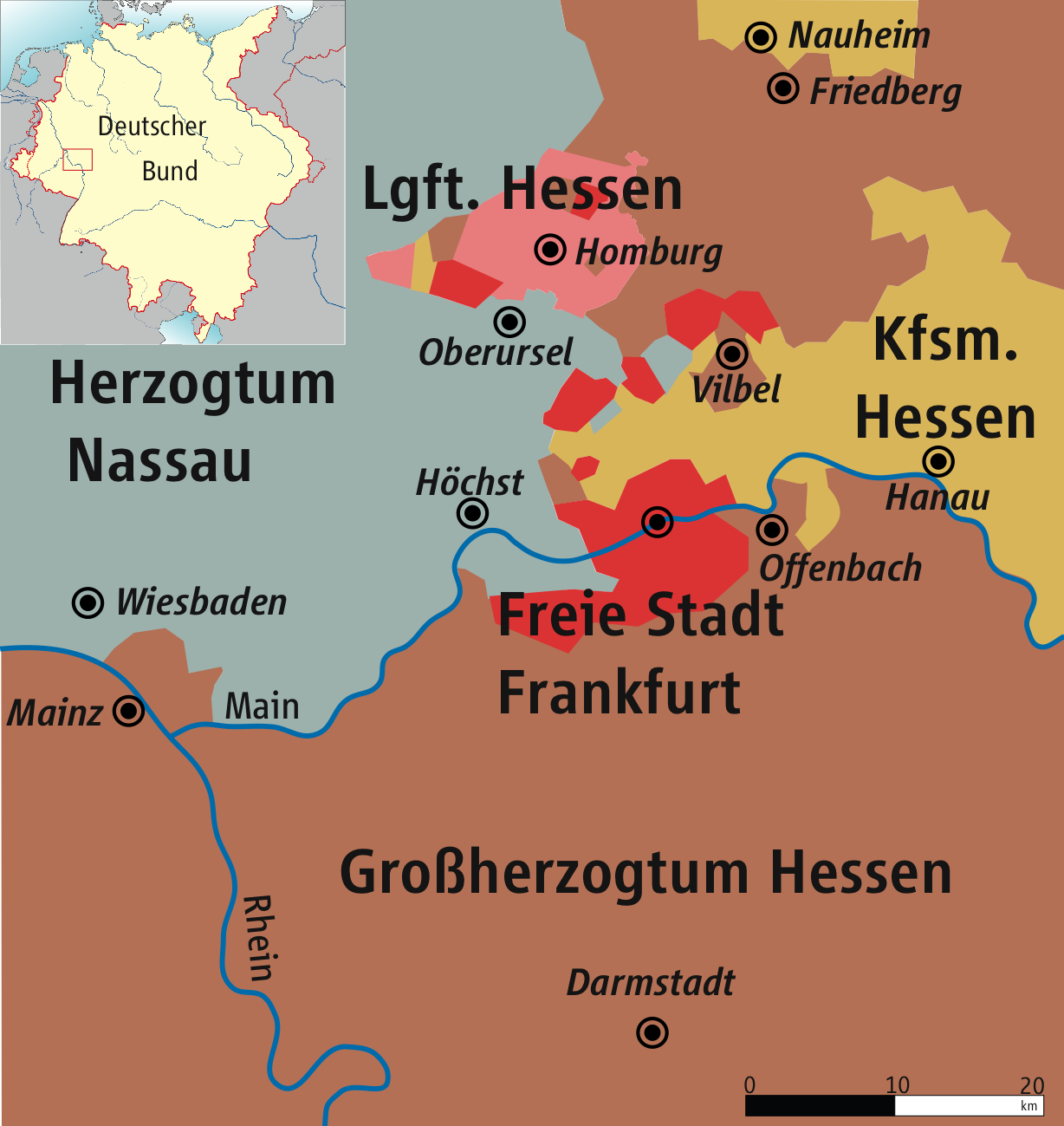
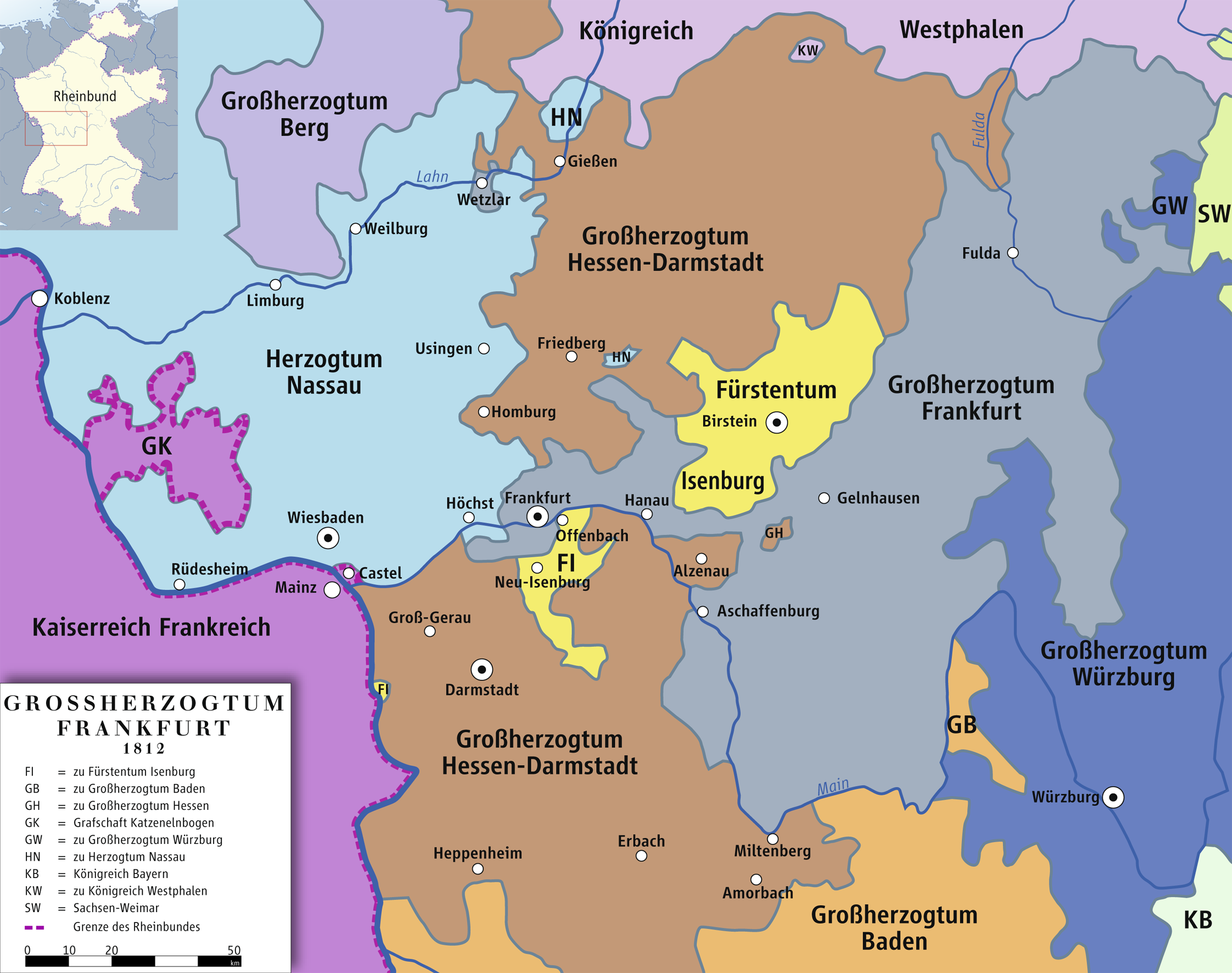


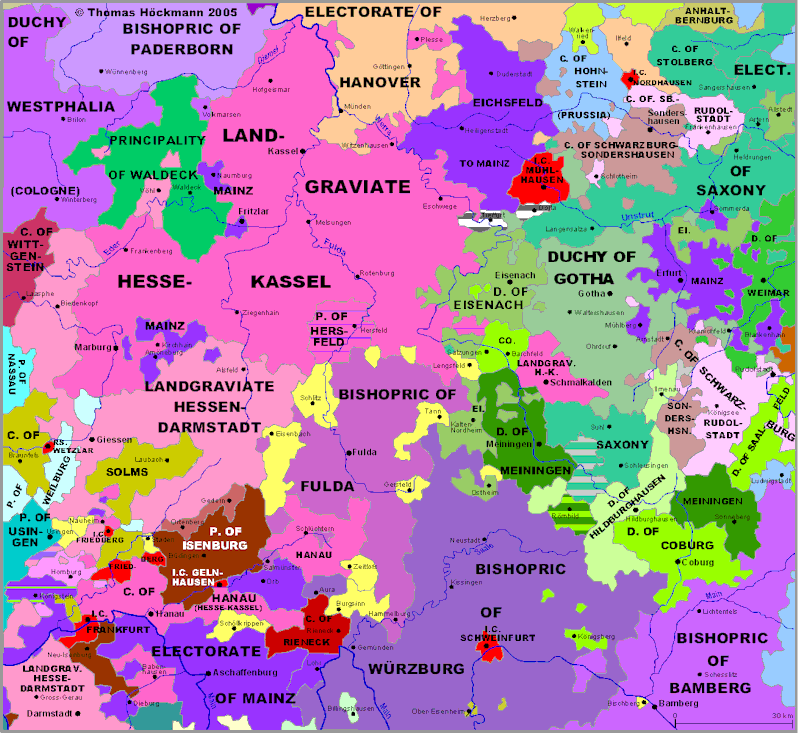
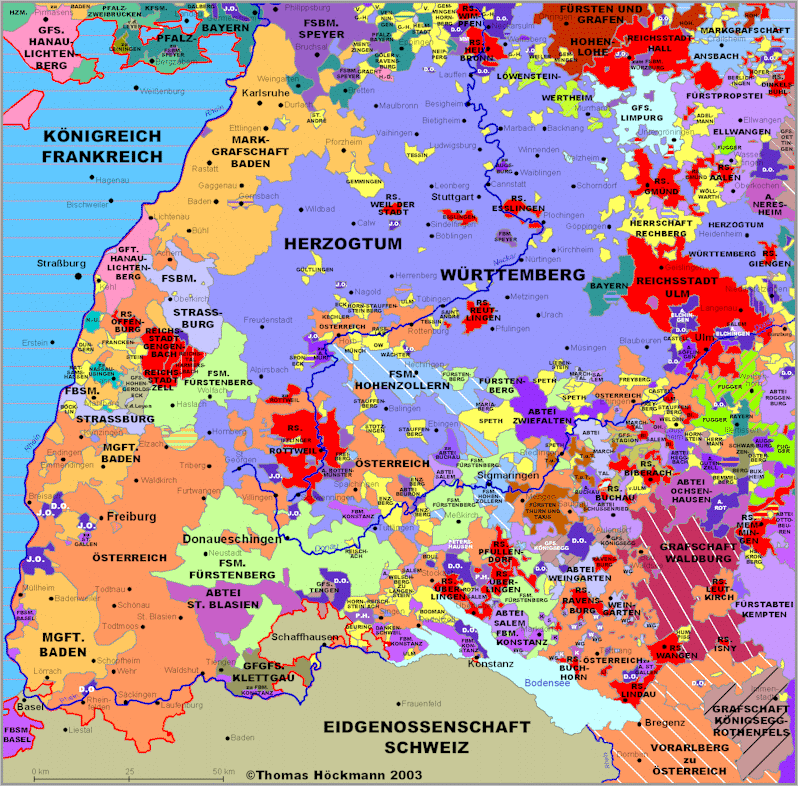

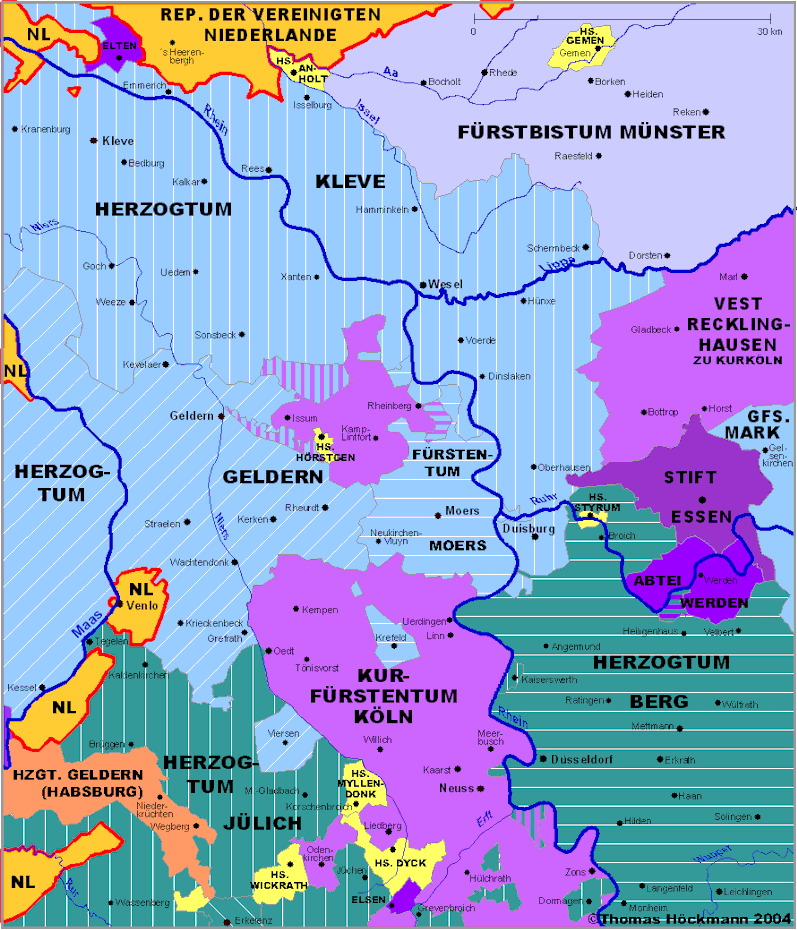


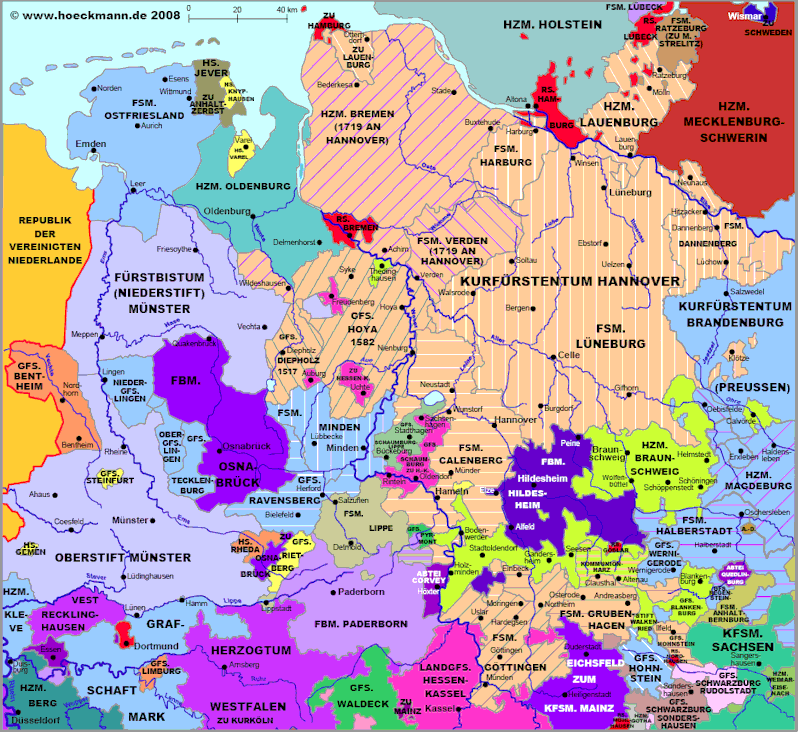
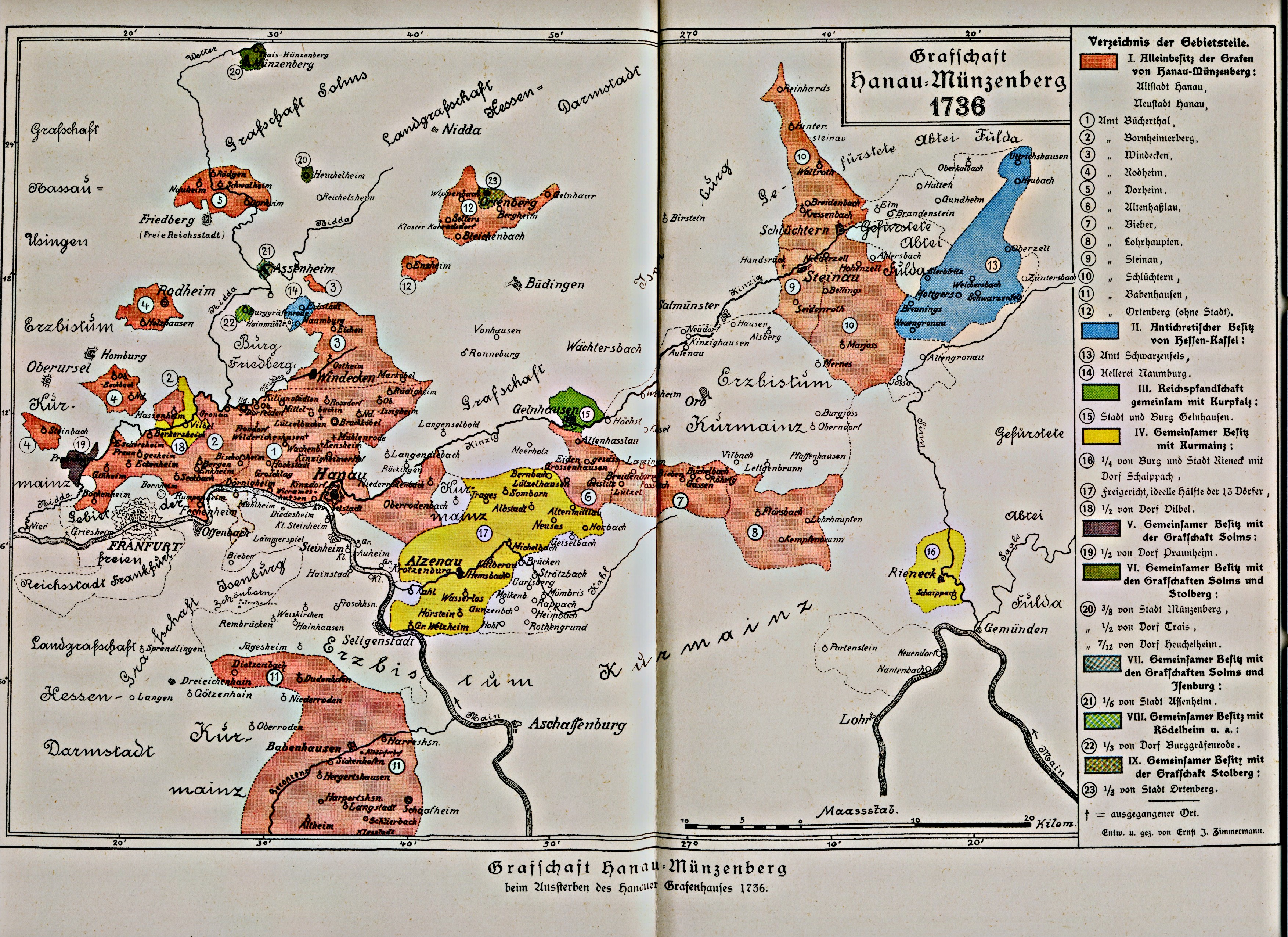


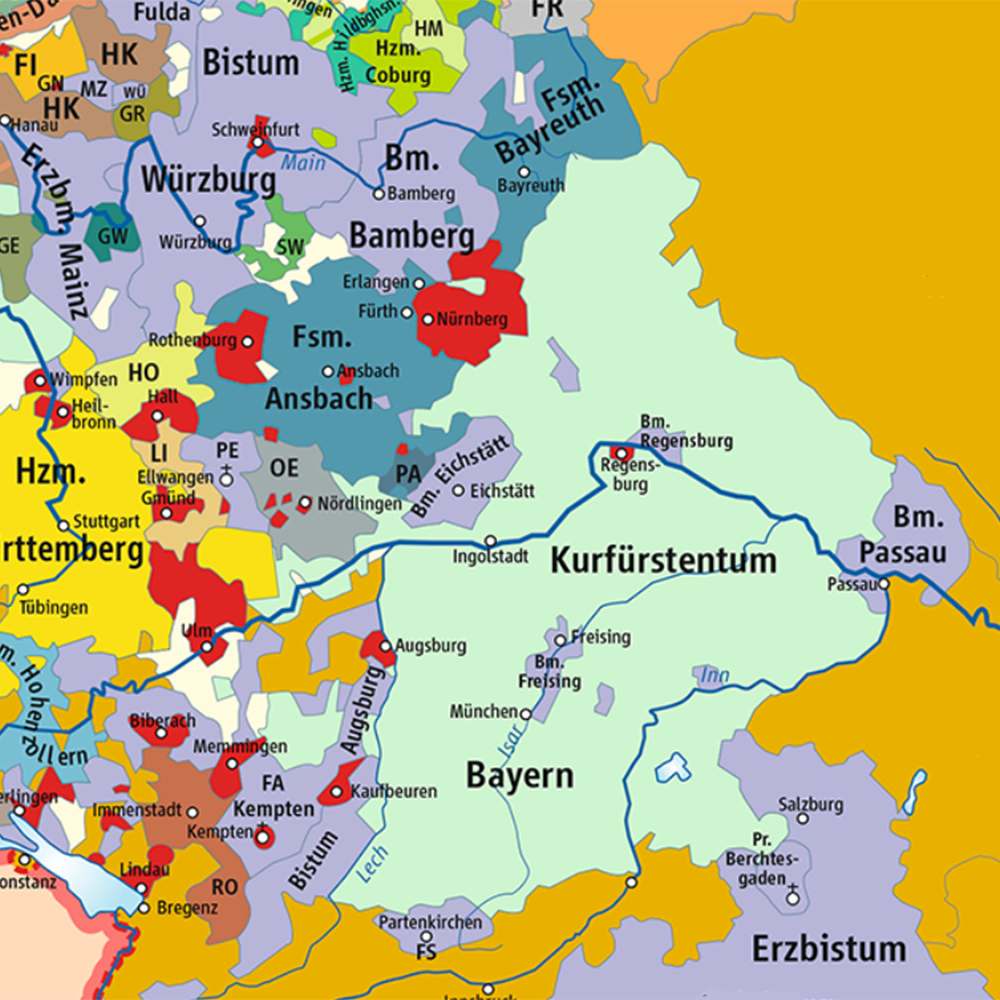
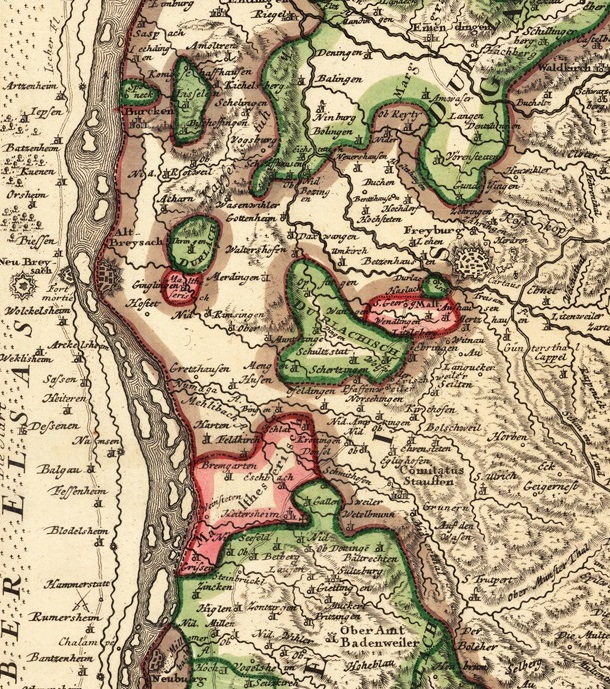


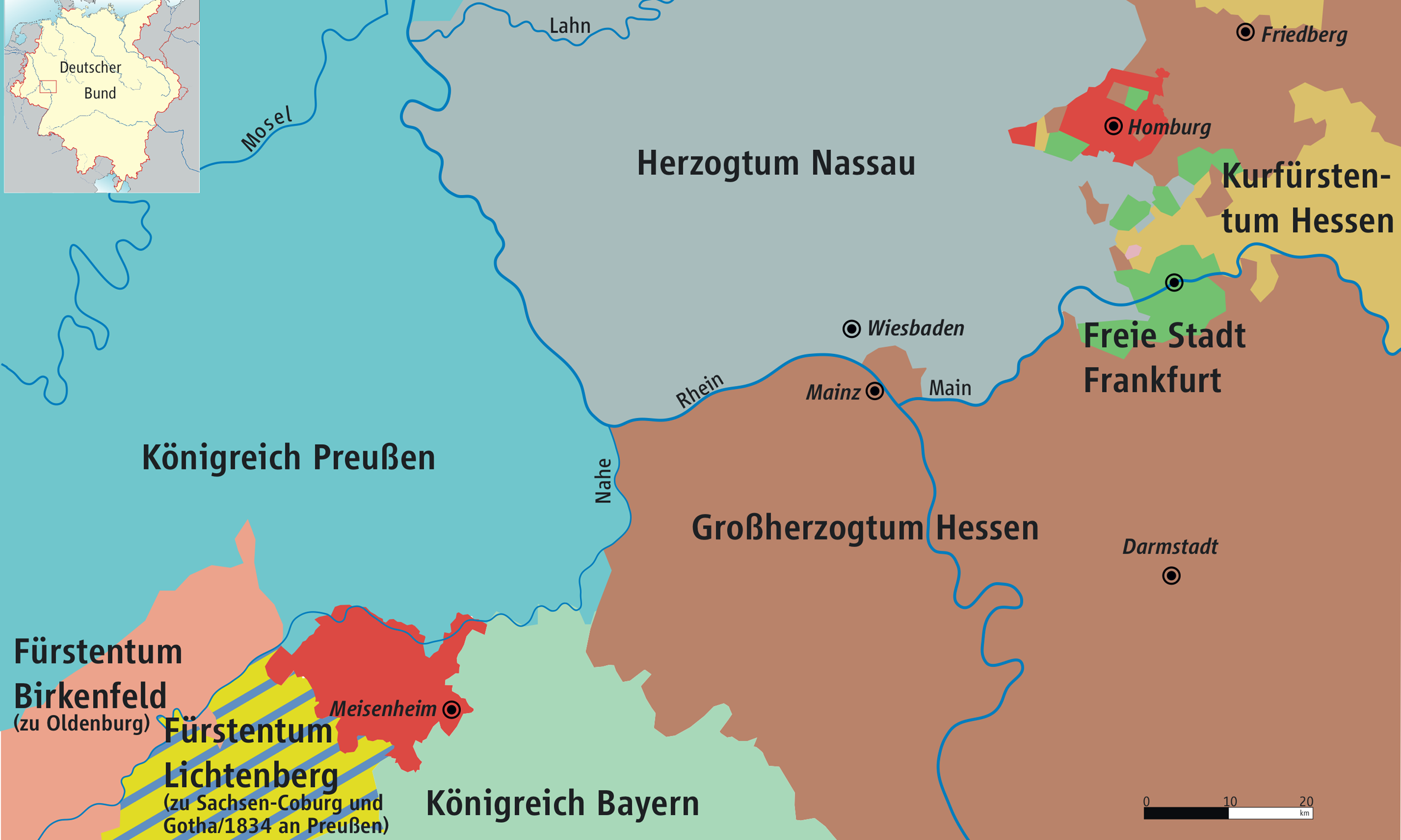


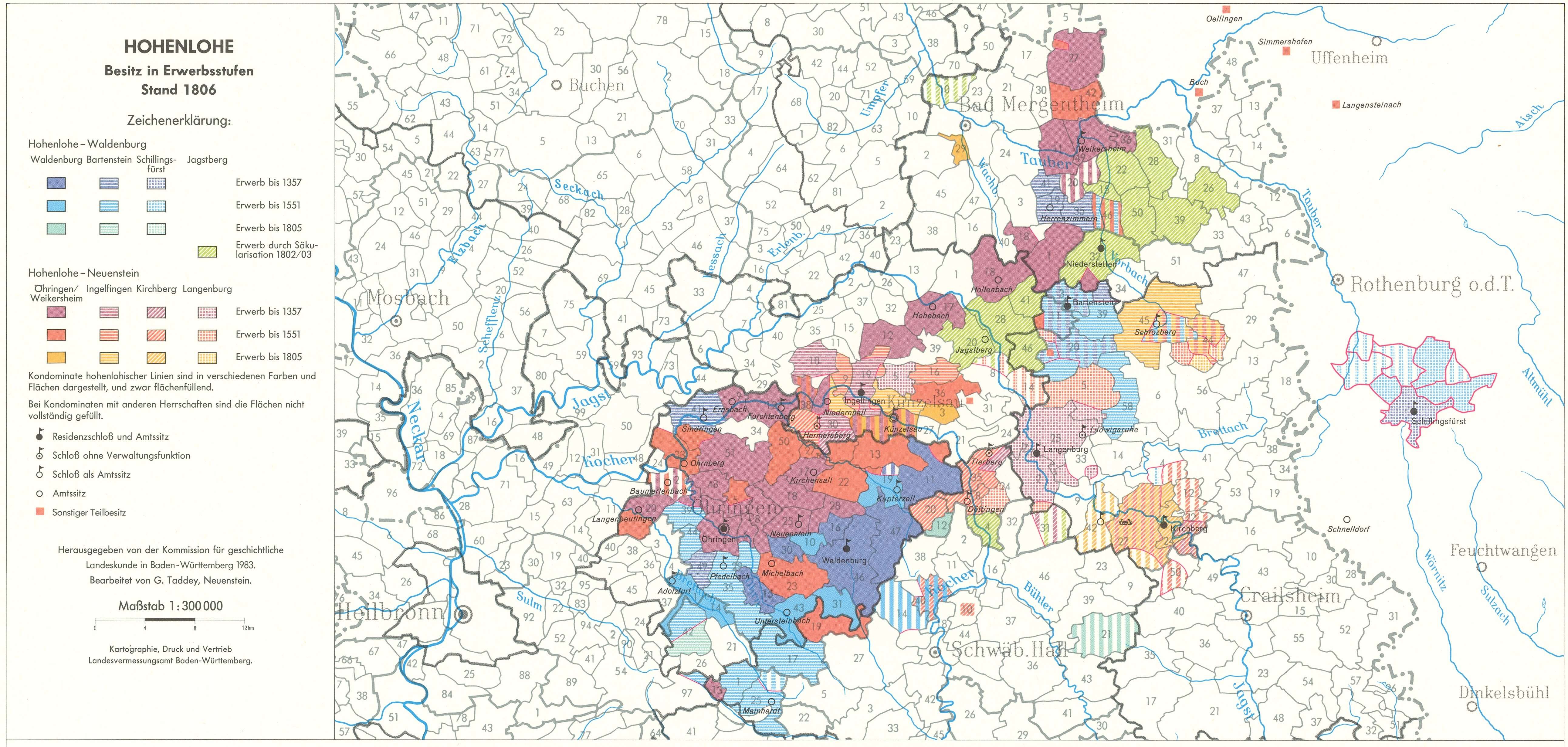


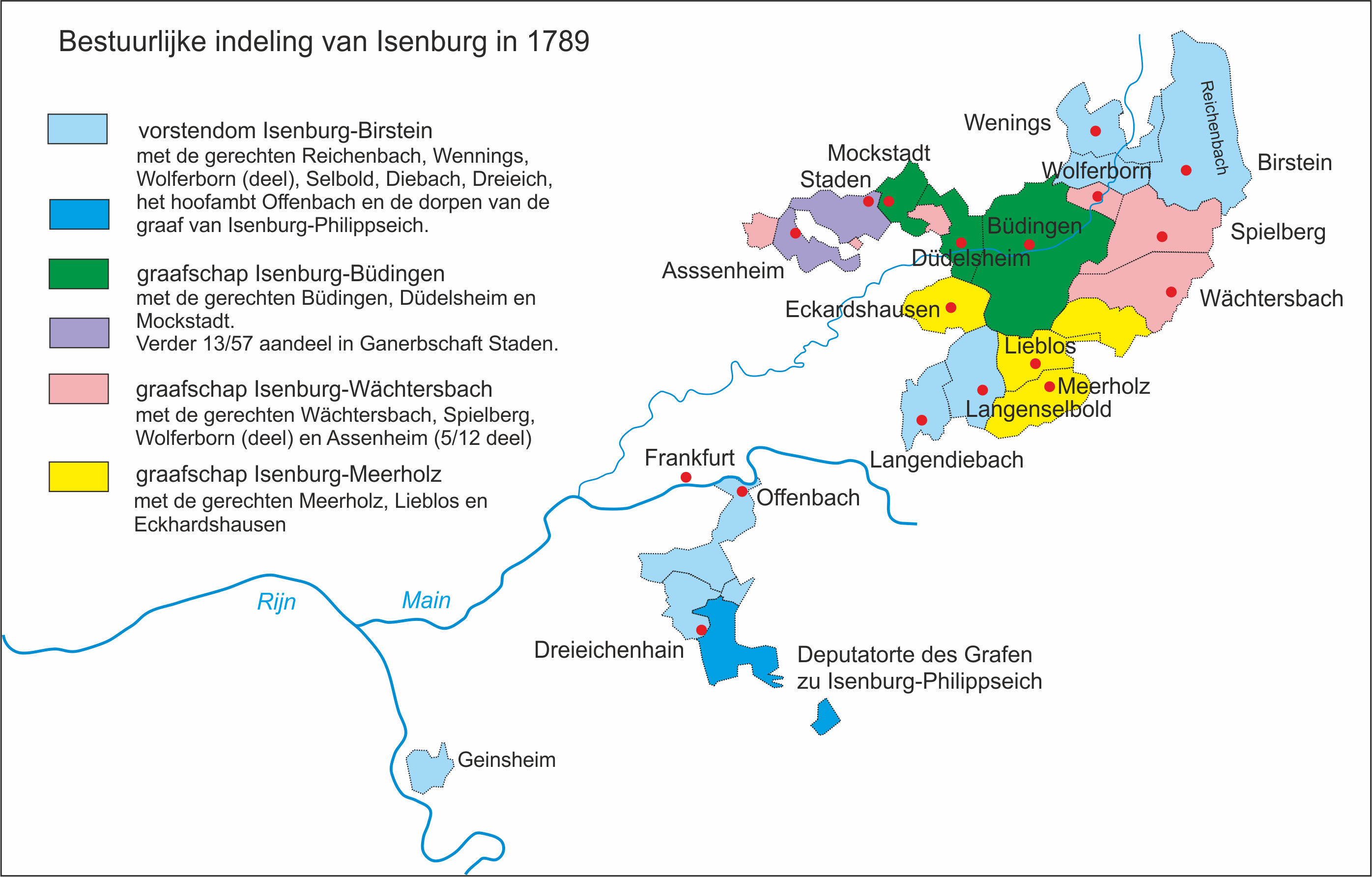





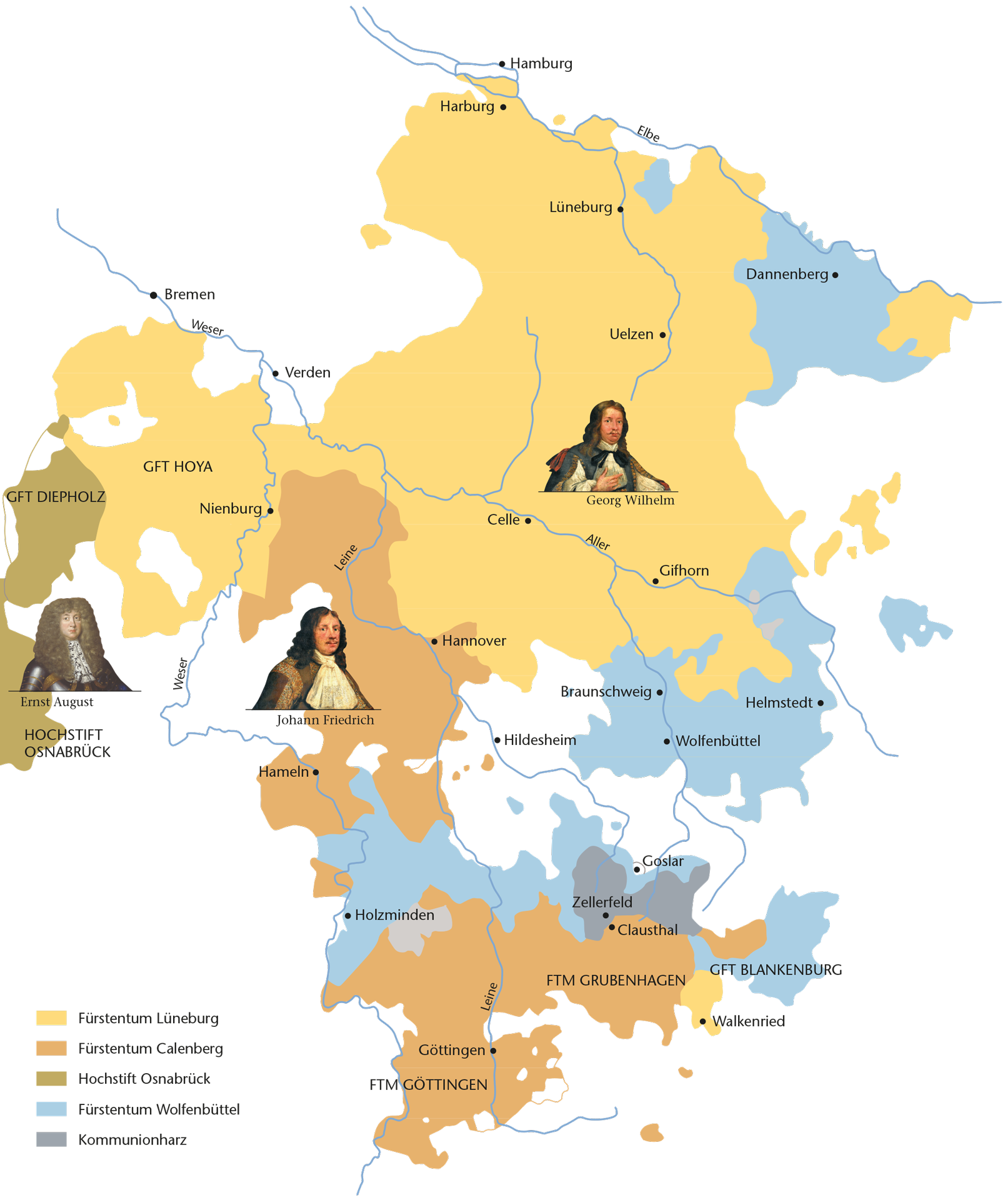
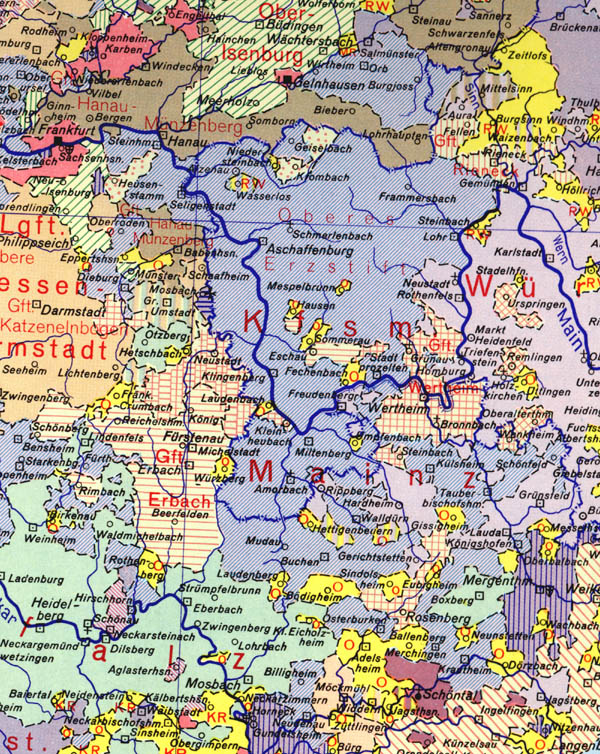
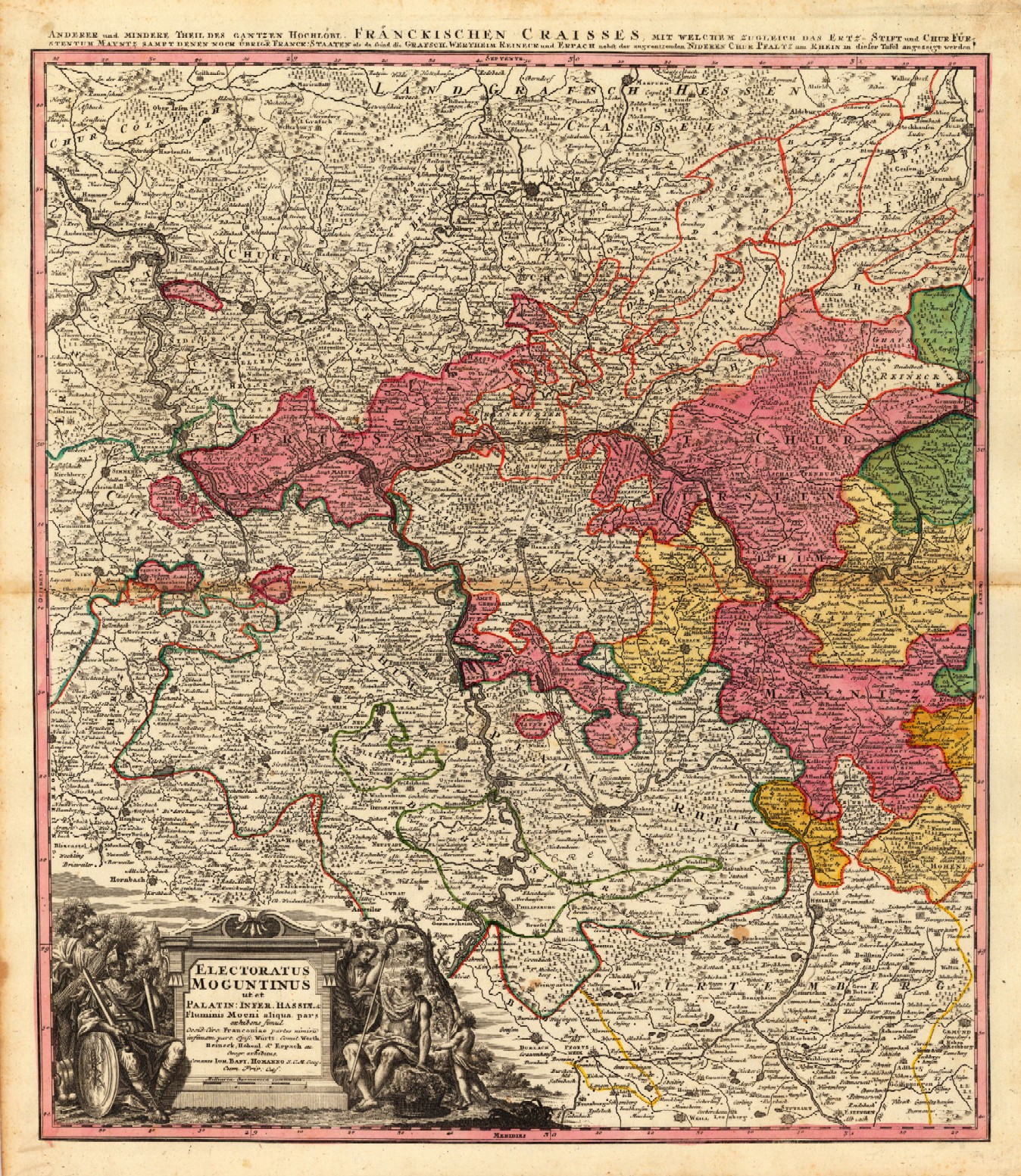


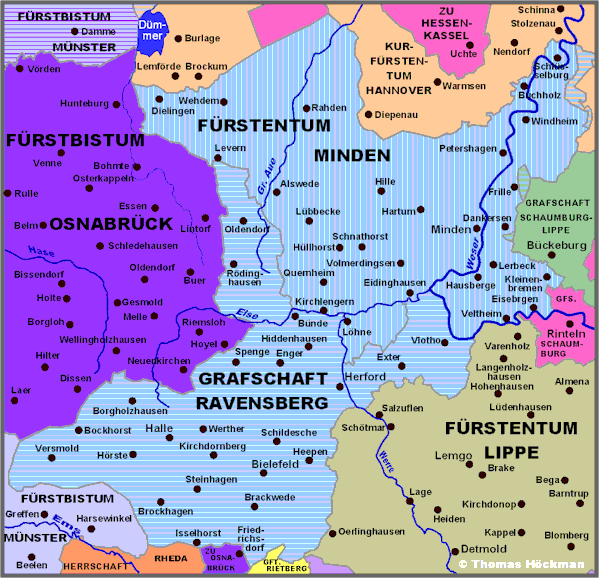
|
Bishopric (1789) |
(Münster in Westphalia) |
(1803 est.) |
c.795
Bishopric of Münster (Hochstift
Münster/Episcopus Monasteriensis).
1134
Bishops also Princes of the Empire (Episcopatus
Monasteriensis/
Fürstbistum Münster [Erbfürstentum
Münster]).
1252
Countess Jutta
von Vechta-Ravensberg sold Meppen to the Bishop.
1269
Purchase of the County of
Horstmar.
24 Jun 1429
Wildeshausen in pledge from the
Prince-Archbishopric of Bremen.
14 Jul 1450 - 12 Oct 1457 Münster Diocesan Feud (Münsterischen
Stiftsfehde), dispute over the
occupation of bishop's seat between the Moers and Hoya
families,
the
cathedral chapter, and the city of Münster.
Feb 1534 - 24 Jun 1535 Anabaptist
(Protestant) theocratic government, from 8 Sep 1534
under
John of
Leiden (Johan Beukelszoon)(b. 1509 - d. 1536).
The prince-
bishop and all the Roman Catholics and Lutherans had to
leave the
city.
1629
The last towns of the
Münsterland region became Catholic again.
1657 - 1669
Münster town attempts to break away from
the bishop.
14 Oct 1709
Acquisition of the Lordship of Werth for
75,000 Thaler.
23 May
1802
Ceded to Prussia by Franco-Prussian treaty.
23 May 1802 - 27 Apr 1803 Occupied by
Prussia.
27 Apr
1803
Final Act (enactment of Reichsdeputationshauptschluss
of
25 Feb 1803) secularizes the Prince-Bishopric
of Münster and
partitions it between Prussia, Oldenburg, Arenberg,
Croy, and
Looz-Corswarem, and Salm. The northern area is
annexed to
Oldenburg;
the southern area is partitioned between Croy-Dülman,
Rheina-Wolbeck, Salm-Horstmar, Salm-Salm,
and Prussia.
23 Oct 1806 - 18 Nov 1806
Occupied by Kingdom of Holland.
18 Nov 1806 - 1 Mar 1808 Occupied by France.
5 Nov
1806
Münster subordinated (together with
Mark, Osnabrück, Tecklenburg,
and Lingen) as the Countries of Münster, Osnabrück,
the Mark, and
Tecklenburg (Pays de Munster, Osnabruck, la
Marck et Tecklenburg).
1 Mar 1808
Annexed to Berg
and Cleves.
13 Dec
1810
Annexed to France
(as part of département
Lippe)(see under
Germany).
18 Nov 1813 - 25 May 1815 Allied
administration.
25 May
1815
Southern part to Prussia,
and a northern part (Bexten-Listrup,
Gleesen
and Holsten) to Hanover.
Prince-Bishops (title Fürstbischof zu Münster)
15 Aug 1688 - 5 May 1706
Friedrich Christian Freiherr von (b. 1644 -
d. 1706)
Plettenberg-Lenhausen
16 Aug 1706 - 25 Dec 1718 Franz Arnold von
Wolff-Metternich (b. 1658 - d. 1718)
zur Gracht
26 Mar 1719 - 6 Feb 1761 Clemens August
Maria Herzog von (b. 1700 - d. 1761)
Bayern
7 Apr 1761 - 15 Apr
1784 Maximilian Friedrich
Reichsgraf (b. 1708 - d. 1784)
von
Königsegg und Rotenfels
15 Apr 1784 - 26 Jul 1801
Maximilian Franz Xaver Joseph (b.
1756 - d. 1835)
Johann Anton de Paula Wenzel
Erzherzog von Österreich
26 Jul 1801 - 3 Aug 1802 Franz
Friedrich Wilhelm Freiherr (b. 1719 - d.
1810)
von Fürstenberg (cathedral dean)
(acting)
9 Sep 1801 - 19 Oct 1801 Anton
Victor Joseph Johann Raimund (b. 1779 - d. 1835)
Erzherzog von Österreich
(titular; resigned 19 Oct 1801)
President of the Münster Spezial-organisations-kommission
3 Aug 1802 - 1 Dec
1803 Maximilian Friedrich Boner
(b. 1766 - d. 1822)
(Prussia)
Holland (French)
Military governor
Oct 1806 - Nov 1806 Herman
Willem
Daendels
(b. 1762 - d. 1818)
Governors-general of the
Countries of Münster, Osnabrück, the Mark
and Tecklenburg
(Gouverneur
Général des pays de Munster, Osnabruck, la Marck
et Tecklenburg)(in Münster)
Nov 1806 - Feb
1807 Louis
Henri Loison (1st time) (b.
1771 - d. 1816)
Feb 1807 - Aug
1807 Simon
Canuel
(b. 1767 - d. 1841)
Aug 1807 - 1808
Louis Henri Loison (2nd
time) (s.a.)
General Vicars of the Diocese of Münster
(title Generalvikar des Bistums Münster)
1688 -
1705
Johannes Caspar Bordewick
(b. 1650 - d. 1721)
1761 -
1770
Caspar Ferdinand Droste zu Füchten (b. 1713 - d. 1774)
1770 - 3 Aug
1802
Franz Friedrich Wilhelm Freiherr (s.a.)
von Fürstenberg (continues to 1806)
Hofkammerdirektoren
1680 -
1742
Vacant
[office held by the oldest council member present]
1742 - 1761
Johann Adam von Falkenberg
1771 -
1778
Adam Franz Wenner
(b. 1731 - d. 1788)
1789 - 3 Aug 1802
Arnold Philipp
Heckmann
(b. 1739 - d. 1818)
© Ben Cahoon